
A preposition of place is a small picture. At is a point, in is a space, and on is a surface. Once something moves, the picture becomes a path: to, into, onto, through, across, along. Picture the scene first, and the preposition usually follows.
关于本指南: 表示地点和方向的介词
本主题中的每个介词都回答两个问题之一:某物在哪里,或者朝哪个方向移动?本指南分为五个部分,与诊断测试的五个部分完全对应。
你可以先做诊断测验,看看这个主题的哪些部分需要复习,也可以直接进入练习活动,其中包含复习幻灯片。
本指南本身为英文。这些翻译只是额外提供的便利,可能不够完美。
このガイドについて: 場所と方向の前置詞
このテーマの前置詞はすべて、次の 2 つの問いのどちらかに答えます。何かがどこにあるか、またはどちらへ動くか。このガイドは 5 つのパートで、診断テストの 5 つのパートと完全に対応しています。
まず診断テストを受けて、このテーマのどの部分を復習すべきか確認することもできますし、復習スライドを含む練習アクティビティにそのまま進むこともできます。
このガイド自体は英語です。これらの翻訳は補助として提供しているもので、完全とは限りません。
이 가이드 소개: 장소와 방향의 전치사
이 주제의 모든 전치사는 두 가지 질문 중 하나에 답합니다. 어떤 것이 어디에 있는지, 또는 어느 방향으로 움직이는지입니다. 이 가이드는 다섯 부분으로 되어 있으며, 진단 테스트의 다섯 부분과 정확히 일치합니다.
먼저 진단 퀴즈로 이 주제에서 복습이 필요한 부분을 확인해도 되고, 복습 슬라이드가 포함된 연습 활동으로 바로 들어가도 됩니다.
가이드 자체는 영어로 되어 있습니다. 이 번역은 부가적으로 제공되는 것이며 완벽하지 않을 수 있습니다.
Giới thiệu hướng dẫn này: Giới từ chỉ nơi chốn và phương hướng
Mọi giới từ trong chủ đề này trả lời một trong hai câu hỏi: vật ở đâu, hoặc nó di chuyển theo hướng nào? Hướng dẫn này gồm năm phần, khớp chính xác với năm phần của bài kiểm tra chẩn đoán.
Bạn có thể bắt đầu bằng bài kiểm tra chẩn đoán để biết phần nào cần ôn lại, hoặc vào thẳng các hoạt động luyện tập, trong đó có cả slide ôn tập.
Đọc hướng dẫn bằng tiếng Việt →
Bản hướng dẫn này được viết bằng tiếng Anh. Các bản dịch chỉ là phần hỗ trợ thêm và có thể chưa hoàn hảo.
इस गाइड के बारे में: स्थान और दिशा के prepositions
इस विषय का हर preposition दो प्रश्नों में से एक का उत्तर देता है: कोई चीज़ कहाँ है, या वह किस ओर जाती है? इस गाइड के पाँच भाग हैं, जो निदान परीक्षा के पाँच भागों से ठीक मेल खाते हैं।
आप निदान क्विज़ से शुरू करके जान सकते हैं कि इस विषय के कौन-से भाग दोहराने चाहिए, या सीधे अभ्यास गतिविधियों में जा सकते हैं, जिनमें दोहराव की स्लाइडें भी हैं।
गाइड स्वयं अंग्रेज़ी में है। ये अनुवाद अतिरिक्त सुविधा के रूप में हैं और पूरी तरह सटीक न भी हों।
نبذة عن هذا الدليل: حروف الجر الدالة على المكان والاتجاه
كل حرف جر في هذا الموضوع يجيب عن أحد سؤالين: أين يوجد الشيء، أو في أي اتجاه يتحرك؟ يتكون هذا الدليل من خمسة أجزاء تطابق تمامًا الأجزاء الخمسة في الاختبار التشخيصي.
يمكنك البدء بالاختبار التشخيصي لمعرفة الأجزاء التي تحتاج إلى مراجعة، أو الانتقال مباشرة إلى أنشطة التدريب، وتشمل شرائح مراجعة.
الدليل نفسه بالإنجليزية. هذه الترجمات مجرد خدمة إضافية وقد لا تكون دقيقة تمامًا.
Об этом руководстве: Предлоги места и направления
Каждый предлог в этой теме отвечает на один из двух вопросов: где что-то находится или в каком направлении оно движется? В этом руководстве пять частей, и они точно соответствуют пяти частям диагностического теста.
Можно начать с диагностического теста, чтобы узнать, какие части темы стоит повторить, или сразу перейти к упражнениям, в которые входят слайды для повторения.
Читать руководство на русском →
Само руководство написано на английском. Эти переводы — дополнительная помощь, и они могут быть неидеальными.
Acerca de esta guía: Preposiciones de lugar y dirección
Cada preposición de este tema responde a una de dos preguntas: dónde está algo o hacia dónde se mueve. Esta guía tiene cinco partes, y coinciden exactamente con las cinco partes del diagnóstico.
Puedes empezar con el cuestionario de diagnóstico para saber qué partes del tema conviene repasar, o ir directamente a las actividades de práctica, que incluyen diapositivas de repaso.
La guía en sí está en inglés. Estas traducciones son un añadido de cortesía y pueden no ser perfectas.
À propos de ce guide: Prépositions de lieu et de direction
Chaque préposition de ce sujet répond à l'une de deux questions : où se trouve quelque chose, ou dans quelle direction il se déplace ? Ce guide comporte cinq parties, qui correspondent exactement aux cinq parties du diagnostic.
Vous pouvez commencer par le quiz de diagnostic pour savoir quelles parties du sujet réviser, ou passer directement aux activités d'entraînement, qui comprennent des diapositives de révision.
Le guide lui-même est en anglais. Ces traductions sont un complément offert et peuvent ne pas être parfaites.
Sobre este guia: Preposições de lugar e direção
Cada preposição deste tema responde a uma de duas perguntas: onde algo está, ou em que direção se move? Este guia tem cinco partes, que correspondem exatamente às cinco partes do teste diagnóstico.
Você pode começar pelo teste diagnóstico para ver quais partes do tema precisam de revisão, ou ir direto para as atividades de prática, que incluem slides de revisão.
O guia em si está em inglês. Estas traduções são um recurso extra e podem não ser perfeitas.
Your diagnostic result says which part needs review. Tap that part below.
Three pictures, and what happens when things move
Each place picture has a movement partner. Ask first whether anything is moving.
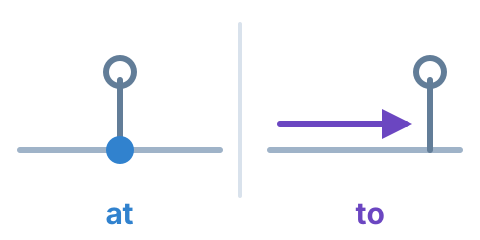
at / to
a point
She is at the gate. She walks to the gate.
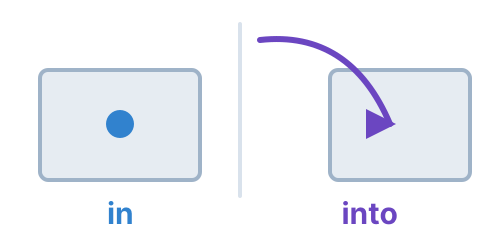
in / into
a space with boundaries
The cat is in the box. It jumps into the box.
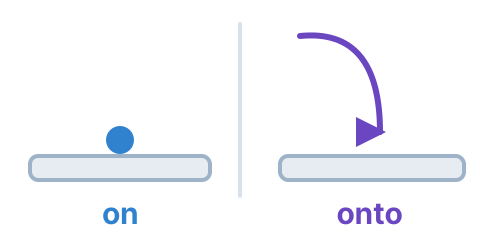
on / onto
a surface or a line
The cup is on the shelf. It falls onto the floor.
Blue: where something is. Purple: which way it moves. The first question is always the same: is anything moving?
At, in, and on
Is the place a point, a space, or a surface?
The rule: Use at for a point or a place where something happens, in for a space with boundaries, and on for a surface, a line, a floor, or a page.
One noun, three pictures
| Sentence | How you picture the place |
|---|---|
| The students are waiting at the museum. | a meeting point on the way somewhere |
| The students are in the museum. | inside the building |
| There is a flag on the museum. | on its roof or wall, a surface |
| Leave it at the front desk. | a point where something happens |
| There is a pen in the desk. | inside a drawer |
Addresses, floors, and pages
| at | on | in |
|---|---|---|
| at 25 Hill Road (full address) | on Hill Road (street name only) | in the city center, in Brazil |
| at the corner (of two streets) | on the second floor | in the corner (of a room) |
| at the top of the page | on page 40, on the menu | in the book, in the photo |
British English also uses in with streets (in Hill Road). This guide uses US English. At the corner of two streets but in the corner of a room: the street corner is a point, the room corner is a small space between two walls.
Grammar recap
At, in, and on also work with time (at 6:00, on Monday, in June), with a similar point, day, and longer-period logic.
Common errors in this part
- in or on where at is needed
Let's meet in the main gate at noon.✓ Let's meet at the main gate at noon.A gate is a meeting point: at. - at or on where in is needed
My sister works at Singapore.✓ My sister works in Singapore.A city is a space: in. - at or in where on is needed
There's a spider in the ceiling.✓ There's a spider on the ceiling.A ceiling is a surface: on.
Location or movement?
Is something staying in one place, or moving to a destination?
The rule: Location verbs take at, in, or on; movement verbs take to, into, or onto. Arrive takes at or in, reach and enter take no preposition, and home and abroad take none after go or come.
| Location | Movement |
|---|---|
| be, live, stay, wait, work at / in / on | go, come, move, travel, run to / into / onto |
| The kids are in the pool. | The kids dived into the pool. |
| Our friends live in Peru. | Our friends moved to Peru. |
Verbs with their own pattern
| Verb | Pattern | Example |
|---|---|---|
| arrive | at + a building or point; in + a city or country | arrive at the stadium, arrive in Kenya |
| get (= arrive) | to + destination | get to class on time |
| reach, enter, approach | no preposition | reach the border, approach the gate |
| go, come, get | no preposition before home, here, there, abroad, downstairs | come here, get home late |
Arriving somewhere
arrive at the stadium, get to the stadium, reach the stadium
Not: arrive to
Arrive never takes to. Home and abroad never take to after go or come.
In speech, in and on are common after movement verbs (jump in the lake, put it on the table). This is correct English. Into and onto make the movement more explicit, so learners are safe choosing them.
Common errors in this part
- Movement word for a location
She is still to the library.✓ She is still at the library.Be shows no movement: at. - Location word after a movement verb
Next month we are flying in Osaka for a conference.✓ Next month we are flying to Osaka for a conference.The destination after fly takes to. - arrive to
The package arrived to our office today.✓ The package arrived at our office today.Arrive at a building. - to home, to abroad
Can you come to here for a minute?✓ Can you come here for a minute?Here takes no preposition.
Movement along a route
What shape is the path?
The rule: Through goes inside, across goes side to side, along follows a line, over goes above, past goes beside and beyond, around goes in a curve, and toward shows direction without arriving.
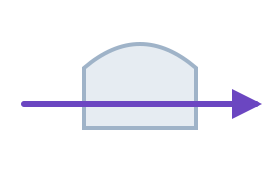 throughinside, end to end
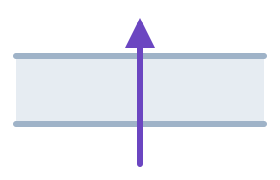 acrossside to side
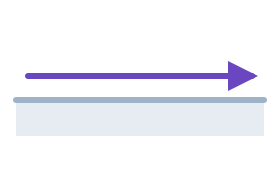 alongfollowing a line
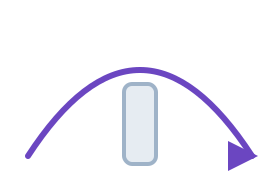 overabove, side to side
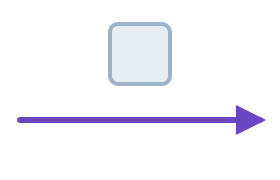 pastbeside, then beyond
 aroundin a curve
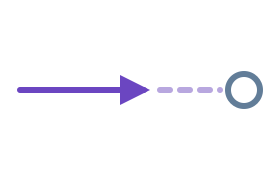 towarddirection only
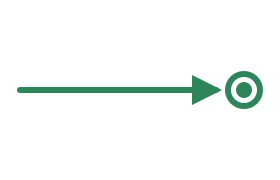 toarrives
Pairs that learners mix up
| Pair | Choose by the picture |
|---|---|
| through / across | a forest, a crowd, a window: through (inside). A bridge, a field, a border: across (side to side). |
| along / across | walk along the beach (its length); walk across the beach to the water (side to side). |
| over / past | fly over the city (above it); drive past the city (beside it, without entering). |
| to / toward | run to the car (you get there); run toward the car (you may stop before it). |
Some places allow two pictures. Across the park means from one side of an open space to the other; through the park suggests paths, trees, or buildings around you. Both can be correct. US English prefers toward; British English more often uses towards.
Common errors in this part
- through or across confused
The subway runs across a tunnel under the harbor.✓ The subway runs through a tunnel under the harbor.Inside a tunnel: through. - along or across confused
They jogged across the river path every morning.✓ They jogged along the river path every morning.The length of a path: along. - Wrong route word
The plane flew past the mountains, high above them.✓ The plane flew over the mountains.Above them: over. - to or toward confused
He swam to the island but turned back halfway.✓ He swam toward the island but turned back halfway.He did not arrive: toward.
Relative position
Where is it compared with the other thing?
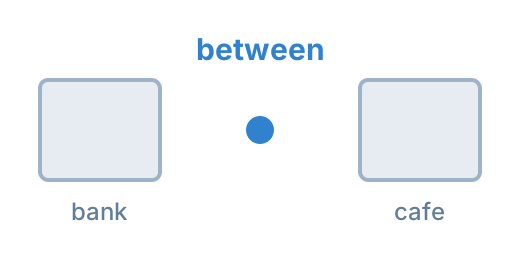
The rule: Between is for two separate things, among for a group. Over and under are direct or covering; above and below compare levels. Learn next to, in front of, and across from as whole phrases.
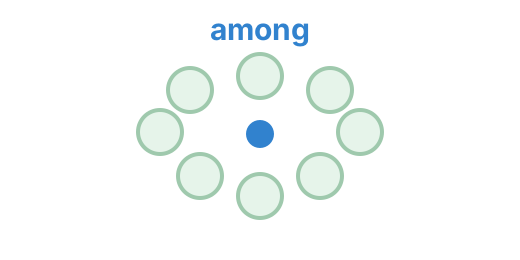
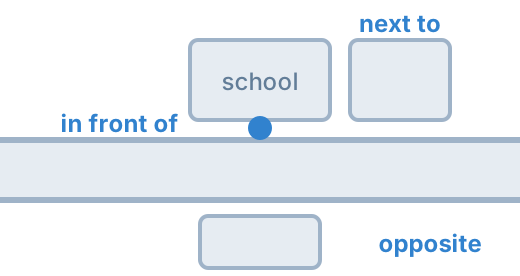
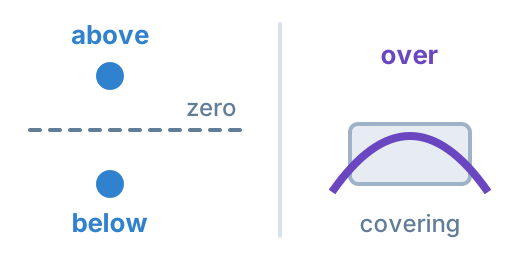
Learn the whole phrase
| Correct form | Common error |
|---|---|
| next to the door | next the door |
| in front of the hotel | in the front of the hotel (this means inside, at its front part) |
| across from the gym, opposite the gym | across of the gym, opposite of the gym |
| near the gym, beside the gym | near of the gym, beside of the gym |
| on top of the fridge | on top the fridge |
Over and above often overlap: a light over the door and a light above the door are both fine. Use below and above for levels and scales (below freezing, above the national average), and over and under for covering (under a blanket). In the front of is correct English with a different meaning: in the front of the car means inside, in the front seats.
Common errors in this part
- between or among confused
She stood between the other dancers on stage.✓ She stood among the other dancers on stage.A group: among. - above/over or under/below confused
Last night it dropped to five degrees under zero.✓ Last night it dropped to five degrees below zero.Zero is a level: below. - in front of, opposite, or next to confused
The cafe is in front of the station, across the road.✓ The cafe is opposite the station, across the road.Facing from the other side: opposite. - Wrong form of a position phrase
The printer is near of my desk.✓ The printer is near my desk.Near takes no of.
Fixed pairings
Is this a pairing to learn as a whole phrase?
The rule: Some pairings are conventions: on the bus, in a car, by train, on TV, in the newspaper, in the rain, at work, on vacation. Learn them as phrases.
| Group | Examples | Watch out |
|---|---|---|
| Transport | on the bus, on the subway, on a flight; in a car, in a taxi; by train | on foot, not by foot |
| Media | on TV, on the radio, on social media, on a podcast; in a novel, in the magazine | on the internet, online |
| Weather | in the rain, in the heat, in the fog | not under the rain |
| Body | a bruise on her arm, tap someone on the shoulder, hit on the head | the body part takes the, not a possessive, in these phrases |
| Institutions | at school, at college, at church, in class, in bed, in prison | no article when you mean the usual purpose |
| Activities | at a wedding, at a game, on a tour, on a business trip, on duty | on vacation (US), on holiday (UK) |
Getting on and off
get on / off the bus, the train, the plane
Getting in and out
get in / out of the car, the taxi
Some pairings differ between varieties. US speakers say in the hospital; UK speakers usually say in hospital for a patient. This guide uses US English. These are conventions, so learning them as whole phrases works better than looking for a rule.
Common errors in this part
- Wrong preposition with transport
She came here with train.✓ She came here by train.The method: by, no article. - Wrong preposition with media
I heard that song in the radio yesterday.✓ I heard that song on the radio yesterday.Radio takes on. - Fixed pairing
We met a lot of new people in the party.✓ We met a lot of new people at the party.Events take at. - Fixed pairing
We walked home under the snow.✓ We walked home in the snow.Weather takes in.
Self-check
Is each sentence correct? Tap to see the answer. The part label tells you where to look if you were not sure.
Part 1The meeting is in room 204 on the third floor.
Correct. A room is a space (in); a floor takes on.
Part 1I'll wait for you in the ticket machine.
Incorrect. At the ticket machine. It is a point, not a space you can go inside.
Part 2We arrived in Hanoi late at night.
Correct. Arrive in a city.
Part 2Tomorrow I'm going to downtown to buy shoes.
Incorrect. Go downtown. Like home and abroad, downtown takes no preposition in US English.
Part 3The river flows through the middle of the city.
Correct. The city surrounds the river, so through.
Part 3Is there a bridge along the river near here?
Incorrect. A bridge goes across a river, from one side to the other: a bridge across the river.
Part 4Her office is across from mine, so we can wave to each other.
Correct. Across from means facing from the other side.
Part 4His grades have been under average this term.
Incorrect. Below average. Average is a level, so below.
Part 5He got off the train at the wrong stop.
Correct. Trains take on and off.
Part 5I watched the whole game in my phone.
Incorrect. On my phone. Screens and devices take on.
AI practice prompt
Paste this into an AI chat tool and replace the bracket with your language.