
Level: B2
Before You Read | Reading | Vocabulary | Word Partners | Activities | Speed Challenge | Quick Reading | Questions | AI Prompts | Discussion | Language Focus | Resources
Printable: Student handout (PDF | Word) | Teacher’s key (PDF | Word)
Before You Read
Think about these questions or discuss them with a partner.
- What sports or games do people of different ages play together where you live?
- Have you ever tried a sport that was completely new to you? What was it like at first?
- Why might a new sport become popular in one country but not in another?
Reading
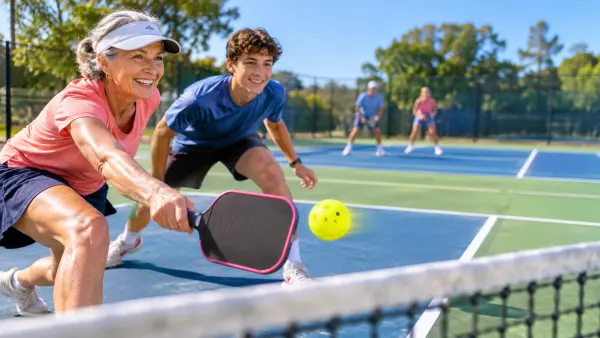
On a Saturday morning at a local park, the old tennis court has new lines painted on it. Instead of two players, there are sixteen, spread across four smaller courts. Every few seconds you hear a sharp pop as a flat paddle hits a plastic ball full of holes. This is pickleball, and in many countries it has gone from an odd hobby to a genuine craze. Why do some new sports catch on so quickly, while most never leave the backyard?
Pickleball began as a cure for a boring summer afternoon. In 1965, on Bainbridge Island near Seattle, Joel Pritchard and his friend Bill Bell came home to find their families with nothing to do. There was a badminton court but not the right equipment, so they improvised with table tennis paddles and a plastic ball with holes. A third friend, Barney McCallum, helped write the rules. Even the name is disputed: one story links it to the family dog, Pickles, but the Pritchards said the dog was named after the game. For decades, pickleball stayed a quiet pastime in community centers and retirement communities.
The court is the size of a doubles badminton court, about a third of a tennis court, so nobody runs far. The paddle is light, the ball is slow, and the serve is hit underhand. A zone next to the net, nicknamed “the kitchen,” stops players from standing at the net and hitting every ball out of the air. The result is unusually accessible. Tennis has a long learning curve, but in pickleball many people can keep a rally going in their first hour. Because most games are doubles, with four players standing fairly close together, it is also very sociable: people chat between points.
Then came a surge. In the United States, the Sports and Fitness Industry Association (SFIA) estimates that 24.3 million people played in 2025, up from about 4.2 million in 2020. Many observers believe the COVID-19 pandemic helped, since it was an outdoor game people could play at a distance, and that early momentum did not fade when life returned to normal. The players have been getting younger, too: in the SFIA data for 2025, people aged 13 to 24 played at a higher rate than any other age group. Cities have been painting pickleball lines on tennis courts, and some clubs have converted whole tennis courts into several pickleball courts. The game has been spreading abroad as well, from Canada to Malaysia, Vietnam, and India, although estimates of player numbers vary enormously.
Not everyone is happy. That pop is sharp and repetitive, and next to busy courts it can go on from early morning until dark. In towns in the United States and Canada, residents have complained, and some have gone to court. A few cities have limited playing hours or taken down nets. The backlash has surprised many players, but to a neighbor the noise can be a real nuisance. The usual answer is a compromise: quieter paddles and balls, sound-absorbing walls, fixed hours, and new courts built farther from homes.
Easy to learn does not mean free of risk. Doctors in the United States have reported more pickleball injuries, especially among older players, who are more prone to falls. One study of US emergency room data found that pickleball fractures rose sharply between 2002 and 2022, and most of the people injured were over 60. Part of that rise simply reflects the huge number of new players. A few simple precautions help: warm up first, wear court shoes, and turn and run for a high ball instead of stepping backward. Pain or swelling after a fall that does not go away is a reason to see a doctor.
Pickleball is not alone. Padel, a doubles racket game played on a small court surrounded by glass walls, was invented in Acapulco, Mexico, in 1969 and later became hugely popular in Spain and Argentina. A 2026 industry report estimated about 19 million padel players worldwide, with fast growth in places such as Saudi Arabia, France, and Indonesia. Both sports began as a niche pastime for a small circle of fans, and they share a recipe: a small court, a quick start, and plenty of talking. Booms are hard to sustain, though. In Chile, about 80 padel clubs closed in 2024 when demand fell. A lasting sport may depend on something simple: whether people still show up on an ordinary Tuesday evening, years after the excitement has worn off.
Vocabulary
Each word has a frequency score, a rank, and a tag. The score shows how common the word is in modern English: higher means more common, and each full point means roughly ten times more common. The rank is the word’s position on a list of about 321,000 English word forms, from most to least common. The tag shows where you are most likely to meet the word: Current, Formal, Literary, or Dated. The paragraph number shows where the word first appears in the reading. The labels are information, not instructions. Deciding which words are worth your time is up to you. How to read the scores, ranks, and tags.
craze (noun): an activity or interest that becomes very popular very quickly with many people.
Frequency: 3.35 | Rank: 18,297 | Current | Paragraph 1
Translations: 热潮 | ブーム | 열풍 | सनक | هوس | повальное увлечение | furor | engouement
- Pickleball has become a craze in many countries.
- The dance became a craze on social media last summer.
improvised (verb, past tense): made or did something with whatever was available, without planning or the proper equipment.
Frequency: 3.37 | Rank: 17,813 | Current | Paragraph 2
Translations: 临时凑合 | 間に合わせた | 즉석에서 마련했다 | जुगाड़ किया | ارتجلوا | импровизировали | improvisaron | ont improvisé
- The families improvised with table tennis paddles and a plastic ball.
- We forgot the tent poles, so we improvised with sticks.
accessible (adjective): easy for many different kinds of people to start, use, or take part in.
Frequency: 4.18 | Rank: 5,309 | Current | Paragraph 3
Translations: 容易上手的 | 取り組みやすい | 접근하기 쉬운 | सुलभ | متاح للجميع | доступный | accesible | accessible
- A small court and a slow ball make pickleball accessible to beginners.
- The museum tries to make art accessible to children.
learning curve (noun phrase): the time and effort it takes to learn a new skill well.
Frequency: no score (phrase) | Current | Paragraph 3
Translations: 学习曲线 | 習得までの道のり | 학습 곡선 | सीखने में लगने वाला समय | منحنى التعلم | период освоения | curva de aprendizaje | courbe d’apprentissage
- Tennis has a longer learning curve than pickleball.
- The new software has a steep learning curve, so the first week is hard.
sociable (adjective): friendly and full of chances to talk and spend time with other people.
Frequency: 2.97 | Rank: 30,017 | Current | Paragraph 3
Translations: 适合社交的 | 社交的な | 사교적인 | मेल-जोल वाला | اجتماعي | располагающий к общению | social | convivial
- Pickleball is sociable because players chat between points.
- A shared lunch is a sociable way to start a new job.
surge (noun): a sudden, large increase in the number or amount of something.
Frequency: 3.82 | Rank: 9,313 | Current | Paragraph 4
Translations: 激增 | 急増 | 급증 | उछाल | طفرة | резкий рост | auge | essor
- There was a surge in pickleball players after 2020.
- The shop saw a surge in sales before the holiday.
momentum (noun): the energy or force that keeps something growing or moving forward once it has started.
Frequency: 4.07 | Rank: 6,347 | Current | Paragraph 4
Translations: 势头 | 勢い | 탄력 | गति | زخم | импульс | impulso | élan
- The pandemic gave pickleball momentum.
- Our team lost momentum after the first goal.
converted (verb, past participle): changed something so that it can be used for a different purpose.
Frequency: 4.21 | Rank: 5,025 | Current | Paragraph 4
Translations: 改建 | 転用した | 개조했다 | परिवर्तित किया | حوّلوا | переоборудовали | transformaron | ont transformé
- The park converted one tennis court into four pickleball courts.
- They converted the old garage into a small office.
backlash (noun): a strong negative reaction from many people against something that is changing or growing.
Frequency: 3.66 | Rank: 11,870 | Current | Paragraph 5
Translations: 强烈反对 | 反発 | 반발 | तीखा विरोध | رد فعل غاضب | волна недовольства | reacción en contra | réaction hostile
- The noise caused a backlash from neighbors.
- The company faced a backlash after it raised prices.
nuisance (noun): something or someone that keeps annoying you or causing small problems.
Frequency: 3.50 | Rank: 14,928 | Current | Paragraph 5
Translations: 滋扰 | 迷惑 | 골칫거리 | परेशानी | إزعاج | помеха | molestia | nuisance
- The pop of the ball can be a nuisance for neighbors.
- Mosquitoes are a nuisance on summer evenings.
compromise (noun): an agreement in which each side gives up part of what it wants.
Frequency: 4.15 | Rank: 5,595 | Current | Paragraph 5
Translations: 折中方案 | 妥協案 | 타협안 | समझौता | حل وسط | компромисс | solución intermedia | compromis
- Fixed playing hours are a compromise between players and neighbors.
- We reached a compromise: pizza tonight and pasta tomorrow.
prone (adjective): likely to suffer from something or to do something, usually something bad.
Frequency: 3.93 | Rank: 7,910 | Current | Paragraph 6
Translations: 容易 | なりやすい | ~하기 쉬운 | प्रवण | عرضة لـ | подверженный | propenso | sujet à
- Older players are more prone to falls on the court.
- I am prone to headaches when I do not sleep enough.
precautions (noun, plural): actions you take in advance to stop something bad or dangerous from happening.
Frequency: 3.59 | Rank: 13,127 | Current | Paragraph 6
Translations: 预防措施 | 予防策 | 예방 조치 | सावधानियाँ | احتياطات | меры предосторожности | precauciones | précautions
- Warming up is one of the easiest precautions a player can take.
- Take precautions when you hike alone, such as telling a friend your route.
niche (adjective): interesting to or used by only a small, special group of people.
Frequency: 3.85 | Rank: 8,918 | Current | Paragraph 7
Translations: 小众的 | ニッチな | 틈새의 | सीमित दायरे का | محدود الانتشار | нишевый | de nicho | de niche
- Padel was a niche sport outside Spain and Argentina for many years.
- She runs a niche online shop that sells only old maps.
sustain (verb): to keep something going at the same level for a long time.
Frequency: 3.93 | Rank: 7,910 | Formal | Paragraph 7
Translations: 维持 | 持続させる | 유지하다 | बनाए रखना | الحفاظ على | поддерживать | mantener | maintenir
- Padel clubs in Chile could not sustain their fast growth.
- It is hard to sustain a new habit without a plan.
Word Partners
Collocations. Match the two halves to make common phrases. Then use three of the phrases in sentences of your own.
| 1. the latest | a. momentum |
| 2. a steep | b. public backlash |
| 3. a sudden | c. compromise |
| 4. gain | d. surge in demand |
| 5. face a | e. nuisance |
| 6. a public | f. precautions |
| 7. reach a | g. craze |
| 8. take | h. learning curve |
Answers
- the latest craze (g)
- a steep learning curve (h)
- a sudden surge in demand (d)
- gain momentum (a)
- face a public backlash (b)
- a public nuisance (e)
- reach a compromise (c)
- take precautions (f)
Word families. Complete each sentence with the correct form of the word in brackets.
- Pickleball is popular partly because of its __________: almost anyone can play. (accessible)
- The club plans the __________ of two old tennis courts next spring. (converted)
- The school closed early as a __________ measure before the storm. (precautions)
- Playing on a hot day without water is not a __________ habit. (sustain)
- He can make an excellent meal through pure __________ with whatever is in the fridge. (improvised)
- After the game, the players like to stay and __________ over coffee. (sociable)
Answers
- accessibility
- conversion
- precautionary
- sustainable
- improvisation
- socialize / socialise
Activity Page
Open the activity page in a new tab
Speed Challenge
Answer 12 questions against the clock. Every wrong answer adds 5 seconds, and the lowest score wins. Open the speed challenge in a new tab.
Quick Reading and Typing: Pickleball in Brief
A shorter version of the reading that uses the lesson vocabulary. Read it for a quick introduction to the topic, or use it for reading aloud, shadowing (reading along with a model), and typing practice.
On many old tennis courts, you can now see four small courts, players of all ages, and a plastic ball with holes. This is pickleball, and in many countries it has become a craze. It began in 1965 on Bainbridge Island, near Seattle. Joel Pritchard and Bill Bell came home to bored families and had no proper badminton equipment. So they improvised with table tennis paddles and a plastic ball. For decades, it was a quiet hobby.
The game is easy to start. The court is small, the paddle is light, and the ball is slow, so the sport is very accessible. Tennis has a long learning curve, but many pickleball beginners can keep a rally going in their first hour. Most games are doubles, so the sport is also sociable, and people chat between points.
Then came a surge. A US industry group estimates that 24.3 million Americans played in 2025, up from about 4.2 million in 2020. Many observers think the pandemic gave the game momentum. Cities have been painting new lines, and some clubs have converted tennis courts into pickleball courts. The game has been spreading to countries such as Canada, Malaysia, Vietnam, and India.
There has also been a backlash. The pop of the ball can be a real nuisance for neighbors, and some towns have limited playing hours. A common compromise is quieter equipment and fixed hours. Injuries matter too. Older players are more prone to falls, and US hospital data show a sharp rise in pickleball fractures. Simple precautions, such as warming up and wearing court shoes, can help.
Padel, invented in Mexico in 1969, has followed a similar path, especially in Spain and Argentina. Both sports began as a niche pastime for a small group of fans. The hard part is to sustain a boom. In Chile, about 80 padel clubs closed in 2024 when demand fell.
How to practice
- Read the text silently once and check any words you are unsure of.
- Read it aloud slowly, one sentence at a time. On the typing page, the Listen button reads each line with your device’s voice, so you can listen first and then repeat.
- Shadow: read aloud again at a natural speed, trying to keep a steady rhythm without stopping.
- Record yourself, listen back, and note one sentence to practice again.
- Type it on the typing page below and check your speed and accuracy.
Open the typing practice in a new tab
Comprehension Questions
- Where and when was pickleball invented?
- Why did the inventors of pickleball need to improvise?
- What makes pickleball easier for beginners than tennis?
- Why is pickleball described as sociable?
- How did the number of pickleball players in the United States change between 2020 and 2025?
- Why do some neighbors complain about pickleball courts?
- What kinds of compromise can reduce conflict over noise?
- What precautions can players take to avoid injury?
- What does the story of padel in Chile suggest about new sports?
IELTS-Style Questions
- True, False, or Not Given: “Pickleball was invented by a professional tennis coach.” Explain your answer using the reading.
- Yes, No, or Not Given: “The writer thinks that pickleball is easier for beginners to start than tennis.” Explain your answer using the reading.
- Author’s purpose: Why does the writer mention padel clubs in Chile? Is it (a) to show that a sports boom can end, (b) to show that padel was invented in Chile, or (c) to compare the prices of tennis and padel?
AI Discussion Prompt
I just read an article about pickleball and the rise of new sports. It covered how pickleball was invented in 1965 on Bainbridge Island in the United States, why its small court and slow ball make it easy to learn and sociable, its growth to about 24.3 million US players in 2025, noise complaints from neighbors, injuries among older players, and the similar rise of padel, including club closures in Chile. I am an English learner at about B2 level. Please ask me one question at a time, starting with sports I play or watch. Respond to my ideas first, then briefly correct any language errors, and ask follow-up questions that make me explain and support my opinions.
AI Vocabulary Prompt
I want to practice vocabulary from an article about pickleball and the rise of new sports. Please quiz me on the following words one at a time, using a mix of question types: multiple choice, true/false, and sentence completion. Give me feedback after each answer before moving on, and bring back the words I miss later. Here are the words: craze, improvised, accessible, learning curve, sociable, surge, momentum, converted, backlash, nuisance, compromise, prone, precautions, niche, sustain.
Discussion Questions
- What sport or physical activity do you enjoy most? Why?
- Have you ever played pickleball, padel, or badminton? Would you like to try?
- Do you prefer sports you play alone, with a partner, or in a big team? Why?
- What is the best way to meet new people where you live: sports, classes, clubs, or something else?
- Which games or hobbies became a craze among your friends? How long did they last?
- Is it better for a sport to be easy to start or hard to master? Can it be both?
- Should public parks give more space to new sports, or protect space for older ones like tennis?
- If a noisy court were built next to your home, how would you feel? What compromise would be fair?
- How much responsibility do players have for their own safety, and how much do clubs and cities have?
- Why do you think some sports grow in one country but stay unknown in others?
- How much do social media and famous players help a sport grow?
- Should new sports like pickleball or padel be added to the Olympic Games? Why or why not?
- What makes a hobby last for years instead of disappearing after a few months?
- Imagine you could invent a new sport. What would make people want to keep playing it?
Language Focus: Present Perfect Continuous
What it is: The present perfect continuous (have or has + been + verb-ing) describes an action or trend that started in the past and is still going on now, or has only just stopped.
Why writers use it: Articles about trends use it to show that a change is ongoing, not finished. It focuses on the activity and its duration, while the present perfect simple (has grown) focuses on the result.
Examples from the reading:
- “The players have been getting younger, too…”
- “Cities have been painting pickleball lines on tennis courts…”
- “The game has been spreading abroad as well…”
Part A. Sentence starters Finish each sentence so that it is true for you. Use have / has been + verb-ing.
- Lately, I have been …
- I have been studying English since …
- For the last few weeks, my friends and I have been …
- Recently, people in my city have been …
- I have been trying to …
Model answers
- Lately, I have been sleeping less than usual because of exams.
- I have been studying English since I was nine years old.
- For the last few weeks, my friends and I have been playing badminton on Fridays.
- Recently, people in my city have been riding electric scooters to work.
- I have been trying to drink more water every day.
Part B. Questions Answer each question in a full sentence. Try to answer using the present perfect continuous. Then ask a partner.
- How long have you been learning English?
- What have you been doing in your free time lately?
- What new hobby or game have people around you been talking about?
- How long have you been living in your current home?
- What have you been watching or reading recently?
Model answers
- I have been learning English for about ten years.
- Lately, I have been going for long walks in the evening.
- People around me have been talking about a new board game cafe.
- I have been living in my current apartment for two years.
- I have been watching a cooking show about street food.
Online Resources
- SFIA Releases 2026 Pickleball Single Sport Report (Sports and Fitness Industry Association). The source of the US player numbers in paragraph 4, including the figures on younger players and women.
- Pickleball (Wikipedia). The history of the game, the different stories about its name, the rules of the kitchen, and the court size.
- Pickleball Related Fractures Up Significantly in Older Adults (HealthDay). A short news report on the study of US emergency room data in paragraph 6.
- History of padel: Who invented it and how the sport began (LTA Padel). How padel started in Acapulco in 1969 and spread to Spain and Argentina.
- Padel is experiencing unstoppable growth: more than 58,000 courts worldwide and 19.4 million players (Padel Addict). A summary of the 2026 Global Padel Report, with court numbers by country and the warning from Chile.