
介词表示地点,就像一幅小图。at 是一个点,in 是一个空间,on 是一个表面。一旦事物开始移动,这幅图就变成一条路径:to, into, onto, through, across, along。先想象画面,介词通常就随之而来。
阅读英文版指南 → 本页为机器翻译,未经母语者审校,可能有不准确之处。以英文版为准。
诊断结果会告诉你哪个部分需要复习。请点击下面对应的部分。
三幅图,以及事物移动时会发生什么
每个表示位置的画面都有一个表示移动的搭档。先问问自己:有东西在移动吗?
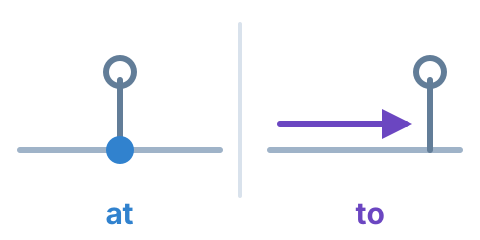
at / to
一个点
She is at the gate. She walks to the gate.
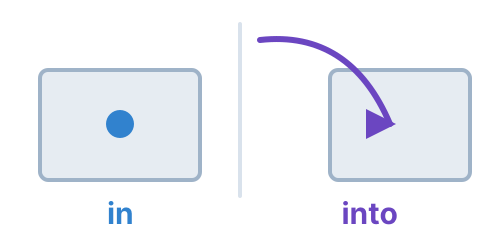
in / into
有边界的空间
The cat is in the box. It jumps into the box.
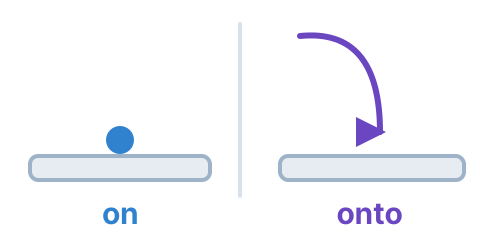
on / onto
一个表面或一条线
The cup is on the shelf. It falls onto the floor.
蓝色:某物在哪里。紫色:它朝哪个方向移动。第一个问题永远一样:有东西在移动吗?
at、in 和 on
这个地方是一个点、一个空间,还是一个表面?
规则: at 用于一个点或事情发生的地方,in 用于有边界的空间,on 用于表面、线、地面或页面。
一个名词,三幅图
| 句子 | 你如何想象这个地方 |
|---|---|
| The students are waiting at the museum. | 途中的一个集合点 |
| The students are in the museum. | 在建筑物内部 |
| There is a flag on the museum. | 在它的屋顶或墙上,是一个表面 |
| Leave it at the front desk. | 事情发生的一个点 |
| There is a pen in the desk. | 在抽屉里面 |
地址、楼层和页面
| at | on | in |
|---|---|---|
| at 25 Hill Road(完整地址) | on Hill Road(只有街道名) | in the city center, in Brazil |
| at the corner(两条街的交叉口) | on the second floor | in the corner(房间的角落) |
| at the top of the page | on page 40, on the menu | in the book, in the photo |
英式英语也会在街道名前用 in(in Hill Road)。本指南采用美式英语。两条街的拐角用 at the corner,房间的角落用 in the corner:街角是一个点,房间的角落是两面墙之间的小空间。
本部分的常见错误
- 该用 at 却用了 in 或 on
Let's meet in the main gate at noon.✓ Let's meet at the main gate at noon.大门是一个集合点:用 at。 - 该用 in 却用了 at 或 on
My sister works at Singapore.✓ My sister works in Singapore.城市是一个空间:用 in。 - 该用 on 却用了 at 或 in
There's a spider in the ceiling.✓ There's a spider on the ceiling.天花板是一个表面:用 on。
位置还是移动?
东西是停留在一处,还是朝目的地移动?
规则: 表示位置的动词用 at、in 或 on;表示移动的动词用 to、into 或 onto。arrive 后接 at 或 in,reach 和 enter 后面不接介词,go 或 come 后面的 home 和 abroad 也不接介词。
| 位置 | 移动 |
|---|---|
| be, live, stay, wait, work at / in / on | go, come, move, travel, run to / into / onto |
| The kids are in the pool. | The kids dived into the pool. |
| Our friends live in Peru. | Our friends moved to Peru. |
有自己固定用法的动词
| 动词 | 用法 | 例句 |
|---|---|---|
| arrive | at + 建筑物或某个点;in + 城市或国家 | arrive at the stadium, arrive in Kenya |
| get (= arrive) | to + 目的地 | get to class on time |
| reach, enter, approach | 不接介词 | reach the border, approach the gate |
| go, come, get | home, here, there, abroad, downstairs 之前不接介词 | come here, get home late |
到达某地
arrive at the stadium, get to the stadium, reach the stadium
不能说:arrive to
arrive 后面从不接 to。go 或 come 之后的 home 和 abroad 也从不接 to。
口语中,移动动词后常用 in 和 on(jump in the lake, put it on the table)。这是正确的英语。into 和 onto 把移动表达得更明确,所以学习者选用它们更保险。
本部分的常见错误
- 用了表示移动的词来表示位置
She is still to the library.✓ She is still at the library.be 不表示移动:用 at。 - 移动动词后面用了表示位置的词
Next month we are flying in Osaka for a conference.✓ Next month we are flying to Osaka for a conference.fly 之后的目的地用 to。 - arrive to
The package arrived to our office today.✓ The package arrived at our office today.到达建筑物用 arrive at。 - to home, to abroad
Can you come to here for a minute?✓ Can you come here for a minute?here 前面不接介词。
沿路线移动
路径是什么形状?
规则: through 表示从内部穿过,across 表示从一侧到另一侧,along 表示沿着一条线,over 表示从上方越过,past 表示从旁边经过并继续往前,around 表示绕弧线,toward 表示朝某方向但不一定到达。
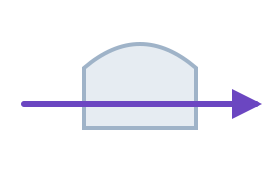 through在内部,从一端到另一端
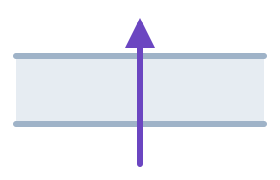 across从一侧到另一侧
 along沿着一条线
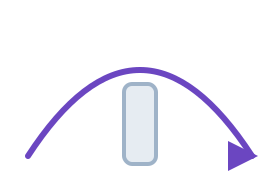 over在上方,从一侧到另一侧
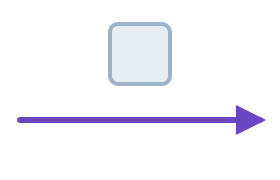 past从旁边经过,然后继续向前
 around绕一个弧线
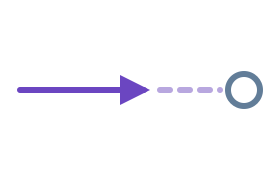 toward只表示方向
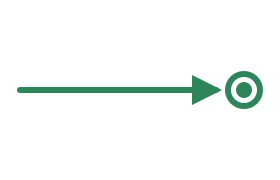 to到达
学习者容易混淆的词对
| 词对 | 按画面选择 |
|---|---|
| through / across | a forest, a crowd, a window: through (inside). A bridge, a field, a border: across (side to side). |
| along / across | walk along the beach (its length); walk across the beach to the water (side to side). |
| over / past | fly over the city (above it); drive past the city (beside it, without entering). |
| to / toward | run to the car (you get there); run toward the car (you may stop before it). |
有些地方可以用两种画面。across the park 指从开阔空间的一侧到另一侧;through the park 暗示周围有小路、树木或建筑。两者都可能正确。美式英语偏好 toward,英式英语更常用 towards。
本部分的常见错误
- through 和 across 混淆
The subway runs across a tunnel under the harbor.✓ The subway runs through a tunnel under the harbor.在隧道里面:用 through。 - along 和 across 混淆
They jogged across the river path every morning.✓ They jogged along the river path every morning.沿着路径的长度:用 along。 - 路线词用错
The plane flew past the mountains, high above them.✓ The plane flew over the mountains.在它们上方:用 over。 - to 和 toward 混淆
He swam to the island but turned back halfway.✓ He swam toward the island but turned back halfway.他没有到达:用 toward。
相对位置
和另一个事物相比,它在哪里?
规则: between 用于两个分开的事物,among 用于一群事物。over 和 under 表示正上方或覆盖;above 和 below 比较高低层次。next to、in front of 和 across from 要当作整个短语来学。
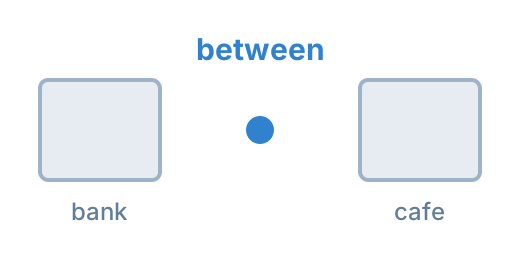

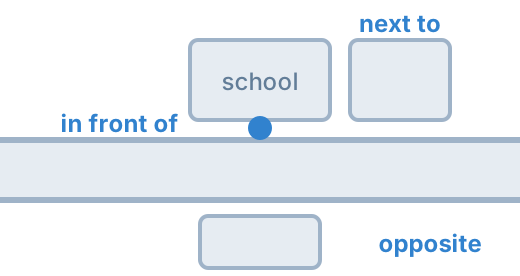
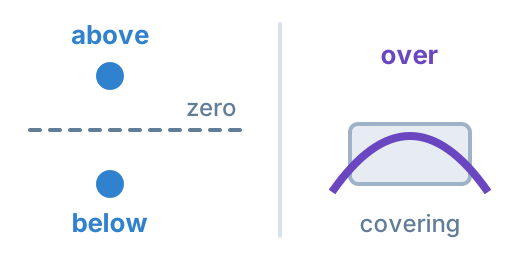
把整个短语记下来
| 正确形式 | 常见错误 |
|---|---|
| next to the door | next the door |
| in front of the hotel | in the front of the hotel(这表示在里面,靠前的部分) |
| across from the gym, opposite the gym | across of the gym, opposite of the gym |
| near the gym, beside the gym | near of the gym, beside of the gym |
| on top of the fridge | on top the fridge |
over 和 above 常常重叠:a light over the door 和 a light above the door 都可以。below 和 above 用于层次和标准(below freezing, above the national average),over 和 under 用于覆盖(under a blanket)。in the front of 是正确的英语,但意思不同:in the front of the car 指在车里,坐在前排。
本部分的常见错误
- between 和 among 混淆
She stood between the other dancers on stage.✓ She stood among the other dancers on stage.一群事物:用 among。 - above/over 和 under/below 混淆
Last night it dropped to five degrees under zero.✓ Last night it dropped to five degrees below zero.零是一个水平线:用 below。 - in front of、opposite 和 next to 混淆
The cafe is in front of the station, across the road.✓ The cafe is opposite the station, across the road.从另一侧面对面:用 opposite。 - 位置短语的形式错误
The printer is near of my desk.✓ The printer is near my desk.near 后面不加 of。
固定搭配
这是需要当作整个短语来学的搭配吗?
规则: 有些搭配是约定俗成的:on the bus, in a car, by train, on TV, in the newspaper, in the rain, at work, on vacation。请把它们当作短语来记。
| 类别 | 例子 | 注意 |
|---|---|---|
| 交通 | on the bus, on the subway, on a flight; in a car, in a taxi; by train | on foot, not by foot |
| 媒体 | on TV, on the radio, on social media, on a podcast; in a novel, in the magazine | on the internet, online |
| 天气 | in the rain, in the heat, in the fog | not under the rain |
| 身体 | a bruise on her arm, tap someone on the shoulder, hit on the head | 在这些短语中,身体部位前用 the,不用所有格 |
| 机构 | at school, at college, at church, in class, in bed, in prison | 表示通常用途时不加冠词 |
| 活动 | at a wedding, at a game, on a tour, on a business trip, on duty | on vacation (US), on holiday (UK) |
上下大型交通工具
get on / off the bus, the train, the plane
上下小型车辆
get in / out of the car, the taxi
有些搭配在不同英语变体中不同。美国人说 in the hospital;英国人说病人在医院时通常用 in hospital。本指南采用美式英语。这些是约定俗成的用法,所以把它们当作整个短语来学,比寻找规则更有效。
本部分的常见错误
- 交通方式的介词用错
She came here with train.✓ She came here by train.表示方式:用 by,不加冠词。 - 媒体的介词用错
I heard that song in the radio yesterday.✓ I heard that song on the radio yesterday.radio 用 on。 - 固定搭配
We met a lot of new people in the party.✓ We met a lot of new people at the party.活动用 at。 - 固定搭配
We walked home under the snow.✓ We walked home in the snow.天气用 in。
自测
每个句子正确吗?点击查看答案。如果不确定,部分标签会告诉你该看哪里。
第 1 部分The meeting is in room 204 on the third floor.
正确。 房间是一个空间(in);楼层用 on。
第 1 部分I'll wait for you in the ticket machine.
错误。 应该是 At the ticket machine。它是一个点,不是可以走进去的空间。
第 2 部分We arrived in Hanoi late at night.
正确。 到达城市用 arrive in。
第 2 部分Tomorrow I'm going to downtown to buy shoes.
错误。 应该是 Go downtown。和 home、abroad 一样,downtown 在美式英语中不接介词。
第 3 部分The river flows through the middle of the city.
正确。 城市环绕着河流,所以用 through。
第 3 部分Is there a bridge along the river near here?
错误。 桥是从河的一侧到另一侧,所以是 a bridge across the river。
第 4 部分Her office is across from mine, so we can wave to each other.
正确。 across from 表示从另一侧面对面。
第 4 部分His grades have been under average this term.
错误。 应该是 below average。平均值是一个水平线,所以用 below。
第 5 部分He got off the train at the wrong stop.
正确。 火车用 on 和 off。
第 5 部分I watched the whole game in my phone.
错误。 应该是 On my phone。屏幕和设备用 on。
AI 练习提示词
把下面的内容粘贴到 AI 聊天工具中。