
Adjectives that share a root, such as bored and boring, are often confused. The -ed form describes the person who feels, and the -ing form describes what causes the feeling. Two parts of this topic are about meaning, two are about form, and one needs both. This guide has five parts, and they match the five parts of the diagnostic exactly.
关于本指南: -ed 与 -ing 形容词
词根相同的形容词,如 bored 和 boring,常常被混淆。-ed 形式描述有感受的人,-ing 形式描述引起感受的事物。本主题有两个部分讲意义,两个部分讲形式,还有一个部分两者兼顾。本指南分为五个部分,与诊断测试的五个部分完全对应。
你可以先做诊断测验,看看这个主题的哪些部分需要复习,也可以直接进入练习活动,其中包含复习幻灯片。
本指南本身为英文。这些翻译只是额外提供的便利,可能不够完美。
このガイドについて: -ed 形容詞と -ing 形容詞
bored と boring のように語根が同じ形容詞は、よく混同されます。-ed 形は感情を持つ人を、-ing 形は感情を引き起こすものを表します。このテーマの 2 つのパートは意味、2 つは形について、残りの 1 つはその両方にかかわります。このガイドは 5 つのパートで、診断テストの 5 つのパートと完全に対応しています。
まず診断テストを受けて、このテーマのどの部分を復習すべきか確認することもできますし、復習スライドを含む練習アクティビティにそのまま進むこともできます。
このガイド自体は英語です。これらの翻訳は補助として提供しているもので、完全とは限りません。
이 가이드 소개: -ed와 -ing 형용사
bored와 boring처럼 어근이 같은 형용사는 자주 혼동됩니다. -ed 형태는 감정을 느끼는 사람을, -ing 형태는 감정을 일으키는 대상을 나타냅니다. 이 주제의 두 영역은 의미, 두 영역은 형태에 관한 것이고, 한 영역은 두 가지를 모두 다룹니다. 이 가이드는 다섯 부분으로 되어 있으며, 진단 테스트의 다섯 부분과 정확히 일치합니다.
먼저 진단 퀴즈로 이 주제에서 복습이 필요한 부분을 확인해도 되고, 복습 슬라이드가 포함된 연습 활동으로 바로 들어가도 됩니다.
가이드 자체는 영어로 되어 있습니다. 이 번역은 부가적으로 제공되는 것이며 완벽하지 않을 수 있습니다.
Giới thiệu hướng dẫn này: Tính từ -ed và -ing
Những tính từ có cùng gốc, như bored và boring, thường bị nhầm lẫn. Dạng -ed mô tả người cảm thấy, còn dạng -ing mô tả thứ gây ra cảm xúc. Hai phần của chủ đề này nói về ý nghĩa, hai phần nói về hình thức, và một phần kết hợp cả hai. Hướng dẫn này gồm năm phần, khớp chính xác với năm phần của bài kiểm tra chẩn đoán.
Bạn có thể bắt đầu bằng bài kiểm tra chẩn đoán để biết phần nào cần ôn lại, hoặc vào thẳng các hoạt động luyện tập, trong đó có cả slide ôn tập.
Đọc hướng dẫn bằng tiếng Việt →
Bản hướng dẫn này được viết bằng tiếng Anh. Các bản dịch chỉ là phần hỗ trợ thêm và có thể chưa hoàn hảo.
इस गाइड के बारे में: -ed और -ing विशेषण
bored और boring जैसे एक ही मूल वाले विशेषण अक्सर गड़बड़ा जाते हैं। -ed रूप उस व्यक्ति का वर्णन करता है जो महसूस करता है, और -ing रूप उसका जो भावना पैदा करता है। इस विषय के दो भाग अर्थ के बारे में हैं, दो रूप के बारे में, और एक भाग दोनों को जोड़ता है। इस गाइड के पाँच भाग हैं, जो निदान परीक्षा के पाँच भागों से ठीक मेल खाते हैं।
आप निदान क्विज़ से शुरू करके जान सकते हैं कि इस विषय के कौन-से भाग दोहराने चाहिए, या सीधे अभ्यास गतिविधियों में जा सकते हैं, जिनमें दोहराव की स्लाइडें भी हैं।
गाइड स्वयं अंग्रेज़ी में है। ये अनुवाद अतिरिक्त सुविधा के रूप में हैं और पूरी तरह सटीक न भी हों।
نبذة عن هذا الدليل: الصفات المنتهية بـ ed وing
الصفات ذات الجذر المشترك مثل bored وboring كثيرًا ما يُخلط بينها. الصيغة المنتهية بـ -ed تصف الشخص الذي يشعر، والمنتهية بـ -ing تصف ما يسبب الشعور. جزآن من هذا الموضوع عن المعنى، وجزآن عن الصيغة، وجزء واحد يجمع بين الاثنين. يتكون هذا الدليل من خمسة أجزاء تطابق تمامًا الأجزاء الخمسة في الاختبار التشخيصي.
يمكنك البدء بالاختبار التشخيصي لمعرفة الأجزاء التي تحتاج إلى مراجعة، أو الانتقال مباشرة إلى أنشطة التدريب، وتشمل شرائح مراجعة.
الدليل نفسه بالإنجليزية. هذه الترجمات مجرد خدمة إضافية وقد لا تكون دقيقة تمامًا.
Об этом руководстве: Прилагательные на -ed и -ing
Прилагательные с общим корнем, такие как bored и boring, часто путают. Форма на -ed описывает человека, который чувствует, а форма на -ing — то, что вызывает чувство. Две части этой темы посвящены значению, две — форме, а одна объединяет и то и другое. В этом руководстве пять частей, и они точно соответствуют пяти частям диагностического теста.
Можно начать с диагностического теста, чтобы узнать, какие части темы стоит повторить, или сразу перейти к упражнениям, в которые входят слайды для повторения.
Читать руководство на русском →
Само руководство написано на английском. Эти переводы — дополнительная помощь, и они могут быть неидеальными.
Acerca de esta guía: Adjetivos en -ed e -ing
Los adjetivos que comparten raíz, como bored y boring, se confunden a menudo. La forma -ed describe a la persona que siente, y la forma -ing describe lo que causa el sentimiento. Dos partes de este tema tratan del significado, dos de la forma y una combina ambas cosas. Esta guía tiene cinco partes, y coinciden exactamente con las cinco partes del diagnóstico.
Puedes empezar con el cuestionario de diagnóstico para saber qué partes del tema conviene repasar, o ir directamente a las actividades de práctica, que incluyen diapositivas de repaso.
La guía en sí está en inglés. Estas traducciones son un añadido de cortesía y pueden no ser perfectas.
À propos de ce guide: Adjectifs en -ed et -ing
Les adjectifs qui partagent une racine, comme bored et boring, sont souvent confondus. La forme en -ed décrit la personne qui ressent, et la forme en -ing ce qui provoque le sentiment. Deux parties de ce sujet portent sur le sens, deux sur la forme, et une combine les deux. Ce guide comporte cinq parties, qui correspondent exactement aux cinq parties du diagnostic.
Vous pouvez commencer par le quiz de diagnostic pour savoir quelles parties du sujet réviser, ou passer directement aux activités d'entraînement, qui comprennent des diapositives de révision.
Le guide lui-même est en anglais. Ces traductions sont un complément offert et peuvent ne pas être parfaites.
Sobre este guia: Adjetivos em -ed e -ing
Adjetivos que têm a mesma raiz, como bored e boring, costumam ser confundidos. A forma -ed descreve a pessoa que sente, e a forma -ing descreve o que causa o sentimento. Duas partes deste tema tratam do significado, duas da forma e uma combina as duas coisas. Este guia tem cinco partes, que correspondem exatamente às cinco partes do teste diagnóstico.
Você pode começar pelo teste diagnóstico para ver quais partes do tema precisam de revisão, ou ir direto para as atividades de prática, que incluem slides de revisão.
O guia em si está em inglês. Estas traduções são um recurso extra e podem não ser perfeitas.
Your diagnostic result says which part needs review. Tap that part below.
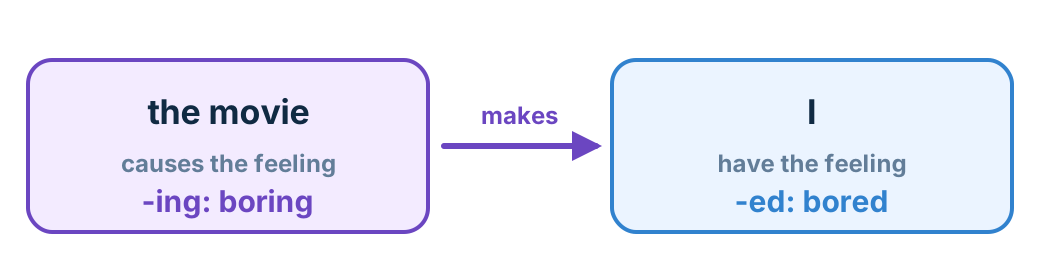
The core idea: who feels it, and what causes it?
The two forms come from the same verb, so the difference is easy to miss. The noun the adjective describes decides.
| -ed: the person feels | -ing: it causes the feeling |
|---|---|
| bored | boring |
| tired | tiring |
| confused | confusing |
| excited | exciting |
| interested | interesting |
| stressed | stressful |
| scared | scary |
- 1
Find the noun the adjective describes. It may be the subject, the noun right after it, or the object of make or find.
- 2
Does that noun feel it? Use -ed: the tired travelers, the news made me worried.
- 3
Does it cause the feeling? Use -ing: a tiring journey, I found the film boring. A person can do either (Part 1).
Parts 1 and 2 are about meaning. Part 3 needs meaning and form. Parts 4 and 5 are about form: irregular pairs, endings, spelling, and prepositions.
After be, feel, and seem
Does the subject feel it, or cause it? A person can do either.
The rule: The one who feels it takes -ed. What causes the feeling takes -ing.
After be, feel, look, seem, and get
| Subject | Feels it: -ed | Causes it: -ing |
|---|---|---|
| a person | I am bored. | My uncle is boring. |
| a thing or event | (cannot feel) | The film is boring. |
| a situation | (cannot feel) | The wait was tiring. |
People can be both
| Sentence | Meaning |
|---|---|
| He is bored. | He feels uninterested. |
| He is boring. | He makes other people feel bored. |
| She is tired. | She needs rest. |
| She is tiring. | She wears other people out. |
A feeling needs a feeler
People and animals can feel. A movie, a book, a job, or a game cannot, so it never takes -ed for a feeling.
Common errors in this part
- -ing used for the person who feels
I felt really boring at the party.✓ I felt really bored at the party.You are the one who feels it. - -ed used for what causes the feeling
The second half of the lesson was tired.✓ The second half of the lesson was tiring.A lesson cannot feel tired. - a person described the wrong way round
My roommate never stops talking about himself. He is so bored.✓ My roommate never stops talking about himself. He is so boring.He makes other people feel it.
More: a quick test for people
Ask whether the person feels it or makes others feel it. The audience was amused (they feel it). The comedian was amusing (he causes it).
Before a noun
Does the noun feel it, or cause it? Looks and voices show a feeling.
The rule: Before a noun, ask whether the noun feels it (-ed) or causes it (-ing). A look, voice, or face shows a feeling, so it usually takes -ed.
The same question before a noun
| Feels it: -ed | Causes it: -ing |
|---|---|
| tired travelers | a tiring journey |
| excited fans | an exciting match |
| confused students | a confusing map |
| disappointed customers | a disappointing meal |
Looks, voices, and faces
| Phrase | Meaning |
|---|---|
| a worried look | the person is worried |
| a bored expression | the person is bored |
| surprised faces | the people are surprised |
A look or a voice does not feel anything, but it shows how the person feels, so English usually uses -ed. A worrying look would be a look that makes you worry.
Common errors in this part
- -ed used for what causes the feeling
It was a really interested trip.✓ It was a really interesting trip.A trip causes the feeling. - -ing used for the person who feels
The exciting crowd cheered when the band came on.✓ The excited crowd cheered when the band came on.The crowd feels it. - -ing used for the person who feels
He answered with a boring sigh.✓ He answered with a bored sigh.A sigh shows how he feels.
Make, find, and it
Who is the object of make? What is found? What does it stand for?
The rule: After make someone, use -ed for that person's feeling. After find something, and after it is or what I find, use -ing for the cause.
Look at the object, or at what it stands for
| Pattern | Example | Who or what? |
|---|---|---|
| make or leave + person + -ed | The delay made us annoyed. | we feel it |
| get or become + -ed | I get bored easily. | I feel it |
| find + thing + -ing | I found the book boring. | the book causes it |
| it is + -ing + to or that | It is tiring to commute every day. | the situation causes it |
| what I find + -ing | What I find most annoying is the noise. | the noise causes it |
A common mistake
It makes me boring. This says that it turns you into a boring person. To say how you feel, use -ed: It makes me bored.
Common errors in this part
- -ing after make someone
Long meetings make me boring.✓ Long meetings make me bored.Make me describes how you feel. - -ed used for what causes the feeling
I found the lecture very interested.✓ I found the lecture very interesting.After find, the lecture causes the feeling. - -ed used for what causes the feeling
It is surprised that the shop is still open.✓ It is surprising that the shop is still open.It stands for the situation.
Irregular pairs and endings
Is the partner word, ending, and spelling right?
The rule: Stressed pairs with stressful, and scared with scary. Write the whole -ed ending, check the spelling, and use -ly for an adverb.
Some pairs do not follow the pattern
| Feeling (person) | Cause (thing) |
|---|---|
| stressed | stressful (not stressing) |
| scared | scary or frightening (not scaring) |
| worried | worrying |
| relaxed | relaxing |
I am scary means you frighten other people. I feel stressful is not correct: use stressed.
Write the whole ending
| Rule | Example |
|---|---|
| do not drop -ed | I am interested in art (not interest) |
| drop a silent e | excite → excited, exciting |
| consonant + y becomes i before -ed | worry → worried (but worrying) |
| double letters stay | embarrass → embarrassed |
| add -ly for an adverb | interesting → interestingly |
Common errors in this part
- stressful or scary used for the person who feels
I feel so stressful this week.✓ I feel so stressed this week.The person who feels stress is stressed. - the base verb instead of the adjective
I am interest in learning Spanish.✓ I am interested in learning Spanish.Write the -ed ending. - -ed or -ing spelling error
We were all very embarassed.✓ We were all very embarrassed.Embarrassed has double r and double s.
Prepositions after -ed adjectives
Which preposition follows the adjective? Learn the pair.
The rule: Learn each -ed adjective with its preposition.
Learn each adjective with its preposition
| Adjective | Preposition | Example |
|---|---|---|
| interested | in | interested in history |
| excited, worried, concerned | about | worried about the exam |
| surprised, shocked, amazed | by | shocked by the news |
| bored, satisfied, disappointed | with | bored with this game |
| tired, scared | of | tired of waiting |
A few adjectives allow two prepositions, such as surprised at or by, bored with or of, and disappointed with or in. In US English, excited for is also common. Learn one and use it consistently.
Common errors in this part
- the wrong preposition after an -ed adjective
I am interested about Japanese films.✓ I am interested in Japanese films.Interested takes in. - the wrong preposition after an -ed adjective
She is worried of the weather tomorrow.✓ She is worried about the weather tomorrow.Worried takes about. - the wrong preposition after an -ed adjective
We were disappointed of the hotel.✓ We were disappointed with the hotel.Disappointed takes with.
More: -ing adjectives and prepositions
-ing adjectives usually take no fixed preposition, but you can add for or to to say who feels it: The film was boring for the children.
Self-check
Is each sentence correct? Tap to see the answer. The part label tells you where to look if you were not sure.
Part 1The students seemed confused by the question.
Correct. The students feel it.
Part 1My job is very tired these days.
Incorrect. My job is very tiring these days. A job causes the feeling.
Part 2We stayed in a relaxing little hotel by the lake.
Correct. The hotel causes the feeling.
Part 2The boring children started to throw paper at each other.
Incorrect. The bored children started to throw paper at each other. The children feel it.
Part 3The loud music made the neighbors annoyed.
Correct. After made the neighbors, describe how they feel.
Part 3I find grammar rules confused.
Incorrect. I find grammar rules confusing. After find, the rules cause the feeling.
Part 4I get scary when I walk home alone at night.
Incorrect. I get scared when I walk home alone at night. The person who feels fear is scared.
Part 4Starting at a new school can be stressful.
Correct. What causes stress is stressful.
Part 5Are you interested on this topic?
Incorrect. Are you interested in this topic? Interested takes in.
Part 5They were shocked by the size of the bill.
Correct. Shocked usually takes by.
AI practice prompt
Paste this into an AI chat tool and replace the bracket with your language.