
Modifiers are words, usually adverbs or adjectives, that change or add meaning to another word. They can make a description stronger, weaker, more precise, or more polite. Three parts of this topic are about choosing the right modifier, and two are about form and order. This guide has five parts, and they match the five parts of the diagnostic exactly.
关于本指南: 修饰语
修饰语是改变或补充另一个词含义的词,通常是副词或形容词。它们可以让描述更强、更弱、更精确或更委婉。本指南分为五个部分,与诊断测试的五个部分完全对应。
你可以先做诊断测验,看看这个主题的哪些部分需要复习,也可以直接进入练习活动,其中包含复习幻灯片。
本指南本身为英文。这些翻译只是额外提供的便利,可能不够完美。
このガイドについて: 修飾語
修飾語とは、ほかの語の意味を変えたり加えたりする語で、通常は副詞か形容詞です。描写を強めたり、弱めたり、より正確にしたり、より丁寧にしたりできます。このガイドは 5 つのパートで、診断テストの 5 つのパートと完全に対応しています。
まず診断テストを受けて、このテーマのどの部分を復習すべきか確認することもできますし、復習スライドを含む練習アクティビティにそのまま進むこともできます。
このガイド自体は英語です。これらの翻訳は補助として提供しているもので、完全とは限りません。
이 가이드 소개: 수식어
수식어는 다른 단어의 의미를 바꾸거나 더하는 단어로, 보통 부사나 형용사입니다. 표현을 더 강하게, 약하게, 정확하게, 또는 공손하게 만들 수 있습니다. 이 가이드는 다섯 부분으로 되어 있으며, 진단 테스트의 다섯 부분과 정확히 일치합니다.
먼저 진단 퀴즈로 이 주제에서 복습이 필요한 부분을 확인해도 되고, 복습 슬라이드가 포함된 연습 활동으로 바로 들어가도 됩니다.
가이드 자체는 영어로 되어 있습니다. 이 번역은 부가적으로 제공되는 것이며 완벽하지 않을 수 있습니다.
Giới thiệu hướng dẫn này: Từ bổ nghĩa
Từ bổ nghĩa là những từ, thường là trạng từ hoặc tính từ, làm thay đổi hoặc bổ sung nghĩa cho một từ khác. Chúng có thể làm mô tả mạnh hơn, yếu hơn, chính xác hơn hoặc lịch sự hơn. Hướng dẫn này gồm năm phần, khớp chính xác với năm phần của bài kiểm tra chẩn đoán.
Bạn có thể bắt đầu bằng bài kiểm tra chẩn đoán để biết phần nào cần ôn lại, hoặc vào thẳng các hoạt động luyện tập, trong đó có cả slide ôn tập.
Đọc hướng dẫn bằng tiếng Việt →
Bản hướng dẫn này được viết bằng tiếng Anh. Các bản dịch chỉ là phần hỗ trợ thêm và có thể chưa hoàn hảo.
इस गाइड के बारे में: Modifier (संशोधक शब्द)
Modifier वे शब्द हैं, आमतौर पर क्रियाविशेषण या विशेषण, जो किसी दूसरे शब्द का अर्थ बदलते या बढ़ाते हैं। वे किसी वर्णन को ज़्यादा तीव्र, कमज़ोर, सटीक या विनम्र बना सकते हैं। इस गाइड के पाँच भाग हैं, जो निदान परीक्षा के पाँच भागों से ठीक मेल खाते हैं।
आप निदान क्विज़ से शुरू करके जान सकते हैं कि इस विषय के कौन-से भाग दोहराने चाहिए, या सीधे अभ्यास गतिविधियों में जा सकते हैं, जिनमें दोहराव की स्लाइडें भी हैं।
गाइड स्वयं अंग्रेज़ी में है। ये अनुवाद अतिरिक्त सुविधा के रूप में हैं और पूरी तरह सटीक न भी हों।
نبذة عن هذا الدليل: المعدِّلات
المعدِّلات كلمات، وهي عادةً ظروف أو صفات، تغيّر معنى كلمة أخرى أو تضيف إليه. ويمكنها أن تجعل الوصف أقوى أو أضعف أو أدق أو ألطف. يتكون هذا الدليل من خمسة أجزاء تطابق تمامًا الأجزاء الخمسة في الاختبار التشخيصي.
يمكنك البدء بالاختبار التشخيصي لمعرفة الأجزاء التي تحتاج إلى مراجعة، أو الانتقال مباشرة إلى أنشطة التدريب، وتشمل شرائح مراجعة.
الدليل نفسه بالإنجليزية. هذه الترجمات مجرد خدمة إضافية وقد لا تكون دقيقة تمامًا.
Об этом руководстве: Модификаторы
Модификаторы — это слова, обычно наречия или прилагательные, которые меняют или дополняют значение другого слова. Они могут сделать описание сильнее, слабее, точнее или вежливее. В этом руководстве пять частей, и они точно соответствуют пяти частям диагностического теста.
Можно начать с диагностического теста, чтобы узнать, какие части темы стоит повторить, или сразу перейти к упражнениям, в которые входят слайды для повторения.
Читать руководство на русском →
Само руководство написано на английском. Эти переводы — дополнительная помощь, и они могут быть неидеальными.
Acerca de esta guía: Modificadores
Los modificadores son palabras, normalmente adverbios o adjetivos, que cambian o añaden significado a otra palabra. Pueden hacer una descripción más fuerte, más débil, más precisa o más cortés. Esta guía tiene cinco partes, y coinciden exactamente con las cinco partes del diagnóstico.
Puedes empezar con el cuestionario de diagnóstico para saber qué partes del tema conviene repasar, o ir directamente a las actividades de práctica, que incluyen diapositivas de repaso.
La guía en sí está en inglés. Estas traducciones son un añadido de cortesía y pueden no ser perfectas.
À propos de ce guide: Modificateurs
Les modificateurs sont des mots, généralement des adverbes ou des adjectifs, qui changent ou ajoutent du sens à un autre mot. Ils peuvent rendre une description plus forte, plus faible, plus précise ou plus polie. Ce guide comporte cinq parties, qui correspondent exactement aux cinq parties du diagnostic.
Vous pouvez commencer par le quiz de diagnostic pour savoir quelles parties du sujet réviser, ou passer directement aux activités d'entraînement, qui comprennent des diapositives de révision.
Le guide lui-même est en anglais. Ces traductions sont un complément offert et peuvent ne pas être parfaites.
Sobre este guia: Modificadores
Modificadores são palavras, geralmente advérbios ou adjetivos, que mudam ou acrescentam sentido a outra palavra. Eles podem deixar uma descrição mais forte, mais fraca, mais precisa ou mais educada. Este guia tem cinco partes, que correspondem exatamente às cinco partes do teste diagnóstico.
Você pode começar pelo teste diagnóstico para ver quais partes do tema precisam de revisão, ou ir direto para as atividades de prática, que incluem slides de revisão.
O guia em si está em inglês. Estas traduções são um recurso extra e podem não ser perfeitas.
Your diagnostic result says which part needs review. Tap that part below.
The core idea: what is the modifier modifying?
The right modifier depends on the word it modifies. The same word can be correct in one place and wrong in another.
| The word being modified | Use | Example |
|---|---|---|
| gradable adjective | very, really, quite, extremely | very tired |
| extreme adjective | absolutely, completely, totally | absolutely perfect |
| comparative | much, far, a little, even | much friendlier |
| superlative | by far, easily (before the) | by far the best |
| verb | really, a lot, very much | really like, like it a lot |
- 1
What is the modifier modifying? An adjective, a comparison, a verb, or a noun.
- 2
Which modifier fits that word? Very for gradable adjectives, absolutely for extreme ones, much for comparatives, really for verbs (Parts 1 to 3).
- 3
Is the form and position right? An adverb, not an adjective, and not between a verb and its object. So or such, hard or hardly (Parts 4 and 5).
Modifiers can make a statement stronger, weaker, more precise, or more polite. Parts 1 to 3 are about choosing the word. Parts 4 and 5 are about form and order.
Very, absolutely, or too?
Is the adjective gradable, already extreme, or more than you want?
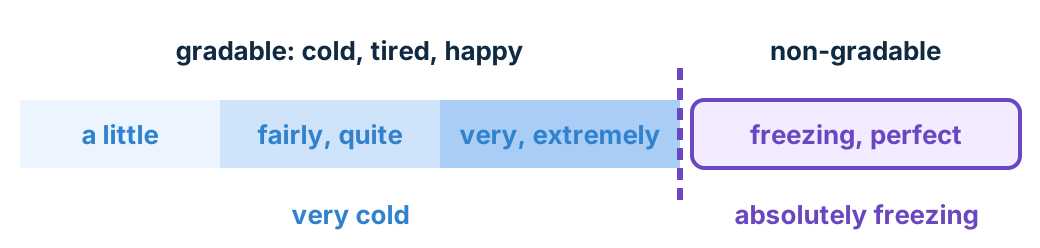
The rule: Use very with gradable adjectives (very cold) and absolutely with extreme ones (absolutely freezing). Too means more than you want. Enough goes after the adjective.
Can it be more or less, or is it already extreme?
| Gradable | Extreme (non-gradable) |
|---|---|
| cold, hot, tired, happy, sad, angry, big, small, interesting, boring, nice, difficult, tall, funny | freezing, boiling, exhausted, thrilled, furious, enormous, fascinating, terrifying, perfect, impossible, starving, spotless, tiny |
Gradable: very
It is very cold today.
I am so tired.
He is fairly confident.
Extreme: absolutely
That is an absolutely perfect answer.
I am completely exhausted.
That idea is utterly ridiculous.
Really works with both kinds: really cold, really freezing. In American English quite usually means very. In British English it often means fairly.
Too, very, and enough
| Word | Meaning | Example |
|---|---|---|
| very | strong, often praise | The cake is very good. |
| too | more than you want, a problem | The tea is too hot to drink. |
| adjective + enough | as much as you need | Is the room big enough for ten people? |
| enough + noun | as many or as much as you need | We have enough chairs. |
Many learners use too to mean very, because words like Korean 너무 or Chinese 太 can do both jobs. In English, too good or too delicious sounds like a problem, not praise.
Common errors in this part
- too used as praise
Your new haircut looks too nice!✓ Your new haircut looks really nice!Too means more than you want, so it sounds like a complaint. - very with a non-gradable adjective
By midnight we were very starving.✓ By midnight we were absolutely starving.Starving is already extreme. - enough in the wrong place
Is the printer enough fast for the whole office?✓ Is the printer fast enough for the whole office?Enough goes after the adjective.
More: negatives with gradable adjectives
In negatives, English often softens the modifier: It’s not very warm outside. I’m not particularly hungry. That was not exactly thrilling.
Comparatives and superlatives
Is it a comparison of two things, or of one thing with all the others?
The rule: With a comparative, use much, far, a lot, a little, or even, not very or so, and never add more to an -er form. Before the + superlative, use by far or easily. Very goes after the: the very best.
Comparatives
| Modifier | Difference | Example |
|---|---|---|
| much, a lot, far | large | The train is much faster than the bus. |
| a little, slightly, a bit | small | My room is slightly bigger than yours. |
| even | surprising | The sequel is even better than the first film. |
Use -er or more, not both: much easier, not more easier. Better and worse are already comparatives, so they never take more.
Superlatives
| Modifier | Position | Example |
|---|---|---|
| by far, easily | before the | It is by far the oldest building in town. |
| very | after the | This is the very best seat in the theater. |
| possibly | before the, adds caution | This is possibly the cheapest flight this month. |
Use a comparative for two things and a superlative for three or more: the taller of the two, the tallest in the class.
Common errors in this part
- very or so with a comparative
The second hotel was very nicer.✓ The second hotel was much nicer.Very does not modify a comparative. - a doubled comparative or superlative
My grades are more better this year.✓ My grades are much better this year.Better is already a comparative. - very before the superlative
It was very the longest meeting of my life.✓ It was by far the longest meeting of my life.Very goes after the, not before it.
More: very much with comparatives
Very alone cannot modify a comparative, but very much can, especially in British English: She feels very much better today.
Verbs and natural pairs
Is the modifier going with a verb, or with a word that has a usual partner?
The rule: Very does not modify a verb: say really like or like it very much. Many modifiers have usual partners: highly recommended, strongly agree, deeply regret.
Very does not go before a verb
| Pattern | Example |
|---|---|
| really + verb | I really like this song. |
| verb + object + a lot or very much | I like this song a lot. I like it very much. |
| much + prefer | I much prefer tea to coffee. |
| a verb with a usual partner | totally agree, strongly disagree, deeply regret, greatly appreciate |
Chinese 很 can go before a verb such as 喜欢 (like), so learners often write very like. In English, very cannot do this.
Natural pairs
| Natural | Avoid | Meaning |
|---|---|---|
| highly recommended | strongly suggested | |
| highly skilled | very competent | |
| well known | known by many people | |
| widely regarded | generally considered | |
| deeply grateful | sincerely thankful | |
| strongly opposed | firmly against | |
| bitterly cold | extremely cold |
Tone and register
| Modifier | Register | Example |
|---|---|---|
| so, really, pretty | casual | I’m so happy you came! |
| fairly, rather, somewhat | neutral or formal | The results were fairly encouraging. |
| extremely, incredibly | neutral but strong | She worked incredibly hard. |
| highly, deeply, greatly | formal or written | I am deeply concerned. |
Common errors in this part
- very before a verb
I very miss my family.✓ I really miss my family.Very does not modify a verb. - an unnatural modifier pairing
I highly agree with the new rules.✓ I strongly agree with the new rules.Agree pairs with strongly or totally. - too used as praise
I too much love this show.✓ I really love this show.Too much is not a way to say very.
Adverb form and position
Does it describe a verb or an adjective, and where is the object?
The rule: Use an adverb to describe a verb or an adjective (speak clearly, incredibly quiet). Put it before an adjective, and after a verb and its object, not between them.
Adjective or adverb?
| Adjective | Adverb | Example |
|---|---|---|
| clear, careful, quick | clearly, carefully, quickly | She drives carefully. |
| good | well | He sings well. |
| fast, hard, late | fast, hard, late (no -ly) | They arrived late. |
Hardly and lately are different words: hardly means almost not, and lately means recently. In casual speech some people say real good or drive safe, but use the adverb in writing.
Position
| It modifies | Position | Example |
|---|---|---|
| an adjective or adverb | just before it | She is extremely talented. He drove incredibly fast. |
| a verb with an object | after the object | He plays the piano well. |
| a verb (really, completely, hardly) | usually before the main verb | I completely forgot her birthday. |
Say
She speaks English very well.
I completely forgot her birthday.
He drove incredibly fast.
Not
She speaks very well English.I forgot completely her birthday.He drove incredible fast.
Common errors in this part
- an adjective where an adverb is needed
She finished the exercise very quick.✓ She finished the exercise very quickly.Quickly describes the verb finished. - an adverb between a verb and its object
My sister speaks fluently three languages.✓ My sister speaks three languages fluently.Put the adverb after the object. - an adjective where an adverb is needed
Our new printer works very good.✓ Our new printer works very well.Well is the adverb of good.
So, such, and hardly
So or such? Hard or hardly?
The rule: So + adjective, such (a) + adjective + noun, and so much or so many + noun. Hard means with effort. Hardly means almost not, so do not add not.
So and such
| Structure | Example |
|---|---|
| so + adjective or adverb | The lake was so calm that we could see the bottom. |
| so much + uncountable noun, so many + plural noun | There was so much food that we took some home. |
| such a + adjective + singular noun | It was such a long flight. |
| such + adjective + plural or uncountable noun | They are such good friends. We had such bad luck. |
For a result with that, use so or such, not too: so tired that, not too tired that. In formal English, so + adjective + a + noun is also possible: so good a teacher.
Hard, hardly, and other negative modifiers
| Word | Meaning | Example |
|---|---|---|
| hard | with a lot of effort | She studies hard. |
| hardly | almost not | She hardly studies. |
| barely, scarcely | almost not, only just | We barely caught the train. |
| hardly ever | almost never | I hardly ever drive. |
Hardly, barely, and scarcely are already negative, so do not add not. In formal writing, hardly can start a sentence with inversion, followed by when: Hardly had the meeting started when the power went out. No sooner uses than instead.
Common errors in this part
- so and such confused
We had so fun at the party.✓ We had so much fun at the party.Fun is a noun, so use so much fun or such fun. - hard and hardly confused
Everyone on the team worked hardly to finish on time.✓ Everyone on the team worked hard to finish on time.Hard means with effort. Hardly means almost not. - a negative added to hardly, barely, or scarcely
I can't hardly wait for the holidays.✓ I can hardly wait for the holidays.Hardly is already negative.
Self-check
Is each sentence correct? Tap to see the answer. The part label tells you where to look if you were not sure.
Part 1The water is too cold for swimming today.
Correct. Too shows a problem: the water is colder than you want.
Part 1The final exam was very impossible.
Incorrect. The final exam was completely impossible. Impossible is non-gradable.
Part 2This laptop is a lot lighter than my old one.
Correct. A lot shows a big difference with a comparative.
Part 2Anna is the most kindest person I know.
Incorrect. Anna is the kindest person I know. Kindest is already a superlative.
Part 3I very enjoyed your presentation.
Incorrect. I really enjoyed your presentation. Very does not modify a verb.
Part 3The chef is highly skilled.
Correct. Highly skilled is a natural pair.
Part 4He drives very carefully at night.
Correct. Carefully describes drives, and very goes before carefully.
Part 4She plays beautiful the violin.
Incorrect. She plays the violin beautifully. Use an adverb, and put it after the object.
Part 5It was such a boring lecture that I left early.
Correct. Such a comes before an adjective plus a singular noun.
Part 5She works hardly every day.
Incorrect. She works hard every day. Hardly means almost not.
AI practice prompt
Paste this into an AI chat tool and replace the bracket with your language.