
Una preposición de lugar es una pequeña imagen. At es un punto, in es un espacio y on es una superficie. Cuando algo se mueve, la imagen se convierte en un camino: to, into, onto, through, across, along. Imagina primero la escena y la preposición suele aparecer sola.
Leer la guía en inglés → Esta página está traducida automáticamente y no la ha revisado un hablante nativo, por lo que puede contener errores. La versión en inglés es la de referencia.
El resultado de tu diagnóstico indica qué parte necesitas repasar. Toca esa parte más abajo.
Tres imágenes y lo que pasa cuando las cosas se mueven
Cada imagen de lugar tiene una pareja de movimiento. Pregunta primero si algo se mueve.
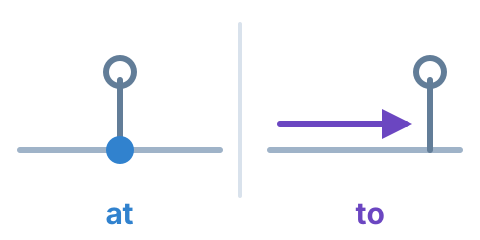
at / to
un punto
She is at the gate. She walks to the gate.
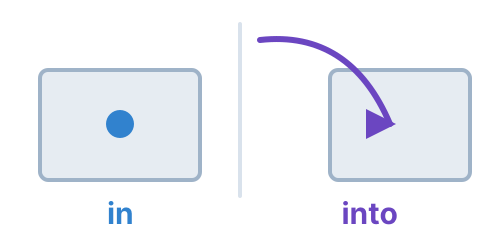
in / into
un espacio con límites
The cat is in the box. It jumps into the box.
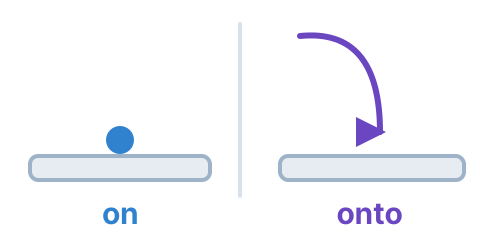
on / onto
una superficie o una línea
The cup is on the shelf. It falls onto the floor.
Azul: dónde está algo. Morado: en qué dirección se mueve. La primera pregunta siempre es la misma: ¿se mueve algo?
At, in y on
¿El lugar es un punto, un espacio o una superficie?
La regla: Usa at para un punto o un lugar donde ocurre algo, in para un espacio con límites y on para una superficie, una línea, un suelo o una página.
Un sustantivo, tres imágenes
| Oración | Cómo te imaginas el lugar |
|---|---|
| The students are waiting at the museum. | un punto de encuentro en el camino hacia otro sitio |
| The students are in the museum. | dentro del edificio |
| There is a flag on the museum. | en su tejado o pared, una superficie |
| Leave it at the front desk. | un punto donde ocurre algo |
| There is a pen in the desk. | dentro de un cajón |
Direcciones, pisos y páginas
| at | on | in |
|---|---|---|
| at 25 Hill Road (dirección completa) | on Hill Road (solo el nombre de la calle) | in the city center, in Brazil |
| at the corner (esquina de dos calles) | on the second floor | in the corner (rincón de una habitación) |
| at the top of the page | on page 40, on the menu | in the book, in the photo |
El inglés británico también usa in con nombres de calles (in Hill Road). Esta guía usa inglés estadounidense. Se dice at the corner para la esquina de dos calles, pero in the corner para el rincón de una habitación: la esquina de la calle es un punto, y el rincón es un pequeño espacio entre dos paredes.
Repaso de gramática
At, in y on también se usan con el tiempo (at 6:00, on Monday, in June), con una lógica parecida: un punto, un día, un periodo más largo.
Errores comunes en esta parte
- in u on donde hace falta at
Let's meet in the main gate at noon.✓ Let's meet at the main gate at noon.Una puerta de entrada es un punto de encuentro: at. - at u on donde hace falta in
My sister works at Singapore.✓ My sister works in Singapore.Una ciudad es un espacio: in. - at o in donde hace falta on
There's a spider in the ceiling.✓ There's a spider on the ceiling.Un techo es una superficie: on.
¿Lugar o movimiento?
¿Algo se queda en un lugar o se mueve hacia un destino?
La regla: Los verbos de lugar llevan at, in u on; los verbos de movimiento llevan to, into u onto. Arrive lleva at o in, reach y enter no llevan preposición, y home y abroad no llevan ninguna después de go o come.
| Lugar | Movimiento |
|---|---|
| be, live, stay, wait, work at / in / on | go, come, move, travel, run to / into / onto |
| The kids are in the pool. | The kids dived into the pool. |
| Our friends live in Peru. | Our friends moved to Peru. |
Verbos con su propio patrón
| Verbo | Patrón | Ejemplo |
|---|---|---|
| arrive | at + un edificio o punto; in + una ciudad o un país | arrive at the stadium, arrive in Kenya |
| get (= arrive) | to + destino | get to class on time |
| reach, enter, approach | sin preposición | reach the border, approach the gate |
| go, come, get | sin preposición antes de home, here, there, abroad, downstairs | come here, get home late |
Llegar a algún sitio
arrive at the stadium, get to the stadium, reach the stadium
Incorrecto: arrive to
Arrive nunca lleva to. Home y abroad nunca llevan to después de go o come.
En el habla, in y on son comunes después de verbos de movimiento (jump in the lake, put it on the table). Es inglés correcto. Into y onto hacen el movimiento más explícito, así que a los estudiantes les conviene elegirlas.
Errores comunes en esta parte
- Palabra de movimiento para un lugar
She is still to the library.✓ She is still at the library.Be no indica movimiento: at. - Palabra de lugar después de un verbo de movimiento
Next month we are flying in Osaka for a conference.✓ Next month we are flying to Osaka for a conference.El destino después de fly lleva to. - arrive to
The package arrived to our office today.✓ The package arrived at our office today.Arrive at para un edificio. - to home, to abroad
Can you come to here for a minute?✓ Can you come here for a minute?Here no lleva preposición.
Movimiento a lo largo de una ruta
¿Qué forma tiene el recorrido?
La regla: Through va por dentro, across va de un lado a otro, along sigue una línea, over va por encima, past pasa junto a algo y sigue más allá, around va en curva y toward muestra la dirección sin llegar.
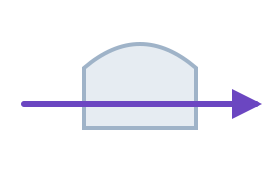 throughpor dentro, de un extremo a otro
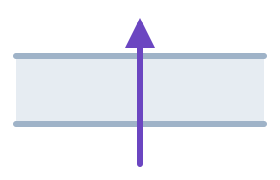 acrossde un lado a otro
 alongsiguiendo una línea
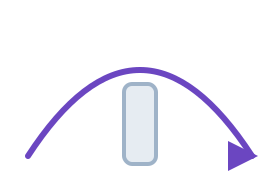 overpor encima, de un lado a otro
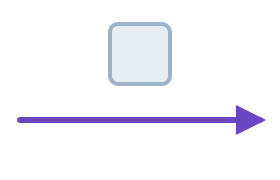 pastjunto a algo y luego más allá
 arounden curva
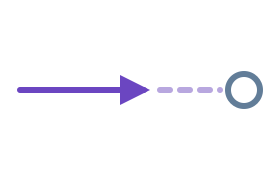 towardsolo dirección
 tollega
Pares que los estudiantes confunden
| Par | Elige según la imagen |
|---|---|
| through / across | a forest, a crowd, a window: through (inside). A bridge, a field, a border: across (side to side). |
| along / across | walk along the beach (its length); walk across the beach to the water (side to side). |
| over / past | fly over the city (above it); drive past the city (beside it, without entering). |
| to / toward | run to the car (you get there); run toward the car (you may stop before it). |
Algunos lugares admiten dos imágenes. Across the park significa de un lado a otro de un espacio abierto; through the park sugiere que hay caminos, árboles o edificios a tu alrededor. Ambos pueden ser correctos. El inglés estadounidense prefiere toward; el británico usa más a menudo towards.
Errores comunes en esta parte
- confusión entre through y across
The subway runs across a tunnel under the harbor.✓ The subway runs through a tunnel under the harbor.Dentro de un túnel: through. - confusión entre along y across
They jogged across the river path every morning.✓ They jogged along the river path every morning.A lo largo de un camino: along. - Palabra de ruta incorrecta
The plane flew past the mountains, high above them.✓ The plane flew over the mountains.Por encima de ellas: over. - confusión entre to y toward
He swam to the island but turned back halfway.✓ He swam toward the island but turned back halfway.No llegó: toward.
Posición relativa
¿Dónde está en comparación con la otra cosa?
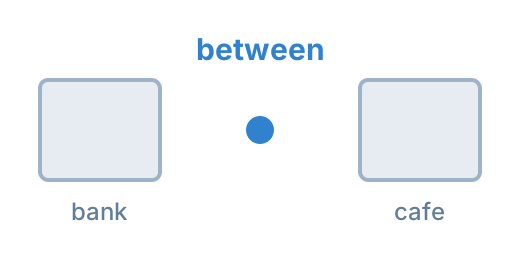
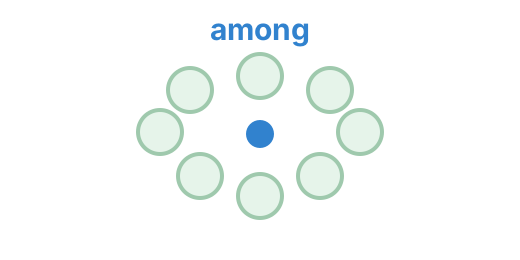
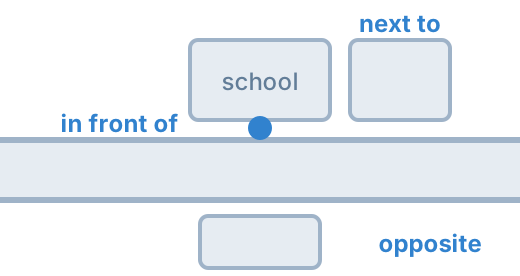
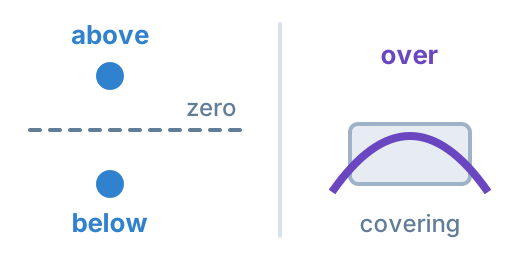
La regla: Between se usa para dos cosas separadas y among para un grupo. Over y under indican justo encima o cubriendo; above y below comparan niveles. Aprende next to, in front of y across from como expresiones completas.
Aprende la expresión completa
| Forma correcta | Error común |
|---|---|
| next to the door | next the door |
| in front of the hotel | in the front of the hotel (esto significa dentro, en su parte delantera) |
| across from the gym, opposite the gym | across of the gym, opposite of the gym |
| near the gym, beside the gym | near of the gym, beside of the gym |
| on top of the fridge | on top the fridge |
Over y above a menudo coinciden: a light over the door y a light above the door son ambas correctas. Usa below y above para niveles y escalas (below freezing, above the national average), y over y under para cubrir (under a blanket). In the front of es inglés correcto, pero con otro significado: in the front of the car significa dentro del coche, en los asientos delanteros.
Errores comunes en esta parte
- confusión entre between y among
She stood between the other dancers on stage.✓ She stood among the other dancers on stage.Un grupo: among. - confusión entre above/over y under/below
Last night it dropped to five degrees under zero.✓ Last night it dropped to five degrees below zero.El cero es un nivel: below. - confusión entre in front of, opposite y next to
The cafe is in front of the station, across the road.✓ The cafe is opposite the station, across the road.Enfrente, desde el otro lado: opposite. - Forma incorrecta de una expresión de posición
The printer is near of my desk.✓ The printer is near my desk.Near no lleva of.
Combinaciones fijas
¿Es una combinación que hay que aprender como expresión completa?
La regla: Algunas combinaciones son convenciones: on the bus, in a car, by train, on TV, in the newspaper, in the rain, at work, on vacation. Apréndelas como expresiones.
| Grupo | Ejemplos | Ojo |
|---|---|---|
| Transporte | on the bus, on the subway, on a flight; in a car, in a taxi; by train | on foot, not by foot |
| Medios | on TV, on the radio, on social media, on a podcast; in a novel, in the magazine | on the internet, online |
| Clima | in the rain, in the heat, in the fog | not under the rain |
| Cuerpo | a bruise on her arm, tap someone on the shoulder, hit on the head | en estas expresiones la parte del cuerpo lleva the, no un posesivo |
| Instituciones | at school, at college, at church, in class, in bed, in prison | sin artículo cuando te refieres a su uso habitual |
| Actividades | at a wedding, at a game, on a tour, on a business trip, on duty | on vacation (US), on holiday (UK) |
Subir y bajar de un transporte grande
get on / off the bus, the train, the plane
Subir y bajar de un coche
get in / out of the car, the taxi
Algunas combinaciones varían entre variedades del inglés. Los estadounidenses dicen in the hospital; los británicos suelen decir in hospital para un paciente. Esta guía usa inglés estadounidense. Son convenciones, así que aprenderlas como expresiones completas funciona mejor que buscar una regla.
Errores comunes en esta parte
- Preposición incorrecta con transporte
She came here with train.✓ She came here by train.El medio: by, sin artículo. - Preposición incorrecta con medios
I heard that song in the radio yesterday.✓ I heard that song on the radio yesterday.Radio lleva on. - Combinación fija
We met a lot of new people in the party.✓ We met a lot of new people at the party.Los eventos llevan at. - Combinación fija
We walked home under the snow.✓ We walked home in the snow.El clima lleva in.
Autoevaluación
¿Es correcta cada oración? Toca para ver la respuesta. La etiqueta de la parte te indica dónde mirar si no estabas seguro.
Parte 1The meeting is in room 204 on the third floor.
Correcta. Una habitación es un espacio (in); un piso lleva on.
Parte 1I'll wait for you in the ticket machine.
Incorrecta. Lo correcto es At the ticket machine. Es un punto, no un espacio en el que se pueda entrar.
Parte 2We arrived in Hanoi late at night.
Correcta. Arrive in para una ciudad.
Parte 2Tomorrow I'm going to downtown to buy shoes.
Incorrecta. Lo correcto es Go downtown. Como home y abroad, downtown no lleva preposición en inglés estadounidense.
Parte 3The river flows through the middle of the city.
Correcta. La ciudad rodea el río, así que through.
Parte 3Is there a bridge along the river near here?
Incorrecta. Un puente va de un lado a otro de un río: a bridge across the river.
Parte 4Her office is across from mine, so we can wave to each other.
Correcta. Across from significa enfrente, desde el otro lado.
Parte 4His grades have been under average this term.
Incorrecta. Lo correcto es below average. El promedio es un nivel, así que below.
Parte 5He got off the train at the wrong stop.
Correcta. Los trenes llevan on y off.
Parte 5I watched the whole game in my phone.
Incorrecta. Lo correcto es On my phone. Las pantallas y los dispositivos llevan on.
Indicación para practicar con IA
Pega esto en una herramienta de chat con IA.