
Conditionals talk about what happens if something is true. The tense you choose shows how real you think the situation is: a fact, a real possibility, an imagined situation, or a past that cannot change. One part of this topic is about real situations, two are about unreal ones, and two mix both. This guide has five parts, and they match the five parts of the diagnostic exactly.
关于本指南: 条件句
条件句谈论如果某事为真会发生什么。所用的时态表明说话人认为情况有多真实:事实、真实的可能性、想象的情况,或无法改变的过去。本主题有一个部分讲真实情况,两个部分讲非真实情况,另外两个部分两者兼有。本指南分为五个部分,与诊断测试的五个部分完全对应。
你可以先做诊断测验,看看这个主题的哪些部分需要复习,也可以直接进入练习活动,其中包含复习幻灯片。
本指南本身为英文。这些翻译只是额外提供的便利,可能不够完美。
このガイドについて: 条件文
条件文は、あることが本当ならどうなるかを述べます。時制は、話し手が状況をどのくらい現実的だと考えているかを示します:事実、現実の可能性、想像上の状況、または変えられない過去です。このテーマの 1 つのパートは現実の状況、2 つは非現実の状況を扱い、残りの 2 つは両方を含みます。このガイドは 5 つのパートで、診断テストの 5 つのパートと完全に対応しています。
まず診断テストを受けて、このテーマのどの部分を復習すべきか確認することもできますし、復習スライドを含む練習アクティビティにそのまま進むこともできます。
このガイド自体は英語です。これらの翻訳は補助として提供しているもので、完全とは限りません。
이 가이드 소개: 조건문
조건문은 어떤 일이 사실이라면 무슨 일이 일어나는지를 말합니다. 시제는 말하는 사람이 상황을 얼마나 현실적으로 보는지를 보여 줍니다: 사실, 실제 가능성, 상상한 상황, 또는 바꿀 수 없는 과거입니다. 이 주제의 한 부분은 현실 상황을, 두 부분은 비현실 상황을 다루고, 나머지 두 부분은 둘 다 포함합니다. 이 가이드는 다섯 부분으로 되어 있으며, 진단 테스트의 다섯 부분과 정확히 일치합니다.
먼저 진단 퀴즈로 이 주제에서 복습이 필요한 부분을 확인해도 되고, 복습 슬라이드가 포함된 연습 활동으로 바로 들어가도 됩니다.
가이드 자체는 영어로 되어 있습니다. 이 번역은 부가적으로 제공되는 것이며 완벽하지 않을 수 있습니다.
Giới thiệu hướng dẫn này: Câu điều kiện
Câu điều kiện nói về điều xảy ra nếu một việc là thật. Thì của động từ cho thấy người nói nghĩ tình huống thật đến mức nào: một sự thật, một khả năng có thật, một tình huống tưởng tượng, hay một quá khứ không thể thay đổi. Một phần của chủ đề này nói về tình huống có thật, hai phần nói về tình huống không có thật, và hai phần còn lại có cả hai. Hướng dẫn này gồm năm phần, khớp chính xác với năm phần của bài kiểm tra chẩn đoán.
Bạn có thể bắt đầu bằng bài kiểm tra chẩn đoán để biết phần nào cần ôn lại, hoặc vào thẳng các hoạt động luyện tập, trong đó có cả slide ôn tập.
Đọc hướng dẫn bằng tiếng Việt →
Bản hướng dẫn này được viết bằng tiếng Anh. Các bản dịch chỉ là phần hỗ trợ thêm và có thể chưa hoàn hảo.
इस गाइड के बारे में: Conditional (शर्तिया वाक्य)
Conditional यह बताते हैं कि अगर कोई बात सच हो तो क्या होगा। काल यह दिखाता है कि बोलने वाला स्थिति को कितना वास्तविक मानता है: एक तथ्य, एक वास्तविक संभावना, एक कल्पित स्थिति, या ऐसा अतीत जो बदल नहीं सकता। इस विषय का एक भाग वास्तविक स्थितियों के बारे में है, दो अवास्तविक के बारे में, और दो में दोनों हैं। इस गाइड के पाँच भाग हैं, जो निदान परीक्षा के पाँच भागों से ठीक मेल खाते हैं।
आप निदान क्विज़ से शुरू करके जान सकते हैं कि इस विषय के कौन-से भाग दोहराने चाहिए, या सीधे अभ्यास गतिविधियों में जा सकते हैं, जिनमें दोहराव की स्लाइडें भी हैं।
गाइड स्वयं अंग्रेज़ी में है। ये अनुवाद अतिरिक्त सुविधा के रूप में हैं और पूरी तरह सटीक न भी हों।
نبذة عن هذا الدليل: الجمل الشرطية
تتحدث الجمل الشرطية عما يحدث إذا صح أمر ما. ويبيّن الزمن مدى واقعية الموقف في نظر المتكلم: حقيقة، أو احتمال حقيقي، أو موقف متخيَّل، أو ماضٍ لا يمكن تغييره. جزء واحد من هذا الموضوع عن مواقف حقيقية، وجزآن عن مواقف غير حقيقية، وجزآن يجمعان بين الاثنين. يتكون هذا الدليل من خمسة أجزاء تطابق تمامًا الأجزاء الخمسة في الاختبار التشخيصي.
يمكنك البدء بالاختبار التشخيصي لمعرفة الأجزاء التي تحتاج إلى مراجعة، أو الانتقال مباشرة إلى أنشطة التدريب، وتشمل شرائح مراجعة.
الدليل نفسه بالإنجليزية. هذه الترجمات مجرد خدمة إضافية وقد لا تكون دقيقة تمامًا.
Об этом руководстве: Условные предложения
Условные предложения говорят о том, что произойдёт, если что-то верно. Время глагола показывает, насколько реальной говорящий считает ситуацию: факт, реальная возможность, воображаемая ситуация или прошлое, которое нельзя изменить. Одна часть этой темы посвящена реальным ситуациям, две — нереальным, а ещё две сочетают и то и другое. В этом руководстве пять частей, и они точно соответствуют пяти частям диагностического теста.
Можно начать с диагностического теста, чтобы узнать, какие части темы стоит повторить, или сразу перейти к упражнениям, в которые входят слайды для повторения.
Читать руководство на русском →
Само руководство написано на английском. Эти переводы — дополнительная помощь, и они могут быть неидеальными.
Acerca de esta guía: Condicionales
Los condicionales hablan de lo que ocurre si algo es cierto. El tiempo verbal muestra lo real que el hablante considera la situación: un hecho, una posibilidad real, una situación imaginada o un pasado que no se puede cambiar. Una parte de este tema trata de situaciones reales, dos de situaciones irreales, y otras dos combinan ambas. Esta guía tiene cinco partes, y coinciden exactamente con las cinco partes del diagnóstico.
Puedes empezar con el cuestionario de diagnóstico para saber qué partes del tema conviene repasar, o ir directamente a las actividades de práctica, que incluyen diapositivas de repaso.
La guía en sí está en inglés. Estas traducciones son un añadido de cortesía y pueden no ser perfectas.
À propos de ce guide: Conditionnels
Les conditionnels parlent de ce qui se passe si quelque chose est vrai. Le temps montre à quel point le locuteur juge la situation réelle : un fait, une possibilité réelle, une situation imaginée ou un passé qu'on ne peut plus changer. Une partie de ce sujet porte sur des situations réelles, deux sur des situations irréelles, et deux autres combinent les deux. Ce guide comporte cinq parties, qui correspondent exactement aux cinq parties du diagnostic.
Vous pouvez commencer par le quiz de diagnostic pour savoir quelles parties du sujet réviser, ou passer directement aux activités d'entraînement, qui comprennent des diapositives de révision.
Le guide lui-même est en anglais. Ces traductions sont un complément offert et peuvent ne pas être parfaites.
Sobre este guia: Condicionais
As condicionais falam do que acontece se algo for verdade. O tempo verbal mostra o quanto o falante considera a situação real: um fato, uma possibilidade real, uma situação imaginada ou um passado que não pode ser mudado. Uma parte deste tema trata de situações reais, duas de situações irreais, e outras duas combinam as duas coisas. Este guia tem cinco partes, que correspondem exatamente às cinco partes do teste diagnóstico.
Você pode começar pelo teste diagnóstico para ver quais partes do tema precisam de revisão, ou ir direto para as atividades de prática, que incluem slides de revisão.
O guia em si está em inglês. Estas traduções são um recurso extra e podem não ser perfeitas.
Your diagnostic result says which part needs review. Tap that part below.
The core idea: how real is the situation?
The tense you choose tells the reader how likely you think the situation is. The same if-sentence changes meaning when the tense changes.
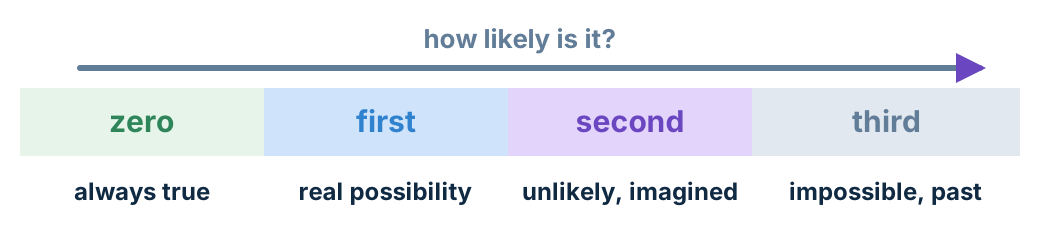
| Type | if-clause | Result | Example |
|---|---|---|---|
| zero | present simple | present simple | If you heat ice, it melts. |
| first | present simple | will + base verb | If it rains, we will stay home. |
| second | past simple | would + base verb | If I had time, I would help. |
| third | past perfect | would have + participle | If I had known, I would have called. |
| mixed | past perfect or past simple | would or would have | If I had studied, I would be a doctor now. |
- 1
Is it true, or could it really happen? Use the zero or first conditional. Is it imagined? Use the second (Part 1).
- 2
Is each half about now or about the past? Choose the second, third, or a mixed conditional (Part 2).
- 3
Which linking word fits? If, when, unless, or in case, all with the present for the future (Part 3).
The tense signals how real the speaker thinks the situation is. Part 4 applies the same idea to wishes and regrets, and Part 5 covers formal forms without if.
Real or imagined?
Is it a real possibility or only imagined? The tense shows which.
The rule: The tense shows how likely the situation is: if plus present, then will or the present, for real possibilities and facts; if plus past, then would, for imagined ones.
The same situation, two levels of reality
| Meaning | Pattern | Example |
|---|---|---|
| fact (zero) | if + present simple, present simple | If you heat ice, it melts. |
| real possibility (first) | if + present simple, will + base verb | If I get the job, I will move to Busan. |
| imagined (second) | if + past simple, would + base verb | If I got the job, I would move to Busan. |
| advice | if I were you, I would | If I were you, I would apologize. |
Say
If it rains, we will stay home.
If I had more time, I would learn Spanish.
Not
If it will rain, we will stay home.If I would have more time, I would learn Spanish.
The past simple after if does not mean the past here. It means the speaker sees the situation as imagined or unlikely.
Common errors in this part
- will in the if-clause
If the weather will be nice on Sunday, we will go hiking.✓ If the weather is nice on Sunday, we will go hiking.A real plan takes the present simple after if. - the wrong conditional for the meaning
I don't have a dog, but if I have one, I would walk it every morning.✓ I don't have a dog, but if I had one, I would walk it every morning.An imagined situation takes the past simple. - the wrong tense pair
If you boil an egg for ten minutes, it would become hard.✓ If you boil an egg for ten minutes, it becomes hard.A general fact takes the present simple in both parts.
More: if I was, and will after if
Many native speakers say if I was you in informal speech. Use were in writing and exams. Will can follow if when it means be willing (If you will wait here, I’ll get the manager) or when the result comes first in time (If it will help, I’ll stay late).
Which time?
Is each half of the sentence about now or about the past?
The rule: Match each half to its own time: a past condition takes had plus participle, a present result takes would plus base verb, and a past result takes would have plus participle.
Ask the time question twice
| Condition | Result | Pattern | Example |
|---|---|---|---|
| now | now | if + past simple, would + base verb | If I had a car, I would drive. |
| past | past | if + past perfect, would have + participle | If I had known, I would have called you. |
| past | now | if + past perfect, would + base verb | If I had studied medicine, I would be a doctor now. |
| now | past | if + past simple, would have + participle | If I were braver, I would have spoken up yesterday. |
Look for time words such as now, today, yesterday, and last year. They tell you which pattern each half needs. Would does not go in the if-clause: If I would have known is wrong.
Would have, could have, might have
| Modal | Meaning | Example |
|---|---|---|
| would have | certain result | If I had left earlier, I would have caught the train. |
| could have | possible result | If I had left earlier, I could have caught the train. |
| might have | uncertain result | If I had left earlier, I might have caught the train. |
Common errors in this part
- would in the if-clause
If I would have seen the message, I would have replied.✓ If I had seen the message, I would have replied.The if-clause takes the past perfect, not would have. - a mixed conditional with the wrong pattern
If I had taken the earlier flight, I would have been in Rome now.✓ If I had taken the earlier flight, I would be in Rome now.Now needs would plus the base verb. - the third conditional built the wrong way
If they had invited me, I would have went.✓ If they had invited me, I would have gone.Would have is followed by the past participle.
If, when, unless, and in case
Which word fits the meaning: if, when, unless, or in case?
The rule: After if, when, unless, as long as, and in case, the present simple talks about the future. Use when for what you expect, if for what may happen, unless for if not, and in case for a precaution.
Choose the word by the meaning
| Word | Meaning | Example |
|---|---|---|
| when | you expect it to happen | When the game ends, we’ll get dinner. |
| if | it may not happen | If the game ends early, we’ll get dinner. |
| unless | if not | Unless you hurry, you will miss the bus. |
| as long as, provided that | only if | You can borrow it as long as you bring it back. |
| in case | as a precaution | Take an umbrella in case it rains. |
The present for the future after all of them
| Clause | Example |
|---|---|
| when | I will call you when I get home. |
| as soon as | Tell me as soon as she arrives. |
| until, before, once | Wait until the light turns green. |
Korean and Japanese learners often use if for events that will certainly happen, because one form covers both meanings in those languages. In English, use when for what you expect.
Common errors in this part
- if and when mixed up
If I wake up tomorrow, I'll call you.✓ When I wake up tomorrow, I'll call you.Waking up is expected, so use when. - will in the if-clause
Please wait here until the doctor will call your name.✓ Please wait here until the doctor calls your name.After until, the present simple talks about the future. - unless, wish, or another alternative built wrongly
Unless you don't book early, the hotel will be full.✓ Unless you book early, the hotel will be full.Unless already means if not.
Wishes and regrets
Is the wish or regret about now or about the past?
The rule: Wish and if only take a past form about the present and the past perfect about the past. Wish plus would complains about someone's behavior, and it's time takes the past simple.
One step back in time
| About | Pattern | Example |
|---|---|---|
| the present | wish + past simple | I wish I had more time. |
| a present ability | wish + could | I wish I could sing. |
| the past | wish + past perfect | I wish I hadn’t sent that email. |
| someone’s behavior | wish + would | I wish you would turn the TV down. |
| it should happen now | it’s time + past simple | It’s time we left. |
If only works like wish but is stronger. Do not use wish plus would about yourself: say I wish I could, not I wish I would.
Common errors in this part
- unless, wish, or another alternative built wrongly
I wish I have a bigger apartment.✓ I wish I had a bigger apartment.A wish about the present takes the past simple. - unless, wish, or another alternative built wrongly
I wish I didn't say that to my boss yesterday.✓ I wish I hadn't said that to my boss yesterday.A wish about the past takes the past perfect. - unless, wish, or another alternative built wrongly
I wish I would speak Chinese.✓ I wish I could speak Chinese.About your own ability, use could, not would.
More: would rather
I’d rather you didn’t tell anyone also uses the past simple to talk about the present.
Formal conditionals
Can you spot a condition when if disappears?
The rule: Formal English can drop if and put had, were, or should first. But for plus a noun means without, otherwise means if not, and were to makes a future event sound unlikely.
Conditions without if
| Normal | Formal |
|---|---|
| If I had known, I would have called. | Had I known, I would have called. |
| If I were in charge, I would change it. | Were I in charge, I would change it. |
| If you need help, call us. | Should you need help, call us. |
| If it hadn’t been for the map, we would have gotten lost. | But for the map, we would have gotten lost. |
Otherwise and were to
| Form | Meaning | Example |
|---|---|---|
| otherwise | if not | Leave now, otherwise you’ll be late. |
| if + were to | unlikely future | If the company were to close, many people would lose their jobs. |
These forms are common in business letters, notices, and exams such as IELTS and TOEIC. In conversation, the normal if-clause is more usual.
Common errors in this part
- a formal conditional built wrongly
If had we known about the delay, we would have waited.✓ Had we known about the delay, we would have waited.Inversion drops if. - a formal conditional built wrongly
But for you helped me, I would have failed.✓ But for your help, I would have failed.But for is followed by a noun. - a formal conditional built wrongly
Should you will need a taxi, ask at reception.✓ Should you need a taxi, ask at reception.After should, use the base verb.
Self-check
Is each sentence correct? Tap to see the answer. The part label tells you where to look if you were not sure.
Part 1If I see a good jacket in the sale, I will buy it.
Correct. A real possibility: the present after if, and will in the result.
Part 1If I would live by the sea, I would swim every day.
Incorrect. If I lived by the sea, I would swim every day. Do not use would after if.
Part 2If we had taken a map, we wouldn't have gotten lost.
Correct. Both halves are about the past.
Part 2If she had gone to bed earlier, she would have felt better now.
Incorrect. If she had gone to bed earlier, she would feel better now. Now needs would plus the base verb.
Part 3Take a jacket in case it gets windy on the boat.
Correct. In case describes a precaution, and it takes the present simple.
Part 3I'll tell you the news when I will see you.
Incorrect. I’ll tell you the news when I see you. After when, the present simple talks about the future.
Part 4I wish I could remember her name.
Correct. A wish about a present ability takes could.
Part 4If only I listened to you last year!
Incorrect. If only I had listened to you last year! About the past, use the past perfect.
Part 5Were I you, I would take the job.
Correct. Were I you is a formal way to say if I were you.
Part 5Should you wanting more information, visit our website.
Incorrect. Should you want more information, visit our website. After should, use the base verb.
AI practice prompt
Paste this into an AI chat tool and replace the bracket with your language.