
Gerunds and infinitives are the -ing form and the to form of a verb. Which one follows another word is mostly a matter of learning patterns, and a few verbs change meaning with the form. Three parts of this topic are about the form that follows a verb, one is about prepositions and the two uses of to, and one covers adjectives, purpose, and passive or perfect forms. This guide has five parts, and they match the five parts of the diagnostic exactly.
关于本指南: 动名词与不定式
动名词和不定式是动词的 -ing 形式和 to 形式。一个词后面接哪一种,主要靠学习固定搭配,还有少数动词会随形式改变意思。本主题有三个部分讲动词后面接哪种形式,一个部分讲介词和 to 的两种用法,一个部分讲形容词、目的以及被动或完成形式。本指南分为五个部分,与诊断测试的五个部分完全对应。
你可以先做诊断测验,看看这个主题的哪些部分需要复习,也可以直接进入练习活动,其中包含复习幻灯片。
本指南本身为英文。这些翻译只是额外提供的便利,可能不够完美。
このガイドについて: 動名詞と不定詞
動名詞と不定詞は、動詞の -ing 形と to 形です。ある語の後にどちらが続くかは、主に型を覚えることで決まり、形によって意味が変わる動詞も少しあります。このテーマの 3 つのパートは動詞の後の形について、1 つは前置詞と to の 2 つの使い方について、1 つは形容詞、目的、受動形や完了形についてです。このガイドは 5 つのパートで、診断テストの 5 つのパートと完全に対応しています。
まず診断テストを受けて、このテーマのどの部分を復習すべきか確認することもできますし、復習スライドを含む練習アクティビティにそのまま進むこともできます。
このガイド自体は英語です。これらの翻訳は補助として提供しているもので、完全とは限りません。
이 가이드 소개: 동명사와 부정사
동명사와 부정사는 동사의 -ing 형태와 to 형태입니다. 어떤 단어 뒤에 어느 쪽이 오는지는 주로 패턴을 익혀야 하며, 몇몇 동사는 형태에 따라 뜻이 달라집니다. 이 주제의 세 영역은 동사 뒤에 오는 형태에 관한 것이고, 한 영역은 전치사와 to의 두 가지 쓰임에 관한 것이며, 한 영역은 형용사, 목적, 수동형과 완료형을 다룹니다. 이 가이드는 다섯 부분으로 되어 있으며, 진단 테스트의 다섯 부분과 정확히 일치합니다.
먼저 진단 퀴즈로 이 주제에서 복습이 필요한 부분을 확인해도 되고, 복습 슬라이드가 포함된 연습 활동으로 바로 들어가도 됩니다.
가이드 자체는 영어로 되어 있습니다. 이 번역은 부가적으로 제공되는 것이며 완벽하지 않을 수 있습니다.
Giới thiệu hướng dẫn này: Danh động từ và động từ nguyên mẫu
Danh động từ và động từ nguyên mẫu có to là dạng -ing và dạng to của động từ. Dạng nào theo sau một từ chủ yếu do học thuộc mẫu, và một vài động từ đổi nghĩa theo dạng. Ba phần của chủ đề này nói về dạng theo sau động từ, một phần nói về giới từ và hai cách dùng của to, và một phần nói về tính từ, mục đích và dạng bị động hoặc hoàn thành. Hướng dẫn này gồm năm phần, khớp chính xác với năm phần của bài kiểm tra chẩn đoán.
Bạn có thể bắt đầu bằng bài kiểm tra chẩn đoán để biết phần nào cần ôn lại, hoặc vào thẳng các hoạt động luyện tập, trong đó có cả slide ôn tập.
Đọc hướng dẫn bằng tiếng Việt →
Bản hướng dẫn này được viết bằng tiếng Anh. Các bản dịch chỉ là phần hỗ trợ thêm và có thể chưa hoàn hảo.
इस गाइड के बारे में: Gerund और infinitive
Gerund और infinitive क्रिया के -ing रूप और to रूप हैं। किसी शब्द के बाद कौन-सा आता है, यह ज़्यादातर ढाँचे सीखने की बात है, और कुछ क्रियाएँ रूप के साथ अर्थ बदल देती हैं। इस विषय के तीन भाग बताते हैं कि क्रिया के बाद कौन-सा रूप आता है, एक भाग preposition और to के दो उपयोगों के बारे में है, और एक विशेषण, उद्देश्य और passive या perfect रूपों को कवर करता है। इस गाइड के पाँच भाग हैं, जो निदान परीक्षा के पाँच भागों से ठीक मेल खाते हैं।
आप निदान क्विज़ से शुरू करके जान सकते हैं कि इस विषय के कौन-से भाग दोहराने चाहिए, या सीधे अभ्यास गतिविधियों में जा सकते हैं, जिनमें दोहराव की स्लाइडें भी हैं।
गाइड स्वयं अंग्रेज़ी में है। ये अनुवाद अतिरिक्त सुविधा के रूप में हैं और पूरी तरह सटीक न भी हों।
نبذة عن هذا الدليل: المصدر الاسمي والمصدر
المصدر الاسمي والمصدر هما صيغتا -ing وto للفعل. أي منهما يلي كلمة أخرى مسألة تعلّم أنماط في الغالب، وبعض الأفعال يتغير معناها مع الصيغة. ثلاثة أجزاء من هذا الموضوع عن الصيغة التي تلي الفعل، وجزء عن حروف الجر والاستخدامين لـ to، وجزء يغطي الصفات والغرض وصيغ المبني للمجهول أو التام. يتكون هذا الدليل من خمسة أجزاء تطابق تمامًا الأجزاء الخمسة في الاختبار التشخيصي.
يمكنك البدء بالاختبار التشخيصي لمعرفة الأجزاء التي تحتاج إلى مراجعة، أو الانتقال مباشرة إلى أنشطة التدريب، وتشمل شرائح مراجعة.
الدليل نفسه بالإنجليزية. هذه الترجمات مجرد خدمة إضافية وقد لا تكون دقيقة تمامًا.
Об этом руководстве: Герундий и инфинитив
Герундий и инфинитив: это форма на -ing и форма с to. Какая из них следует за словом, в основном вопрос выученных моделей, а у нескольких глаголов значение меняется с формой. Три части этой темы посвящены форме после глагола, одна часть посвящена предлогам и двум употреблениям to, и одна охватывает прилагательные, цель, а также пассивные и перфектные формы. В этом руководстве пять частей, и они точно соответствуют пяти частям диагностического теста.
Можно начать с диагностического теста, чтобы узнать, какие части темы стоит повторить, или сразу перейти к упражнениям, в которые входят слайды для повторения.
Читать руководство на русском →
Само руководство написано на английском. Эти переводы — дополнительная помощь, и они могут быть неидеальными.
Acerca de esta guía: Gerundios e infinitivos
Los gerundios y los infinitivos son la forma -ing y la forma con to de un verbo. Cuál sigue a otra palabra es sobre todo cuestión de aprender patrones, y unos pocos verbos cambian de significado con la forma. Tres partes de este tema tratan de la forma que sigue a un verbo, una trata de las preposiciones y los dos usos de to, y una cubre adjetivos, propósito y formas pasivas o perfectas. Esta guía tiene cinco partes, y coinciden exactamente con las cinco partes del diagnóstico.
Puedes empezar con el cuestionario de diagnóstico para saber qué partes del tema conviene repasar, o ir directamente a las actividades de práctica, que incluyen diapositivas de repaso.
La guía en sí está en inglés. Estas traducciones son un añadido de cortesía y pueden no ser perfectas.
À propos de ce guide: Gérondifs et infinitifs
Les gérondifs et les infinitifs sont la forme en -ing et la forme en to d'un verbe. Savoir laquelle suit un autre mot est surtout une question de structures à apprendre, et quelques verbes changent de sens avec la forme. Trois parties de ce sujet portent sur la forme qui suit un verbe, une sur les prépositions et les deux emplois de to, et une couvre les adjectifs, le but et les formes passives ou accomplies. Ce guide comporte cinq parties, qui correspondent exactement aux cinq parties du diagnostic.
Vous pouvez commencer par le quiz de diagnostic pour savoir quelles parties du sujet réviser, ou passer directement aux activités d'entraînement, qui comprennent des diapositives de révision.
Le guide lui-même est en anglais. Ces traductions sont un complément offert et peuvent ne pas être parfaites.
Sobre este guia: Gerúndios e infinitivos
Gerúndios e infinitivos são a forma -ing e a forma com to de um verbo. Qual deles vem depois de outra palavra é, em grande parte, uma questão de aprender padrões, e alguns verbos mudam de significado conforme a forma. Três partes deste tema tratam da forma que vem depois de um verbo, uma trata das preposições e dos dois usos de to, e uma cobre adjetivos, finalidade e formas passivas ou perfeitas. Este guia tem cinco partes, que correspondem exatamente às cinco partes do teste diagnóstico.
Você pode começar pelo teste diagnóstico para ver quais partes do tema precisam de revisão, ou ir direto para as atividades de prática, que incluem slides de revisão.
O guia em si está em inglês. Estas traduções são um recurso extra e podem não ser perfeitas.
Your diagnostic result says which part needs review. Tap that part below.
The core idea: which form follows the verb?
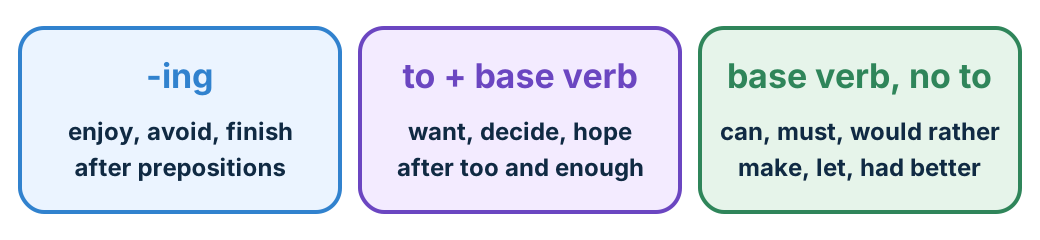
After a verb, a preposition, or an adjective, English needs a specific form: -ing, to plus the base verb, or the bare base verb. The word before it usually decides.
| Form | Follows | Example |
|---|---|---|
| -ing (gerund) | enjoy, avoid, finish, suggest; prepositions; the subject of a sentence | I enjoy cooking. She is interested in joining. |
| to + base verb (infinitive) | want, decide, hope, refuse; many adjectives; purpose | They decided to rent a car. It’s hard to say no. |
| base verb | modals, would rather, had better, make, let, have | She can drive. The joke made me laugh. |
- 1
Is it a modal, would rather, had better, make, let, or have? Use the base verb with no to (Part 2).
- 2
Is the word before it a preposition? Use -ing, even when the preposition is to, as in look forward to (Part 4).
- 3
Otherwise, which group is the verb in? Learn the -ing group and the to group (Part 1), and watch for verbs that change meaning (Part 3).
- 4
Does the subject receive the action, or did it happen earlier? Use a passive or perfect form (Part 5).
The choice between -ing and to after a verb is mostly a memory task. Groups are the fastest way to learn it.
After a verb: -ing or to?
Is the verb in the -ing group or the to group? There is no rule, so learn the groups.
The rule: Enjoy, avoid, finish, mind, consider, and keep take -ing. Want, decide, hope, refuse, afford, and manage take to plus the base verb.
Two groups to memorize
| Takes -ing | Takes to + base verb |
|---|---|
| enjoy, finish, mind, quit | want, decide, hope, plan |
| avoid, deny, admit | refuse, agree, promise |
| consider, discuss, suggest, imagine | afford, manage, offer |
| keep, practice, miss | learn, expect, seem |
| Pattern | Example |
|---|---|
| verb + -ing | He finished reading the novel. We discussed hiring more staff. |
| verb + to | He managed to fix the printer. They decided to rent a car. |
| negative | She admitted not reading the email. She promised not to tell anyone. |
After to, the verb never shows tense: decided to rent, not decided to rented. Consider and discuss take -ing directly, with no about.
Common errors in this part
- to where the verb needs -ing
I really enjoy to travel alone.✓ I really enjoy traveling alone.Enjoy is followed by -ing. - -ing where the verb needs to
They refused paying the extra fee.✓ They refused to pay the extra fee.Refuse is followed by to plus the base verb. - a missing or extra preposition
We discussed about moving the meeting.✓ We discussed moving the meeting.Discuss takes the -ing form directly, with no about.
More: a spelling reminder
The gerund follows the usual -ing spelling rules: write becomes writing, sit becomes sitting, and lie becomes lying. US spelling keeps one l in traveling and canceling.
Modals and verbs with an object
Is it a modal, make, let, or have? Then use the base verb. Does the verb have an object? Check whether it takes to.
The rule: Modals, would rather, had better, make, let, and have take the base verb. Want, ask, tell, and allow take an object plus to. Suggest takes -ing or a that clause.
When there is no to
| Pattern | Form | Example |
|---|---|---|
| modal verb | base verb | She can drive. |
| would rather, had better | base verb | I’d rather walk. You’d better hurry. |
| would like, would love, would prefer | to + base verb | I’d like to walk. |
| make, let, have + object | base verb | The joke made me laugh. Let me carry that. |
| want, ask, tell, allow + object | to + base verb | He told us to sit down. |
| suggest, recommend | -ing, or that + subject + base verb | She suggested going by bus. She suggested that we go by bus. |
Suggest never takes an object plus to: not she suggested us to go.
Common errors in this part
- an object plus to after suggest
My tutor suggested me to read the news.✓ My tutor suggested that I read the news.Suggest takes -ing or a that clause, not an object plus to. - the wrong form after an object
The manager made us to stay late.✓ The manager made us stay late.Make takes an object and the bare base verb. - a tensed verb where the base verb or -ing is needed
I couldn't found my keys.✓ I couldn't find my keys.After a modal, use the base verb, even in the past.
Same verb, different meaning
Does the form change the meaning? Then ask whether it is a task or a memory.
The rule: Stop, remember, forget, and regret change meaning: -ing is the action itself or a memory, and to is a task, a purpose, or an announcement.
A task or a memory?
| Verb | + -ing | + to |
|---|---|---|
| stop | stop smoking: end the action | stop to rest: stop in order to do it |
| remember | I remember locking it: a memory | Remember to lock it: a task |
| forget | I’ll never forget meeting her: a memory | I forgot to email her: a missed task |
| regret | I regret saying that: sorry about the past | We regret to say: a formal announcement |
Both forms, almost the same meaning
It started to rain and it started raining mean almost the same thing.
Common errors in this part
- the wrong form after stop, remember, forget, or regret
I forgot locking the car, so I went back.✓ I forgot to lock the car, so I went back.A missed task takes to plus the base verb. - the wrong form after stop, remember, forget, or regret
He stopped to eat meat three years ago.✓ He stopped eating meat three years ago.Stop plus -ing ends a habit. - the wrong form after stop, remember, forget, or regret
I regret to lend him my car last week.✓ I regret lending him my car last week.Regret about the past takes -ing.
More: try
Try to stay calm means make an attempt. Try restarting it means do it as an experiment to see what happens. The two often overlap, and the context usually shows which is meant.
Prepositions, to, and used to
Is the word before the verb a preposition? Is to a preposition here, or part of the verb?
The rule: After a preposition, use -ing, including to in look forward to and be used to. Used to plus the base verb is a past habit. Spend time and have trouble take -ing.
Is to a preposition?
| Pattern | Form | Example |
|---|---|---|
| after a preposition | -ing | She is interested in joining the club. Before leaving, check the windows. |
| look forward to, object to | -ing (to is a preposition) | I look forward to meeting you. |
| be used to, get used to | -ing (to is a preposition) | I’m used to playing on grass. |
| used to (past habit) | base verb (to is part of the verb) | We used to play tennis. |
| spend time, have trouble, it’s worth | -ing | He spent a week painting the fence. It’s worth checking. |
A quick test: if you can put a noun after to (I look forward to the weekend), to is a preposition and the verb takes -ing.
Common errors in this part
- to or the base verb after a preposition
I'm looking forward to work with you.✓ I'm looking forward to working with you.In look forward to, to is a preposition, so -ing follows. - mixing up used to and be used to
I'm used to eat spicy food.✓ I'm used to eating spicy food.Be used to is followed by -ing. - to after spend time, have trouble, or worth
She spends hours to practice the violin.✓ She spends hours practicing the violin.Spend time is followed by -ing.
Adjectives, purpose, and passive forms
Is the verb the subject, after an adjective, or a purpose? Does the subject do the action or receive it?
The rule: A verb used as the subject takes -ing. Adjectives, too, enough, and purpose take to. Being done and to be done are passive; having done and to have done show an earlier action.
Position and voice decide
| Pattern | Form | Example |
|---|---|---|
| verb as the subject | -ing | Swimming is good exercise. |
| after many adjectives | to + base verb | It’s hard to say no. |
| too or enough | to + base verb | The print is too small to read. She is old enough to vote. |
| purpose | to + base verb | She saved money to buy a bike. |
| passive | being done, to be done | I hate being interrupted. Everyone wants to be liked. |
| earlier action | having done, to have done | Having lived there, she knows the area. He seems to have forgotten. |
Common errors in this part
- the wrong form for a verb used as the subject
Eat too much sugar is bad for your teeth.✓ Eating too much sugar is bad for your teeth.A verb used as the subject takes -ing. - the wrong passive or perfect form
She hates telling what to wear.✓ She hates being told what to wear.She receives the action, so use being plus the past participle. - for or -ing instead of to for purpose
He joined a gym for lose weight.✓ He joined a gym to lose weight.Purpose takes to plus the base verb.
Self-check
Is each sentence correct? Tap to see the answer. The part label tells you where to look if you were not sure.
Part 1My father keeps to forget his glasses.
Incorrect. My father keeps forgetting his glasses. Keep is followed by -ing.
Part 1We can't afford to eat out every night.
Correct. Afford is followed by to plus the base verb.
Part 2Her advice made me feel better.
Correct. Make takes an object and the bare base verb.
Part 2I'd rather to take the bus.
Incorrect. I’d rather take the bus. Would rather takes the bare base verb.
Part 3Please remember to water the plants while I'm away.
Correct. Remember to is a task you must do.
Part 3I remember to visit this museum as a child.
Incorrect. I remember visiting this museum as a child. A memory takes -ing.
Part 4I'm not used to working at night.
Correct. Be used to is followed by -ing.
Part 4It's worth to visit the old town.
Incorrect. It’s worth visiting the old town. It’s worth is followed by -ing.
Part 5The mountain was too steep to climb without ropes.
Correct. Too plus an adjective takes to plus the base verb.
Part 5To have missed the bus, we took a taxi.
Incorrect. Having missed the bus, we took a taxi. An earlier action at the start of a sentence takes having plus the past participle.
AI practice prompt
Paste this into an AI chat tool and replace the bracket with your language.