
Modal verbs such as can, must, and should add meaning to another verb: ability, permission, obligation, or how certain the speaker is. Three parts of this topic are about the present and future, one is about the past, and one is about the form modals take. This guide has five parts, and they match the five parts of the diagnostic exactly.
关于本指南: 情态动词
情态动词,如 can、must 和 should,用来表示能力、许可、义务、可能性和确定性。同一个句子换一个情态动词,意思就会完全不同。本主题有两个部分讲现在的能力和义务,一个部分讲现在的可能性,一个部分讲谈论过去的情态动词,一个部分讲它们共同的形式。本指南分为五个部分,与诊断测试的五个部分完全对应。
你可以先做诊断测验,看看这个主题的哪些部分需要复习,也可以直接进入练习活动,其中包含复习幻灯片。
本指南本身为英文。这些翻译只是额外提供的便利,可能不够完美。
このガイドについて: 法助動詞
can、must、should のような法助動詞は、能力、許可、義務、可能性、確信度を表すのに使います。同じ文でも法助動詞を変えると、意味がまったく変わります。このテーマの 2 つのパートは現在の能力と義務について、1 つは現在の可能性について、1 つは過去について語る法助動詞について、1 つはそれらに共通する形についてです。このガイドは 5 つのパートで、診断テストの 5 つのパートと完全に対応しています。
まず診断テストを受けて、このテーマのどの部分を復習すべきか確認することもできますし、復習スライドを含む練習アクティビティにそのまま進むこともできます。
このガイド自体は英語です。これらの翻訳は補助として提供しているもので、完全とは限りません。
이 가이드 소개: 조동사
can, must, should 같은 조동사는 능력, 허가, 의무, 가능성, 확신을 나타내는 데 씁니다. 같은 문장이라도 조동사를 바꾸면 뜻이 완전히 달라집니다. 이 주제의 두 영역은 현재의 능력과 의무에 관한 것이고, 한 영역은 현재의 가능성에 관한 것이며, 한 영역은 과거를 말하는 조동사에 관한 것이고, 한 영역은 그것들이 공유하는 형태에 관한 것입니다. 이 가이드는 다섯 부분으로 되어 있으며, 진단 테스트의 다섯 부분과 정확히 일치합니다.
먼저 진단 퀴즈로 이 주제에서 복습이 필요한 부분을 확인해도 되고, 복습 슬라이드가 포함된 연습 활동으로 바로 들어가도 됩니다.
가이드 자체는 영어로 되어 있습니다. 이 번역은 부가적으로 제공되는 것이며 완벽하지 않을 수 있습니다.
Giới thiệu hướng dẫn này: Động từ khuyết thiếu
Các động từ khuyết thiếu như can, must và should dùng để nói về khả năng, sự cho phép, nghĩa vụ, khả năng xảy ra và sự chắc chắn. Cùng một câu nhưng đổi động từ khuyết thiếu sẽ đổi hẳn ý nghĩa. Hai phần của chủ đề này nói về khả năng và nghĩa vụ ở hiện tại, một phần nói về khả năng xảy ra ở hiện tại, một phần nói về động từ khuyết thiếu chỉ quá khứ, và một phần nói về hình thức chung của chúng. Hướng dẫn này gồm năm phần, khớp chính xác với năm phần của bài kiểm tra chẩn đoán.
Bạn có thể bắt đầu bằng bài kiểm tra chẩn đoán để biết phần nào cần ôn lại, hoặc vào thẳng các hoạt động luyện tập, trong đó có cả slide ôn tập.
Đọc hướng dẫn bằng tiếng Việt →
Bản hướng dẫn này được viết bằng tiếng Anh. Các bản dịch chỉ là phần hỗ trợ thêm và có thể chưa hoàn hảo.
इस गाइड के बारे में: Modal क्रियाएँ
can, must और should जैसे modal क्षमता, अनुमति, बाध्यता, संभावना और निश्चितता बताने के लिए हैं। एक ही वाक्य में modal बदलने से अर्थ पूरी तरह बदल जाता है। इस विषय के दो भाग वर्तमान की क्षमता और बाध्यता के बारे में हैं, एक भाग वर्तमान की संभावना के बारे में है, एक भाग अतीत की बात करने वाले modal के बारे में है, और एक भाग उनके साझा रूप के बारे में है। इस गाइड के पाँच भाग हैं, जो निदान परीक्षा के पाँच भागों से ठीक मेल खाते हैं।
आप निदान क्विज़ से शुरू करके जान सकते हैं कि इस विषय के कौन-से भाग दोहराने चाहिए, या सीधे अभ्यास गतिविधियों में जा सकते हैं, जिनमें दोहराव की स्लाइडें भी हैं।
गाइड स्वयं अंग्रेज़ी में है। ये अनुवाद अतिरिक्त सुविधा के रूप में हैं और पूरी तरह सटीक न भी हों।
نبذة عن هذا الدليل: الأفعال الناقصة
تُستخدم الأفعال الناقصة مثل can وmust وshould للتعبير عن القدرة والإذن والالتزام والاحتمال والتأكد. وتغيير الفعل الناقص في الجملة نفسها يغيّر المعنى تمامًا. جزآن من هذا الموضوع عن القدرة والالتزام في الحاضر، وجزء عن الاحتمال في الحاضر، وجزء عن الأفعال الناقصة التي تتحدث عن الماضي، وجزء عن صيغتها المشتركة. يتكون هذا الدليل من خمسة أجزاء تطابق تمامًا الأجزاء الخمسة في الاختبار التشخيصي.
يمكنك البدء بالاختبار التشخيصي لمعرفة الأجزاء التي تحتاج إلى مراجعة، أو الانتقال مباشرة إلى أنشطة التدريب، وتشمل شرائح مراجعة.
الدليل نفسه بالإنجليزية. هذه الترجمات مجرد خدمة إضافية وقد لا تكون دقيقة تمامًا.
Об этом руководстве: Модальные глаголы
Модальные глаголы, такие как can, must и should, используются для выражения способности, разрешения, обязанности, возможности и уверенности. Изменение модального глагола в одном и том же предложении полностью меняет смысл. Две части этой темы посвящены способности и обязанности в настоящем, одна — возможности в настоящем, одна — модальным глаголам о прошлом, и одна — их общей форме. В этом руководстве пять частей, и они точно соответствуют пяти частям диагностического теста.
Можно начать с диагностического теста, чтобы узнать, какие части темы стоит повторить, или сразу перейти к упражнениям, в которые входят слайды для повторения.
Читать руководство на русском →
Само руководство написано на английском. Эти переводы — дополнительная помощь, и они могут быть неидеальными.
Acerca de esta guía: Verbos modales
Los modales como can, must y should se usan para hablar de capacidad, permiso, obligación, posibilidad y certeza. La misma oración cambia por completo de significado si se cambia el modal. Dos partes de este tema tratan de la capacidad y la obligación en el presente, una de la posibilidad en el presente, una de los modales que hablan del pasado, y una de la forma que comparten. Esta guía tiene cinco partes, y coinciden exactamente con las cinco partes del diagnóstico.
Puedes empezar con el cuestionario de diagnóstico para saber qué partes del tema conviene repasar, o ir directamente a las actividades de práctica, que incluyen diapositivas de repaso.
La guía en sí está en inglés. Estas traducciones son un añadido de cortesía y pueden no ser perfectas.
À propos de ce guide: Verbes modaux
Les modaux comme can, must et should servent à exprimer la capacité, la permission, l'obligation, la possibilité et la certitude. Changer le modal dans la même phrase change complètement le sens. Deux parties de ce sujet portent sur la capacité et l'obligation au présent, une sur la possibilité au présent, une sur les modaux qui parlent du passé, et une sur la forme qu'ils partagent. Ce guide comporte cinq parties, qui correspondent exactement aux cinq parties du diagnostic.
Vous pouvez commencer par le quiz de diagnostic pour savoir quelles parties du sujet réviser, ou passer directement aux activités d'entraînement, qui comprennent des diapositives de révision.
Le guide lui-même est en anglais. Ces traductions sont un complément offert et peuvent ne pas être parfaites.
Sobre este guia: Verbos modais
Os verbos modais, como can, must e should, servem para falar de capacidade, permissão, obrigação, possibilidade e certeza. A mesma frase muda completamente de sentido quando se troca o modal. Duas partes deste tema tratam de capacidade e obrigação no presente, uma de possibilidade no presente, uma dos modais que falam do passado e uma da forma que eles compartilham. Este guia tem cinco partes, que correspondem exatamente às cinco partes do teste diagnóstico.
Você pode começar pelo teste diagnóstico para ver quais partes do tema precisam de revisão, ou ir direto para as atividades de prática, que incluem slides de revisão.
O guia em si está em inglês. Estas traduções são um recurso extra e podem não ser perfeitas.
Your diagnostic result says which part needs review. Tap that part below.
The core idea: what is the modal telling you?
The same sentence can change completely when the modal changes. Context, not the modal alone, tells you exactly what is meant.
| Use | Modal | Example |
|---|---|---|
| ability | can, could, be able to | She can speak five languages. |
| permission | can, could, may | May I come in? |
| obligation | must, have to | You have to wear a uniform. |
| advice | should, ought to | You should see a doctor. |
| possibility | might, may, could | It might rain later. |
| certainty | must, can’t | That can’t be true. |
| the past | had to, was able to, should have, must have | You should have called me. |
- 1
What is it about: ability, obligation, or certainty? Each has its own set of modals (Parts 1 to 3).
- 2
Is it about the past? Use had to or was able to for what happened, and modal plus have plus the past participle for judgments and guesses (Part 4).
- 3
Check the form: base verb, no -s, no to (except ought to), and no do (Part 5).
The same modal can mean different things in different contexts, so context always decides the meaning.
Ability and permission
Can the person do it, or are they allowed to? Ability and permission use the same modals.
The rule: Can and could show ability, and be able to replaces can in other forms: will be able to, has been able to. Can, could, and may ask for permission. Could and would make polite requests.
Ability and permission use the same modals
| Use | Example |
|---|---|
| ability now | She can speak five languages. |
| ability in the past | He could swim before he could walk. |
| future ability | You will be able to drive next year. |
| permission | Can I use your phone? May I come in? |
Requests and suggestions
| Use | Example |
|---|---|
| request | Could you open the window? Would you help me? |
| suggestion | Shall we leave now? Let’s get some coffee. |
Common errors in this part
- can, could, or be able to built the wrong way
I hope we will can meet again soon.✓ I hope we will be able to meet again soon.Can cannot follow will. Use will be able to. - a modal with the wrong meaning
Could you mind waiting a moment?✓ Would you mind waiting a moment?The polite request with mind uses would. - can, could, or be able to built the wrong way
He is can cook very well.✓ He can cook very well.Can is never used with be.
Obligation and necessity
Is it required, forbidden, or optional? The modal shows which.
The rule: Must and have to show obligation, and only have to works in the past and future. Mustn't forbids, don't have to means not necessary. Should and ought to advise, and had better warns.
Must versus have to
| Use | Example |
|---|---|
| obligation, own opinion | I must finish this today. |
| obligation, outside rule | You have to wear a uniform at this school. |
| prohibited | You mustn’t smoke in here. |
| not necessary | You don’t have to come if you’re busy. |
Should, ought to, and had better
| Use | Example |
|---|---|
| advice | You should see a doctor. You ought to apologize. |
| strong warning | You had better leave now, or you’ll miss the train. |
Have to is not a true modal, so it changes for tense and person: had to, will have to, has to.
Common errors in this part
- mustn't and don't have to confused
You mustn't pay for the tickets. They're free.✓ You don't have to pay for the tickets. They're free.Mustn't means forbidden, not unnecessary. - must and have to confused
We must wait two hours at the airport yesterday.✓ We had to wait two hours at the airport yesterday.Must has no past form. - the wrong strength of advice or obligation
You would better check the time.✓ You had better check the time.It is always had better.
More: needn’t as a modal
In British English, needn’t can work like a modal without do: You needn’t worry. In most other varieties, don’t need to is more common: You don’t need to worry.
Possibility and certainty
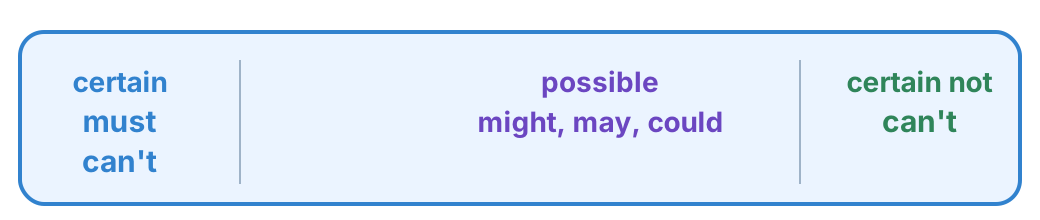
How sure is the speaker? The modal shows the degree of certainty.
The rule: Must shows near certainty, might, may, and could show possibility, and can't shows near certainty that something is false. Can is for what is generally possible.
How sure is the speaker?
| Certainty | Modal | Example |
|---|---|---|
| almost certain, true | must | She must be tired after that flight. |
| possible | might, may, could | He might be at home. |
| almost certain, not true | can’t | That can’t be true. |
Degrees of possibility
| Modal | Nuance |
|---|---|
| might | a real possibility |
| may | similar to might, slightly more formal |
| could | one option among several: We could go to the beach, or we could stay home. |
| can | what is generally possible, not a chance in one situation: Winter here can be very cold. |
Common errors in this part
- can used for a possibility in one situation
Call Mia first. She can be busy right now.✓ Call Mia first. She might be busy right now.For a possibility in one situation, use might, may, or could. - the wrong modal for how certain the speaker is
He might be rich. He owns three houses and a boat.✓ He must be rich. He owns three houses and a boat.Strong evidence calls for must. - the wrong modal for how certain the speaker is
That must be Ken's car. Ken doesn't drive.✓ That can't be Ken's car. Ken doesn't drive.When the evidence rules it out, use can't.
More: must not for a negative guess
Must not can make a confident negative guess, especially in American English: He must not be home; his car is gone. Can’t is stronger and says something is impossible. Mustn’t, the short form, is less common in this meaning.
Modals about the past
Did it happen? Was it necessary? Was it a good idea? The past form of the modal answers these questions.
The rule: Use had to for past obligation and was able to for one past success. Should have, must have, could have, can't have, and needn't have judge or guess about the past.
Judging and guessing about the past
| Use | Example |
|---|---|
| a good idea that didn’t happen | You should have called me. |
| a strong guess about the past | She must have left already. |
| was possible, didn’t happen | We could have won the game. |
Couldn’t have and needn’t have
| Use | Example |
|---|---|
| was impossible | I couldn’t have finished without your help. |
| happened, but unnecessary | You needn’t have brought a gift. |
Had to, didn’t need to, and was able to
| Use | Example |
|---|---|
| past obligation | I had to work late last night. |
| not necessary, so it didn’t happen | I didn’t need to buy a ticket; it was free. |
| general ability in the past | She could read at four. |
| one past success | After two hours, we were able to fix the car. |
Should of is a mishearing of should have. Do not write it.
Common errors in this part
- could used for one past success
After a long search, I could find my passport.✓ After a long search, I was able to find my passport.One past success takes was able to or managed to. - a past modal built the wrong way
They should of asked for directions.✓ They should have asked for directions.Should of is a misspelling of should have. - the wrong past modal for the meaning
I needn't have paid for parking; it was free, so I didn't.✓ I didn't need to pay for parking; it was free, so I didn't.Needn't have means it happened. Didn't need to fits when it did not.
More: may have and might have
May have and might have make a less certain guess about the past. The speaker does not know whether it happened: She may have missed the bus. Could have can also be a guess like this, but it often means something was possible and did not happen.
Form, negatives, and questions
Does the sentence follow the modal’s fixed form? Base verb, no -s, no to, and no do.
The rule: Most modals take the bare base verb with no to, no -s, and no do. Have to and be able to change for person and tense and use do or does.
The same form for every true modal
| Rule | Example |
|---|---|
| no to after a modal | She can swim, not can to swim. |
| no -s on the modal | He can swim, not he cans swim. |
| negative: modal + not, no do | She cannot swim. He should not go. |
Ought to is the one modal that keeps to: You ought to rest.
Questions, and semi-modals
| Type | Example |
|---|---|
| modal question | Can you help me? Should I call her? |
| have to question | Does he have to work on Sundays? |
| be able to question | Will she be able to come? |
Common errors in this part
- do or does used with a true modal
Do you can help me tomorrow?✓ Can you help me tomorrow?True modals make questions without do. - -s added after a modal
She should calls her mother.✓ She should call her mother.The verb after a modal has no -s. - have to or be able to built like a true modal
Does he has to wear a helmet?✓ Does he have to wear a helmet?After does, have stays in the base form.
Self-check
Is each sentence correct? Tap to see the answer. The part label tells you where to look if you were not sure.
Part 1I'd like to can play the piano.
Incorrect. I’d like to be able to play the piano. Can has no to form.
Part 1May I leave a few minutes early today?
Correct. May asks for permission politely.
Part 2You don't have to shout. I can hear you fine.
Correct. Don’t have to means it is not necessary.
Part 2You mustn't bring a gift, but it would be nice.
Incorrect. You don’t have to bring a gift. Mustn’t means forbidden.
Part 3It can snow tonight, so drive carefully.
Incorrect. It might snow tonight. Can shows what is generally possible.
Part 3She can't be at home. I just saw her at the bank.
Correct. Can’t shows the speaker is sure it is not true.
Part 4We could win the final last year.
Incorrect. We were able to win the final. One past success takes was able to.
Part 4You should have seen his face!
Correct. Should have plus the past participle.
Part 5He must to wear glasses for driving.
Incorrect. He must wear glasses. No to after must.
Part 5Does she have to work tomorrow?
Correct. Have to uses does for questions.
AI practice prompt
Paste this into an AI chat tool and replace the bracket with your language.