
动名词和不定式是动词的 -ing 形式和 to 形式。一个词后面接哪一种,主要靠学习固定搭配,还有少数动词会随形式改变意思。本主题有三个部分讲 动词后面接哪种形式,一个部分讲 介词和 to 的两种用法,一个部分讲 形容词、目的以及被动或完成形式。本指南分为五个部分,与诊断测试的五个部分完全对应。
阅读英文版指南 → 本页为机器翻译,未经母语者审校,可能有不准确之处。以英文版为准。
你的诊断结果会告诉你哪个部分需要复习。请点击下面对应的部分。
核心思路:动词后面接哪种形式?
动词、介词或形容词之后,英语需要特定的形式:-ing、to 加动词原形,或不带 to 的动词原形。通常由前面的词决定。
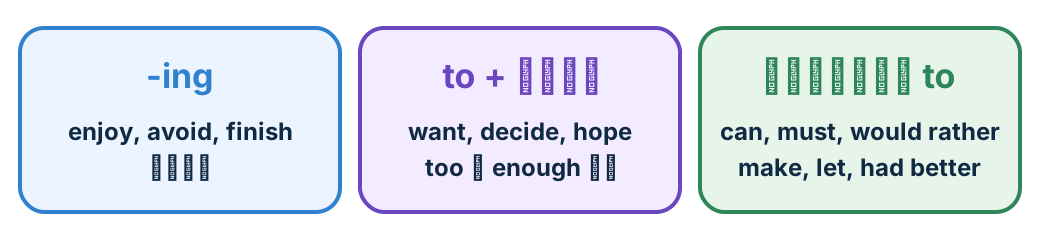
| 形式 | 后接于 | 例句 |
|---|---|---|
| -ing (gerund) | enjoy, avoid, finish, suggest;介词;句子的主语 | I enjoy cooking. She is interested in joining. |
| to + 动词原形 (infinitive) | want, decide, hope, refuse;许多形容词;目的 | They decided to rent a car. It’s hard to say no. |
| 动词原形 | 情态动词, would rather, had better, make, let, have | She can drive. The joke made me laugh. |
- 1
它是情态动词、would rather、had better、make、let 或 have 吗? 使用不带 to 的动词原形(第 2 部分)。
- 2
前面的词是介词吗? 使用 -ing,即使介词是 to,如 look forward to(第 4 部分)。
- 3
否则,这个动词属于哪一组? 学习 -ing 组和 to 组(第 1 部分),并留意会改变意思的动词(第 3 部分)。
- 4
主语是动作的承受者,还是动作发生得更早? 使用被动或完成形式(第 5 部分)。
动词之后选择 -ing 还是 to,主要靠记忆。分组是最快的学习方法。
动词之后:-ing 还是 to?
这个动词属于 -ing 组还是 to 组?没有规则,所以要记住分组。
规则: Enjoy, avoid, finish, mind, consider 和 keep 后面接 -ing。Want, decide, hope, refuse, afford 和 manage 后面接 to 加动词原形。
需要记住的两组
| 接 -ing | 接 to + 动词原形 |
|---|---|
| enjoy, finish, mind, quit | want, decide, hope, plan |
| avoid, deny, admit | refuse, agree, promise |
| consider, discuss, suggest, imagine | afford, manage, offer |
| keep, practice, miss | learn, expect, seem |
| 句型 | 例句 |
|---|---|
| 动词 + -ing | He finished reading the novel. We discussed hiring more staff. |
| 动词 + to | He managed to fix the printer. They decided to rent a car. |
| 否定 | She admitted not reading the email. She promised not to tell anyone. |
to 之后,动词不会出现时态变化:decided to rent,而不是 decided to rented。Consider 和 discuss 后面直接接 -ing,不加 about。
本部分的常见错误
- 动词需要 -ing 却用了 to
I really enjoy to travel alone.✓ I really enjoy traveling alone.Enjoy 后面接 -ing。 - 动词需要 to 却用了 -ing
They refused paying the extra fee.✓ They refused to pay the extra fee.Refuse 后面接 to 加动词原形。 - 介词缺少或多余
We discussed about moving the meeting.✓ We discussed moving the meeting.Discuss 后面直接接 -ing 形式,不加 about。
补充:拼写提示
动名词遵循通常的 -ing 拼写规则:write 变成 writing,sit 变成 sitting,lie 变成 lying。美式拼写中 traveling 和 canceling 只有一个 l。
情态动词和带宾语的动词
它是情态动词、make、let 或 have 吗?那就用动词原形。动词带宾语吗?看看它是否接 to。
规则: 情态动词、would rather、had better、make、let 和 have 后面接动词原形。Want, ask, tell 和 allow 后面接宾语加 to。Suggest 后面接 -ing 或 that 从句。
什么时候不用 to
| 句型 | 形式 | 例句 |
|---|---|---|
| 情态动词 | 动词原形 | She can drive. |
| would rather, had better | 动词原形 | I’d rather walk. You’d better hurry. |
| would like, would love, would prefer | to + 动词原形 | I’d like to walk. |
| make, let, have + 宾语 | 动词原形 | The joke made me laugh. Let me carry that. |
| want, ask, tell, allow + 宾语 | to + 动词原形 | He told us to sit down. |
| suggest, recommend | -ing,或 that + 主语 + 动词原形 | She suggested going by bus. She suggested that we go by bus. |
Suggest 后面从不接宾语加 to:不能说 she suggested us to go。
本部分的常见错误
- suggest 之后用了宾语加 to
My tutor suggested me to read the news.✓ My tutor suggested that I read the news.Suggest 后面接 -ing 或 that 从句,不接宾语加 to。 - 宾语之后用了错误的形式
The manager made us to stay late.✓ The manager made us stay late.Make 后面接宾语和不带 to 的动词原形。 - 需要动词原形或 -ing 的地方用了带时态的动词
I couldn't found my keys.✓ I couldn't find my keys.情态动词之后用动词原形,即使表示过去也一样。
同一个动词,不同的意思
形式会改变意思吗?那就问问它是任务还是记忆。
规则: Stop, remember, forget 和 regret 会改变意思:-ing 表示动作本身或记忆,to 表示任务、目的或通知。
任务还是记忆?
| 动词 | + -ing | + to |
|---|---|---|
| stop | stop smoking:结束这个动作 | stop to rest:停下来去做某事 |
| remember | I remember locking it:一段记忆 | Remember to lock it:一项任务 |
| forget | I’ll never forget meeting her:一段记忆 | I forgot to email her:没做的任务 |
| regret | I regret saying that:对过去感到抱歉 | We regret to say:正式通知 |
两种形式,意思几乎相同
It started to rain 和 it started raining 的意思几乎相同。
本部分的常见错误
- stop、remember、forget 或 regret 之后用了错误的形式
I forgot locking the car, so I went back.✓ I forgot to lock the car, so I went back.没做的任务后面接 to 加动词原形。 - stop、remember、forget 或 regret 之后用了错误的形式
He stopped to eat meat three years ago.✓ He stopped eating meat three years ago.Stop 加 -ing 表示结束一个习惯。 - stop、remember、forget 或 regret 之后用了错误的形式
I regret to lend him my car last week.✓ I regret lending him my car last week.对过去的后悔后面接 -ing。
补充:try
Try to stay calm 意思是做一次尝试。 Try restarting it 意思是当作实验来做,看看会发生什么。两者常有重叠,通常可以根据语境判断是哪一种。
介词、to 和 used to
动词前面的词是介词吗?这里的 to 是介词,还是动词的一部分?
规则: 介词之后用 -ing,包括 look forward to 和 be used to 里的 to。Used to 加动词原形表示过去的习惯。Spend time 和 have trouble 后面接 -ing。
to 是介词吗?
| 句型 | 形式 | 例句 |
|---|---|---|
| 介词之后 | -ing | She is interested in joining the club. Before leaving, check the windows. |
| look forward to, object to | -ing(to 是介词) | I look forward to meeting you. |
| be used to, get used to | -ing(to 是介词) | I’m used to playing on grass. |
| used to(过去的习惯) | 动词原形(to 是动词的一部分) | We used to play tennis. |
| spend time, have trouble, it’s worth | -ing | He spent a week painting the fence. It’s worth checking. |
一个快速测试:如果 to 后面可以放名词(I look forward to the weekend),那么 to 是介词,动词接 -ing。
本部分的常见错误
- 介词之后用了 to 或动词原形
I'm looking forward to work with you.✓ I'm looking forward to working with you.在 look forward to 中,to 是介词,所以后面接 -ing。 - 混淆 used to 和 be used to
I'm used to eat spicy food.✓ I'm used to eating spicy food.Be used to 后面接 -ing。 - spend time、have trouble 或 worth 之后用了 to
She spends hours to practice the violin.✓ She spends hours practicing the violin.Spend time 后面接 -ing。
形容词、目的和被动形式
这个动词是主语、在形容词之后,还是表示目的?主语是做动作还是承受动作?
规则: 用作主语的动词接 -ing。形容词、too、enough 和目的之后接 to。Being done 和 to be done 是被动;having done 和 to have done 表示更早的动作。
位置和语态决定形式
| 句型 | 形式 | 例句 |
|---|---|---|
| 用作主语的动词 | -ing | Swimming is good exercise. |
| 许多形容词之后 | to + 动词原形 | It’s hard to say no. |
| too 或 enough | to + 动词原形 | The print is too small to read. She is old enough to vote. |
| 目的 | to + 动词原形 | She saved money to buy a bike. |
| 被动 | being done, to be done | I hate being interrupted. Everyone wants to be liked. |
| 更早的动作 | having done, to have done | Having lived there, she knows the area. He seems to have forgotten. |
本部分的常见错误
- 用作主语的动词用了错误的形式
Eat too much sugar is bad for your teeth.✓ Eating too much sugar is bad for your teeth.用作主语的动词接 -ing。 - 被动或完成形式错误
She hates telling what to wear.✓ She hates being told what to wear.她是动作的承受者,所以用 being 加过去分词。 - 表示目的时用了 for 或 -ing 而不是 to
He joined a gym for lose weight.✓ He joined a gym to lose weight.表示目的时接 to 加动词原形。
自我检测
下面每个句子是否正确?点击查看答案。部分标签告诉你,如果拿不准,应该去看哪一部分。
第 1 部分My father keeps to forget his glasses.
不正确。 My father keeps forgetting his glasses. Keep 后面接 -ing。
第 1 部分We can't afford to eat out every night.
正确。 Afford 后面接 to 加动词原形。
第 2 部分Her advice made me feel better.
正确。 Make 后面接宾语和不带 to 的动词原形。
第 2 部分I'd rather to take the bus.
不正确。 I’d rather take the bus. Would rather 后面接不带 to 的动词原形。
第 3 部分Please remember to water the plants while I'm away.
正确。 Remember to 表示你必须做的一项任务。
第 3 部分I remember to visit this museum as a child.
不正确。 I remember visiting this museum as a child. 记忆接 -ing。
第 4 部分I'm not used to working at night.
正确。 Be used to 后面接 -ing。
第 4 部分It's worth to visit the old town.
不正确。 It’s worth visiting the old town. It’s worth 后面接 -ing。
第 5 部分The mountain was too steep to climb without ropes.
正确。 Too 加形容词后面接 to 加动词原形。
第 5 部分To have missed the bus, we took a taxi.
不正确。 Having missed the bus, we took a taxi. 句首表示更早的动作时,用 having 加过去分词。
AI 练习提示词
把下面的内容粘贴到 AI 聊天工具中。