
Gerund और infinitive क्रिया के -ing रूप और to रूप हैं। किसी शब्द के बाद कौन-सा आता है, यह ज़्यादातर ढाँचे सीखने की बात है, और कुछ क्रियाएँ रूप के साथ अर्थ बदल देती हैं। इस विषय के तीन भाग बताते हैं कि क्रिया के बाद कौन-सा रूप आता है, एक भाग preposition और to के दो उपयोगोंके बारे में है, और एक विशेषण, उद्देश्य और passive या perfect रूपोंको कवर करता है। इस गाइड के पाँच भाग हैं, जो निदान परीक्षा के पाँच भागों से ठीक मेल खाते हैं।
अंग्रेज़ी गाइड पढ़ें → यह पेज मशीन अनुवाद है और किसी मूल भाषी ने इसकी जाँच नहीं की है, इसलिए इसमें गलतियाँ हो सकती हैं। अंग्रेज़ी संस्करण ही आधार है।
आपका निदान परिणाम बताता है कि किस भाग को दोहराना चाहिए। नीचे उस भाग पर टैप करें।
मुख्य विचार: क्रिया के बाद कौन-सा रूप आता है?
क्रिया, preposition या विशेषण के बाद अंग्रेज़ी में एक निश्चित रूप चाहिए: -ing, to के साथ क्रिया का मूल रूप, या बिना to के क्रिया का मूल रूप। आमतौर पर पहले आने वाला शब्द तय करता है।
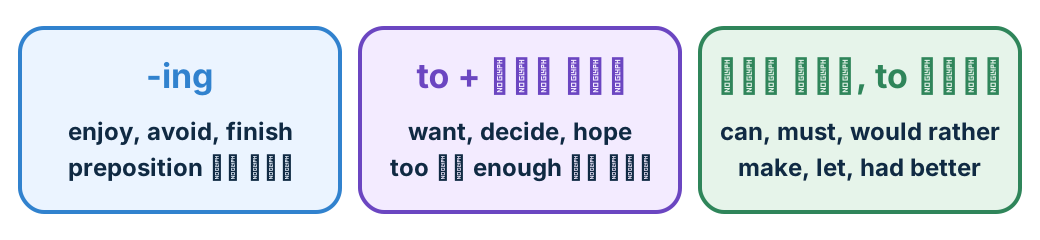
| रूप | किसके बाद आता है | उदाहरण |
|---|---|---|
| -ing (gerund) | enjoy, avoid, finish, suggest; preposition के बाद; वाक्य का कर्ता | I enjoy cooking. She is interested in joining. |
| to + क्रिया का मूल रूप (infinitive) | want, decide, hope, refuse; कई विशेषणों के बाद; उद्देश्य | They decided to rent a car. It’s hard to say no. |
| क्रिया का मूल रूप | modal क्रियाएँ, would rather, had better, make, let, have | She can drive. The joke made me laugh. |
- 1
क्या यह modal क्रिया, would rather, had better, make, let या have है? बिना to के क्रिया का मूल रूप इस्तेमाल करें (भाग 2)।
- 2
क्या इसके पहले का शब्द preposition है? -ing इस्तेमाल करें, तब भी जब preposition to हो, जैसे look forward to में (भाग 4)।
- 3
नहीं तो, क्रिया किस समूह में है? -ing समूह और to समूह सीखें (भाग 1), और अर्थ बदलने वाली क्रियाओं पर ध्यान दें (भाग 3)।
- 4
क्या कर्ता पर क्रिया का असर पड़ता है, या क्रिया पहले हो चुकी है? passive या perfect रूप इस्तेमाल करें (भाग 5)।
क्रिया के बाद -ing और to में चुनाव ज़्यादातर याद करने की बात है। समूहों में सीखना सबसे तेज़ तरीका है।
क्रिया के बाद: -ing या to?
क्या क्रिया -ing समूह में है या to समूह में? कोई नियम नहीं है, इसलिए समूह याद करें।
नियम: Enjoy, avoid, finish, mind, consider और keep के बाद -ing आता है। Want, decide, hope, refuse, afford और manage के बाद to के साथ क्रिया का मूल रूप आता है।
याद करने के लिए दो समूह
| -ing लेने वाली क्रियाएँ | to + क्रिया का मूल रूप लेने वाली क्रियाएँ |
|---|---|
| enjoy, finish, mind, quit | want, decide, hope, plan |
| avoid, deny, admit | refuse, agree, promise |
| consider, discuss, suggest, imagine | afford, manage, offer |
| keep, practice, miss | learn, expect, seem |
| ढाँचा | उदाहरण |
|---|---|
| क्रिया + -ing | He finished reading the novel. We discussed hiring more staff. |
| क्रिया + to | He managed to fix the printer. They decided to rent a car. |
| नकारात्मक | She admitted not reading the email. She promised not to tell anyone. |
to के बाद क्रिया में काल नहीं दिखता: decided to rent, न कि decided to rented। Consider और discuss के बाद सीधे -ing आता है, about नहीं।
इस भाग की आम गलतियाँ
- -ing की जगह to का इस्तेमाल
I really enjoy to travel alone.✓ I really enjoy traveling alone.Enjoy के बाद -ing आता है। - to की जगह -ing का इस्तेमाल
They refused paying the extra fee.✓ They refused to pay the extra fee.Refuse के बाद to के साथ क्रिया का मूल रूप आता है। - preposition छूटना या फालतू होना
We discussed about moving the meeting.✓ We discussed moving the meeting.Discuss के बाद सीधे -ing रूप आता है, about नहीं।
और जानें: वर्तनी की याद
Gerund सामान्य -ing वर्तनी नियमों का पालन करता है: write से writing, sit से sitting, और lie से lying। अमेरिकी वर्तनी में traveling और canceling में एक ही l रहता है।
Modal क्रियाएँ और कर्म वाली क्रियाएँ
क्या यह modal क्रिया, make, let या have है? तो क्रिया का मूल रूप इस्तेमाल करें। क्या क्रिया का कर्म है? देखें कि उसके बाद to आता है या नहीं।
नियम: Modal क्रियाओं, would rather, had better, make, let और have के बाद क्रिया का मूल रूप आता है। Want, ask, tell और allow के बाद कर्म के साथ to आता है। Suggest के बाद -ing या that वाला उपवाक्य आता है।
जब to नहीं होता
| ढाँचा | रूप | उदाहरण |
|---|---|---|
| modal क्रिया | क्रिया का मूल रूप | She can drive. |
| would rather, had better | क्रिया का मूल रूप | I’d rather walk. You’d better hurry. |
| would like, would love, would prefer | to + क्रिया का मूल रूप | I’d like to walk. |
| make, let, have + कर्म | क्रिया का मूल रूप | The joke made me laugh. Let me carry that. |
| want, ask, tell, allow + कर्म | to + क्रिया का मूल रूप | He told us to sit down. |
| suggest, recommend | -ing, या that + कर्ता + क्रिया का मूल रूप | She suggested going by bus. She suggested that we go by bus. |
Suggest के बाद कभी कर्म के साथ to नहीं आता: she suggested us to go नहीं कहते।
इस भाग की आम गलतियाँ
- suggest के बाद कर्म के साथ to
My tutor suggested me to read the news.✓ My tutor suggested that I read the news.Suggest के बाद -ing या that वाला उपवाक्य आता है, कर्म के साथ to नहीं। - कर्म के बाद गलत रूप
The manager made us to stay late.✓ The manager made us stay late.Make के बाद कर्म और बिना to के क्रिया का मूल रूप आता है। - जहाँ क्रिया का मूल रूप या -ing चाहिए वहाँ काल वाली क्रिया
I couldn't found my keys.✓ I couldn't find my keys.Modal क्रिया के बाद क्रिया का मूल रूप इस्तेमाल करें, भूतकाल में भी।
वही क्रिया, अलग अर्थ
क्या रूप से अर्थ बदलता है? तो पूछें कि यह काम है या याद।
नियम: Stop, remember, forget और regret का अर्थ बदलता है: -ing स्वयं क्रिया या याद को बताता है, और to किसी काम, उद्देश्य या घोषणा को बताता है।
काम या याद?
| क्रिया | + -ing | + to |
|---|---|---|
| stop | stop smoking: क्रिया को खत्म करना | stop to rest: उसे करने के लिए रुकना |
| remember | I remember locking it: एक याद | Remember to lock it: एक काम |
| forget | I’ll never forget meeting her: एक याद | I forgot to email her: छूटा हुआ काम |
| regret | I regret saying that: बीती बात पर अफ़सोस | We regret to say: औपचारिक घोषणा |
दोनों रूप, लगभग एक जैसा अर्थ
It started to rain और it started raining का अर्थ लगभग एक ही है।
इस भाग की आम गलतियाँ
- stop, remember, forget या regret के बाद गलत रूप
I forgot locking the car, so I went back.✓ I forgot to lock the car, so I went back.छूटे हुए काम के बाद to के साथ क्रिया का मूल रूप आता है। - stop, remember, forget या regret के बाद गलत रूप
He stopped to eat meat three years ago.✓ He stopped eating meat three years ago.Stop के साथ -ing किसी आदत के खत्म होने को बताता है। - stop, remember, forget या regret के बाद गलत रूप
I regret to lend him my car last week.✓ I regret lending him my car last week.बीती बात पर अफ़सोस के बाद -ing आता है।
और जानें: try
Try to stay calm का अर्थ है कोशिश करना। Try restarting it का अर्थ है प्रयोग के तौर पर करके देखना कि क्या होता है। दोनों अर्थ अक्सर मिल जाते हैं, और संदर्भ से आमतौर पर पता चल जाता है कि कौन-सा मतलब है।
Preposition, to और used to
क्या क्रिया से पहले का शब्द preposition है? क्या यहाँ to preposition है, या क्रिया का हिस्सा?
नियम: Preposition के बाद -ing इस्तेमाल करें, look forward to और be used to वाला to भी इसमें शामिल है। Used to के साथ क्रिया का मूल रूप बीती आदत है। Spend time और have trouble के बाद -ing आता है।
क्या to preposition है?
| ढाँचा | रूप | उदाहरण |
|---|---|---|
| preposition के बाद | -ing | She is interested in joining the club. Before leaving, check the windows. |
| look forward to, object to | -ing (to preposition है) | I look forward to meeting you. |
| be used to, get used to | -ing (to preposition है) | I’m used to playing on grass. |
| used to (बीती आदत) | क्रिया का मूल रूप (to क्रिया का हिस्सा है) | We used to play tennis. |
| spend time, have trouble, it’s worth | -ing | He spent a week painting the fence. It’s worth checking. |
एक आसान जाँच: अगर to के बाद संज्ञा रख सकते हैं (I look forward to the weekend), तो to preposition है और क्रिया के साथ -ing आता है।
इस भाग की आम गलतियाँ
- preposition के बाद to या क्रिया का मूल रूप
I'm looking forward to work with you.✓ I'm looking forward to working with you.Look forward to में to preposition है, इसलिए उसके बाद -ing आता है। - used to और be used to में गड़बड़ी
I'm used to eat spicy food.✓ I'm used to eating spicy food.Be used to के बाद -ing आता है। - spend time, have trouble या worth के बाद to
She spends hours to practice the violin.✓ She spends hours practicing the violin.Spend time के बाद -ing आता है।
विशेषण, उद्देश्य और passive रूप
क्या क्रिया कर्ता है, विशेषण के बाद है, या उद्देश्य है? क्या कर्ता क्रिया करता है या उस पर क्रिया होती है?
नियम: कर्ता के रूप में इस्तेमाल क्रिया के साथ -ing आता है। विशेषणों, too, enough और उद्देश्य के बाद to आता है। Being done और to be done passive हैं; having done और to have done पहले हो चुकी क्रिया बताते हैं।
स्थान और वाच्य तय करते हैं
| ढाँचा | रूप | उदाहरण |
|---|---|---|
| कर्ता के रूप में क्रिया | -ing | Swimming is good exercise. |
| कई विशेषणों के बाद | to + क्रिया का मूल रूप | It’s hard to say no. |
| too या enough | to + क्रिया का मूल रूप | The print is too small to read. She is old enough to vote. |
| उद्देश्य | to + क्रिया का मूल रूप | She saved money to buy a bike. |
| passive | being done, to be done | I hate being interrupted. Everyone wants to be liked. |
| पहले हो चुकी क्रिया | having done, to have done | Having lived there, she knows the area. He seems to have forgotten. |
इस भाग की आम गलतियाँ
- कर्ता के रूप में क्रिया के लिए गलत रूप
Eat too much sugar is bad for your teeth.✓ Eating too much sugar is bad for your teeth.कर्ता के रूप में इस्तेमाल क्रिया के साथ -ing आता है। - गलत passive या perfect रूप
She hates telling what to wear.✓ She hates being told what to wear.उस पर क्रिया होती है, इसलिए being के साथ क्रिया का तीसरा रूप इस्तेमाल करें। - उद्देश्य के लिए to की जगह for या -ing
He joined a gym for lose weight.✓ He joined a gym to lose weight.उद्देश्य के लिए to के साथ क्रिया का मूल रूप आता है।
स्वयं जाँच
क्या हर वाक्य सही है? उत्तर देखने के लिए टैप करें। भाग का लेबल बताता है कि पक्का न होने पर कहाँ देखना है।
भाग 1My father keeps to forget his glasses.
गलत। My father keeps forgetting his glasses. Keep के बाद -ing आता है।
भाग 1We can't afford to eat out every night.
सही। Afford के बाद to के साथ क्रिया का मूल रूप आता है।
भाग 2Her advice made me feel better.
सही। Make के बाद कर्म और बिना to के क्रिया का मूल रूप आता है।
भाग 2I'd rather to take the bus.
गलत। I’d rather take the bus. Would rather के बाद बिना to के क्रिया का मूल रूप आता है।
भाग 3Please remember to water the plants while I'm away.
सही। Remember to ऐसा काम है जो आपको करना है।
भाग 3I remember to visit this museum as a child.
गलत। I remember visiting this museum as a child. याद के साथ -ing आता है।
भाग 4I'm not used to working at night.
सही। Be used to के बाद -ing आता है।
भाग 4It's worth to visit the old town.
गलत। It’s worth visiting the old town. It’s worth के बाद -ing आता है।
भाग 5The mountain was too steep to climb without ropes.
सही। Too के साथ विशेषण के बाद to और क्रिया का मूल रूप आता है।
भाग 5To have missed the bus, we took a taxi.
गलत। Having missed the bus, we took a taxi. वाक्य की शुरुआत में पहले हो चुकी क्रिया के लिए having के साथ क्रिया का तीसरा रूप आता है।
AI अभ्यास प्रॉम्प्ट
इसे किसी AI चैट टूल में पेस्ट करें।