
Questions and negatives in English run on one small word: the auxiliary verb. Questions put it before the subject, negatives put not after it, and question tags repeat it at the end. When a verb has no auxiliary, English borrows do.
关于本指南: 疑问句与否定句
英语的疑问句和否定句靠同一个机制运作:助动词。疑问句把助动词移到主语前,否定句在它后面加 not,附加疑问句则重复它。本指南还讲主语疑问句与宾语疑问句、间接疑问句,以及如何回答否定疑问句。本指南分为五个部分,与诊断测试的五个部分完全对应。
你可以先做诊断测验,看看这个主题的哪些部分需要复习,也可以直接进入练习活动,其中包含复习幻灯片。
本指南本身为英文。这些翻译只是额外提供的便利,可能不够完美。
このガイドについて: 疑問文と否定文
英語の疑問文と否定文は、助動詞という同じ仕組みで動いています。疑問文は助動詞を主語の前に移し、否定文はその後に not を付け、付加疑問はそれを繰り返します。このガイドでは、主語と目的語の疑問文、間接疑問文、否定疑問文への答え方も扱います。このガイドは 5 つのパートで、診断テストの 5 つのパートと完全に対応しています。
まず診断テストを受けて、このテーマのどの部分を復習すべきか確認することもできますし、復習スライドを含む練習アクティビティにそのまま進むこともできます。
このガイド自体は英語です。これらの翻訳は補助として提供しているもので、完全とは限りません。
이 가이드 소개: 의문문과 부정문
영어의 의문문과 부정문은 같은 장치, 즉 조동사로 움직입니다. 의문문은 조동사를 주어 앞으로 옮기고, 부정문은 그 뒤에 not을 붙이며, 부가 의문문은 그것을 반복합니다. 이 가이드는 주어 의문문과 목적어 의문문, 간접 의문문, 부정 의문문에 답하는 법도 다룹니다. 이 가이드는 다섯 부분으로 되어 있으며, 진단 테스트의 다섯 부분과 정확히 일치합니다.
먼저 진단 퀴즈로 이 주제에서 복습이 필요한 부분을 확인해도 되고, 복습 슬라이드가 포함된 연습 활동으로 바로 들어가도 됩니다.
가이드 자체는 영어로 되어 있습니다. 이 번역은 부가적으로 제공되는 것이며 완벽하지 않을 수 있습니다.
Giới thiệu hướng dẫn này: Câu hỏi và câu phủ định
Câu hỏi và câu phủ định trong tiếng Anh vận hành theo cùng một cơ chế: trợ động từ. Câu hỏi đưa trợ động từ lên trước chủ ngữ, câu phủ định thêm not sau nó, và câu hỏi đuôi lặp lại nó. Hướng dẫn này cũng đề cập câu hỏi về chủ ngữ và tân ngữ, câu hỏi gián tiếp, và cách trả lời câu hỏi phủ định. Hướng dẫn này gồm năm phần, khớp chính xác với năm phần của bài kiểm tra chẩn đoán.
Bạn có thể bắt đầu bằng bài kiểm tra chẩn đoán để biết phần nào cần ôn lại, hoặc vào thẳng các hoạt động luyện tập, trong đó có cả slide ôn tập.
Đọc hướng dẫn bằng tiếng Việt →
Bản hướng dẫn này được viết bằng tiếng Anh. Các bản dịch chỉ là phần hỗ trợ thêm và có thể chưa hoàn hảo.
इस गाइड के बारे में: प्रश्न और नकारात्मक वाक्य
अंग्रेज़ी में प्रश्न और नकारात्मक वाक्य एक ही व्यवस्था पर चलते हैं: सहायक क्रिया। प्रश्न उसे कर्ता से पहले ले आते हैं, नकारात्मक वाक्य उसके बाद not जोड़ते हैं, और question tag उसे दोहराते हैं। यह गाइड कर्ता और कर्म वाले प्रश्न, अप्रत्यक्ष प्रश्न, और नकारात्मक प्रश्नों का उत्तर देना भी समझाती है। इस गाइड के पाँच भाग हैं, जो निदान परीक्षा के पाँच भागों से ठीक मेल खाते हैं।
आप निदान क्विज़ से शुरू करके जान सकते हैं कि इस विषय के कौन-से भाग दोहराने चाहिए, या सीधे अभ्यास गतिविधियों में जा सकते हैं, जिनमें दोहराव की स्लाइडें भी हैं।
गाइड स्वयं अंग्रेज़ी में है। ये अनुवाद अतिरिक्त सुविधा के रूप में हैं और पूरी तरह सटीक न भी हों।
نبذة عن هذا الدليل: الأسئلة والنفي
تعمل الأسئلة والنفي في الإنجليزية بالآلية نفسها: الفعل المساعد. فالسؤال ينقله إلى ما قبل الفاعل، والنفي يضيف not بعده، والسؤال الذيلي يكرره. ويتناول هذا الدليل أيضًا أسئلة الفاعل والمفعول به، والأسئلة غير المباشرة، والإجابة عن الأسئلة المنفية. يتكون هذا الدليل من خمسة أجزاء تطابق تمامًا الأجزاء الخمسة في الاختبار التشخيصي.
يمكنك البدء بالاختبار التشخيصي لمعرفة الأجزاء التي تحتاج إلى مراجعة، أو الانتقال مباشرة إلى أنشطة التدريب، وتشمل شرائح مراجعة.
الدليل نفسه بالإنجليزية. هذه الترجمات مجرد خدمة إضافية وقد لا تكون دقيقة تمامًا.
Об этом руководстве: Вопросы и отрицания
Вопросы и отрицания в английском работают на одном механизме: вспомогательном глаголе. Вопрос ставит его перед подлежащим, отрицание добавляет после него not, а разделительный вопрос его повторяет. В руководстве также разобраны вопросы к подлежащему и к дополнению, косвенные вопросы и ответы на отрицательные вопросы. В этом руководстве пять частей, и они точно соответствуют пяти частям диагностического теста.
Можно начать с диагностического теста, чтобы узнать, какие части темы стоит повторить, или сразу перейти к упражнениям, в которые входят слайды для повторения.
Читать руководство на русском →
Само руководство написано на английском. Эти переводы — дополнительная помощь, и они могут быть неидеальными.
Acerca de esta guía: Preguntas y negativas
En inglés, las preguntas y las negativas funcionan con el mismo mecanismo: el verbo auxiliar. La pregunta lo coloca antes del sujeto, la negativa añade not después de él y la coletilla lo repite. La guía también trata las preguntas de sujeto y de objeto, las preguntas indirectas y cómo responder a preguntas negativas. Esta guía tiene cinco partes, y coinciden exactamente con las cinco partes del diagnóstico.
Puedes empezar con el cuestionario de diagnóstico para saber qué partes del tema conviene repasar, o ir directamente a las actividades de práctica, que incluyen diapositivas de repaso.
La guía en sí está en inglés. Estas traducciones son un añadido de cortesía y pueden no ser perfectas.
À propos de ce guide: Questions et négations
En anglais, les questions et les négations reposent sur le même mécanisme : l'auxiliaire. La question le place avant le sujet, la négation ajoute not après lui, et la question-tag le reprend. Le guide traite aussi des questions sur le sujet et sur l'objet, des questions indirectes et de la réponse aux questions négatives. Ce guide comporte cinq parties, qui correspondent exactement aux cinq parties du diagnostic.
Vous pouvez commencer par le quiz de diagnostic pour savoir quelles parties du sujet réviser, ou passer directement aux activités d'entraînement, qui comprennent des diapositives de révision.
Le guide lui-même est en anglais. Ces traductions sont un complément offert et peuvent ne pas être parfaites.
Sobre este guia: Perguntas e frases negativas
Em inglês, perguntas e frases negativas funcionam com o mesmo mecanismo: o verbo auxiliar. A pergunta o coloca antes do sujeito, a negativa acrescenta not depois dele e a question tag o repete. O guia também trata de perguntas sobre o sujeito e sobre o objeto, perguntas indiretas e como responder a perguntas negativas. Este guia tem cinco partes, que correspondem exatamente às cinco partes do teste diagnóstico.
Você pode começar pelo teste diagnóstico para ver quais partes do tema precisam de revisão, ou ir direto para as atividades de prática, que incluem slides de revisão.
O guia em si está em inglês. Estas traduções são um recurso extra e podem não ser perfeitas.
Your diagnostic result says which part needs review. Tap that part below.
One auxiliary, four patterns
Find the auxiliary first. Every pattern in this guide moves it, adds not to it, or repeats it.
| Verb | Statement | Question | Negative | Tag |
|---|---|---|---|---|
| be | She’s ready. | Is she ready? | She isn’t ready. | She’s ready, isn’t she? |
| perfect | They’ve left. | Have they left? | They haven’t left. | They’ve left, haven’t they? |
| modal | He can drive. | Can he drive? | He can’t drive. | He can drive, can’t he? |
| present simple | You work here. | Do you work here? | You don’t work here. | You work here, don’t you? |
| past simple | She called. | Did she call? | She didn’t call. | She called, didn’t she? |
Move it, or borrow do
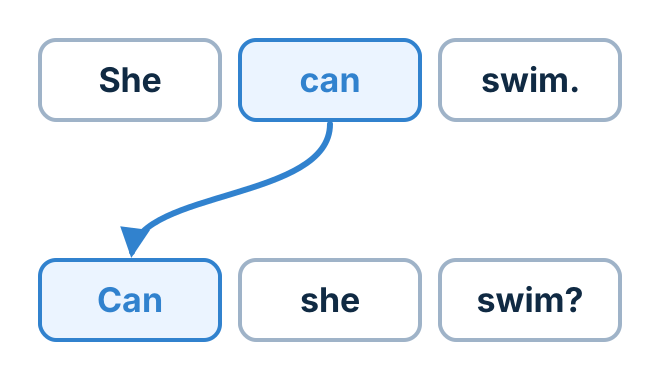
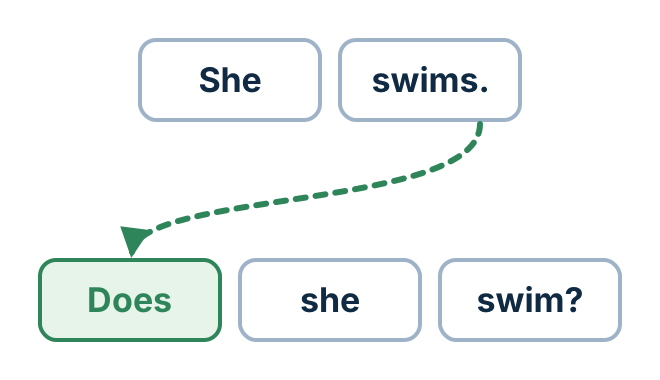
The -s of swims and the past tense of called move to the auxiliary (does, did), so the main verb goes back to its base form.
Present continuous
Questions and negatives with be plus -ing (Are you listening? He isn’t working today) are covered with the rest of that tense in the Present Continuous guide. Present continuous guide →
Present perfect
Questions with ever and negatives with yet (Have you ever…? I haven’t finished yet) are covered in the Present Perfect guide. Present perfect guide →
Direct questions
Which auxiliary does the question need, and what form follows it?
The rule: Put an auxiliary before the subject: be, have, or a modal moves there, and other verbs add do, does, or did. After do, does, or did, the main verb is the base form.
Which auxiliary starts the question?
| If the verb is | Use | Example |
|---|---|---|
| be | am, is, are, was, were | Were the tickets expensive? |
| a perfect form | have, has, had | Has the parcel arrived? |
| a continuous form | am, is, are, was, were | Is it still snowing? |
| a modal | can, will, should, must… | Should we book a table? |
| any other verb, present | do, does | Does this bus stop at the library? |
| any other verb, past | did | Did the team win on Saturday? |
Question word, then the same order
| Question word | Auxiliary | Subject | Rest |
|---|---|---|---|
| Where | did | you | park? |
| How much | does | the course | cost? |
| What | are | you | laughing at? |
| How long | will | the meeting | last? |
have for possession
Do you have a pen? is the safest question with have as a main verb. Have you got a pen? is also common, especially in British English. Have you a pen? sounds old-fashioned.
Statement questions
In speech, a statement with rising intonation (You’re leaving already?) shows surprise or checks something you think is true. It is informal and not a replacement for normal question order.
Common errors in this part
- No auxiliary before the subject
Why you are laughing?✓ Why are you laughing?The auxiliary goes before the subject. - Wrong verb form after the auxiliary
Does he wants a drink?✓ Does he want a drink?After does, use the base form. - Wrong auxiliary
Do you be hungry?✓ Are you hungry?Be makes its own question, with no do.
Subject and object questions
Is the question word the subject or the object?
The rule: If the question word is the subject, use statement order with no do. If it is the object, use normal question order.
Three steps
- 1
Answer the question with a full sentence.
- 2
Find the answer word. Before the verb, it is the subject. After the verb, it is the object.
- 3
Subject: keep statement order, no do. Object: auxiliary before the subject.
| Question | Full answer | Type |
|---|---|---|
| Who invited Sam? | Lena invited Sam. | subject: no do |
| Who did Sam invite? | Sam invited Lena. | object: did + subject |
| What broke the printer? | A paper jam broke the printer. | subject: no do |
| What did the printer print? | The printer printed a blank page. | object: did + subject |
A subject question can still contain an auxiliary that belongs to the verb itself: Who can help? What is happening? Who has seen this film? Only the extra do is left out.
Common errors in this part
- do in a subject question
Who did win the race?✓ Who won the race?Who is the subject, so there is no did. - Missing auxiliary in an object question
What you bought at the market?✓ What did you buy at the market?What is the object, so add did. - do in a subject question
Which bus does go to the stadium?✓ Which bus goes to the stadium?Which bus is the subject, so there is no does.
Indirect questions
Is the question inside another sentence?
The rule: After an opening such as Can you tell me, Do you know, I wonder, or asked, use statement order with no do. A yes-no question adds if or whether.
The opening decides the punctuation
| Opening is a question: ends with ? | Opening is a statement: ends with . |
|---|---|
| Can you tell me where the exit is? | I wonder where the exit is. |
| Do you know when the film starts? | I don’t know when the film starts. |
| Do you have any idea who sent this? | I’m not sure who sent this. |
Yes-no questions: if or whether
| Direct | Indirect |
|---|---|
| Is the museum free? | Do you know if the museum is free? |
| Will they agree? | I doubt whether they will agree. |
Use whether, not if, before to (whether to stay) and after a preposition (a debate about whether it works).
Reported questions
| Direct question | Reported |
|---|---|
| “Are you tired?” | She asked if I was tired. |
| “Where did you go?” | He asked where I had gone. |
| “Will you be there?” | They asked if I would be there. |
| “Can you swim?” | She asked if I could swim. |
If the situation is still true, the tense can stay: She asked where I live (and I still live there).
Do you know …? or … do you think?
Do you know where he lives? asks for a fact, and the answer can be yes or no. Where do you think he lives? asks for an opinion, so the question word moves to the front and do you think takes its place as the question part.
Common errors in this part
- Question order in an indirect question
Do you know when does the shop open?✓ Do you know when the shop opens?Statement order after do you know. - Missing if or whether
I'm not sure is she coming.✓ I'm not sure if she's coming.A yes-no question needs if or whether. - Word order with do you think
Do you think where she went?✓ Where do you think she went?The question word goes first.
Negatives
Is there an auxiliary for not, and is there already a negative word?
The rule: Put not after the auxiliary, or use don't, doesn't, or didn't plus the base form. Use one negative per clause, and answer negative questions by the facts.
Short forms
One negative per clause
| not + any-word | no-word, no not |
|---|---|
| I didn’t tell anyone. | I told no one. |
| There isn’t anything to eat. | There’s nothing to eat. |
| He hasn’t been anywhere. | He’s been nowhere. |
The no-word versions are often more formal or more emphatic. Some varieties of English use double negatives in speech, but they are not standard in writing or exams.
Answering a negative question
| Question | If the fact is positive | If the fact is negative |
|---|---|---|
| Aren’t you hungry? | Yes, I am. | No, I’m not. |
| Didn’t she pass the test? | Yes, she did. | No, she didn’t. |
Yes and no follow the fact
In some languages, yes means "what you said is right." In English, yes and no match the fact that follows, so yes is always followed by a positive and no by a negative.
I don’t think
English usually puts the negative on think: I don’t think it will rain sounds more natural than I think it won’t rain, though both are correct. The same goes for believe, expect, and suppose.
Common errors in this part
- not without an auxiliary
She not speaks French.✓ She doesn't speak French.Not needs does here, and speak goes back to the base form. - Double negative
We didn't get no reply.✓ We didn't get any reply.One negative per clause. - Yes and no reversed
Isn't this your bag? Yes, it isn't.✓ Isn't this your bag? No, it isn't.The fact is negative, so the answer is no.
Question tags
What is the auxiliary, and is the sentence positive or negative?
The rule: Repeat the auxiliary (or use do, does, or did) with a pronoun, and usually switch the polarity: a positive sentence takes a negative tag, a negative sentence a positive tag.
Build the tag in two steps
- 1
Find the auxiliary. If there is none, use do, does, or did in the same tense.
- 2
Switch the polarity and use a pronoun: positive becomes negative, negative becomes positive.
| Sentence | Auxiliary | Tag |
|---|---|---|
| Your brother plays tennis, | (does) | doesn’t he? |
| We won’t be late, | will | will we? |
| The shops were closed, | were | weren’t they? |
| She’d already gone, | had | hadn’t she? |
| You could hear me, | could | couldn’t you? |
Tags that break the pattern
| Sentence | Tag |
|---|---|
| I’m on the list, | aren’t I? |
| Let’s ask her, | shall we? |
| Pass me the salt, | will you? / could you? |
| No one noticed, | did they? |
| There isn’t much time, | is there? |
| This is yours, | isn’t it? |
Intonation
A falling tone on the tag means you expect agreement (It’s cold, isn’t it?). A rising tone means it is a real question and you are not sure.
Same-polarity tags
A positive sentence with a positive tag (So you’re moving to Canada, are you?) does exist, but it shows surprise or interest rather than checking. The diagnostic tests the usual opposite-polarity pattern.
Common errors in this part
- Tag does not match the sentence
They've been to Rome, didn't they?✓ They've been to Rome, haven't they?They've is they have, so the tag uses have. - Tag has the same polarity
You aren't busy, aren't you?✓ You aren't busy, are you?A negative sentence takes a positive tag. - Special tag forms
Let's start, don't we?✓ Let's start, shall we?Let's takes shall we.
Self-check
Is each sentence correct? Tap to see the answer. The part label tells you where to look if you were not sure.
Part 1Do you have time for a quick coffee?
Correct. Have for possession is an ordinary verb here, so the question uses do.
Part 1Where your brother is studying?
Incorrect. The auxiliary goes before the subject: Where is your brother studying?
Part 2What caused the delay?
Correct. What is the subject (something caused the delay), so there is no did.
Part 2Who did she marry?
Correct. Who is the object (she married someone), so the question needs did.
Part 3Could you tell me how much does the ticket cost?
Incorrect. After could you tell me, use statement order: how much the ticket costs.
Part 3I wonder whether the train will be on time.
Correct. Whether introduces an indirect yes-no question, and the sentence ends with a period.
Part 4I don't have no idea.
Incorrect. Use one negative: I don’t have any idea, or I have no idea.
Part 4Didn't you finish the book? Yes, I finished it last week.
Correct. The fact is positive, so the answer is yes.
Part 5I'm invited too, aren't I?
Correct. After I’m, the tag is aren’t I.
Part 5He hasn't replied yet, hasn't he?
Incorrect. A negative sentence takes a positive tag: He hasn’t replied yet, has he?
AI practice prompt
Paste this into an AI chat tool and replace the bracket with your language.