
En inglés, las preguntas y las negativas giran en torno a una palabra pequeña: el verbo auxiliar. La pregunta lo pone antes del sujeto, la negativa añade not después de él y la coletilla lo repite al final. Cuando un verbo no tiene auxiliar, el inglés toma prestado do.
Leer la guía en inglés → Esta página está traducida automáticamente y no la ha revisado un hablante nativo, por lo que puede contener errores. La versión en inglés es la de referencia.
El resultado del diagnóstico indica qué parte conviene repasar. Toca esa parte abajo.
Un auxiliar, cuatro patrones
Busca primero el auxiliar. Cada patrón de esta guía lo mueve, le añade not o lo repite.
| Verbo | Afirmación | Pregunta | Negativa | Coletilla |
|---|---|---|---|---|
| be | She’s ready. | Is she ready? | She isn’t ready. | She’s ready, isn’t she? |
| perfecto | They’ve left. | Have they left? | They haven’t left. | They’ve left, haven’t they? |
| modal | He can drive. | Can he drive? | He can’t drive. | He can drive, can’t he? |
| presente simple | You work here. | Do you work here? | You don’t work here. | You work here, don’t you? |
| pasado simple | She called. | Did she call? | She didn’t call. | She called, didn’t she? |
Muévelo o toma prestado do
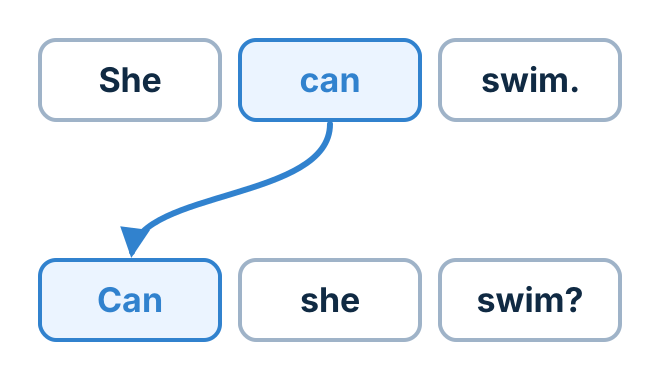
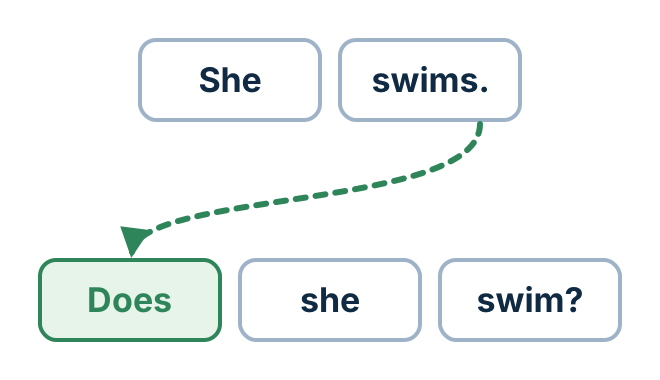
La -s de swims y el pasado de called pasan al auxiliar (does, did), así que el verbo principal vuelve a su forma base.
Presente continuo
Las preguntas y negativas con be más -ing (Are you listening? He isn’t working today) se tratan junto con el resto de ese tiempo en la guía del presente continuo. Guía del presente continuo (en inglés) →
Presente perfecto
Las preguntas con ever y las negativas con yet (Have you ever…? I haven’t finished yet) se tratan en la guía del presente perfecto. Guía del presente perfecto (en inglés) →
Preguntas directas
¿Qué auxiliar necesita la pregunta y qué forma va después?
La regla: Pon un auxiliar antes del sujeto: be, have o un modal pasan ahí, y los demás verbos añaden do, does o did. Después de do, does o did, el verbo principal va en forma base.
¿Con qué auxiliar empieza la pregunta?
| Si el verbo es | Usa | Ejemplo |
|---|---|---|
| be | am, is, are, was, were | Were the tickets expensive? |
| una forma perfecta | have, has, had | Has the parcel arrived? |
| una forma continua | am, is, are, was, were | Is it still snowing? |
| un modal | can, will, should, must… | Should we book a table? |
| otro verbo, presente | do, does | Does this bus stop at the library? |
| otro verbo, pasado | did | Did the team win on Saturday? |
Primero la palabra interrogativa, luego el mismo orden
| Palabra interrogativa | Auxiliar | Sujeto | Resto |
|---|---|---|---|
| Where | did | you | park? |
| How much | does | the course | cost? |
| What | are | you | laughing at? |
| How long | will | the meeting | last? |
have de posesión
Do you have a pen? es la pregunta más segura con have como verbo principal. Have you got a pen? también es común, sobre todo en inglés británico. Have you a pen? suena anticuado.
Preguntas con forma de afirmación
Al hablar, una afirmación con entonación ascendente (You’re leaving already?) muestra sorpresa o comprueba algo que crees cierto. Es informal y no sustituye el orden normal de la pregunta.
Errores comunes en esta parte
- Falta el auxiliar antes del sujeto
Why you are laughing?✓ Why are you laughing?El auxiliar va antes del sujeto. - Forma verbal incorrecta tras el auxiliar
Does he wants a drink?✓ Does he want a drink?Después de does, usa la forma base. - Auxiliar equivocado
Do you be hungry?✓ Are you hungry?Be forma su propia pregunta, sin do.
Preguntas de sujeto y de objeto
¿La palabra interrogativa es el sujeto o el objeto?
La regla: Si la palabra interrogativa es el sujeto, usa el orden de la afirmación sin do. Si es el objeto, usa el orden normal de pregunta.
Tres pasos
- 1
Responde la pregunta con una oración completa.
- 2
Busca la palabra de la respuesta. Si va antes del verbo, es el sujeto. Si va después, es el objeto.
- 3
Sujeto: mantén el orden de la afirmación, sin do. Objeto: el auxiliar antes del sujeto.
| Pregunta | Respuesta completa | Tipo |
|---|---|---|
| Who invited Sam? | Lena invited Sam. | sujeto: sin do |
| Who did Sam invite? | Sam invited Lena. | objeto: did + sujeto |
| What broke the printer? | A paper jam broke the printer. | sujeto: sin do |
| What did the printer print? | The printer printed a blank page. | objeto: did + sujeto |
Una pregunta de sujeto puede tener un auxiliar que pertenece al propio verbo: Who can help? What is happening? Who has seen this film? Solo se omite el do añadido.
Errores comunes en esta parte
- do en una pregunta de sujeto
Who did win the race?✓ Who won the race?Who es el sujeto, así que no hay did. - Falta el auxiliar en una pregunta de objeto
What you bought at the market?✓ What did you buy at the market?What es el objeto, así que añade did. - do en una pregunta de sujeto
Which bus does go to the stadium?✓ Which bus goes to the stadium?Which bus es el sujeto, así que no hay does.
Preguntas indirectas
¿La pregunta está dentro de otra oración?
La regla: Después de un inicio como Can you tell me, Do you know, I wonder o asked, usa el orden de la afirmación sin do. Una pregunta de sí o no añade if o whether.
El inicio decide la puntuación
| El inicio es una pregunta: termina en ? | El inicio es una afirmación: termina en . |
|---|---|
| Can you tell me where the exit is? | I wonder where the exit is. |
| Do you know when the film starts? | I don’t know when the film starts. |
| Do you have any idea who sent this? | I’m not sure who sent this. |
Preguntas de sí o no: if o whether
| Directa | Indirecta |
|---|---|
| Is the museum free? | Do you know if the museum is free? |
| Will they agree? | I doubt whether they will agree. |
Usa whether, no if, antes de to (whether to stay) y después de una preposición (a debate about whether it works).
Preguntas referidas
| Pregunta directa | Referida |
|---|---|
| “Are you tired?” | She asked if I was tired. |
| “Where did you go?” | He asked where I had gone. |
| “Will you be there?” | They asked if I would be there. |
| “Can you swim?” | She asked if I could swim. |
Si la situación sigue siendo cierta, el tiempo puede quedarse igual: She asked where I live (y sigo viviendo allí).
¿Do you know …? o … do you think?
Do you know where he lives? pregunta por un hecho, y la respuesta puede ser yes o no. Where do you think he lives? pide una opinión, así que la palabra interrogativa pasa al principio y do you think ocupa el lugar de la parte interrogativa.
Errores comunes en esta parte
- Orden de pregunta en una pregunta indirecta
Do you know when does the shop open?✓ Do you know when the shop opens?Orden de afirmación después de do you know. - Falta if o whether
I'm not sure is she coming.✓ I'm not sure if she's coming.Una pregunta de sí o no necesita if o whether. - Orden con do you think
Do you think where she went?✓ Where do you think she went?La palabra interrogativa va primero.
Negativas
¿Hay un auxiliar para not, y ya hay una palabra negativa?
La regla: Pon not después del auxiliar, o usa don’t, doesn’t o didn’t más la forma base. Usa una negación por oración y responde a las preguntas negativas según los hechos.
Formas contraídas
Una negación por oración
| not + palabra con any | palabra con no, sin not |
|---|---|
| I didn’t tell anyone. | I told no one. |
| There isn’t anything to eat. | There’s nothing to eat. |
| He hasn’t been anywhere. | He’s been nowhere. |
Las versiones con palabras en no suelen ser más formales o más enfáticas. Algunas variedades del inglés usan la doble negación al hablar, pero no es estándar en la escritura ni en los exámenes.
Responder a una pregunta negativa
| Pregunta | Si el hecho es afirmativo | Si el hecho es negativo |
|---|---|---|
| Aren’t you hungry? | Yes, I am. | No, I’m not. |
| Didn’t she pass the test? | Yes, she did. | No, she didn’t. |
Yes y no siguen al hecho
En algunos idiomas, yes significa “lo que dijiste es correcto”. En inglés, yes y no coinciden con el hecho que viene después, así que tras yes siempre va algo afirmativo y tras no, algo negativo.
I don’t think
En inglés se suele negar think: I don’t think it will rain suena más natural que I think it won’t rain, aunque las dos son correctas. Lo mismo pasa con believe, expect y suppose.
Errores comunes en esta parte
- not sin auxiliar
She not speaks French.✓ She doesn't speak French.Aquí not necesita does, y speak vuelve a la forma base. - Doble negación
We didn't get no reply.✓ We didn't get any reply.Una negación por oración. - Yes y no invertidos
Isn't this your bag? Yes, it isn't.✓ Isn't this your bag? No, it isn't.El hecho es negativo, así que la respuesta es no.
Coletillas interrogativas
¿Cuál es el auxiliar, y la oración es afirmativa o negativa?
La regla: Repite el auxiliar (o usa do, does o did) con un pronombre y normalmente cambia la polaridad: una oración afirmativa lleva coletilla negativa, y una negativa, coletilla afirmativa.
Forma la coletilla en dos pasos
- 1
Busca el auxiliar. Si no hay, usa do, does o did en el mismo tiempo.
- 2
Cambia la polaridad y usa un pronombre: lo afirmativo pasa a negativo y lo negativo a afirmativo.
| Oración | Auxiliar | Coletilla |
|---|---|---|
| Your brother plays tennis, | (does) | doesn’t he? |
| We won’t be late, | will | will we? |
| The shops were closed, | were | weren’t they? |
| She’d already gone, | had | hadn’t she? |
| You could hear me, | could | couldn’t you? |
Coletillas que rompen el patrón
| Oración | Coletilla |
|---|---|
| I’m on the list, | aren’t I? |
| Let’s ask her, | shall we? |
| Pass me the salt, | will you? / could you? |
| No one noticed, | did they? |
| There isn’t much time, | is there? |
| This is yours, | isn’t it? |
Entonación
Un tono descendente en la coletilla indica que esperas acuerdo (It’s cold, isn’t it?). Un tono ascendente indica una pregunta real y que no estás seguro.
Coletillas de la misma polaridad
Una oración afirmativa con coletilla afirmativa (So you’re moving to Canada, are you?) existe, pero expresa sorpresa o interés, no comprobación. El diagnóstico evalúa el patrón habitual de polaridad contraria.
Errores comunes en esta parte
- La coletilla no coincide con la oración
They've been to Rome, didn't they?✓ They've been to Rome, haven't they?They’ve es they have, así que la coletilla usa have. - La coletilla tiene la misma polaridad
You aren't busy, aren't you?✓ You aren't busy, are you?Una oración negativa lleva coletilla afirmativa. - Coletillas especiales
Let's start, don't we?✓ Let's start, shall we?Let’s lleva shall we.
Autoevaluación
¿Es correcta cada oración? Toca para ver la respuesta. Si no estabas seguro, la etiqueta de la parte te dice dónde mirar.
Parte 1Do you have time for a quick coffee?
Correcto. Aquí have de posesión es un verbo normal, así que la pregunta usa do.
Parte 1Where your brother is studying?
Incorrecto. El auxiliar va antes del sujeto: Where is your brother studying?
Parte 2What caused the delay?
Correcto. What es el sujeto (something caused the delay), así que no hay did.
Parte 2Who did she marry?
Correcto. Who es el objeto (she married someone), así que la pregunta necesita did.
Parte 3Could you tell me how much does the ticket cost?
Incorrecto. Después de could you tell me, usa el orden de la afirmación: how much the ticket costs.
Parte 3I wonder whether the train will be on time.
Correcto. Whether introduce una pregunta indirecta de sí o no, y la oración termina en punto.
Parte 4I don't have no idea.
Incorrecto. Usa una sola negación: I don’t have any idea, o I have no idea.
Parte 4Didn't you finish the book? Yes, I finished it last week.
Correcto. El hecho es afirmativo, así que la respuesta es yes.
Parte 5I'm invited too, aren't I?
Correcto. Después de I’m, la coletilla es aren’t I.
Parte 5He hasn't replied yet, hasn't he?
Incorrecto. Una oración negativa lleva coletilla afirmativa: He hasn’t replied yet, has he?
Instrucción para practicar con IA
Pega esto en una herramienta de chat con IA.
Mostrar la instrucción
Más práctica en otros sitios
- Test-English: Questions, different types (B1, orden de las palabras y auxiliares, en inglés)
- Test-English: Subject questions and questions with a preposition (A2, en inglés)
- Test-English: Indirect questions (B1, en inglés)
- Perfect English Grammar: Subject and object questions (en inglés)
- British Council LearnEnglish: Question tags (B1 a B2, en inglés)