
英语的疑问句和否定句都靠一个小词运作:助动词。疑问句把它放在主语前面,否定句在它后面加 not,附加疑问句在句末重复它。如果动词没有助动词,英语就借用 do。
阅读英文版指南 → 本页为机器翻译,未经母语者审校,可能有不准确之处。以英文版为准。
诊断结果会告诉你哪个部分需要复习。点击下面对应的部分。
一个助动词,四种句型
先找到助动词。本指南中的每种句型都是移动它、在它后面加 not,或者重复它。
| 动词 | 陈述句 | 疑问句 | 否定句 | 附加疑问 |
|---|---|---|---|---|
| be | She’s ready. | Is she ready? | She isn’t ready. | She’s ready, isn’t she? |
| 完成时 | They’ve left. | Have they left? | They haven’t left. | They’ve left, haven’t they? |
| 情态动词 | He can drive. | Can he drive? | He can’t drive. | He can drive, can’t he? |
| 一般现在时 | You work here. | Do you work here? | You don’t work here. | You work here, don’t you? |
| 一般过去时 | She called. | Did she call? | She didn’t call. | She called, didn’t she? |
移动它,或者借用 do
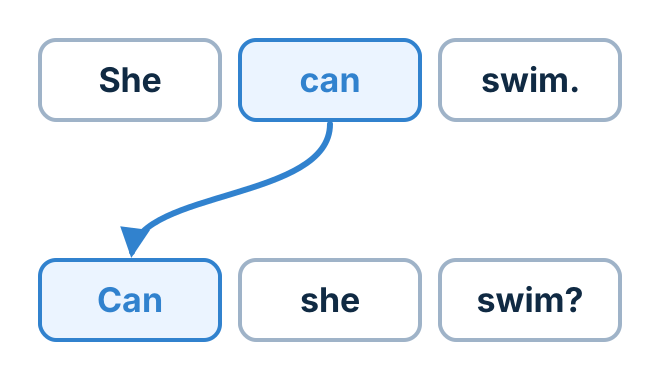
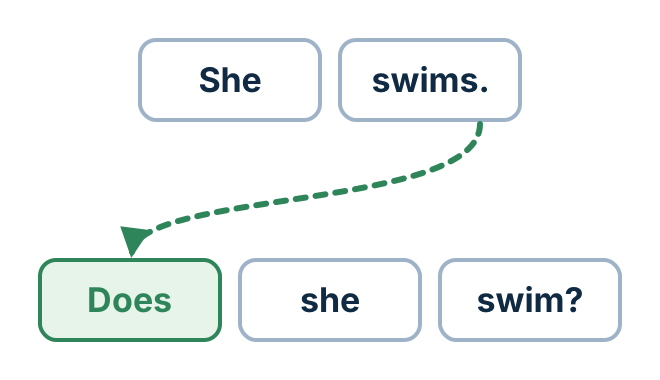
swims 的 -s 和 called 的过去时都转移到助动词上(does、did),所以主要动词回到原形。
现在进行时
be 加 -ing 的疑问句和否定句(Are you listening? He isn’t working today)在现在进行时指南中与该时态的其他内容一起讲解。 现在进行时指南(英文)→
现在完成时
带 ever 的疑问句和带 yet 的否定句(Have you ever…? I haven’t finished yet)在现在完成时指南中讲解。 现在完成时指南(英文)→
直接疑问句
疑问句需要哪个助动词?它后面用什么形式?
规则: 把助动词放在主语前:be、have 或情态动词直接移过去,其他动词加 do、does 或 did。do、does 或 did 后面的主要动词用原形。
疑问句以哪个助动词开头?
| 如果动词是 | 使用 | 例句 |
|---|---|---|
| be | am, is, are, was, were | Were the tickets expensive? |
| 完成时形式 | have, has, had | Has the parcel arrived? |
| 进行时形式 | am, is, are, was, were | Is it still snowing? |
| 情态动词 | can, will, should, must… | Should we book a table? |
| 其他动词,现在时 | do, does | Does this bus stop at the library? |
| 其他动词,过去时 | did | Did the team win on Saturday? |
疑问词在前,后面语序不变
| 疑问词 | 助动词 | 主语 | 其余部分 |
|---|---|---|---|
| Where | did | you | park? |
| How much | does | the course | cost? |
| What | are | you | laughing at? |
| How long | will | the meeting | last? |
表示拥有的 have
Do you have a pen? 是 have 作主要动词时最稳妥的问法。Have you got a pen? 也很常见,尤其在英式英语中。Have you a pen? 听起来很老派。
陈述式疑问句
口语中,用升调说出的陈述句(You’re leaving already?)表示惊讶,或确认你认为属实的事。这是非正式用法,不能代替正常的疑问语序。
本部分的常见错误
- 主语前没有助动词
Why you are laughing?✓ Why are you laughing?助动词要放在主语前。 - 助动词后的动词形式错误
Does he wants a drink?✓ Does he want a drink?does 后面用原形。 - 助动词选错
Do you be hungry?✓ Are you hungry?be 自己构成疑问句,不用 do。
主语疑问句和宾语疑问句
疑问词是主语还是宾语?
规则: 如果疑问词是主语,用陈述语序,不用 do。如果是宾语,用一般疑问语序。
三个步骤
- 1
用完整的句子回答这个问题。
- 2
找到答案词。在动词前面就是主语,在动词后面就是宾语。
- 3
主语:保持陈述语序,不用 do。宾语:助动词放在主语前。
| 疑问句 | 完整回答 | 类型 |
|---|---|---|
| Who invited Sam? | Lena invited Sam. | 主语:不用 do |
| Who did Sam invite? | Sam invited Lena. | 宾语:did + 主语 |
| What broke the printer? | A paper jam broke the printer. | 主语:不用 do |
| What did the printer print? | The printer printed a blank page. | 宾语:did + 主语 |
主语疑问句仍然可以含有动词本身带的助动词:Who can help? What is happening? Who has seen this film? 省略的只是额外的 do。
本部分的常见错误
- 主语疑问句中用了 do
Who did win the race?✓ Who won the race?Who 是主语,所以不用 did。 - 宾语疑问句缺少助动词
What you bought at the market?✓ What did you buy at the market?What 是宾语,所以要加 did。 - 主语疑问句中用了 do
Which bus does go to the stadium?✓ Which bus goes to the stadium?Which bus 是主语,所以不用 does。
间接疑问句
这个问题是否嵌在另一个句子里?
规则: 在 Can you tell me、Do you know、I wonder 或 asked 这类开头之后,用陈述语序,不用 do。一般疑问句要加 if 或 whether。
开头决定句末标点
| 开头是疑问句:以 ? 结尾 | 开头是陈述句:以 . 结尾 |
|---|---|
| Can you tell me where the exit is? | I wonder where the exit is. |
| Do you know when the film starts? | I don’t know when the film starts. |
| Do you have any idea who sent this? | I’m not sure who sent this. |
一般疑问句:if 或 whether
| 直接 | 间接 |
|---|---|
| Is the museum free? | Do you know if the museum is free? |
| Will they agree? | I doubt whether they will agree. |
在 to 前面(whether to stay)和介词后面(a debate about whether it works),用 whether,不用 if。
转述疑问句
| 直接疑问句 | 转述 |
|---|---|
| “Are you tired?” | She asked if I was tired. |
| “Where did you go?” | He asked where I had gone. |
| “Will you be there?” | They asked if I would be there. |
| “Can you swim?” | She asked if I could swim. |
如果情况现在仍然属实,时态可以不变:She asked where I live(我现在仍住在那里)。
Do you know …? 还是 … do you think?
Do you know where he lives? 问的是事实,可以用 yes 或 no 回答。Where do you think he lives? 问的是看法,所以疑问词移到最前面,do you think 充当疑问部分。
本部分的常见错误
- 间接疑问句用了疑问语序
Do you know when does the shop open?✓ Do you know when the shop opens?do you know 后面用陈述语序。 - 缺少 if 或 whether
I'm not sure is she coming.✓ I'm not sure if she's coming.一般疑问句需要 if 或 whether。 - do you think 的语序
Do you think where she went?✓ Where do you think she went?疑问词放在最前面。
否定句
有没有助动词可以接 not?句中是否已经有否定词?
规则: 把 not 放在助动词后,或用 don’t、doesn’t、didn’t 加原形。每个分句只用一个否定,回答否定疑问句时按事实。
缩约形式
每个分句一个否定
| not + any 类词 | no 类词,不用 not |
|---|---|
| I didn’t tell anyone. | I told no one. |
| There isn’t anything to eat. | There’s nothing to eat. |
| He hasn’t been anywhere. | He’s been nowhere. |
no 类词的说法通常更正式或语气更强。有些英语变体在口语中使用双重否定,但在书面语和考试中不算标准。
回答否定疑问句
| 疑问句 | 如果事实是肯定的 | 如果事实是否定的 |
|---|---|---|
| Aren’t you hungry? | Yes, I am. | No, I’m not. |
| Didn’t she pass the test? | Yes, she did. | No, she didn’t. |
yes 和 no 跟着事实走
在有些语言里,yes 的意思是“你说得对”。在英语里,yes 和 no 与后面的事实一致,所以 yes 后面总是肯定,no 后面总是否定。
I don’t think
英语通常把否定放在 think 上:I don’t think it will rain 比 I think it won’t rain 更自然,不过两者都正确。believe、expect 和 suppose 也一样。
本部分的常见错误
- not 前没有助动词
She not speaks French.✓ She doesn't speak French.这里 not 需要 does,speak 回到原形。 - 双重否定
We didn't get no reply.✓ We didn't get any reply.每个分句一个否定。 - yes 和 no 用反了
Isn't this your bag? Yes, it isn't.✓ Isn't this your bag? No, it isn't.事实是否定的,所以回答用 no。
附加疑问句
助动词是什么?句子是肯定还是否定?
规则: 重复助动词(或用 do、does、did)加代词,并且通常转换极性:肯定句配否定附加疑问,否定句配肯定附加疑问。
分两步构成附加疑问
- 1
找到助动词。如果没有,就用同一时态的 do、does 或 did。
- 2
转换极性并使用代词:肯定变否定,否定变肯定。
| 句子 | 助动词 | 附加疑问 |
|---|---|---|
| Your brother plays tennis, | (does) | doesn’t he? |
| We won’t be late, | will | will we? |
| The shops were closed, | were | weren’t they? |
| She’d already gone, | had | hadn’t she? |
| You could hear me, | could | couldn’t you? |
不按常规的附加疑问
| 句子 | 附加疑问 |
|---|---|
| I’m on the list, | aren’t I? |
| Let’s ask her, | shall we? |
| Pass me the salt, | will you? / could you? |
| No one noticed, | did they? |
| There isn’t much time, | is there? |
| This is yours, | isn’t it? |
语调
附加疑问用降调,表示你期待对方同意(It’s cold, isn’t it?)。用升调,表示这是真正的提问,你并不确定。
同极性附加疑问
肯定句配肯定附加疑问(So you’re moving to Canada, are you?)确实存在,但它表达的是惊讶或兴趣,而不是确认。诊断测试考的是常见的相反极性句型。
本部分的常见错误
- 附加疑问与句子不匹配
They've been to Rome, didn't they?✓ They've been to Rome, haven't they?They’ve 就是 they have,所以附加疑问用 have。 - 附加疑问极性相同
You aren't busy, aren't you?✓ You aren't busy, are you?否定句要配肯定附加疑问。 - 特殊的附加疑问形式
Let's start, don't we?✓ Let's start, shall we?Let’s 配 shall we。
自我检测
每个句子正确吗?点击查看答案。如果不确定,部分标签会告诉你该看哪里。
第 1 部分Do you have time for a quick coffee?
正确。 这里表示拥有的 have 是普通动词,所以疑问句用 do。
第 1 部分Where your brother is studying?
错误。 助动词要放在主语前:Where is your brother studying?
第 2 部分What caused the delay?
正确。 What 是主语(something caused the delay),所以不用 did。
第 2 部分Who did she marry?
正确。 Who 是宾语(she married someone),所以疑问句需要 did。
第 3 部分Could you tell me how much does the ticket cost?
错误。 could you tell me 后面用陈述语序:how much the ticket costs。
第 3 部分I wonder whether the train will be on time.
正确。 whether 引导间接的一般疑问句,句子以句号结尾。
第 4 部分I don't have no idea.
错误。 只用一个否定:I don’t have any idea,或 I have no idea。
第 4 部分Didn't you finish the book? Yes, I finished it last week.
正确。 事实是肯定的,所以回答用 yes。
第 5 部分I'm invited too, aren't I?
正确。 I’m 后面的附加疑问是 aren’t I。
第 5 部分He hasn't replied yet, hasn't he?
错误。 否定句要配肯定附加疑问:He hasn’t replied yet, has he?
AI 练习提示词
把这段文字粘贴到 AI 聊天工具中。