

Past forms tell the reader when something happened, whether it was finished or still going on, and which of two events came first. Most mistakes come from choosing between two similar forms, so each part of this guide is built around one of those choices. This guide has five parts, and they match the five parts of the diagnostic exactly.
关于本指南: 过去时动词形式
过去时的各种形式告诉听者事情何时发生、是已经完成还是正在进行,以及两个事件中哪个先发生。大多数错误来自在两个相似的形式之间做选择,所以每个部分都围绕其中一个选择来设计。本指南分为五个部分,与诊断测试的五个部分完全对应。
你可以先做诊断测验,看看这个主题的哪些部分需要复习,也可以直接进入练习活动,其中包含复习幻灯片。
本指南本身为英文。这些翻译只是额外提供的便利,可能不够完美。
このガイドについて: 過去時制の動詞の形
過去時制の形は、出来事がいつ起きたのか、完了していたのか進行中だったのか、2 つの出来事のどちらが先だったのかを伝えます。間違いの多くは似た 2 つの形のどちらを選ぶかで起こるため、各パートはその選択の 1 つを中心に作られています。このガイドは 5 つのパートで、診断テストの 5 つのパートと完全に対応しています。
まず診断テストを受けて、このテーマのどの部分を復習すべきか確認することもできますし、復習スライドを含む練習アクティビティにそのまま進むこともできます。
このガイド自体は英語です。これらの翻訳は補助として提供しているもので、完全とは限りません。
이 가이드 소개: 과거 시제 동사 형태
과거 시제 형태는 일이 언제 일어났는지, 끝났는지 아니면 진행 중이었는지, 그리고 두 사건 중 무엇이 먼저였는지를 알려 줍니다. 실수는 대부분 비슷한 두 형태 중 하나를 고를 때 생기므로, 각 부분은 그런 선택 하나를 중심으로 구성되어 있습니다. 이 가이드는 다섯 부분으로 되어 있으며, 진단 테스트의 다섯 부분과 정확히 일치합니다.
먼저 진단 퀴즈로 이 주제에서 복습이 필요한 부분을 확인해도 되고, 복습 슬라이드가 포함된 연습 활동으로 바로 들어가도 됩니다.
가이드 자체는 영어로 되어 있습니다. 이 번역은 부가적으로 제공되는 것이며 완벽하지 않을 수 있습니다.
Giới thiệu hướng dẫn này: Dạng động từ thì quá khứ
Các dạng thì quá khứ cho người nghe biết việc gì xảy ra khi nào, đã xong hay đang diễn ra, và sự việc nào trong hai sự việc xảy ra trước. Phần lớn lỗi sai đến từ việc chọn giữa hai dạng giống nhau, nên mỗi phần được xây dựng quanh một lựa chọn như vậy. Hướng dẫn này gồm năm phần, khớp chính xác với năm phần của bài kiểm tra chẩn đoán.
Bạn có thể bắt đầu bằng bài kiểm tra chẩn đoán để biết phần nào cần ôn lại, hoặc vào thẳng các hoạt động luyện tập, trong đó có cả slide ôn tập.
Đọc hướng dẫn bằng tiếng Việt →
Bản hướng dẫn này được viết bằng tiếng Anh. Các bản dịch chỉ là phần hỗ trợ thêm và có thể chưa hoàn hảo.
इस गाइड के बारे में: भूतकाल की क्रिया के रूप
भूतकाल के रूप बताते हैं कि कोई बात कब हुई, वह पूरी हो चुकी थी या चल रही थी, और दो घटनाओं में से कौन-सी पहले हुई। ज़्यादातर गलतियाँ दो मिलते-जुलते रूपों में से एक चुनते समय होती हैं, इसलिए हर भाग ऐसे ही एक चुनाव पर आधारित है। इस गाइड के पाँच भाग हैं, जो निदान परीक्षा के पाँच भागों से ठीक मेल खाते हैं।
आप निदान क्विज़ से शुरू करके जान सकते हैं कि इस विषय के कौन-से भाग दोहराने चाहिए, या सीधे अभ्यास गतिविधियों में जा सकते हैं, जिनमें दोहराव की स्लाइडें भी हैं।
गाइड स्वयं अंग्रेज़ी में है। ये अनुवाद अतिरिक्त सुविधा के रूप में हैं और पूरी तरह सटीक न भी हों।
نبذة عن هذا الدليل: صيغ أفعال الماضي
تخبر صيغ الماضي السامع متى وقع الأمر، وهل كان منتهيًا أم جاريًا، وأيّ الحدثين وقع أولًا. وتنشأ معظم الأخطاء عند الاختيار بين صيغتين متشابهتين، لذا بُني كل جزء حول واحد من هذه الاختيارات. يتكون هذا الدليل من خمسة أجزاء تطابق تمامًا الأجزاء الخمسة في الاختبار التشخيصي.
يمكنك البدء بالاختبار التشخيصي لمعرفة الأجزاء التي تحتاج إلى مراجعة، أو الانتقال مباشرة إلى أنشطة التدريب، وتشمل شرائح مراجعة.
الدليل نفسه بالإنجليزية. هذه الترجمات مجرد خدمة إضافية وقد لا تكون دقيقة تمامًا.
Об этом руководстве: Формы глаголов прошедшего времени
Формы прошедшего времени сообщают, когда что-то произошло, было ли действие закончено или шло в процессе и какое из двух событий случилось раньше. Большинство ошибок возникает при выборе между двумя похожими формами, поэтому каждая часть построена вокруг одного такого выбора. В этом руководстве пять частей, и они точно соответствуют пяти частям диагностического теста.
Можно начать с диагностического теста, чтобы узнать, какие части темы стоит повторить, или сразу перейти к упражнениям, в которые входят слайды для повторения.
Читать руководство на русском →
Само руководство написано на английском. Эти переводы — дополнительная помощь, и они могут быть неидеальными.
Acerca de esta guía: Formas verbales del pasado
Las formas del pasado le dicen al oyente cuándo ocurrió algo, si estaba terminado o en curso y cuál de dos hechos ocurrió primero. La mayoría de los errores surge al elegir entre dos formas parecidas, así que cada parte gira en torno a una de esas elecciones. Esta guía tiene cinco partes, y coinciden exactamente con las cinco partes del diagnóstico.
Puedes empezar con el cuestionario de diagnóstico para saber qué partes del tema conviene repasar, o ir directamente a las actividades de práctica, que incluyen diapositivas de repaso.
La guía en sí está en inglés. Estas traducciones son un añadido de cortesía y pueden no ser perfectas.
À propos de ce guide: Formes verbales du passé
Les formes du passé indiquent quand une chose s'est produite, si elle était terminée ou en cours, et lequel de deux événements est arrivé en premier. La plupart des erreurs viennent du choix entre deux formes proches, c'est pourquoi chaque partie est construite autour de l'un de ces choix. Ce guide comporte cinq parties, qui correspondent exactement aux cinq parties du diagnostic.
Vous pouvez commencer par le quiz de diagnostic pour savoir quelles parties du sujet réviser, ou passer directement aux activités d'entraînement, qui comprennent des diapositives de révision.
Le guide lui-même est en anglais. Ces traductions sont un complément offert et peuvent ne pas être parfaites.
Sobre este guia: Formas verbais do passado
As formas do passado dizem quando algo aconteceu, se estava terminado ou em andamento, e qual de dois fatos veio primeiro. A maioria dos erros vem da escolha entre duas formas parecidas, por isso cada parte é construída em torno de uma dessas escolhas. Este guia tem cinco partes, que correspondem exatamente às cinco partes do teste diagnóstico.
Você pode começar pelo teste diagnóstico para ver quais partes do tema precisam de revisão, ou ir direto para as atividades de prática, que incluem slides de revisão.
O guia em si está em inglês. Estas traduções são um recurso extra e podem não ser perfeitas.
Your diagnostic result says which part needs review. Tap that part below.
The core idea: where does the action sit in the past?
Picture the past as a timeline. Choose the form by where the action sits: a finished event, an action in progress, something that happened before another past event, or a habit that has ended.
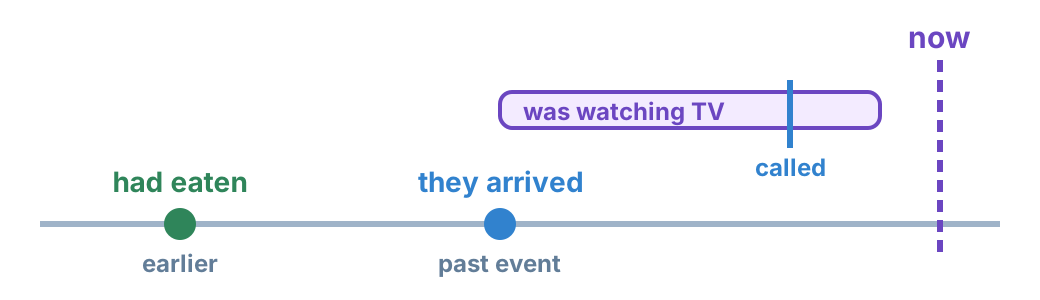
| Form | Structure | Main use |
|---|---|---|
| Simple past | verb + -ed, or irregular | a finished or counted event, a past state |
| Past continuous | was/were + -ing | an action in progress at a past moment |
| Past perfect | had + participle | the earlier of two past events, or a finished result |
| Past perfect continuous | had been + -ing | how long, or why, up to a past moment |
| Used to / would | used to + base, would + base | past habits (would: actions only) |
- 1
Build the form. Past form alone, base form after did, participle after had (Part 1).
- 2
Finished, or in progress? Simple past or past continuous (Part 2).
- 3
Did it come before another past event? Past perfect only if the order matters (Part 3).
- 4
How long, how much, or why? Had been + -ing, had + participle, or have been + -ing (Part 4).
- 5
A habit? Used to, would, the simple past, or usually (Part 5).
Part 1 is about form. Parts 2 and 3 are about time and order. Parts 4 and 5 need both form and meaning.
Base, past, or participle?
Which helper comes before the verb: nothing, did, had, or was? The helper decides the form.
The rule: Use the past form in positive sentences, the base form after did or didn't, and the participle after had.
Irregular verbs have three forms
| Base | Simple past | Participle (after had) |
|---|---|---|
| go | went | gone |
| catch | caught | caught |
| fall | fell | fallen |
| fly | flew | flown |
| write | wrote | written |
| do | did | done |
| get | got | gotten (US) |
Regular verbs add -ed. Irregular verbs have their own forms, and the past and the participle often differ. Watch look-alikes: fell (fall) and felt (feel).
The helper verb decides the form
| After | Use | Example |
|---|---|---|
| nothing | the past form | He caught the ball. |
| did, didn’t | the base form | Did he catch it? He didn’t catch it. |
| had | the participle | He had caught it before. |
| was, were | the -ing form | He was catching the bus. |
Was plus a base verb (I was go) is not English. For one finished action, use the past form alone: I went.
Common errors in this part
- the wrong past form of the verb
My friend teached me how to swim.✓ My friend taught me how to swim.Teach is irregular: taught. - base form and past form mixed up
Did they found a parking space?✓ Did they find a parking space?After did, use the base form. - the wrong past form of the verb
I had forgot her birthday.✓ I had forgotten her birthday.After had, use the participle: forgotten.
More: US and UK past forms
This site uses US English. In the US, learned, dreamed, burned, and spelled are the usual past forms; learnt, dreamt, and burnt are more common in British English. The US participle of get is usually gotten (she had gotten lost), while British English uses got.
Simple past or past continuous?
Was it finished or counted, or was it still going on when something else happened?
The rule: Use was or were plus -ing for an action in progress. Use the simple past for finished, counted, or interrupting events and for state verbs like know.
The longer action is in progress. The shorter one interrupts.
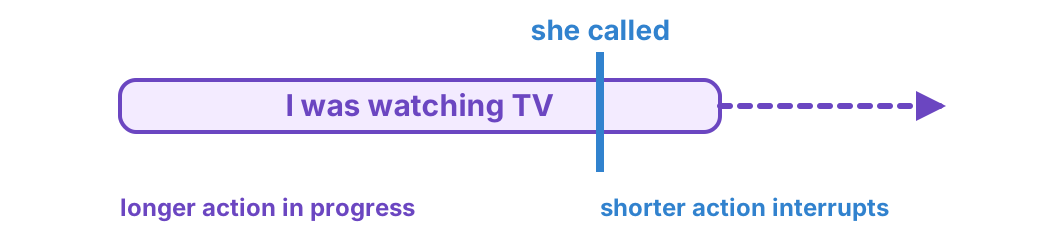
| Simple past | Past continuous |
|---|---|
| a finished action: I finished the book on the train. | an action in progress: I was reading on the train. |
| the short event that interrupts: the storm started | the longer action it interrupts: we were playing cards |
| counted events: the phone rang twice | a repeated annoying habit: he was always losing his keys |
| state verbs: I knew, she owned | not with most state verbs |
State verbs usually stay simple
Was goes with I, he, she, it. Were goes with we, you, they and plural nouns.
Common errors in this part
- -ing with a state verb
When I was ten, I was owning a red bike.✓ When I was ten, I owned a red bike.Own is a state verb, so it takes the simple past. - was, were, or the -ing form wrong
She was cook when I called her.✓ She was cooking when I called her.Was needs the -ing form. - past continuous and simple past mixed up
I was dropping my phone twice on the way to work.✓ I dropped my phone twice on the way to work.Counted events take the simple past.
Simple past or past perfect?
Did one past event happen before another, and does the order matter?
The rule: Use had plus the participle for the earlier of two past events when the order matters. Use the simple past for one past event, events told in order, and any finished time.
Use had only when one past event came before another
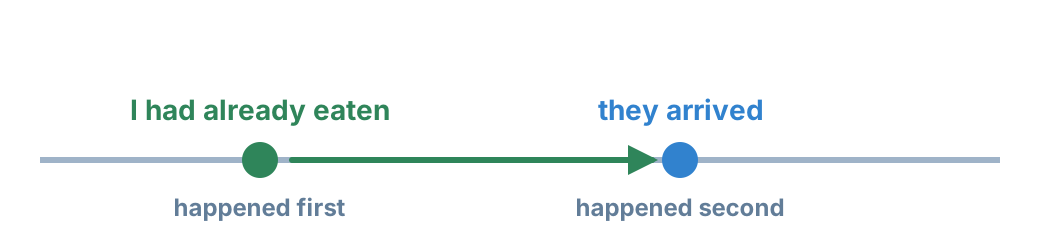
| Situation | Form | Example |
|---|---|---|
| the earlier of two past events | had + participle | The plane had left when I got to the gate. |
| with by the time | had + participle | By the time the ambulance came, he had lost consciousness. |
| one past event, even long ago | simple past | I visited my grandparents last summer. |
| events told in order | simple past | I cooked, did the dishes, and went to bed. |
| after or before already shows the order | simple past (had is also possible) | After the guests left, we cleaned up. |
A finished time (yesterday, last year, in 2021, ago) takes the simple past, never have or has plus the participle.
Common errors in this part
- past perfect where the simple past is enough
I had gone to Tokyo last year.✓ I went to Tokyo last year.One past event at a finished time takes the simple past. - present perfect with a finished time
She has finished the course in 2022.✓ She finished the course in 2022.In 2022 is a finished time. - simple past where the past perfect is needed
By the time I woke up, my roommate left for work.✓ By the time I woke up, my roommate had left for work.By the time points to the earlier action: had left.
More: already and just in American English
In informal American English, already and just often go with the simple past: I already ate. When one past event came before another, careful writing and tests still expect the past perfect: When they arrived, I had already eaten.
Had been, had, or have been?
Are you saying how long, how much, or why? And do you look back from then or from now?
The rule: Use had been plus -ing for how long something went on before a past event, or for the cause of a past state. Use had plus the participle for a finished result or a number. Use have been plus -ing when the time runs up to now.
How long, how much, or why?
| Question | Form | Example |
|---|---|---|
| How long, up to a past moment? | had been + -ing | We had been waiting for twenty minutes when the teacher arrived. |
| Why was it true then? | had been + -ing | He was out of breath because he had been running. |
| How much was finished? | had + participle | By the end of the day, she had answered forty emails. |
| How long, with a state verb? | had + participle | By 2019, they had known each other for thirty years. |
| How long, up to now? | have/has been + -ing | I have been working since six this morning. |
Was plus -ing does not say how long before a past event: not we were waiting for twenty minutes when the teacher arrived.
Common errors in this part
- was or were plus -ing for a duration before a past event
The patient was waiting for three hours when a doctor finally saw him.✓ The patient had been waiting for three hours when a doctor finally saw him.A duration before a past event takes had been plus -ing. - had been and have been mixed up
I'm hungry because I had been working all afternoon.✓ I'm hungry because I have been working all afternoon.The time runs up to now, so use have been. - had been plus -ing for a finished result
By noon, he had been writing three reports.✓ By noon, he had written three reports.A number completed takes had plus the participle.
Used to, would, or simple past?
Is it a past habit, a past state, a single event, or something that is still true?
The rule: Use used to for past habits and states that have ended, would for repeated past actions only, the simple past for single or counted events, and the present simple for habits that are still true.
It was true then, and it is not true now
| Form | Use | Example |
|---|---|---|
| used to + base | a past habit or state that has ended | We used to live in an apartment. |
| didn’t use to, did … use to | negatives and questions | She didn’t use to like spicy food. |
| would + base | a repeated past action, not a state | Every summer, Grandma would take us fishing. |
| simple past | a single event, or a number of times | I went to Jeju three times last year. |
| usually + present simple | a habit that is still true | I usually drink coffee in the morning. |
Used to, be used to, and get used to
be used to + -ing
It feels normal: I’m used to driving on the right now.
get used to + -ing
It is becoming normal: it was hard to get used to the long winters.
Common errors in this part
- used to for the wrong meaning
I used to jog every morning, and I still do.✓ I usually jog every morning.For a habit that is still true, use the present simple. - would used for a past state
When I was young, I would have long hair.✓ When I was young, I used to have long hair.Would does not work with states such as have. - used to built the wrong way
It took a while to get used to speak English at work.✓ It took a while to get used to speaking English at work.Get used to is followed by -ing.
More: didn’t use to or didn’t used to?
Didn’t use to is the standard written form, and it is the one tests expect. Didn’t used to also appears, especially in informal writing, because the two sound the same.
Self-check
Is each sentence correct? Tap to see the answer. The part label tells you where to look if you were not sure.
Part 1She brang cookies to the party.
Incorrect. She brought cookies to the party. Bring is irregular.
Part 1Did the package arrive on time?
Correct. After did, the verb is in the base form.
Part 2I was having a bath when someone knocked on the door.
Correct. The bath was in progress, and the knock interrupted it.
Part 2He was seeming nervous during the interview.
Incorrect. He seemed nervous during the interview. Seem is a state verb.
Part 3I have seen a great play on Saturday.
Incorrect. I saw a great play on Saturday. On Saturday is a finished time.
Part 3When I checked my bag, my phone had disappeared.
Correct. The phone disappeared before I checked.
Part 4The ground was muddy because it had been raining.
Correct. Had been plus -ing explains the cause of a past state.
Part 4By 2020, they had been having that car for ten years.
Incorrect. They had had that car for ten years. Have meaning own is a state verb.
Part 5My grandfather would tell us stories every night.
Correct. Would can describe a repeated past action.
Part 5I am used to wake up early.
Incorrect. I am used to waking up early. Be used to is followed by -ing.
AI practice prompt
Paste this into an AI chat tool and replace the bracket with your language.
Show the prompt
More practice elsewhere
- EnglishPage: Simple past and past continuous
- EnglishPage: Simple past and past perfect
- EnglishPage: Past perfect and past perfect continuous
- Perfect English Grammar: Irregular past simple, part 1
- Perfect English Grammar: Past continuous mixed exercise
- Perfect English Grammar: Past perfect exercise 1