
Level: C1
Reading | Vocabulary | Activities | Speed Challenge | Questions | AI Prompts | Discussion | Language Focus | Resources
Printable: Student handout (PDF) | Teacher’s key (PDF)
Reading
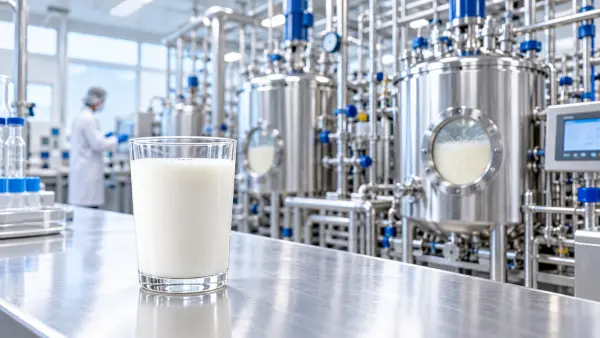
Imagine a glass of milk that never came from a cow. Using a process called precision fermentation, researchers can now grow the exact proteins found in dairy milk inside steel tanks, with no animal involved at all. Genetically engineered yeast or bacteria are grown in bioreactors, fed a sugar-based feedstock, and over several days convert it into a target protein. The idea sounds futuristic, but the technology is not new. It has been used in food production since the 1990s to make an enzyme that curdles milk for cheese. What has changed is the ambition: companies are no longer producing one small ingredient. They are trying to replace a share of the dairy industry itself.
Precision fermentation differs from the oat, soy, and almond milks already on supermarket shelves. Those are plant-based substitutes, recognizable as milk but chemically distinct from it. Proteins made this way are described as bioidentical to their animal-derived counterparts, meaning they are, at the molecular level, the same substance a cow would have produced. Most commercial efforts have focused on beta-lactoglobulin, the main whey protein in cow’s milk, which the American company Perfect Day already produces at industrial scale. Similar ventures have appeared elsewhere: Remilk’s fermented-protein milk reached cafes and shops in Israel in late 2025, while Eden Brew in Australia is still waiting on regulatory approval for its own version of this novel protein.
A study published in February 2026 in Frontiers in Sustainable Food Systems, by researchers at Imperial College London, focuses on land rather than the greenhouse gas emissions most earlier assessments examined. The team calculated milk’s land footprint, the area needed to produce one metric ton, for both conventional and fermented milk in the United Kingdom. Because fermentation itself needs no farmland, only the crops behind it do, the researchers allocated a share of cropland to each nutritional component, protein, fat, and carbohydrate, based on the crop realistically supplying it: sugar beet for the carbohydrate and feedstock, oilseed rape for the fat. Fermented milk’s land footprint came out 94 to 96 percent lower than that of milk from a cow.
Applied nationally, that gap becomes substantial. The researchers modeled three scenarios drawn from the UK Climate Change Committee’s own targets: replacing 20, 50, or all of the country’s cow’s milk with the fermented version by 2050. Even the smallest scenario was projected to free roughly 859,000 hectares once used for grazing and feed crops, and full replacement was projected to free about 4.29 million hectares, an area comparable to mainland Denmark. Some of that land, the authors note, could go toward the country’s own climate commitments, including afforestation and the restoration of drained peatland, both of which need exactly the kind of land dairy farming currently occupies. Under the more ambitious of the two official scenarios, released land could cover nearly 80 percent of what the government’s 2050 land use targets call for.
The analysis is explicitly UK-specific, and its authors caution that the numbers cannot simply be applied elsewhere. Even so, the global picture gives the finding weight. The United Kingdom produces only about 1.6 percent of the world’s milk, while demand elsewhere is rising fast: per-person milk consumption has climbed by more than a thousand percent in India and by well over two thousand percent in China since 1961. If similar land savings held in faster-growing markets, precision fermentation could help mitigate some of the pressure that expanding dairy production puts on land worldwide, though a country-by-country analysis would be needed to know by how much.
Several caveats temper the headline figure. The study measured land alone, not water use, emissions, or the nutritional gap between fermented and cow’s milk, including a large difference in saturated fat: roughly 8 percent of total fat in the study’s assumed rapeseed oil, against 64 percent in whole cow’s milk. The footprint excludes the bioreactors themselves, and it assumes the leftover microbial biomass is simply discarded, since its genetically modified nature complicates any valorization as animal feed. The estimate, in that sense, sits closer to a floor than a ceiling. A separate American analysis of one commercial fermented milk found a far smaller footprint, a discrepancy the authors attribute mainly to differences between US and UK dairy farming, compounded by a general scarcity of independent data on fermentation at commercial scale.
Whether any of this land is actually released depends on questions the study does not model: consumer acceptance, regulatory approval, and the viability of scaling fermentation tanks to a size that could realistically stand in for a national herd of nearly two million dairy cows. The researchers call for further work on all three. Until then, the 4.29 million hectares remains what it has always been: a calculation of what could be freed, not a plan for freeing it.
Vocabulary
Each word has a frequency score, a rank, and a tag. The score shows how common the word is in modern English: higher means more common, and each full point means roughly ten times more common. The rank is the word’s position on a list of about 321,000 English word forms, from most to least common. The tag shows where you are most likely to meet the word: Current, Formal, Literary, or Dated. The paragraph number shows where the word first appears in the reading. The labels are information, not instructions. Deciding which words are worth your time is up to you. How to read the scores, ranks, and tags.
precision fermentation (noun phrase): a process that uses genetically engineered microorganisms in a controlled vessel to produce a specific protein or other ingredient.
Frequency: no score (phrase) | Formal | Paragraph 1
Translations: 精准发酵 | 精密発酵 | 정밀 발효 | परिशुद्ध किण्वन | التخمير الدقيق | точная ферментация | fermentación de precisión | fermentation de précision
- Using precision fermentation, researchers can grow milk proteins without keeping a cow.
- The startup used precision fermentation to brew a protein normally found only in egg whites.
bioreactors (noun, plural): large vessels in which living cells or microorganisms are grown under controlled conditions.
Frequency: 1.89 | Rank: 107,757 | Formal | Paragraph 1
Translations: 生物反应器 | バイオリアクター | 생물반응기 | जैव अभिकारक | المفاعلات الحيوية | биореакторы | biorreactores | bioréacteurs
- The engineered yeast was grown inside large bioreactors at the factory.
- A brewery’s fermenting tanks work on a similar principle to industrial bioreactors.
feedstock (noun): raw material supplied to an industrial process to be converted into a product.
Frequency: 2.60 | Rank: 47,073 | Formal | Paragraph 1
Translations: 原料 | 原料(げんりょう) | 원료 | फीडस्टॉक | المادة الخام | сырьё | materia prima | matière première
- Sugar beet supplied the feedstock that the microbes converted into protein.
- Old cooking oil can serve as a feedstock for producing biodiesel.
bioidentical (adjective): chemically identical to a substance that occurs naturally in a living organism.
Frequency: 1.54 | Rank: 163,711 | Formal | Paragraph 2
Translations: 生物同质的 | バイオアイデンティカルな | 생체동일성의 | जैव-समरूप | متطابق حيوياً | биоидентичный | bioidéntico | bio-identique
- The lab-grown protein is bioidentical to the whey protein found in cow’s milk.
- Some hormone medications are described as bioidentical to the hormones the body produces naturally.
novel (adjective): new and not existing or known before.
Frequency: 4.63 | Rank: 2,339 | Current | Paragraph 2
Translations: 新颖的 | 新規の | 새로운 | नवीन | جديد | новый | novedoso | novateur
- Regulators had to decide how to classify this novel protein before it could be sold.
- The museum’s newest wing is devoted to novel materials used in modern architecture.
land footprint (noun phrase): the area of land needed to produce a given amount of a product.
Frequency: no score (phrase) | Formal | Paragraph 3
Translations: 土地足迹 | 土地フットプリント | 토지 발자국 | भूमि पदचिह्न | البصمة الأرضية | земельный след | huella territorial | empreinte foncière
- Researchers compared the land footprint of fermented milk with that of milk from a cow.
- A vegetable garden usually has a much smaller land footprint than a cattle pasture of the same value.
allocated (verb, past tense): assigned or distributed for a particular purpose according to a plan.
Frequency: 3.83 | Rank: 9,165 | Formal | Paragraph 3
Translations: 分配的 | 割り当てられた | 할당된 | आवंटित | مخصص | распределённый | asignado | attribué
- The researchers allocated a share of cropland to each nutrient in the milk.
- The charity allocated most of its budget to the two regions hit hardest by the drought.
afforestation (noun): the planting of trees on land that was not previously forest.
Frequency: 2.10 | Rank: 84,254 | Formal | Paragraph 4
Translations: 造林 | 植林 | 조림 | वनरोपण | التحريج | облесение | forestación | boisement
- Freed farmland could be used for afforestation, planting trees where none grew before.
- The government funded an afforestation program along the river valley to reduce flooding.
peatland (noun): land consisting of a thick layer of decayed plant matter, often wet, that stores large amounts of carbon.
Frequency: 1.93 | Rank: 102,771 | Formal | Paragraph 4
Translations: 泥炭地 | 泥炭地 | 이탄지 | पीटभूमि | أرض الخث | торфяник | turbera | tourbière
- Restoring drained peatland can help a country meet its climate targets.
- Scotland contains some of Europe’s largest remaining areas of peatland.
comparable (adjective): similar enough in size or nature to be usefully compared with something else.
Frequency: 4.08 | Rank: 6,230 | Current | Paragraph 4
Translations: 可比的 | 匹敵する | 비슷한 | तुलनीय | مماثل | сопоставимый | comparable | comparable
- The freed land was comparable in size to a small European country.
- Her salary in the new job is roughly comparable to what she earned before.
mitigate (verb, base form): to make a harmful, risky, or difficult situation less severe.
Frequency: 3.54 | Rank: 14,106 | Formal | Paragraph 5
Translations: 缓解 | 軽減する | 완화하다 | कम करना | يخفف | смягчать | mitigar | atténuer
- Fermented protein could help mitigate some of the land pressure caused by rising demand.
- Planting trees along the riverbank was meant to mitigate the risk of flooding downstream.
valorization (noun): the process of finding a productive or profitable use for material that would otherwise be treated as waste.
Frequency: 1.78 | Rank: 122,704 | Formal | Paragraph 6
Translations: 增值利用 | 価値化 | 가치화 | मूल्यवर्धन | تثمين | утилизация с извлечением ценности | valorización | valorisation
- Finding a use for the leftover biomass would require successful valorization of the waste.
- The brewery sells its spent grain to farms, a simple form of valorization.
discrepancy (noun): a difference or disagreement between two things that are expected to be the same or similar.
Frequency: 3.29 | Rank: 19,825 | Current | Paragraph 6
Translations: 差异 | 不一致 | 불일치 | विसंगति | تباين | расхождение | discrepancia | divergence
- There was a large discrepancy between the UK and US land footprint estimates.
- The accountant noticed a discrepancy between the invoice and the amount actually paid.
scarcity (noun): a shortage of something that is needed or wanted.
Frequency: 3.37 | Rank: 17,813 | Current | Paragraph 6
Translations: 稀缺 | 不足 | 부족 | अभाव | ندرة | нехватка | escasez | pénurie
- A scarcity of independent data forced the researchers to rely on industry estimates.
- The drought caused a scarcity of clean water across several farming regions.
viability (noun): the ability of something to work successfully in practice.
Frequency: 3.44 | Rank: 16,228 | Formal | Paragraph 7
Translations: 可行性 | 実行可能性 | 실행 가능성 | व्यवहार्यता | الجدوى | жизнеспособность | viabilidad | viabilité
- Scaling up fermentation tanks will test the viability of replacing dairy herds nationally.
- The startup ran a small pilot program to test the viability of its business model.
Activity Page
Open the activity page in a new tab
Speed Challenge
Answer 12 questions against the clock. Every wrong answer adds 5 seconds, and the lowest score wins. Open the speed challenge in a new tab.
Comprehension Questions
- According to the reading, what happens inside a bioreactor during precision fermentation?
- How does precision-fermented protein differ from plant-based milk substitutes such as oat or soy milk?
- What method did the researchers use to calculate milk’s land footprint, and which two crops supply its fat and carbohydrate?
- By how much was fermented milk’s land footprint found to be lower than cow’s milk, and what could the freed UK land be used for?
- Why does the reading say the study’s findings cannot simply be applied outside the United Kingdom?
- What does the reading say about milk consumption trends in India and China, and why does this matter for the study’s conclusions?
- List three things the study’s land footprint calculation does not include.
- Explain in your own words why the reading calls the estimate “closer to a floor than a ceiling.”
- The reading moves from mechanism, to a UK study, to global implications, to limitations. Why might the writer have chosen this order?
IELTS-Style Questions
- True, False, or Not Given: “The Imperial College London study proves that precision fermentation produces less greenhouse gas than dairy farming.” Explain your answer using evidence from the reading.
- Yes, No, or Not Given: “The writer believes precision-fermented milk will replace cow’s milk everywhere within the next few years.” Explain your answer using evidence from the reading.
- Author’s purpose: Why does the writer end with the sentence “a calculation of what could be freed, not a plan for freeing it”? Is its purpose to dismiss the study’s findings, to keep the finding in proportion, or something else?
AI Discussion Prompt
I just read an article about producing milk without a cow using precision fermentation. It covered how genetically engineered microbes brew milk proteins in bioreactors, a 2026 Imperial College London study on the land this could save in the UK if it replaced conventional dairy, how that compares with rising milk demand in India and China, and the study’s own limitations, including what it leaves out and a discrepancy with an American estimate. I am an English learner at about C1 level. Please ask me one question at a time, starting with whether I would try milk made this way. Respond to my ideas first, then briefly correct any language errors, and challenge my assumptions when it is useful.
AI Vocabulary Prompt
I want to practice vocabulary from an article about producing milk without a cow through precision fermentation. Please quiz me on the following words one at a time, using a mix of question types: multiple choice, true/false, and sentence completion. Give me feedback after each answer before moving on, and bring back the words I miss later. Here are the words: precision fermentation, bioreactors, feedstock, bioidentical, novel, land footprint, allocated, afforestation, peatland, comparable, mitigate, valorization, discrepancy, scarcity, viability.
Discussion Questions
- Would you try milk made without a cow if it tasted and behaved exactly like dairy milk? Why or why not?
- Does it matter to you whether a food is “natural,” even if a lab-made version is chemically identical? Explain your view.
- The reading says fermented protein is bioidentical to the protein in cow’s milk. Does knowing something is chemically identical change how you feel about eating it?
- In your country, how would traditional dairy farmers likely react to fermented milk entering the market? What might they gain or lose?
- The study looked only at land use. Why might a government or a company choose to highlight one environmental measure, such as land, over others, such as emissions or water?
- If precision-fermented milk became cheaper than dairy milk, should governments still support traditional dairy farmers? Why or why not?
- The reading names companies in the United States, Israel, and Australia. Why might a global technology like this develop first in a small number of countries?
- Rising milk consumption in China and India is mentioned in the reading. What social or economic changes usually cause a country’s dairy consumption to rise?
- Would you eat cheese, yogurt, or ice cream made from a fermented protein even if you would not drink the milk itself? Does the product matter more than the process?
- The reading says the researchers do not know what will happen to the leftover microbial biomass. Should companies be required to solve a byproduct problem before scaling up a new food technology?
- Freeing farmland for forests or restored peatland sounds appealing on paper. What practical obstacles might slow this down in real life?
- If a technology could genuinely free up millions of hectares of farmland, who should decide what that land is used for: government, private landowners, or someone else?
- The reading ends by saying the study describes what “could” happen, not a plan. How do you usually react when you read impressive projections in the news?
- Do you think most people would accept an entirely new way of producing a familiar food like milk within your lifetime? What would it take to convince them?
Language Focus: Comparative Language for Scale and Proportion
What it is: Comparative language expresses how big a change or difference is, using percentages, multiples, and approximate comparisons, instead of just stating a fact without any sense of scale.
Why writers use it: Research writing and journalism constantly need to say not just that something changed, but by how much and compared with what. This kind of language is common in academic writing, news reports, and any text involving data.
Examples from the reading:
- “Fermented milk’s land footprint came out 94 to 96 percent lower than that of milk from a cow.”
- “…full replacement was projected to free about 4.29 million hectares, an area comparable to mainland Denmark.”
- “…released land could cover nearly 80 percent of what the government’s 2050 land use targets call for.”
- “…per-person milk consumption has climbed by more than a thousand percent in India and by well over two thousand percent in China since 1961.”
Practice task: Rewrite this sentence using comparative language for scale: “The new factory uses much less water than the old one.” Invent a specific percentage or multiple.
(Example answer: “The new factory uses roughly 40 percent less water than the old one, largely because it recycles its cooling water instead of discharging it.”)
Recommended Resources
- Scientists Say This Cow-Free Milk Could Use Up to 96% Less Land Than Dairy Farming (My Modern Met, Linnea Pejcha). The article this lesson is based on, covering the Imperial College London land use study.
- UK Land Use Implications of Replacing Dairy Farming With Precision Fermentation (Frontiers in Sustainable Food Systems). The peer-reviewed study itself, with full methods, data tables, and its own list of limitations.
- Perfect Day (Cause Artist). A company profile of Perfect Day, the business named in paragraph 2 as an industrial-scale producer of fermented whey protein.
- Remilk and Gad Dairies Launch Precision-Fermented New Milk in Israel (The Plant Base). On Remilk’s fermented-protein milk launch in Israel, referenced in paragraph 2.
- Eden Brew Eyes 2026 Approval of Animal-Free Milk Protein in Australia and New Zealand (Green Queen). On Eden Brew’s pending regulatory application, referenced in paragraph 2.