
Prepositions of time answer one of a few questions: when does it happen, how long does it last, where does it end, or how far from now or from another event? Two parts of this topic are about a point, two are about a span, and one mixes both. This guide has five parts, and they match the five parts of the diagnostic exactly.
关于本指南: 时间介词
时间介词回答几个问题之一:它何时发生,持续多久,在哪里结束,或者距离现在或另一个事件有多远?本主题有两个部分讲时间点,两个部分讲时间段,一个部分两者兼有。本指南分为五个部分,与诊断测试的五个部分完全对应。
你可以先做诊断测验,看看这个主题的哪些部分需要复习,也可以直接进入练习活动,其中包含复习幻灯片。
本指南本身为英文。这些翻译只是额外提供的便利,可能不够完美。
このガイドについて: 時間の前置詞
時間の前置詞は、いつ起こるか、どれくらい続くか、どこで終わるか、今または別の出来事からどれくらい離れているか、のいずれかに答えます。このテーマの 2 つのパートは時点について、2 つは期間について、1 つは両方を扱います。このガイドは 5 つのパートで、診断テストの 5 つのパートと完全に対応しています。
まず診断テストを受けて、このテーマのどの部分を復習すべきか確認することもできますし、復習スライドを含む練習アクティビティにそのまま進むこともできます。
このガイド自体は英語です。これらの翻訳は補助として提供しているもので、完全とは限りません。
이 가이드 소개: 시간 전치사
시간 전치사는 언제 일어나는지, 얼마나 오래 계속되는지, 어디서 끝나는지, 지금이나 다른 사건에서 얼마나 떨어져 있는지 중 하나에 답합니다. 이 주제의 두 영역은 시점에 관한 것이고, 두 영역은 기간에 관한 것이며, 한 영역은 둘을 함께 다룹니다. 이 가이드는 다섯 부분으로 되어 있으며, 진단 테스트의 다섯 부분과 정확히 일치합니다.
먼저 진단 퀴즈로 이 주제에서 복습이 필요한 부분을 확인해도 되고, 복습 슬라이드가 포함된 연습 활동으로 바로 들어가도 됩니다.
가이드 자체는 영어로 되어 있습니다. 이 번역은 부가적으로 제공되는 것이며 완벽하지 않을 수 있습니다.
Giới thiệu hướng dẫn này: Giới từ chỉ thời gian
Giới từ chỉ thời gian trả lời một trong vài câu hỏi: việc xảy ra khi nào, kéo dài bao lâu, kết thúc ở đâu, hoặc cách bây giờ hay một sự kiện khác bao xa? Hai phần của chủ đề này nói về thời điểm, hai phần nói về khoảng thời gian, và một phần kết hợp cả hai. Hướng dẫn này gồm năm phần, khớp chính xác với năm phần của bài kiểm tra chẩn đoán.
Bạn có thể bắt đầu bằng bài kiểm tra chẩn đoán để biết phần nào cần ôn lại, hoặc vào thẳng các hoạt động luyện tập, trong đó có cả slide ôn tập.
Đọc hướng dẫn bằng tiếng Việt →
Bản hướng dẫn này được viết bằng tiếng Anh. Các bản dịch chỉ là phần hỗ trợ thêm và có thể chưa hoàn hảo.
इस गाइड के बारे में: समय के preposition
समय वाले preposition कुछ प्रश्नों में से एक का उत्तर देते हैं: यह कब होता है, कितनी देर चलता है, कहाँ खत्म होता है, या अब से या किसी और घटना से कितना दूर है? इस विषय के दो भाग एक बिंदु के बारे में हैं, दो भाग अवधि के बारे में, और एक भाग दोनों को मिलाता है। इस गाइड के पाँच भाग हैं, जो निदान परीक्षा के पाँच भागों से ठीक मेल खाते हैं।
आप निदान क्विज़ से शुरू करके जान सकते हैं कि इस विषय के कौन-से भाग दोहराने चाहिए, या सीधे अभ्यास गतिविधियों में जा सकते हैं, जिनमें दोहराव की स्लाइडें भी हैं।
गाइड स्वयं अंग्रेज़ी में है। ये अनुवाद अतिरिक्त सुविधा के रूप में हैं और पूरी तरह सटीक न भी हों।
نبذة عن هذا الدليل: حروف الجر الزمنية
تجيب حروف الجر الزمنية عن أحد أسئلة قليلة: متى يحدث الشيء، وكم يستمر، وأين ينتهي، وكم يبعد عن الآن أو عن حدث آخر؟ جزآن من هذا الموضوع عن نقطة زمنية، وجزآن عن مدة، وجزء واحد يجمع الاثنين. يتكون هذا الدليل من خمسة أجزاء تطابق تمامًا الأجزاء الخمسة في الاختبار التشخيصي.
يمكنك البدء بالاختبار التشخيصي لمعرفة الأجزاء التي تحتاج إلى مراجعة، أو الانتقال مباشرة إلى أنشطة التدريب، وتشمل شرائح مراجعة.
الدليل نفسه بالإنجليزية. هذه الترجمات مجرد خدمة إضافية وقد لا تكون دقيقة تمامًا.
Об этом руководстве: Предлоги времени
Предлоги времени отвечают на один из нескольких вопросов: когда это происходит, как долго длится, где заканчивается и как далеко от настоящего момента или от другого события? Две части этой темы посвящены моменту времени, две — промежутку, а одна объединяет оба. В этом руководстве пять частей, и они точно соответствуют пяти частям диагностического теста.
Можно начать с диагностического теста, чтобы узнать, какие части темы стоит повторить, или сразу перейти к упражнениям, в которые входят слайды для повторения.
Читать руководство на русском →
Само руководство написано на английском. Эти переводы — дополнительная помощь, и они могут быть неидеальными.
Acerca de esta guía: Preposiciones de tiempo
Las preposiciones de tiempo responden a una de varias preguntas: cuándo ocurre algo, cuánto dura, dónde termina, o a qué distancia está de ahora o de otro hecho. Dos partes de este tema tratan de un punto, dos de un lapso, y una mezcla ambos. Esta guía tiene cinco partes, y coinciden exactamente con las cinco partes del diagnóstico.
Puedes empezar con el cuestionario de diagnóstico para saber qué partes del tema conviene repasar, o ir directamente a las actividades de práctica, que incluyen diapositivas de repaso.
La guía en sí está en inglés. Estas traducciones son un añadido de cortesía y pueden no ser perfectas.
À propos de ce guide: Prépositions de temps
Les prépositions de temps répondent à l'une de quelques questions : quand cela se produit, combien de temps cela dure, où cela se termine, ou à quelle distance de maintenant ou d'un autre événement. Deux parties de ce sujet portent sur un point, deux sur une durée, et une mélange les deux. Ce guide comporte cinq parties, qui correspondent exactement aux cinq parties du diagnostic.
Vous pouvez commencer par le quiz de diagnostic pour savoir quelles parties du sujet réviser, ou passer directement aux activités d'entraînement, qui comprennent des diapositives de révision.
Le guide lui-même est en anglais. Ces traductions sont un complément offert et peuvent ne pas être parfaites.
Sobre este guia: Preposições de tempo
As preposições de tempo respondem a uma de algumas perguntas: quando algo acontece, quanto tempo dura, onde termina, ou a que distância está de agora ou de outro evento. Duas partes deste tema tratam de um ponto, duas tratam de um intervalo, e uma mistura os dois. Este guia tem cinco partes, que correspondem exatamente às cinco partes do teste diagnóstico.
Você pode começar pelo teste diagnóstico para ver quais partes do tema precisam de revisão, ou ir direto para as atividades de prática, que incluem slides de revisão.
O guia em si está em inglês. Estas traduções são um recurso extra e podem não ser perfeitas.
Your diagnostic result says which part needs review. Tap that part below.
The core idea: what is the time doing?
Choose the preposition by what the time expression does in the sentence, not by the word alone. The same time word can take different prepositions in different jobs.
| The sentence tells you | Use | Part |
|---|---|---|
| a point: when it happens | at, on, in | 1 |
| a length, where it started, or the period it happened in | for, since, during, while | 2 |
| a limit: where it ends or must be finished | by, until, within, from…to, over | 3 |
| time counted from now or from another event | ago, in, before, after | 4 |
- 1
Is it a point in time? Choose by size: at for a clock time, on for a day or date, in for a longer period.
- 2
Is it a length or a starting point? For counts the length, since names the start, during names the event, and while does the same before a subject and verb.
- 3
Is there a limit, or a second time? By is a deadline, until is how long, before and after compare with another time, and ago counts back from now.
Parts 1 and 4 are about a point. Parts 2 and 3 are about a span. Part 5 mixes both and adds the words that take no preposition.
In, at, and on
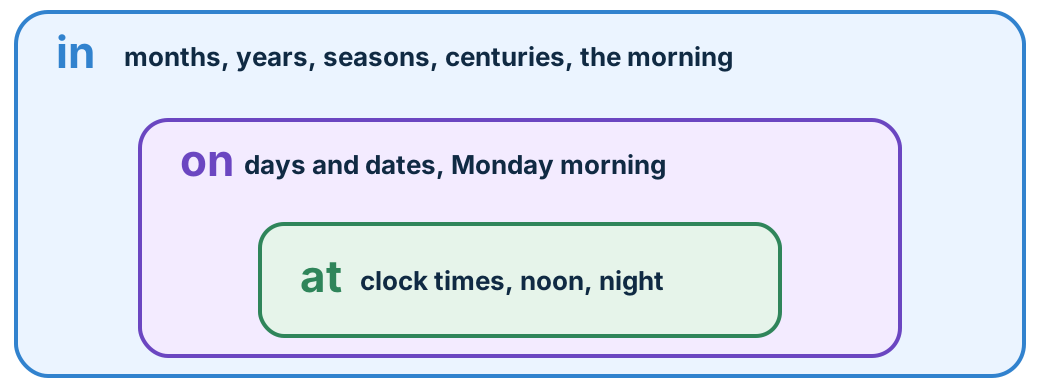
Which day, date, or clock time? The size of the time decides.
The rule: Small point: at. Named day or date: on. Longer period: in. Morning, afternoon, and evening take in, night takes at, and a named day with a part of the day takes on.
The smaller the time, the more specific the word
Parts of the day and holidays
| Time | Preposition | Example |
|---|---|---|
| morning, afternoon, evening | in | I study in the morning. |
| night | at | It is quiet at night. |
| a named day plus a part of the day | on | We meet on Monday morning. |
| one holiday day | on | The concert is on Christmas Eve. |
Some uses differ by region. British English says at the weekend and at Christmas (the whole holiday period). American English says on the weekend, and usually over Christmas or on Christmas. All are correct.
Common errors in this part
- in, at, and on mixed up
The class finishes on 4:30.✓ The class finishes at 4:30.Clock times take at. - wrong preposition with a part of the day
Owls hunt in night.✓ Owls hunt at night.Night takes at, unlike the morning. - wrong preposition with a part of the day
The party is in Saturday night.✓ The party is on Saturday night.A named day makes it on.
More: exact points that take at
Beginning and end of a period take at: at the beginning of March, at the end of the month. So do dawn, sunset and noon, and at the same time and at the moment.
For, since, during, and while
How long, since when, or during what? The question you answer, and what follows, decide.
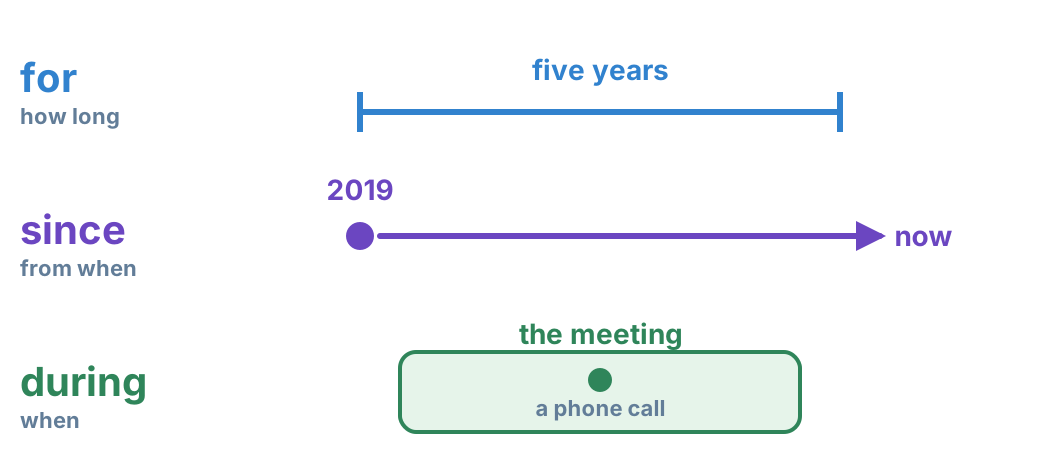
The rule: For counts the length. Since names the starting point. During names the period, before a noun. While does the same before a subject and verb.
Length, start, or event?
| Word | Followed by | Example |
|---|---|---|
| for | a length of time | I have lived here for five years. |
| since | a starting point | I have lived here since 2019. |
| during | a noun for an event or period | No one spoke during the meeting. |
| while | a subject and verb, or an -ing form | No one spoke while the manager was talking. |
Since usually goes with the present perfect. For works with any tense: I stayed there for a week. Do not use during with a bare length of time: during two hours. Use for.
Common errors in this part
- for and since confused
My uncle has been a pilot since twenty years.✓ My uncle has been a pilot for twenty years.Twenty years is a length, so for. - during and while confused
The lights went out during we were eating.✓ The lights went out while we were eating.We were eating has a subject and verb, so while. - for and during confused
He was sick during three days.✓ He was sick for three days.A bare length of time takes for, not during.
Ranges and limits
Where does it start, end, or have to be finished? The limit decides.
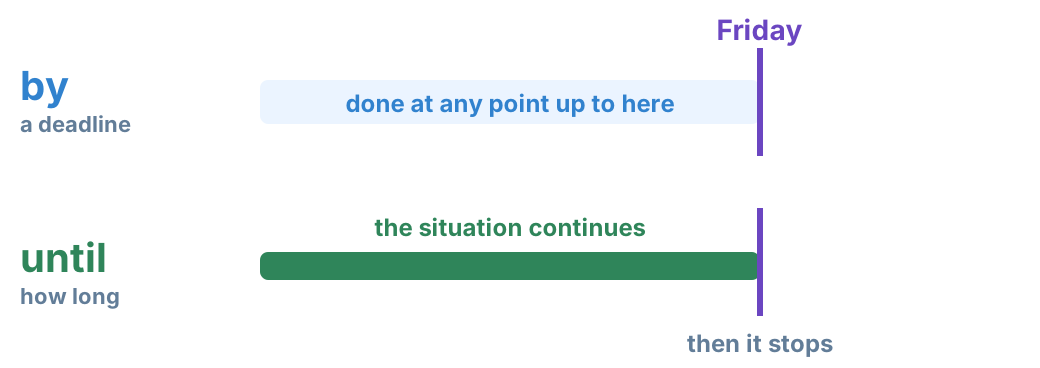
The rule: By is a deadline. Until is how long something continues. From…to gives both ends, within means inside the time frame, and over describes change across a period.
By is a deadline. Until is how long.
from…to, within, and over
| Word | Meaning | Example |
|---|---|---|
| from…to | both ends of a range | The store is open from 9 a.m. to 6 p.m. |
| within | any point before the time frame ends | It must be submitted within 24 hours. |
| over | a stretch of time in which something changes | Things have changed over the years. |
Till is a casual form of until.
Common errors in this part
- by and until confused
The pool stays open by 9 p.m.✓ The pool stays open until 9 p.m.Staying open continues up to 9 p.m. - by and until confused
Return the library books until Monday.✓ Return the library books by Monday.Monday is a deadline. - in and within confused
Delivery is free in 10 miles of the store.✓ Delivery is free within 10 miles of the store.Within means inside a limit.
More: from…to and until
You can give only the end point, or both ends: The café is open until 11 p.m. or Classes run from April to July.
Before, after, ago, and in
Counted from now or from another event? The starting point decides.
The rule: Ago counts back from now, and in plus a time counts forward. Before and after compare with a second time or event.
Ago looks back from now. In looks forward.
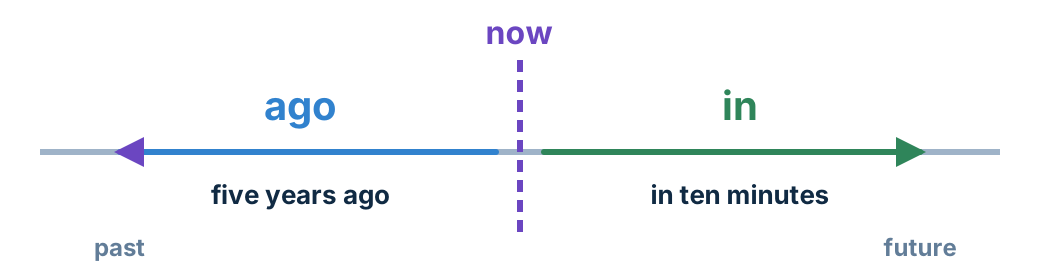
Before and after compare with another time
| Word | Meaning | Example |
|---|---|---|
| before | earlier than something else | We need to leave before 8 a.m. |
| after | later than something else | We will meet after lunch. |
Ago usually goes with the past simple and comes after the time: I moved here five years ago. It never stands before the time.
To count forward from now, use in, not after: the train leaves in ten minutes, not after ten minutes. After needs another time or event: after lunch, after the game.
Common errors in this part
- ago, before, and after confused
We bought this car before three years.✓ We bought this car three years ago.Ago counts back from now. - ago, before, and after confused
The guests left ago an hour.✓ The guests left an hour ago.Ago comes after the time. - after used for time from now
The doctor will see you after five minutes.✓ The doctor will see you in five minutes.In counts forward from now.
Look-alikes and no preposition
Which look-alike, or is no preposition needed? What the sentence measures decides.
The rule: Ask what the sentence measures: a length, a deadline, or a position. This, last, next, every, yesterday, and tomorrow usually take no in, on, or at.
Ask what the sentence measures
| Pair | Choose the first when | Choose the second when |
|---|---|---|
| for / during | you give an amount: for two hours | you name an event: during the meeting |
| for / since | you give a length: for ten years | you give a start: since 2015 |
| by / until | it is a deadline: by Friday | it continues to a point: until Friday |
| in / within | it is exactly that far ahead: in ten minutes | it can happen any time before: within ten minutes |
When no preposition is needed
Say
We leave next Friday.
I saw her last night.
She called me yesterday.
I run every morning.
Not
We leave on next Friday.I saw her at last night.She called me in yesterday.I run in every morning.
This rule is about in, on, and at. Other prepositions can still come first when they add meaning: by tomorrow, until next week, since last year.
Common errors in this part
- a preposition where none is needed
The festival starts on next Saturday.✓ The festival starts next Saturday.Next takes no in, on, or at. - a preposition where none is needed
It rained a lot in last week.✓ It rained a lot last week.Last takes no in, on, or at. - a preposition where none is needed
She waters the plants in every day.✓ She waters the plants every day.Every takes no in, on, or at.
Self-check
Is each sentence correct? Tap to see the answer. The part label tells you where to look if you were not sure.
Part 1The museum opens on 10 a.m.
Incorrect. The museum opens at 10 a.m. Clock times take at.
Part 1Our school was built in 1987.
Correct. Years take in.
Part 2He has taught math since eight years.
Incorrect. He has taught math for eight years. Eight years is a length of time.
Part 2I fell asleep while the teacher was talking.
Correct. The teacher was talking has a subject and verb, so while.
Part 3The sale continues by Sunday.
Incorrect. The sale continues until Sunday. The sale goes on up to that day.
Part 3The tickets must be booked by March 1.
Correct. By gives a deadline.
Part 4She started the job before two months.
Incorrect. She started the job two months ago. Ago counts back from now and follows the time.
Part 4The pizza will arrive in half an hour.
Correct. In plus a length of time counts forward from now.
Part 5We are going camping on this weekend.
Incorrect. We are going camping this weekend. This takes no in, on, or at.
Part 5The printer has not worked since Monday.
Correct. Monday is a starting point, so since.
AI practice prompt
Paste this into an AI chat tool and replace the bracket with your language.