
Comparatives and superlatives are how English measures one thing against another: cheaper, more expensive, the best, as good as. This guide covers the basic forms first, then the patterns that show how big a difference is and how two changes move together.
关于本指南: 比较级和最高级
比较级和最高级用来说明两个或更多事物之间的差别:bigger、more expensive、the best、as good as。前三个部分讲基本形式,适合 B1 水平;后两个部分讲差别的大小(much、slightly、twice as … as)和 the more …, the more … 等高级句型,也可作为 C1 复习。本指南分为五个部分,与诊断测试的五个部分完全对应。
你可以先做诊断测验,看看这个主题的哪些部分需要复习,也可以直接进入练习活动,其中包含复习幻灯片。
本指南本身为英文。这些翻译只是额外提供的便利,可能不够完美。
このガイドについて: 比較級と最上級
比較級と最上級は、2 つ以上のものの違いを表します:bigger、more expensive、the best、as good as。最初の 3 つのパートは B1 向けの基本の形、残りの 2 つのパートは差の大きさ(much、slightly、twice as … as)や the more …, the more … などの上級パターンを扱い、C1 の復習にも使えます。このガイドは 5 つのパートで、診断テストの 5 つのパートと完全に対応しています。
まず診断テストを受けて、このテーマのどの部分を復習すべきか確認することもできますし、復習スライドを含む練習アクティビティにそのまま進むこともできます。
このガイド自体は英語です。これらの翻訳は補助として提供しているもので、完全とは限りません。
이 가이드 소개: 비교급과 최상급
비교급과 최상급은 둘 이상의 대상이 어떻게 다른지 말할 때 씁니다: bigger, more expensive, the best, as good as. 처음 세 부분은 B1 수준의 기본 형태를, 나머지 두 부분은 차이의 크기(much, slightly, twice as … as)와 the more …, the more … 같은 고급 패턴을 다루며 C1 복습용으로도 좋습니다. 이 가이드는 다섯 부분으로 되어 있으며, 진단 테스트의 다섯 부분과 정확히 일치합니다.
먼저 진단 퀴즈로 이 주제에서 복습이 필요한 부분을 확인해도 되고, 복습 슬라이드가 포함된 연습 활동으로 바로 들어가도 됩니다.
가이드 자체는 영어로 되어 있습니다. 이 번역은 부가적으로 제공되는 것이며 완벽하지 않을 수 있습니다.
Giới thiệu hướng dẫn này: So sánh hơn và so sánh nhất
So sánh hơn và so sánh nhất cho biết hai hay nhiều thứ khác nhau thế nào: bigger, more expensive, the best, as good as. Ba phần đầu trình bày các dạng cơ bản ở trình độ B1; hai phần sau nói về mức độ khác biệt (much, slightly, twice as … as) và các mẫu nâng cao như the more …, the more …, cũng phù hợp để ôn tập ở trình độ C1. Hướng dẫn này gồm năm phần, khớp chính xác với năm phần của bài kiểm tra chẩn đoán.
Bạn có thể bắt đầu bằng bài kiểm tra chẩn đoán để biết phần nào cần ôn lại, hoặc vào thẳng các hoạt động luyện tập, trong đó có cả slide ôn tập.
Đọc hướng dẫn bằng tiếng Việt →
Bản hướng dẫn này được viết bằng tiếng Anh. Các bản dịch chỉ là phần hỗ trợ thêm và có thể chưa hoàn hảo.
इस गाइड के बारे में: तुलनात्मक और अतिशयवाचक रूप (comparatives and superlatives)
Comparatives और superlatives से बताया जाता है कि दो या अधिक चीज़ें कैसे अलग हैं: bigger, more expensive, the best, as good as। पहले तीन भाग B1 स्तर के बुनियादी रूप सिखाते हैं; बाकी दो भाग अंतर की मात्रा (much, slightly, twice as … as) और the more …, the more … जैसे उन्नत ढाँचे सिखाते हैं, जो C1 के दोहराव के लिए भी उपयोगी हैं। इस गाइड के पाँच भाग हैं, जो निदान परीक्षा के पाँच भागों से ठीक मेल खाते हैं।
आप निदान क्विज़ से शुरू करके जान सकते हैं कि इस विषय के कौन-से भाग दोहराने चाहिए, या सीधे अभ्यास गतिविधियों में जा सकते हैं, जिनमें दोहराव की स्लाइडें भी हैं।
गाइड स्वयं अंग्रेज़ी में है। ये अनुवाद अतिरिक्त सुविधा के रूप में हैं और पूरी तरह सटीक न भी हों।
نبذة عن هذا الدليل: صيغ المقارنة والتفضيل
تُستخدم صيغ المقارنة والتفضيل لبيان الفرق بين شيئين أو أكثر، مثل bigger وmore expensive وthe best وas good as. تتناول الأجزاء الثلاثة الأولى الصيغ الأساسية لمستوى B1، ويتناول الجزآن الأخيران مقدار الفرق (much وslightly وtwice as … as) وأنماطًا متقدمة مثل the more …, the more …، وهي مفيدة أيضًا للمراجعة في مستوى C1. يتكون هذا الدليل من خمسة أجزاء تطابق تمامًا الأجزاء الخمسة في الاختبار التشخيصي.
يمكنك البدء بالاختبار التشخيصي لمعرفة الأجزاء التي تحتاج إلى مراجعة، أو الانتقال مباشرة إلى أنشطة التدريب، وتشمل شرائح مراجعة.
الدليل نفسه بالإنجليزية. هذه الترجمات مجرد خدمة إضافية وقد لا تكون دقيقة تمامًا.
Об этом руководстве: Сравнительная и превосходная степени
Сравнительная и превосходная степени показывают, чем отличаются два или несколько предметов: bigger, more expensive, the best, as good as. Первые три части посвящены базовым формам уровня B1, а последние две разбирают величину разницы (much, slightly, twice as … as) и продвинутые модели вроде the more …, the more …; они подойдут и для повторения на уровне C1. В этом руководстве пять частей, и они точно соответствуют пяти частям диагностического теста.
Можно начать с диагностического теста, чтобы узнать, какие части темы стоит повторить, или сразу перейти к упражнениям, в которые входят слайды для повторения.
Читать руководство на русском →
Само руководство написано на английском. Эти переводы — дополнительная помощь, и они могут быть неидеальными.
Acerca de esta guía: Comparativos y superlativos
Los comparativos y superlativos sirven para decir en qué se diferencian dos o más cosas: bigger, more expensive, the best, as good as. Las tres primeras partes tratan las formas básicas de nivel B1; las dos últimas tratan el tamaño de la diferencia (much, slightly, twice as … as) y estructuras avanzadas como the more …, the more …, útiles también como repaso en el nivel C1. Esta guía tiene cinco partes, y coinciden exactamente con las cinco partes del diagnóstico.
Puedes empezar con el cuestionario de diagnóstico para saber qué partes del tema conviene repasar, o ir directamente a las actividades de práctica, que incluyen diapositivas de repaso.
La guía en sí está en inglés. Estas traducciones son un añadido de cortesía y pueden no ser perfectas.
À propos de ce guide: Comparatifs et superlatifs
Les comparatifs et les superlatifs servent à dire en quoi deux choses ou plus diffèrent : bigger, more expensive, the best, as good as. Les trois premières parties présentent les formes de base du niveau B1 ; les deux dernières traitent de l'ampleur de la différence (much, slightly, twice as … as) et de structures avancées comme the more …, the more …, utiles aussi pour réviser au niveau C1. Ce guide comporte cinq parties, qui correspondent exactement aux cinq parties du diagnostic.
Vous pouvez commencer par le quiz de diagnostic pour savoir quelles parties du sujet réviser, ou passer directement aux activités d'entraînement, qui comprennent des diapositives de révision.
Le guide lui-même est en anglais. Ces traductions sont un complément offert et peuvent ne pas être parfaites.
Sobre este guia: Comparativos e superlativos
Os comparativos e superlativos servem para dizer em que duas ou mais coisas se diferenciam: bigger, more expensive, the best, as good as. As três primeiras partes tratam das formas básicas do nível B1; as duas últimas tratam do tamanho da diferença (much, slightly, twice as … as) e de estruturas avançadas como the more …, the more …, úteis também como revisão no nível C1. Este guia tem cinco partes, que correspondem exatamente às cinco partes do teste diagnóstico.
Você pode começar pelo teste diagnóstico para ver quais partes do tema precisam de revisão, ou ir direto para as atividades de prática, que incluem slides de revisão.
O guia em si está em inglês. Estas traduções são um recurso extra e podem não ser perfeitas.
Your diagnostic result says which part needs review. Tap that part below.
Three ways to compare
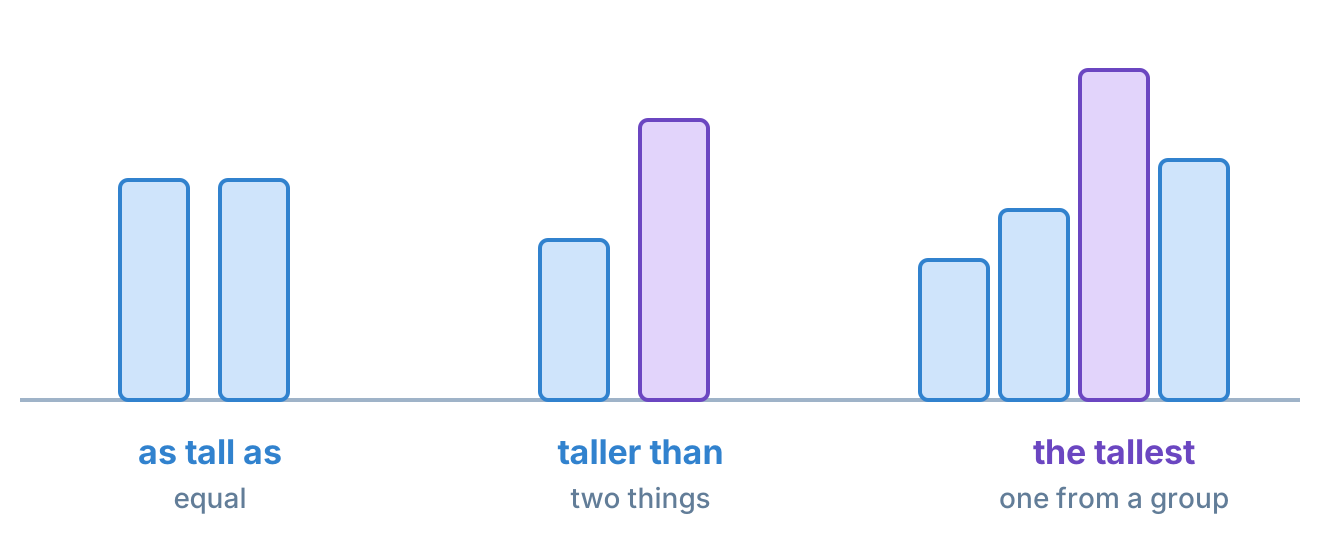
Every comparison starts with one question: are the things equal, is one more than the other, or is one the most in its group?
| Meaning | Pattern | Example |
|---|---|---|
| Equal | as + adjective + as | Ana is as tall as her father. |
| Less | not as … as, less … than | The ferry is not as fast as the plane. |
| More (two things) | comparative + than | Gold is heavier than silver. |
| Most (one from a group) | the + superlative | Jupiter is the largest planet in the solar system. |
Basic patterns (B1)
Parts 1 to 3 cover the forms and the three basic ways to compare. If you are at B1, start here.
Advanced patterns (B2 to C1)
Parts 4 and 5 cover the size of a difference (much, slightly, by far, twice as … as) and patterns such as the more …, the more …. If you are at C1, use them as a review.
Building the forms
Does the word take -er or more? Is it irregular?
The rule: Short words add -er and -est, long words take more and most, and good, bad, far, and little are irregular. Use one marker only: not more better.
Which ending?
| Word | Rule | Comparative | Superlative |
|---|---|---|---|
| small, cheap, young | one syllable: add -er, -est | smaller | the smallest |
| nice, wide | ends in -e: add -r, -st | nicer | the nicest |
| thin, sad | one short vowel + one consonant: double it | thinner | the saddest |
| happy, busy, early | ends in -y: change y to i | happier | the busiest |
| modern, famous | most other two-syllable words: more, most | more modern | the most famous |
| beautiful, important | three or more syllables: more, most | more important | the most beautiful |
| quickly, clearly | -ly adverbs: more, most | more quickly | the most clearly |
| fast, hard, late | adverbs without -ly: add -er, -est | faster | the hardest |
Irregular forms
| Word | Comparative | Superlative |
|---|---|---|
| good, well | better | the best |
| bad, badly | worse | the worst |
| far | farther, further | the farthest, the furthest |
| little (amount) | less | the least |
| much, many | more | the most |
Farther or further?
Both are used for distance. Only further means extra or additional: further details, further questions.
Two-syllable words
Some two-syllable words, such as quiet, simple, narrow, and clever, accept both forms: quieter or more quiet. Words ending in -y usually take -ier.
Adjectives that come from -ed forms take more, even when they are short: more tired, more bored, more worried.
Common errors in this part
- Double comparative
This route is more shorter.✓ This route is shorter.Shorter already means more short. - -er or -est where more or most is needed
This sofa is comfortabler.✓ This sofa is more comfortable.Comfortable has more than two syllables. - Regular ending on an irregular word
Her score was badder than mine.✓ Her score was worse than mine.Bad is irregular: worse, the worst.
Comparative or superlative?
Are you comparing two things or picking one from a group?
The rule: Use a comparative + than for two things and the + superlative for one from a group. After a superlative, use in for places and groups and of for sets and periods. One of the takes a plural noun.
Two things or a group?
| Situation | Clue words | Example |
|---|---|---|
| Two people or things | than | This bag is lighter than that one. |
| One from a group of three or more | in, of, all, ever, among | She is the fastest runner in the club. |
| Second, third, and so on | the second, the third | K2 is the second highest mountain in the world. |
| The lowest degree | the least | This is the least expensive option. |
Partner words after a superlative
| Partner | Use | Example |
|---|---|---|
| in | a place or an organization | the oldest tree in the park, the best team in the league |
| of | a period or a set | the busiest week of the month, the cheapest of the three |
| one of the + plural noun | one member of a top group | one of the most famous paintings in the world |
| present perfect + ever | your whole experience | the longest I have ever waited |
Two items, careful style
When there are exactly two, careful writers use the comparative: the taller of the two brothers. In everyday speech, the superlative is also common here. In informal American English, the simple past also appears after a superlative: the best movie I ever saw.
Common errors in this part
- Comparative and superlative mixed
Amir is the taller person in our office.✓ Amir is the tallest person in our office.In our office shows a group of more than two. - Wrong word after a superlative
It is the longest bridge of the country.✓ It is the longest bridge in the country.A country is a place, so use in. - Singular noun after one of the
This is one of the hardest job I've had.✓ This is one of the hardest jobs I've had.One of the takes a plural noun.
As … as, same, and different
Are the things equal, or is one less?
The rule: Use as + adjective + as for equal things and not as … as or less … than for less. Say the same as, similar to, and different from.
Equal and less
| Pattern | Meaning | Example |
|---|---|---|
| as + adjective + as | equal | This room is as bright as the kitchen. |
| not as + adjective + as | less | The remake is not as funny as the original. |
| less + adjective + than | less | The new model is less noisy than the old one. |
| as much / many + noun + as | equal amount | I don’t have as many followers as you. |
| just as, almost as, nowhere near as | how close | The copy is almost as sharp as the original. |
Fixed partners
| Pattern | Example |
|---|---|
| the same as | My password is the same as before. |
| the same + noun + as | He is the same height as his son. |
| similar to | Portuguese is similar to Spanish in many ways. |
| different from | The final version is different from the draft. |
| like (before a noun, for appearance or manner) | She looks like her grandmother. |
as tall as me or as tall as I am?
Both are accepted. A pronoun such as me is normal in everyday English. Adding the verb (as I am, as she does) sounds more formal. Different than (American) and different to (British) are also common.
Common errors in this part
- as and than mixed
Her car is as old than mine.✓ Her car is as old as mine.As … as uses as twice. - Wrong word after same, similar, or different
His opinion is similar with mine.✓ His opinion is similar to mine.Similar takes to. - Wrong word after same, similar, or different
Your shoes are the same size like mine.✓ Your shoes are the same size as mine.The same + noun + as.
How big is the difference?
Is the difference big or small? Is it a multiple?
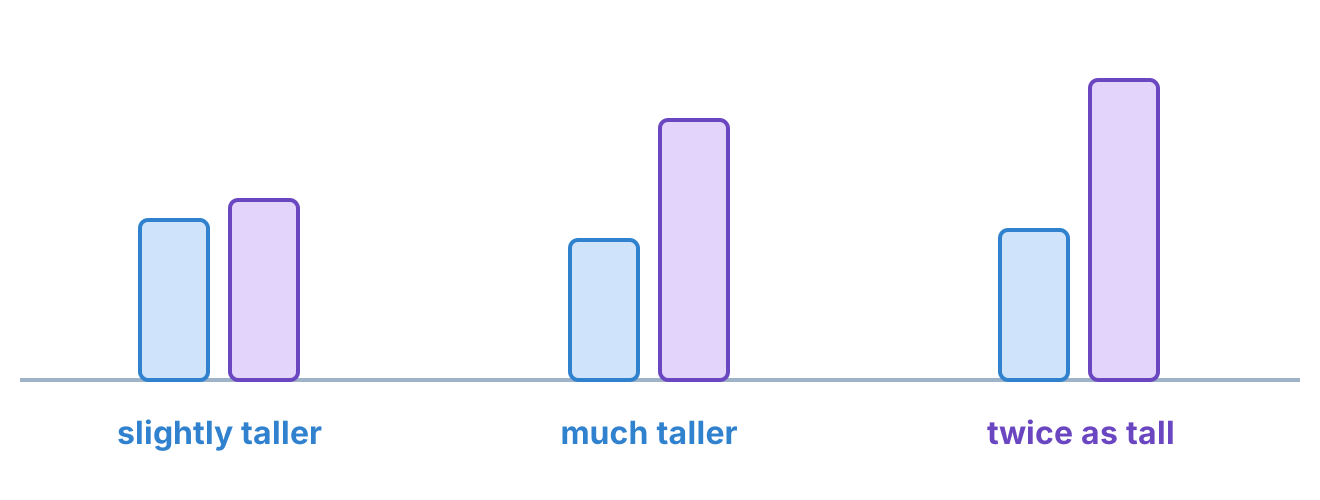
The rule: Before a comparative, use much, far, or a lot for a big difference and slightly or a bit for a small one, not very. Multiples take twice, three times, or half + as … as.
Words before a comparative
| Size of difference | Words | Example |
|---|---|---|
| Big | much, far, a lot, considerably, significantly | far more reliable, a lot cheaper |
| Small | slightly, a bit, a little, marginally | slightly longer, a bit more complicated |
| More than expected | even, still | The sequel was even better. |
| Strong superlative | by far, easily | by far the hardest question, easily the most popular |
much more or many more?
| Before | Use | Example |
|---|---|---|
| a noncount noun | much more, a little more, a lot more | much more space, a little more patience |
| a plural noun | many more, a few more, a lot more | many more options, a few more minutes |
Multiples
| Pattern | Example |
|---|---|
| twice as + adjective + as | The tablet is twice as thick as the phone. |
| three times as + adjective + as | The tower is three times as tall as the church. |
| half as + adjective + as | The new route is half as long. |
| twice the + noun + of | The lake is twice the depth of the reservoir. |
| three times + comparative + than | Common in news writing, but some editors avoid it, and twice bigger than is usually avoided in careful English. |
Grammar recap
The Modifiers guide covers these words in a wider setting, together with very, extremely, absolutely, and so or such.
Common errors in this part
- very before a comparative
The new version is very better.✓ The new version is much better.Very does not go directly before a comparative. - Noncount and plural mixed
We need much more chairs.✓ We need many more chairs.Chairs is a plural noun. - Broken multiple pattern
This box is twice as heavier as that one.✓ This box is twice as heavy as that one.Between as and as, the adjective keeps its basic form.
Advanced patterns
Do two changes move together? Is something changing over time?
The rule: The + comparative …, the + comparative … links two changes. Repeat a comparative to show change over time. After than or as, a verb that matches the main verb can finish the comparison.
The more …, the more …
| Pattern | Example |
|---|---|
| the + comparative + subject + verb, the + comparative + subject + verb | The earlier you book, the cheaper the ticket is. |
| the more + noun + subject + verb | The more questions you ask, the more you understand. |
| the more / less + long adjective + subject + verb | The less crowded the beach is, the happier I am. |
| no verb (short or formal) | The bigger the screen, the higher the price. The sooner, the better. |
The comparative comes first, then the subject and verb: the busier you are, not the more you are busy.
Change over time
| Pattern | Example |
|---|---|
| comparative + and + comparative | The queue got longer and longer. |
| more and more + long adjective | The puzzles became more and more difficult. |
| less and less + adjective | The village is less and less crowded each winter. |
Finishing the comparison with a verb
| Main verb | After than or as | Example |
|---|---|---|
| action verb, present | do / does | She types faster than I do. |
| action verb, past | did | We stayed longer than they did. |
| be | am / is / are / was / were | The hall is bigger than it was. |
| modal | can / will / could | He can swim farther than I can. |
than me or than I do?
Both are correct. Than me is normal in conversation. Than I do is more formal, and it is needed when the verb carries tense or meaning: She earns more now than she did then.
Common errors in this part
- Missing the
The more you laugh, more you relax.✓ The more you laugh, the more you relax.Both halves need the. - Broken the more …, the more … pattern
The more you are busy, the less you sleep.✓ The busier you are, the less you sleep.The comparative comes first, then the subject and verb. - Broken change-over-time pattern
The music got more and more louder.✓ The music got louder and louder.Short words repeat the -er form.
Self-check
Is each sentence correct? Tap to see the answer. The part label tells you where to look if you were not sure.
Part 1Their new house is bigger than ours.
Correct. Big doubles the g before -er.
Part 1This exercise is more easy than the last one.
Incorrect. Easy ends in -y: This exercise is easier than the last one.
Part 2Lake Victoria is the largest lake in Africa.
Correct. One lake is picked from a group, and a place takes in.
Part 2It was one of the strangest day of my life.
Incorrect. One of the takes a plural noun: one of the strangest days of my life.
Part 3My score was not as high as I hoped.
Correct. Not as … as means less.
Part 3Her bag is different with mine.
Incorrect. Use different from: Her bag is different from mine.
Part 4The new train is a lot faster than the old one.
Correct. A lot shows a big difference before a comparative.
Part 4The second room is three times as larger as the first.
Incorrect. The adjective keeps its basic form: three times as large as the first.
Part 5The harder you train, the stronger you become.
Correct. Both halves use the + comparative.
Part 5My grandmother walks faster than I am.
Incorrect. Walks is an action verb, so use do: faster than I do.
AI practice prompt
Paste this into an AI chat tool and replace the bracket with your language.