
Los comparativos y superlativos son la forma en que el inglés mide una cosa frente a otra: cheaper, more expensive, the best, as good as. Esta guía trata primero las formas básicas y luego las estructuras que muestran el tamaño de una diferencia y cómo dos cambios avanzan juntos.
Leer la guía en inglés → Esta página está traducida automáticamente y no la ha revisado un hablante nativo, por lo que puede contener errores. La versión en inglés es la de referencia.
El resultado de tu diagnóstico indica qué parte necesitas repasar. Toca esa parte más abajo.
Tres maneras de comparar
Toda comparación empieza con una pregunta: ¿las cosas son iguales, una es más que la otra, o una es la que más destaca en su grupo?
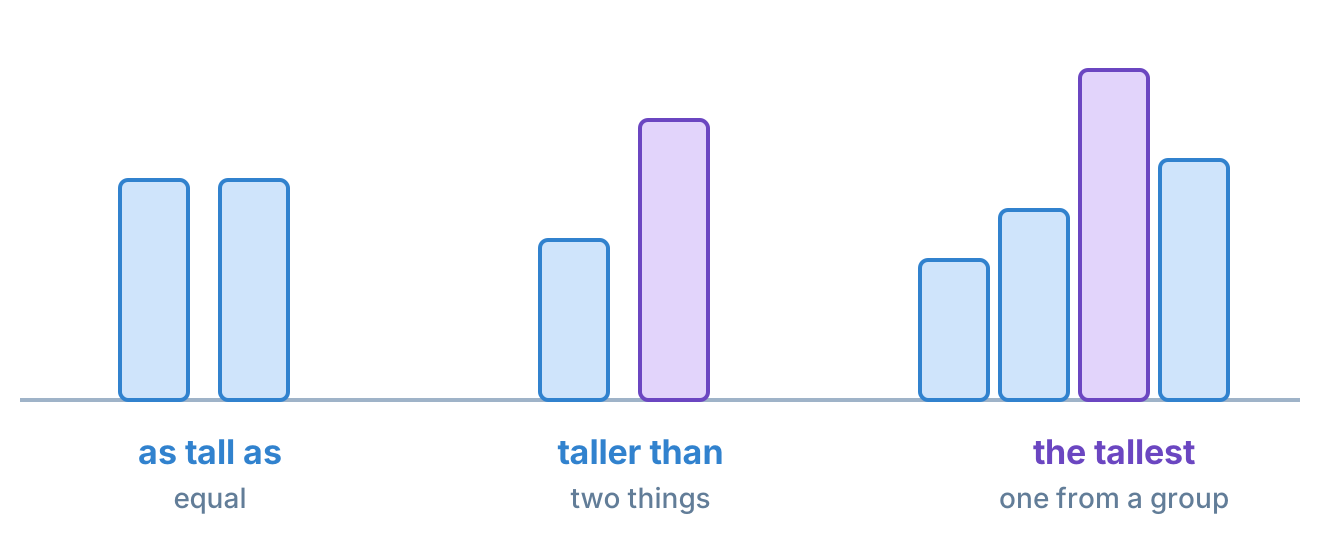
| Significado | Patrón | Ejemplo |
|---|---|---|
| Igual | as + adjetivo + as | Ana is as tall as her father. |
| Menos | not as … as, less … than | The ferry is not as fast as the plane. |
| Más (dos cosas) | comparativo + than | Gold is heavier than silver. |
| El máximo (una de un grupo) | the + superlativo | Jupiter is the largest planet in the solar system. |
Estructuras básicas (B1)
Las partes 1 a 3 tratan las formas y las tres maneras básicas de comparar. Si tienes nivel B1, empieza aquí.
Estructuras avanzadas (B2 a C1)
Las partes 4 y 5 tratan el tamaño de una diferencia (much, slightly, by far, twice as … as) y estructuras como the more …, the more …. Si tienes nivel C1, úsalas como repaso.
Construir las formas
¿La palabra lleva -er o more? ¿Es irregular?
La regla: Las palabras cortas añaden -er y -est, las largas llevan more y most, y good, bad, far y little son irregulares. Usa una sola marca: no more better.
¿Qué terminación?
| Palabra | Regla | Comparativo | Superlativo |
|---|---|---|---|
| small, cheap, young | una sílaba: añade -er, -est | smaller | the smallest |
| nice, wide | termina en -e: añade -r, -st | nicer | the nicest |
| thin, sad | una vocal corta + una consonante: duplica la consonante | thinner | the saddest |
| happy, busy, early | termina en -y: cambia la y por i | happier | the busiest |
| modern, famous | la mayoría de las demás palabras de dos sílabas: more, most | more modern | the most famous |
| beautiful, important | tres sílabas o más: more, most | more important | the most beautiful |
| quickly, clearly | adverbios en -ly: more, most | more quickly | the most clearly |
| fast, hard, late | adverbios sin -ly: añade -er, -est | faster | the hardest |
Formas irregulares
| Palabra | Comparativo | Superlativo |
|---|---|---|
| good, well | better | the best |
| bad, badly | worse | the worst |
| far | farther, further | the farthest, the furthest |
| little (cantidad) | less | the least |
| much, many | more | the most |
¿Farther o further?
Las dos se usan para la distancia. Solo further significa extra o adicional: further details, further questions.
Palabras de dos sílabas
Algunas palabras de dos sílabas, como quiet, simple, narrow y clever, aceptan las dos formas: quieter o more quiet. Las palabras que terminan en -y suelen llevar -ier.
Los adjetivos que vienen de formas en -ed llevan more, aunque sean cortos: more tired, more bored, more worried.
Errores comunes en esta parte
- Comparativo doble
This route is more shorter.✓ This route is shorter.Shorter ya significa more short. - -er o -est donde hace falta more o most
This sofa is comfortabler.✓ This sofa is more comfortable.Comfortable tiene más de dos sílabas. - Terminación regular en una palabra irregular
Her score was badder than mine.✓ Her score was worse than mine.Bad es irregular: worse, the worst.
¿Comparativo o superlativo?
¿Comparas dos cosas o eliges una de un grupo?
La regla: Usa un comparativo + than para dos cosas y the + superlativo para una de un grupo. Después de un superlativo, usa in para lugares y grupos, y of para conjuntos y periodos. One of the lleva un sustantivo plural.
¿Dos cosas o un grupo?
| Situación | Palabras clave | Ejemplo |
|---|---|---|
| Dos personas o cosas | than | This bag is lighter than that one. |
| Una de un grupo de tres o más | in, of, all, ever, among | She is the fastest runner in the club. |
| Segundo, tercero, etc. | the second, the third | K2 is the second highest mountain in the world. |
| El grado más bajo | the least | This is the least expensive option. |
Palabras que acompañan al superlativo
| Palabra acompañante | Uso | Ejemplo |
|---|---|---|
| in | un lugar o una organización | the oldest tree in the park, the best team in the league |
| of | un periodo o un conjunto | the busiest week of the month, the cheapest of the three |
| one of the + sustantivo plural | un miembro de un grupo destacado | one of the most famous paintings in the world |
| presente perfecto + ever | toda tu experiencia | the longest I have ever waited |
Dos elementos, estilo cuidado
Cuando hay exactamente dos, quienes escriben con cuidado usan el comparativo: the taller of the two brothers. En el habla cotidiana, el superlativo también es común aquí. En el inglés americano informal, el pasado simple también aparece después de un superlativo: the best movie I ever saw.
Errores comunes en esta parte
- Mezclar comparativo y superlativo
Amir is the taller person in our office.✓ Amir is the tallest person in our office.In our office indica un grupo de más de dos. - Palabra incorrecta después de un superlativo
It is the longest bridge of the country.✓ It is the longest bridge in the country.Un país es un lugar, así que usa in. - Sustantivo singular después de one of the
This is one of the hardest job I've had.✓ This is one of the hardest jobs I've had.One of the lleva un sustantivo plural.
As … as, same y different
¿Las cosas son iguales, o una es menos?
La regla: Usa as + adjetivo + as para cosas iguales, y not as … as o less … than para indicar menos. Di the same as, similar to y different from.
Igual y menos
| Patrón | Significado | Ejemplo |
|---|---|---|
| as + adjetivo + as | igual | This room is as bright as the kitchen. |
| not as + adjetivo + as | less | The remake is not as funny as the original. |
| less + adjetivo + than | less | The new model is less noisy than the old one. |
| as much / many + sustantivo + as | misma cantidad | I don’t have as many followers as you. |
| just as, almost as, nowhere near as | cuánto se acerca | The copy is almost as sharp as the original. |
Combinaciones fijas
| Patrón | Ejemplo |
|---|---|
| the same as | My password is the same as before. |
| the same + sustantivo + as | He is the same height as his son. |
| similar to | Portuguese is similar to Spanish in many ways. |
| different from | The final version is different from the draft. |
| like (antes de un sustantivo, para el aspecto o la manera) | She looks like her grandmother. |
¿as tall as me o as tall as I am?
Las dos se aceptan. Un pronombre como me es normal en el inglés cotidiano. Añadir el verbo (as I am, as she does) suena más formal. Different than (americano) y different to (británico) también son comunes.
Errores comunes en esta parte
- Mezclar as y than
Her car is as old than mine.✓ Her car is as old as mine.As … as usa as dos veces. - Palabra incorrecta después de same, similar o different
His opinion is similar with mine.✓ His opinion is similar to mine.Similar lleva to. - Palabra incorrecta después de same, similar o different
Your shoes are the same size like mine.✓ Your shoes are the same size as mine.The same + sustantivo + as.
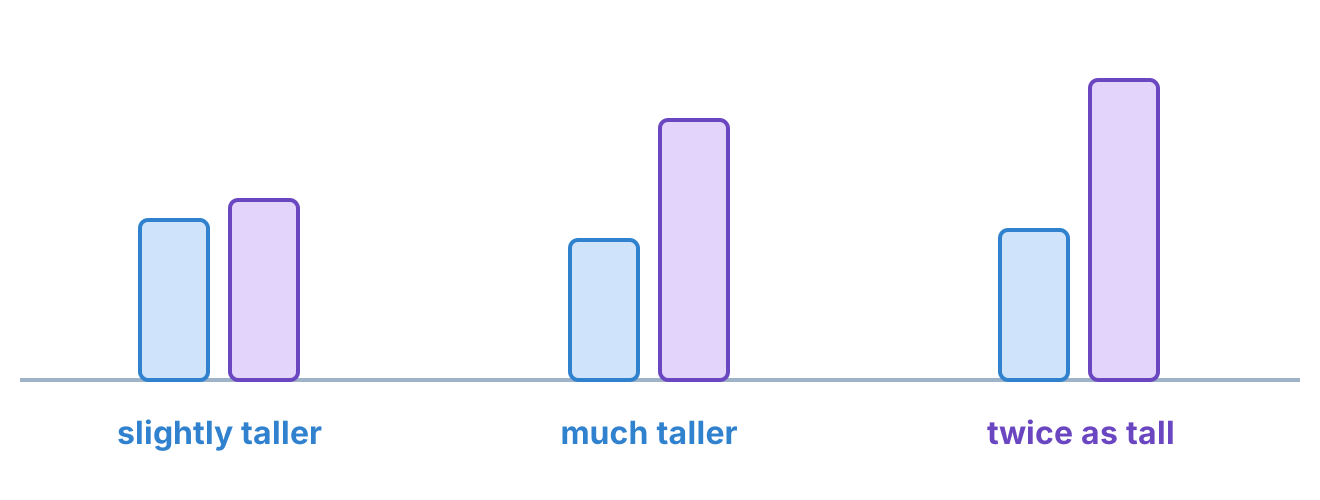
¿Qué tan grande es la diferencia?
¿La diferencia es grande o pequeña? ¿Es un múltiplo?
La regla: Antes de un comparativo, usa much, far o a lot para una diferencia grande, y slightly o a bit para una pequeña, no very. Los múltiplos usan twice, three times o half + as … as.
Palabras antes de un comparativo
| Tamaño de la diferencia | Palabras | Ejemplo |
|---|---|---|
| Grande | much, far, a lot, considerably, significantly | far more reliable, a lot cheaper |
| Pequeña | slightly, a bit, a little, marginally | slightly longer, a bit more complicated |
| Más de lo esperado | even, still | The sequel was even better. |
| Superlativo reforzado | by far, easily | by far the hardest question, easily the most popular |
¿much more o many more?
| Antes de | Uso | Ejemplo |
|---|---|---|
| un sustantivo incontable | much more, a little more, a lot more | much more space, a little more patience |
| un sustantivo plural | many more, a few more, a lot more | many more options, a few more minutes |
Múltiplos
| Patrón | Ejemplo |
|---|---|
| twice as + adjetivo + as | The tablet is twice as thick as the phone. |
| three times as + adjetivo + as | The tower is three times as tall as the church. |
| half as + adjetivo + as | The new route is half as long. |
| twice the + sustantivo + of | The lake is twice the depth of the reservoir. |
| three times + comparativo + than | Common in news writing, but some editors avoid it, and twice bigger than is usually avoided in careful English. |
Repaso gramatical
La guía de modificadores trata estas palabras en un contexto más amplio, junto con very, extremely, absolutely, y so o such.
Errores comunes en esta parte
- very antes de un comparativo
The new version is very better.✓ The new version is much better.Very no va directamente antes de un comparativo. - Mezclar incontable y plural
We need much more chairs.✓ We need many more chairs.Chairs es un sustantivo plural. - Patrón de múltiplo mal construido
This box is twice as heavier as that one.✓ This box is twice as heavy as that one.Entre as y as, el adjetivo mantiene su forma básica.
Estructuras avanzadas
¿Dos cambios avanzan juntos? ¿Algo cambia con el tiempo?
La regla: The + comparativo …, the + comparativo … une dos cambios. Repite un comparativo para mostrar un cambio con el tiempo. Después de than o as, un verbo que corresponde al verbo principal puede cerrar la comparación.
The more …, the more …
| Patrón | Ejemplo |
|---|---|
| the + comparativo + sujeto + verbo, the + comparativo + sujeto + verbo | The earlier you book, the cheaper the ticket is. |
| the more + sustantivo + sujeto + verbo | The more questions you ask, the more you understand. |
| the more / less + adjetivo largo + sujeto + verbo | The less crowded the beach is, the happier I am. |
| sin verbo (forma corta o formal) | The bigger the screen, the higher the price. The sooner, the better. |
Primero va el comparativo y luego el sujeto y el verbo: the busier you are, no the more you are busy.
Cambio con el tiempo
| Patrón | Ejemplo |
|---|---|
| comparativo + and + comparativo | The queue got longer and longer. |
| more and more + adjetivo largo | The puzzles became more and more difficult. |
| less and less + adjetivo | The village is less and less crowded each winter. |
Cerrar la comparación con un verbo
| Verbo principal | Después de than o as | Ejemplo |
|---|---|---|
| verbo de acción, presente | do / does | She types faster than I do. |
| verbo de acción, pasado | did | We stayed longer than they did. |
| be | am / is / are / was / were | The hall is bigger than it was. |
| verbo modal | can / will / could | He can swim farther than I can. |
¿than me o than I do?
Las dos son correctas. Than me es normal en la conversación. Than I do es más formal, y es necesario cuando el verbo aporta tiempo o significado: She earns more now than she did then.
Errores comunes en esta parte
- Falta the
The more you laugh, more you relax.✓ The more you laugh, the more you relax.Las dos mitades necesitan the. - Patrón the more …, the more … mal construido
The more you are busy, the less you sleep.✓ The busier you are, the less you sleep.Primero va el comparativo y luego el sujeto y el verbo. - Patrón de cambio con el tiempo mal construido
The music got more and more louder.✓ The music got louder and louder.Las palabras cortas repiten la forma en -er.
Autoevaluación
¿Es correcta cada oración? Toca para ver la respuesta. La etiqueta de la parte te indica dónde mirar si no estabas seguro.
Parte 1Their new house is bigger than ours.
Correcta. Big duplica la g antes de -er.
Parte 1This exercise is more easy than the last one.
Incorrecta. Easy termina en -y: This exercise is easier than the last one.
Parte 2Lake Victoria is the largest lake in Africa.
Correcta. Se elige un lago de un grupo, y un lugar lleva in.
Parte 2It was one of the strangest day of my life.
Incorrecta. One of the lleva un sustantivo plural: one of the strangest days of my life.
Parte 3My score was not as high as I hoped.
Correcta. Not as … as significa menos.
Parte 3Her bag is different with mine.
Incorrecta. Usa different from: Her bag is different from mine.
Parte 4The new train is a lot faster than the old one.
Correcta. A lot indica una diferencia grande antes de un comparativo.
Parte 4The second room is three times as larger as the first.
Incorrecta. El adjetivo mantiene su forma básica: three times as large as the first.
Parte 5The harder you train, the stronger you become.
Correcta. Las dos mitades usan the + comparativo.
Parte 5My grandmother walks faster than I am.
Incorrecta. Walks es un verbo de acción, así que usa do: faster than I do.
Indicación para practicar con IA
Pega esto en una herramienta de chat con IA.