
Comparativos e superlativos são a forma como o inglês mede uma coisa em relação a outra: cheaper, more expensive, the best, as good as. Este guia trata primeiro das formas básicas e depois das estruturas que mostram o tamanho de uma diferença e como duas mudanças andam juntas.
Ler o guia em inglês → Esta página foi traduzida automaticamente e não foi revisada por um falante nativo, então pode conter erros. A versão em inglês é a de referência.
O resultado do seu diagnóstico mostra qual parte precisa de revisão. Toque nessa parte abaixo.
Três maneiras de comparar
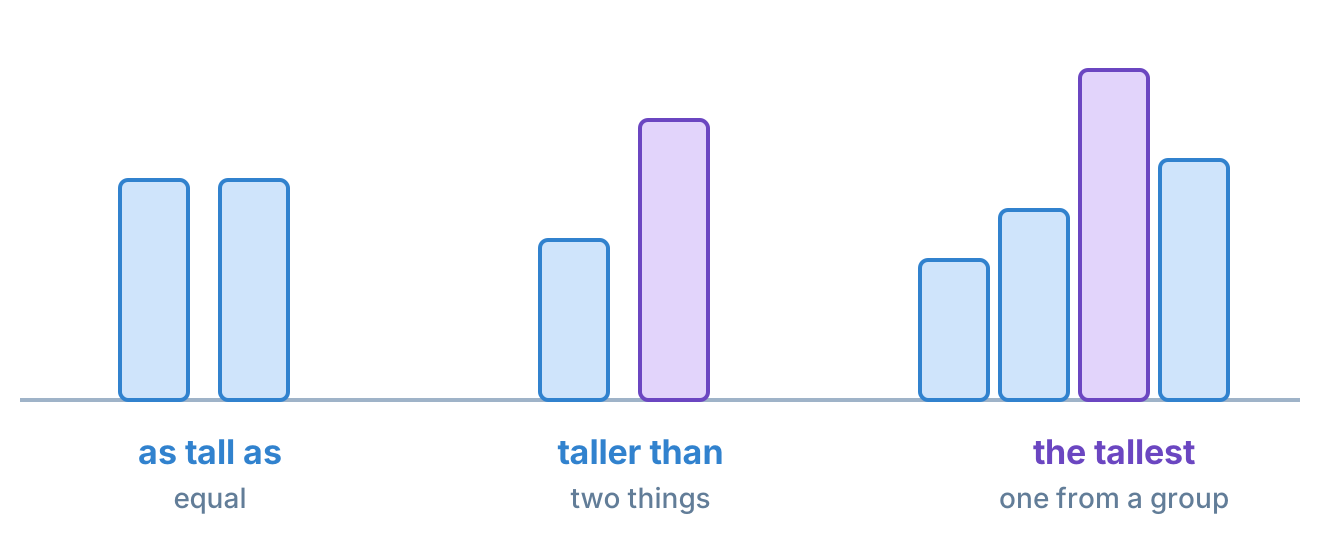
Toda comparação começa com uma pergunta: as coisas são iguais, uma é mais do que a outra ou uma é a que mais se destaca no seu grupo?
| Significado | Estrutura | Exemplo |
|---|---|---|
| Igual | as + adjetivo + as | Ana is as tall as her father. |
| Menos | not as … as, less … than | The ferry is not as fast as the plane. |
| Mais (duas coisas) | comparativo + than | Gold is heavier than silver. |
| O máximo (um de um grupo) | the + superlativo | Jupiter is the largest planet in the solar system. |
Estruturas básicas (B1)
As partes 1 a 3 tratam das formas e das três maneiras básicas de comparar. Se você está no nível B1, comece aqui.
Estruturas avançadas (B2 a C1)
As partes 4 e 5 tratam do tamanho de uma diferença (much, slightly, by far, twice as … as) e de estruturas como the more …, the more …. Se você está no nível C1, use-as como revisão.
Construindo as formas
A palavra leva -er ou more? Ela é irregular?
A regra: Palavras curtas recebem -er e -est, palavras longas levam more e most, e good, bad, far e little são irregulares. Use apenas um marcador: nunca more better.
Qual terminação?
| Palavra | Regra | Comparativo | Superlativo |
|---|---|---|---|
| small, cheap, young | uma sílaba: acrescente -er, -est | smaller | the smallest |
| nice, wide | termina em -e: acrescente -r, -st | nicer | the nicest |
| thin, sad | uma vogal curta + uma consoante: dobre a consoante | thinner | the saddest |
| happy, busy, early | termina em -y: troque y por i | happier | the busiest |
| modern, famous | a maioria das outras palavras de duas sílabas: more, most | more modern | the most famous |
| beautiful, important | três sílabas ou mais: more, most | more important | the most beautiful |
| quickly, clearly | advérbios em -ly: more, most | more quickly | the most clearly |
| fast, hard, late | advérbios sem -ly: acrescente -er, -est | faster | the hardest |
Formas irregulares
| Palavra | Comparativo | Superlativo |
|---|---|---|
| good, well | better | the best |
| bad, badly | worse | the worst |
| far | farther, further | the farthest, the furthest |
| little (quantidade) | less | the least |
| much, many | more | the most |
Farther ou further?
Os dois são usados para distância. Só further significa extra ou adicional: further details, further questions.
Palavras de duas sílabas
Algumas palavras de duas sílabas, como quiet, simple, narrow e clever, aceitam as duas formas: quieter ou more quiet. Palavras terminadas em -y geralmente levam -ier.
Adjetivos que vêm de formas em -ed levam more, mesmo quando são curtos: more tired, more bored, more worried.
Erros comuns nesta parte
- Comparativo duplo
This route is more shorter.✓ This route is shorter.Shorter já significa more short. - -er ou -est onde é preciso more ou most
This sofa is comfortabler.✓ This sofa is more comfortable.Comfortable tem mais de duas sílabas. - Terminação regular em uma palavra irregular
Her score was badder than mine.✓ Her score was worse than mine.Bad é irregular: worse, the worst.
Comparativo ou superlativo?
Você está comparando duas coisas ou escolhendo uma de um grupo?
A regra: Use comparativo + than para duas coisas e the + superlativo para uma de um grupo. Depois de um superlativo, use in para lugares e grupos e of para conjuntos e períodos. One of the leva substantivo plural.
Duas coisas ou um grupo?
| Situação | Palavras-pista | Exemplo |
|---|---|---|
| Duas pessoas ou coisas | than | This bag is lighter than that one. |
| Uma de um grupo de três ou mais | in, of, all, ever, among | She is the fastest runner in the club. |
| Segundo, terceiro etc. | the second, the third | K2 is the second highest mountain in the world. |
| O menor grau | the least | This is the least expensive option. |
Palavras parceiras depois de um superlativo
| Parceira | Uso | Exemplo |
|---|---|---|
| in | um lugar ou uma organização | the oldest tree in the park, the best team in the league |
| of | um período ou um conjunto | the busiest week of the month, the cheapest of the three |
| one of the + substantivo plural | um membro de um grupo de destaque | one of the most famous paintings in the world |
| present perfect + ever | toda a sua experiência | the longest I have ever waited |
Dois itens, estilo cuidadoso
Quando há exatamente dois, quem escreve com cuidado usa o comparativo: the taller of the two brothers. Na fala do dia a dia, o superlativo também é comum aqui. No inglês americano informal, o passado simples também aparece depois de um superlativo: the best movie I ever saw.
Erros comuns nesta parte
- Comparativo e superlativo confundidos
Amir is the taller person in our office.✓ Amir is the tallest person in our office.In our office indica um grupo de mais de dois. - Palavra errada depois de um superlativo
It is the longest bridge of the country.✓ It is the longest bridge in the country.Um país é um lugar, então use in. - Substantivo singular depois de one of the
This is one of the hardest job I've had.✓ This is one of the hardest jobs I've had.One of the leva substantivo plural.
As … as, same e different
As coisas são iguais, ou uma é menos?
A regra: Use as + adjetivo + as para coisas iguais e not as … as ou less … than para menos. Diga the same as, similar to e different from.
Igual e menos
| Estrutura | Significado | Exemplo |
|---|---|---|
| as + adjetivo + as | igual | This room is as bright as the kitchen. |
| not as + adjetivo + as | less | The remake is not as funny as the original. |
| less + adjetivo + than | less | The new model is less noisy than the old one. |
| as much / many + substantivo + as | quantidade igual | I don’t have as many followers as you. |
| just as, almost as, nowhere near as | o quanto se aproxima | The copy is almost as sharp as the original. |
Combinações fixas
| Estrutura | Exemplo |
|---|---|
| the same as | My password is the same as before. |
| the same + substantivo + as | He is the same height as his son. |
| similar to | Portuguese is similar to Spanish in many ways. |
| different from | The final version is different from the draft. |
| like (antes de um substantivo, para aparência ou maneira) | She looks like her grandmother. |
as tall as me ou as tall as I am?
As duas formas são aceitas. Um pronome como me é normal no inglês do dia a dia. Acrescentar o verbo (as I am, as she does) soa mais formal. Different than (americano) e different to (britânico) também são comuns.
Erros comuns nesta parte
- as e than confundidos
Her car is as old than mine.✓ Her car is as old as mine.As … as usa as duas vezes. - Palavra errada depois de same, similar ou different
His opinion is similar with mine.✓ His opinion is similar to mine.Similar leva to. - Palavra errada depois de same, similar ou different
Your shoes are the same size like mine.✓ Your shoes are the same size as mine.The same + substantivo + as.
Qual é o tamanho da diferença?
A diferença é grande ou pequena? É um múltiplo?
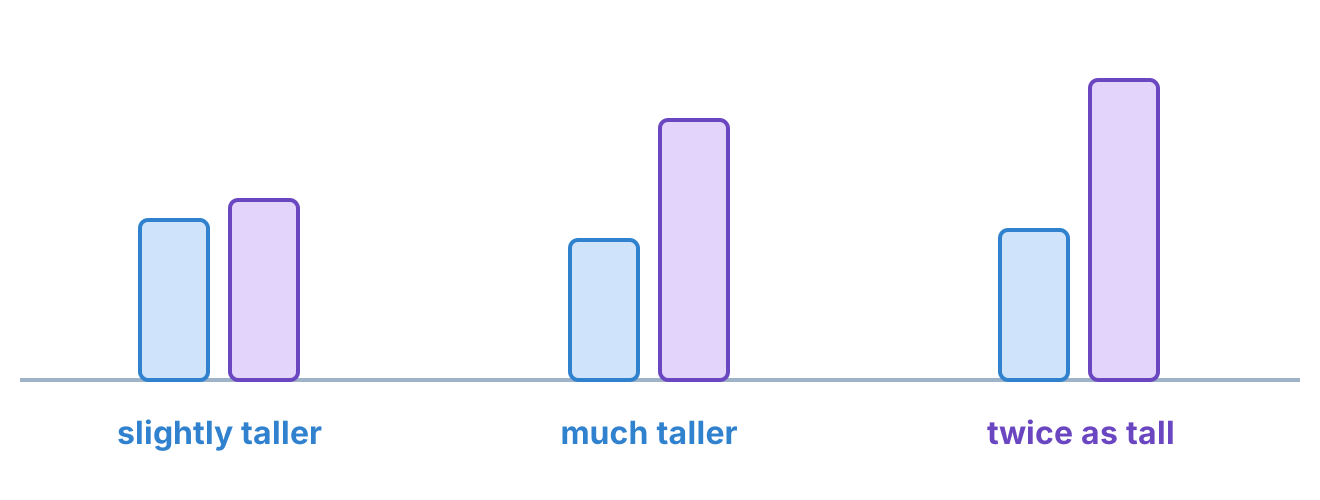
A regra: Antes de um comparativo, use much, far ou a lot para uma diferença grande e slightly ou a bit para uma pequena, não very. Múltiplos usam twice, three times ou half + as … as.
Palavras antes de um comparativo
| Tamanho da diferença | Palavras | Exemplo |
|---|---|---|
| Grande | much, far, a lot, considerably, significantly | far more reliable, a lot cheaper |
| Pequena | slightly, a bit, a little, marginally | slightly longer, a bit more complicated |
| Mais do que o esperado | even, still | The sequel was even better. |
| Superlativo reforçado | by far, easily | by far the hardest question, easily the most popular |
much more ou many more?
| Antes de | Uso | Exemplo |
|---|---|---|
| um substantivo incontável | much more, a little more, a lot more | much more space, a little more patience |
| um substantivo plural | many more, a few more, a lot more | many more options, a few more minutes |
Múltiplos
| Estrutura | Exemplo |
|---|---|
| twice as + adjetivo + as | The tablet is twice as thick as the phone. |
| three times as + adjetivo + as | The tower is three times as tall as the church. |
| half as + adjetivo + as | The new route is half as long. |
| twice the + substantivo + of | The lake is twice the depth of the reservoir. |
| three times + comparativo + than | Common in news writing, but some editors avoid it, and twice bigger than is usually avoided in careful English. |
Resumo de gramática
O guia de modificadores (Modifiers) trata dessas palavras num contexto mais amplo, junto com very, extremely, absolutely e so ou such.
Erros comuns nesta parte
- very antes de um comparativo
The new version is very better.✓ The new version is much better.Very não vem diretamente antes de um comparativo. - Incontável e plural confundidos
We need much more chairs.✓ We need many more chairs.Chairs é um substantivo plural. - Estrutura de múltiplo incorreta
This box is twice as heavier as that one.✓ This box is twice as heavy as that one.Entre as e as, o adjetivo fica na forma básica.
Estruturas avançadas
Duas mudanças andam juntas? Algo está mudando com o tempo?
A regra: The + comparativo …, the + comparativo … liga duas mudanças. Repita um comparativo para mostrar mudança ao longo do tempo. Depois de than ou as, um verbo que corresponde ao verbo principal pode completar a comparação.
The more …, the more …
| Estrutura | Exemplo |
|---|---|
| the + comparativo + sujeito + verbo, the + comparativo + sujeito + verbo | The earlier you book, the cheaper the ticket is. |
| the more + substantivo + sujeito + verbo | The more questions you ask, the more you understand. |
| the more / less + adjetivo longo + sujeito + verbo | The less crowded the beach is, the happier I am. |
| sem verbo (curto ou formal) | The bigger the screen, the higher the price. The sooner, the better. |
O comparativo vem primeiro, depois o sujeito e o verbo: the busier you are, e não the more you are busy.
Mudança ao longo do tempo
| Estrutura | Exemplo |
|---|---|
| comparativo + and + comparativo | The queue got longer and longer. |
| more and more + adjetivo longo | The puzzles became more and more difficult. |
| less and less + adjetivo | The village is less and less crowded each winter. |
Completando a comparação com um verbo
| Verbo principal | Depois de than ou as | Exemplo |
|---|---|---|
| verbo de ação, presente | do / does | She types faster than I do. |
| verbo de ação, passado | did | We stayed longer than they did. |
| be | am / is / are / was / were | The hall is bigger than it was. |
| verbo modal | can / will / could | He can swim farther than I can. |
than me ou than I do?
As duas formas estão corretas. Than me é normal na conversa. Than I do é mais formal, e é necessário quando o verbo carrega tempo ou significado: She earns more now than she did then.
Erros comuns nesta parte
- Falta o the
The more you laugh, more you relax.✓ The more you laugh, the more you relax.As duas metades precisam de the. - Estrutura the more …, the more … incorreta
The more you are busy, the less you sleep.✓ The busier you are, the less you sleep.O comparativo vem primeiro, depois o sujeito e o verbo. - Estrutura de mudança ao longo do tempo incorreta
The music got more and more louder.✓ The music got louder and louder.Palavras curtas repetem a forma em -er.
Autoteste
Cada frase está correta? Toque para ver a resposta. A indicação da parte mostra onde consultar se você não tiver certeza.
Parte 1Their new house is bigger than ours.
Correta. Big dobra o g antes de -er.
Parte 1This exercise is more easy than the last one.
Incorreta. Easy termina em -y: This exercise is easier than the last one.
Parte 2Lake Victoria is the largest lake in Africa.
Correta. Um lago é escolhido de um grupo, e um lugar leva in.
Parte 2It was one of the strangest day of my life.
Incorreta. One of the leva substantivo plural: one of the strangest days of my life.
Parte 3My score was not as high as I hoped.
Correta. Not as … as significa menos.
Parte 3Her bag is different with mine.
Incorreta. Use different from: Her bag is different from mine.
Parte 4The new train is a lot faster than the old one.
Correta. A lot indica uma diferença grande antes de um comparativo.
Parte 4The second room is three times as larger as the first.
Incorreta. O adjetivo fica na forma básica: three times as large as the first.
Parte 5The harder you train, the stronger you become.
Correta. As duas metades usam the + comparativo.
Parte 5My grandmother walks faster than I am.
Incorreta. Walks é um verbo de ação, então use do: faster than I do.
Prompt de prática com IA
Cole isto em uma ferramenta de chat com IA.