
Every sentence with an action has a doer and a receiver. Active and passive voice arrange the same facts in a different order, so the real question is what the sentence is about. This guide covers how to recognize and build the passive in any tense, which verbs can never be passive, the expressions that need be, and how to decide which voice fits.
关于本指南: 主动语态与被动语态
每个含有动作的句子都有施动者和承受者。主动和被动是安排同样事实的两种方式。本主题有四个部分问的是句子是否为被动且构造正确,一个部分问的是它是否应该用被动。本指南分为五个部分,与诊断测试的五个部分完全对应。
你可以先做诊断测验,看看这个主题的哪些部分需要复习,也可以直接进入练习活动,其中包含复习幻灯片。
本指南本身为英文。这些翻译只是额外提供的便利,可能不够完美。
このガイドについて: 能動態と受動態
動作を表すどの文にも、する側と受ける側があります。能動態と受動態は、同じ事実を並べ替える 2 つの方法です。このテーマの 4 つのパートは、文が受動態で正しく作られているかを問い、1 つは、そもそも受動態にすべきかを問います。このガイドは 5 つのパートで、診断テストの 5 つのパートと完全に対応しています。
まず診断テストを受けて、このテーマのどの部分を復習すべきか確認することもできますし、復習スライドを含む練習アクティビティにそのまま進むこともできます。
このガイド自体は英語です。これらの翻訳は補助として提供しているもので、完全とは限りません。
이 가이드 소개: 능동태와 수동태
동작이 있는 모든 문장에는 행위자와 대상이 있습니다. 능동태와 수동태는 같은 사실을 배열하는 두 가지 방법입니다. 이 주제의 네 영역은 문장이 수동태이고 올바르게 만들어졌는지를 묻고, 한 영역은 수동태로 써야 하는지를 묻습니다. 이 가이드는 다섯 부분으로 되어 있으며, 진단 테스트의 다섯 부분과 정확히 일치합니다.
먼저 진단 퀴즈로 이 주제에서 복습이 필요한 부분을 확인해도 되고, 복습 슬라이드가 포함된 연습 활동으로 바로 들어가도 됩니다.
가이드 자체는 영어로 되어 있습니다. 이 번역은 부가적으로 제공되는 것이며 완벽하지 않을 수 있습니다.
Giới thiệu hướng dẫn này: Chủ động và bị động
Mọi câu có hành động đều có người thực hiện và người nhận. Chủ động và bị động là hai cách sắp xếp cùng những sự việc đó. Bốn phần của chủ đề này hỏi câu có phải bị động và được cấu tạo đúng không, và một phần hỏi có nên dùng bị động hay không. Hướng dẫn này gồm năm phần, khớp chính xác với năm phần của bài kiểm tra chẩn đoán.
Bạn có thể bắt đầu bằng bài kiểm tra chẩn đoán để biết phần nào cần ôn lại, hoặc vào thẳng các hoạt động luyện tập, trong đó có cả slide ôn tập.
Đọc hướng dẫn bằng tiếng Việt →
Bản hướng dẫn này được viết bằng tiếng Anh. Các bản dịch chỉ là phần hỗ trợ thêm và có thể chưa hoàn hảo.
इस गाइड के बारे में: Active बनाम passive
हर क्रिया वाले वाक्य में करने वाला और पाने वाला होता है। Active और passive एक ही तथ्यों को सजाने के दो तरीके हैं। इस विषय के चार भाग पूछते हैं कि वाक्य passive है और सही बना है या नहीं, और एक भाग पूछता है कि क्या उसे passive होना चाहिए। इस गाइड के पाँच भाग हैं, जो निदान परीक्षा के पाँच भागों से ठीक मेल खाते हैं।
आप निदान क्विज़ से शुरू करके जान सकते हैं कि इस विषय के कौन-से भाग दोहराने चाहिए, या सीधे अभ्यास गतिविधियों में जा सकते हैं, जिनमें दोहराव की स्लाइडें भी हैं।
गाइड स्वयं अंग्रेज़ी में है। ये अनुवाद अतिरिक्त सुविधा के रूप में हैं और पूरी तरह सटीक न भी हों।
نبذة عن هذا الدليل: المبني للمعلوم والمبني للمجهول
لكل جملة فيها فعل فاعلٌ ومتلقٍّ. والمبني للمعلوم والمبني للمجهول طريقتان لترتيب الحقائق نفسها. أربعة أجزاء من هذا الموضوع تسأل هل الجملة مبنية للمجهول ومبنية بشكل صحيح، وجزء واحد يسأل هل ينبغي أن تكون مبنية للمجهول أصلًا. يتكون هذا الدليل من خمسة أجزاء تطابق تمامًا الأجزاء الخمسة في الاختبار التشخيصي.
يمكنك البدء بالاختبار التشخيصي لمعرفة الأجزاء التي تحتاج إلى مراجعة، أو الانتقال مباشرة إلى أنشطة التدريب، وتشمل شرائح مراجعة.
الدليل نفسه بالإنجليزية. هذه الترجمات مجرد خدمة إضافية وقد لا تكون دقيقة تمامًا.
Об этом руководстве: Актив и пассив
В каждом предложении с действием есть тот, кто действует, и тот, на кого действие направлено. Актив и пассив — два способа расположить одни и те же факты. Четыре части этой темы спрашивают, является ли предложение пассивным и правильно ли оно построено, а одна — стоит ли вообще использовать пассив. В этом руководстве пять частей, и они точно соответствуют пяти частям диагностического теста.
Можно начать с диагностического теста, чтобы узнать, какие части темы стоит повторить, или сразу перейти к упражнениям, в которые входят слайды для повторения.
Читать руководство на русском →
Само руководство написано на английском. Эти переводы — дополнительная помощь, и они могут быть неидеальными.
Acerca de esta guía: Voz activa y pasiva
Toda oración con una acción tiene quien la hace y quien la recibe. La activa y la pasiva son dos formas de ordenar los mismos hechos. Cuatro partes de este tema preguntan si una oración es pasiva y está bien construida, y una pregunta si debería ser pasiva. Esta guía tiene cinco partes, y coinciden exactamente con las cinco partes del diagnóstico.
Puedes empezar con el cuestionario de diagnóstico para saber qué partes del tema conviene repasar, o ir directamente a las actividades de práctica, que incluyen diapositivas de repaso.
La guía en sí está en inglés. Estas traducciones son un añadido de cortesía y pueden no ser perfectas.
À propos de ce guide: Voix active et passive
Toute phrase avec une action a un agent et un receveur. L’actif et le passif sont deux façons d’organiser les mêmes faits. Quatre parties de ce sujet demandent si une phrase est passive et bien construite, et une demande si elle devrait être passive. Ce guide comporte cinq parties, qui correspondent exactement aux cinq parties du diagnostic.
Vous pouvez commencer par le quiz de diagnostic pour savoir quelles parties du sujet réviser, ou passer directement aux activités d’entraînement, qui comprennent des diapositives de révision.
Le guide lui-même est en anglais. Ces traductions sont un complément offert et peuvent ne pas être parfaites.
Sobre este guia: Voz ativa e passiva
Toda frase com uma ação tem quem faz a ação e quem a recebe. A voz ativa e a passiva são duas formas de organizar os mesmos fatos. Quatro partes deste tema perguntam se uma frase é passiva e se está bem construída, e uma pergunta se ela deveria ser passiva. Este guia tem cinco partes, que correspondem exatamente às cinco partes do teste diagnóstico.
Você pode começar pelo teste diagnóstico para ver quais partes do tema precisam de revisão, ou ir direto para as atividades de prática, que incluem slides de revisão.
O guia em si está em inglês. Estas traduções são um recurso extra e podem não ser perfeitas.
Your diagnostic result says which part needs review. Tap that part below.
The core idea
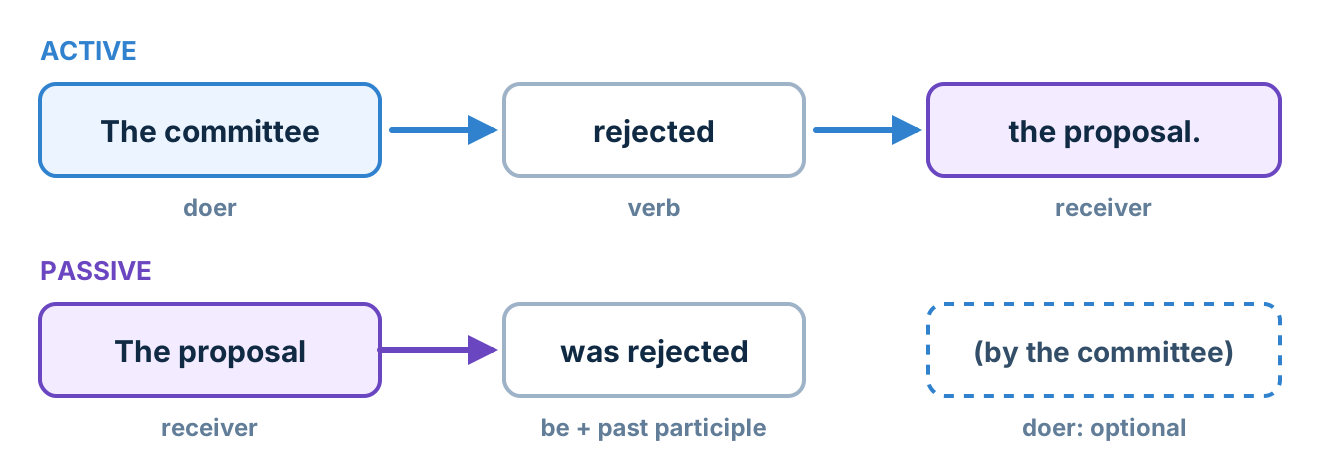
Active and passive are two ways to arrange the same facts. The facts do not change. What changes is which noun comes first, and so what the sentence is about.
| Voice | Pattern | Example | The sentence is about |
|---|---|---|---|
| Active | doer + verb + receiver | The committee rejected the proposal. | the committee |
| Passive | receiver + be + past participle (+ by doer) | The proposal was rejected (by the committee). | the proposal |
- 1
The passive always needs a form of be (is, are, was, were, been, being, be) followed by the past participle (rejected, written, taken). Both halves are required.
- 2
The tense is carried by be. The participle never changes.
- 3
The by phrase is optional, and in real writing it is left out most of the time.
Only verbs that take an object can be passive. Reject, write, build, and give take objects. Happen, arrive, die, and exist do not, so they have no passive form (Part 3).
1
Form
Recognizing the voice
Is this sentence passive or not? Does the subject do the action, or receive it?
The rule: Find the subject. If it receives the action, the verb is be + past participle.
Does the subject do the action or receive it?
Find the subject, then ask: does it do the action, or receive it? If it receives the action, the verb is be + past participle.
Two look-alikes that are not passive
| Form | Example | Passive? |
|---|---|---|
| be + -ing | Workers were painting the hall. | No: active continuous |
| be + being + past participle | The hall was being painted. | Yes: passive continuous |
| be + adjective | The hall was empty. We were late. | No: a state |
| be + past participle | The windows were broken during the storm. | Yes: something broke them |
Sentences on the line
The door was locked can describe a state (it was not open) or an action (someone locked it). Context decides, and both readings are normal English.
Other passives worth recognizing
| Form | Example |
|---|---|
| get-passive (informal) | He got fired. My bike got stolen. |
| two-object verbs | She was offered a promotion. |
| reporting passives | It is believed that the bridge is medieval. He is said to be retiring. |
Common errors in this part
- Passive form for a doer
The students were discussed the article in groups.✓ The students discussed the article in groups.The students did the discussing, so the verb is active. - Active form for a receiver
The new bridge will open by the mayor on Friday.✓ The new bridge will be opened by the mayor on Friday.The bridge receives the action, and the by phrase names the doer. - be + -ing instead of be + past participle
The kitchen is cleaning right now, so please wait outside.✓ The kitchen is being cleaned right now, so please wait outside.The kitchen receives the cleaning: is being cleaned.
2
Form
Building the form
Is the passive put together correctly, in this tense or pattern?
The rule: The passive is be + past participle in every tense and pattern. Change be to match the tense, the subject, and the pattern (be, been, being, to be). Keep the past participle.
The passive in every tense
| Tense | Active | Passive |
|---|---|---|
| present simple | The university publishes the results in June. | The results are published in June. |
| present continuous | They are renovating the library. | The library is being renovated. |
| present perfect | Someone has canceled the meeting. | The meeting has been canceled. |
| past simple | The chef cooked the meal. | The meal was cooked by the chef. |
| past continuous | Workers were repairing the road all week. | The road was being repaired all week. |
| past perfect | The team had finished the report before the deadline. | The report had been finished before the deadline. |
| will | The company will release a new phone. | A new phone will be released. |
| be going to | They are going to close the bridge. | The bridge is going to be closed. |
Future continuous passive (will be being built) and perfect continuous passive (has been being built) are possible but sound heavy. Most writers switch to the active instead.
Modals, infinitives, and -ing forms
| Pattern | Example |
|---|---|
| modal + be + participle | The sample should be stored below four degrees. |
| modal + have been + participle | The error could have been avoided. |
| to be + participle | He wants to be included in the plan. |
| being + participle | She is tired of being asked the same question. |
Verbs with two objects
With give, send, offer, show, tell, teach, and pay, English usually starts the passive with the person: She was offered a promotion. The other version (A promotion was offered to her) is possible but more formal.
Check three things in order
Is be there? Is it the right be for the tense and the subject? Is the verb in its third form?
Common errors in this part
- Missing be
The castle built in the 15th century.✓ The castle was built in the 15th century.A participle alone is not a verb. - Wrong participle
The winners were chose by the audience.✓ The winners were chosen by the audience.Use the third form: chosen. - Wrong agreement
The new computers was installed last week.✓ The new computers were installed last week.be agrees with computers, which is plural.
3
Form and meaning
Verbs that cannot be passive
Does this verb have a passive form at all?
The rule: If nothing receives the action, the verb has no passive form.
Verbs with no passive
The passive moves the object to the front. These verbs never take an object, so there is nothing to move. Many languages express these ideas with a passive-like ending, which is why this error is so common.
Same sentence, different verbs
| Takes an object: passive possible | No object: active only |
|---|---|
| The company was founded in 1987… | …and still exists today. |
| The concert was canceled… | …but the storm happened anyway. |
| The rest of the houses were rebuilt. | Two houses remained after the fire. |
A quick test
Ask what the verb was done to. If there is no answer, there is no passive.
Common errors in this part
- Passive with a verb that takes no object
A strange thing was happened during the exam.✓ A strange thing happened during the exam.Happen has no passive. - Passive with a verb that takes no object
The team is consisted of five engineers.✓ The team consists of five engineers.Consist of is always active. - Active form for a receiver
The old factory closed down and demolished in 2015.✓ The old factory closed down and was demolished in 2015.Close down takes no object, but demolish does.
4
Form and meaning
Feelings and fixed expressions
Does English need be here, even if the idea feels active?
The rule: Use -ed for the person who has a feeling and -ing for what causes it. Some expressions, such as be born, be located, and be married to, need be in English.
-ed or -ing?
| -ed: the person who has the feeling | -ing: the thing that causes it |
|---|---|
| I am bored. | The class is boring. |
| The students were confused. | The lecture was confusing. |
| Even the researchers were surprised. | The findings were surprising. |
I am interesting in economics means you make other people interested. Say I am interested in economics.
Grammar recap
Pairs like bored and boring have their own guide, with more verbs and practice.
Expressions that are passive in English
| Expression | Example |
|---|---|
| be born | She was born in Lagos. |
| be located / be situated | The campus is located near the station. |
| be based | The firm is based in Toronto. |
| be known as / be called | The street is known as the food alley. |
| be married to | He is married to a nurse. |
| be interested in / be involved in | She is involved in the debate club. |
He married a nurse is also correct. It describes the event of marrying. He is married to a nurse describes the present state.
Common errors in this part
- -ing for the person who feels
We were very boring during the long flight.✓ We were very bored during the long flight.We had the feeling, so use bored. - Missing be
My parents born in the same village.✓ My parents were born in the same village.Be born needs be. - Wrong preposition
She is married with a pilot.✓ She is married to a pilot.The phrase is married to.
5
Choice
Choosing the right voice
Should this sentence be passive? This is a judgment, not a rule.
The rule: Ask what the sentence is about. If it is the doer, use active. If it is the thing affected, use passive.
Use the passive when
| Reason | Example |
|---|---|
| The doer is unknown | My wallet was stolen on the subway. |
| The doer is obvious or unimportant | The suspect was arrested yesterday. |
| The result matters more than the doer | Over 200 homes were destroyed in the fire. |
| You are describing a process or method | The samples were heated to 90 degrees and then cooled slowly. |
| You want to keep the same topic | The library opened in March. It was designed by a local firm. |
| You want to avoid blaming someone directly | A mistake was made in the invoice. |
Use the active when
- The doer is the point: Our team won the contract.
- You are telling a story about what people did.
- The passive would hide information the reader needs. “Mistakes were made” is a famous example of a passive used to avoid responsibility.
- You are writing something personal or persuasive, where a clear voice matters.
Active is not always better
Advice to avoid the passive is a style preference, not a grammar rule. In science, law, news, and academic writing, the passive is normal. If you cannot decide, ask what the sentence is about. If you still cannot tell, use the active: it is shorter.
The by phrase
| Sentence | Keep by? |
|---|---|
| Hamlet was written by Shakespeare. | Yes: the doer is the information. |
| The photo was taken by my grandmother in 1962. | Yes: specific and relevant. |
| The thief was arrested by the police. | No: who else would arrest a thief? |
| English is spoken by people all over the world. | No: it adds nothing. |
Register: the get-passive
In speech, get often replaces be, especially for things that happen to people unexpectedly: He got fired. We get paid on the 25th. It is fine in conversation and casual email. In reports and essays, use be: He was dismissed.
Passive overload
Hard to read
The survey was designed by our group. The questions were written by Lin. The data was collected by me and was analyzed by Omar.
Clearer
Our group designed the survey. Lin wrote the questions, I collected the data, and Omar analyzed it.
Common errors in this part
- Unneeded by phrase
Coffee is grown by farmers in the hills of Colombia.✓ Coffee is grown in the hills of Colombia.Who else would grow coffee? The by phrase adds nothing. - get-passive in formal writing
Annual report: The CEO got replaced in June.✓ Annual report: The CEO was replaced in June.Formal writing uses be, not get. - Too many passives with by
The poster was designed by Ana, and the photos were taken by me.✓ Ana designed the poster, and I took the photos.The doers matter, so the active is clearer.
Self-check
Is each sentence correct? Tap to see the answer. The part label tells you where to look if you were not sure.
Part 1The museum is being cleaned this week.
Correct. Is being cleaned is the continuous passive: be, being, then the participle.
Part 1We were late for the meeting, so we were missed the start.
Incorrect. We did the missing: we missed the start. Were late is be + adjective, not a passive.
Part 2The new policy will be introduce next month.
Incorrect. After be, use the participle: will be introduced.
Part 2Applicants are required to submit two references.
Correct. Are required is a present passive, common in rules and instructions.
Part 3The concert was took place in the park.
Incorrect. Take place has no passive: The concert took place in the park.
Part 3Two people were injured, but the driver remained calm.
Correct. Injure takes an object, so it can be passive. Remain does not.
Part 4I was so exciting to get my exam results.
Incorrect. You had the feeling: I was so excited to get my exam results.
Part 4The hotel is located right next to the beach.
Correct. Be located needs be.
Part 5Penicillin was discovered by Alexander Fleming in 1928.
Correct. The doer is the information, so the by phrase stays.
Part 5In a lab report: The solution got heated to 60 degrees.
Incorrect. Formal writing uses be: The solution was heated to 60 degrees.
AI practice prompt
Paste this into an AI chat tool and replace the bracket with your language.