
名词从句是起名词作用的从句: I know that she left, What he said was true。复合句用 because、although、when 等词把一个主句和一个或多个从句连在一起。本主题有两个部分讲 名词从句,两个部分讲 句子结构,还有一个部分两者兼有。本指南分为五个部分,与诊断测试的五个部分完全对应。
阅读英文版指南 → 本页为机器翻译,未经母语者审校,可能有不准确之处。以英文版为准。
诊断结果会告诉你哪个部分需要复习。请点击下面对应的部分。
核心概念:句子中的从句
引导名词从句的词告诉读者后面是哪种从句:完整的陈述、一个事物,还是一个问题。
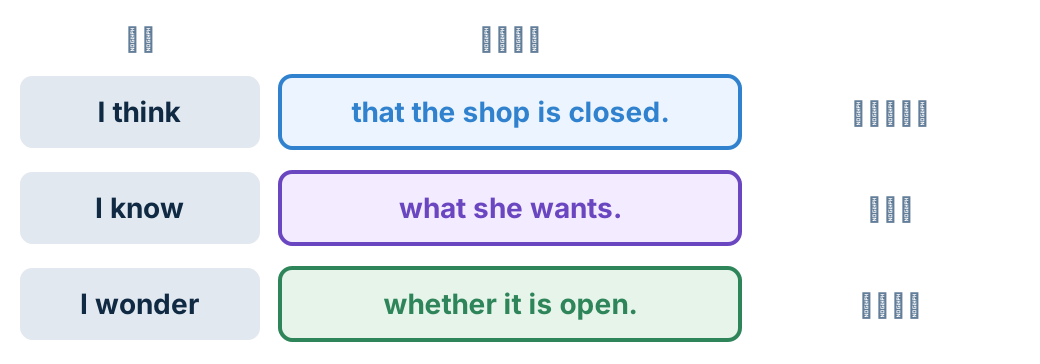
| 引导词 | 用法 | 例句 |
|---|---|---|
| that | 完整的陈述 | I think that the shop is closed. |
| what | ……的东西(the thing that) | I know what she wants. |
| whether, if | 是非问题 | I wonder whether it is open. |
| who, where, why, how | 开放式问题 | Nobody knows why she left. |
| because, although, when | 与主句相连的从句 | We left early because it was late. |
- 1
这个从句是陈述、事物还是问题? 选择 that、what、whether 或疑问词(第 1 部分)。
- 2
这是放在句子里的问题吗? 用陈述语序,不用 do(第 2 部分)。
- 3
每个句子都有主句吗? 用一个连接词连接分句,或者用句号或分号(第 4 和第 5 部分)。
名词从句在一个更大的句子里起名词的作用。第 3 部分说明整个从句作主语时会怎样。
that、what 还是 whether?
这个从句是陈述、事物还是问题?
规则: that 引出完整的陈述;what 意为“……的东西”,在它的从句中留下一个空缺;whether 或 if 把是非问题变成从句。其他疑问词保留自己的意思:why、how、when、where。
根据从句的类型选词
| 引导词 | 后面接什么 | 例句 |
|---|---|---|
| that | 完整的陈述;口语中常省略 | He said that the bus was late. |
| what | 缺少宾语或主语的从句 | Tell me what happened. |
| whether, if | 是非问题 | Ask her whether she is free. |
| why, how, when, where | 开放式问题 | I know where they live. |
一个实用的检验方法:如果能用 the thing that 替换这个词,就用 what。如果从句本身就是一个完整的句子,就用 that。
用 whether,不用 if
| 位置 | 例句 |
|---|---|
| 在介词之后 | It depends on whether it rains. |
| 在 to 加动词之前 | She can’t decide whether to stay. |
| 在句首 | Whether he comes is up to him. |
| 紧接在 or not 之前 | I’ll go whether or not you come. |
这一部分的常见错误
- 混淆了 that 和 what
She showed me that she had bought.✓ She showed me what she had bought.bought 没有宾语,所以用 what。 - 是非问题用了 that
I'm not sure that the train stops here.✓ I'm not sure whether the train stops here.not sure 表示一个是非问题:用 whether 或 if。 - 该用 whether 的地方用了 if
We talked about if we should sell the car.✓ We talked about whether we should sell the car.介词之后用 whether。
更多:名词从句还是关系从句?
that 也可以引出修饰名词的关系从句: the book that I bought。名词从句本身就是宾语或主语: I know that I bought it。关于关系从句,请参阅 关系从句指南(英文).
句中的问句
这个问题是直接问句,还是放在另一个句子里面?
规则: 句子里的问句用陈述语序,不用 do、does 或 did。只有直接问句,包括主句和引号中的问句,才保持疑问语序。
把问句变回陈述句
| 直接问句 | 放在句子里 |
|---|---|
| Where is the station? | Do you know where the station is? |
| What time does the film start? | I’d like to know what time the film starts. |
| Did she pass? | I wonder whether she passed. |
| Who called? | I don’t know who called. |
疑问词本身作主语时(who called、what happened),两种形式的语序相同。标点跟随整个句子:I wonder where she lives 以句号结尾。
三种情况保留疑问语序
| 位置 | 例句 |
|---|---|
| 直接问句 | Where do you live? |
| 主句 | Do you know where she lives? |
| 引号中 | She asked, “Where do you live?” |
| 与 do you think 一起用 | Where do you think she lives? |
这一部分的常见错误
- 句中用了疑问语序
Do you know what is her phone number?✓ Do you know what her phone number is?在句子内部,主语放在动词前面。 - 从句中用了 do、does 或 did
I wonder how much does a ticket cost.✓ I wonder how much a ticket costs.去掉 does,并给动词加 -s。 - 直接问句用了陈述语序
He asked me, "Where you are going?"✓ He asked me, "Where are you going?"引号中的问句保持疑问语序。
更多:转述问句和时态
转述动词是过去时时,从句的时态常常往前推: “Where do you work?” She asked me where I worked. 如果事实仍然成立,用现在时也可以: She asked me where I work.
从句作主语
整个从句作主语时会怎样?
规则: 作主语的从句用单数动词。that 从句作主语时通常用 it 移到句末。在 suggest、insist 和 essential 之后用动词原形。
整个从句作主语
| 句型 | 例句 |
|---|---|
| what 从句 + 单数动词 | What surprised me was the price. |
| whether 从句 + 单数动词 | Whether we go depends on the weather. |
| it + be + 形容词 + that 从句 | It is strange that nobody called. |
| 动词 + it + 形容词 + that 从句 | I find it odd that he left. |
名词、形容词和 suggest 后的 that
| 词语 | 例句 |
|---|---|
| the fact, the idea, the news | The news that she won spread fast. |
| sure, afraid, glad, aware | I’m glad that you came. |
| suggest、insist、recommend + 动词原形 | We recommend that he apply early. |
| essential、important、vital + 动词原形 | It is vital that she be on time. |
在 suggest 等动词之后,英式英语常用 should(that he should apply)或一般现在时。动词原形在美式和英式英语中都正确。suggest 不能接宾语加 to:不说 suggested him to apply。
这一部分的常见错误
- 缺少主语
Is obvious that she loves her job.✓ It is obvious that she loves her job.that 从句在句末,所以由 it 作主语。 - 从句作主语时用了复数动词
What worries me are the cost.✓ What worries me is the cost.what 从句作主语时用单数动词。 - suggest 或 essential 后用错形式
The coach suggested us to stretch first.✓ The coach suggested that we stretch first.suggest 不接宾语加 to。
主句和从句
哪个连接词符合意思?后面接从句还是名词?
规则: 一个连接只用一个连接词,并根据意思来选。although、because 和 while 后接从句;despite、because of 和 during 后接名词或 -ing 形式。
意思相同,结构不同
| 接从句 | 接名词或 -ing | 例句 |
|---|---|---|
| because, since, as(原因) | because of, due to | We stayed in because of the storm. |
| although, even though(对比) | despite, in spite of | Even though it was late, we kept going. |
| while, when, after(时间) | during, after | She slept during the flight. |
| whereas, while(比较) | unlike | He likes tea, whereas I prefer coffee. |
三种连接
| 类型 | 词语 | 标点 |
|---|---|---|
| 从属连词 | because, although, when, if, unless | 从句在前时加逗号 |
| 并列连词 | and, but, so, or | 在连词前加逗号 |
| 过渡词 | however, therefore, as a result | 前面用句号或分号,后面用逗号 |
有些语言(例如中文和越南语)在对比或因果的两个部分都加标记。英语只标记一个:although 或 but,because 或 so。关于 if 和 unless,请参阅 条件句指南(英文).
这一部分的常见错误
- 一个连接用了两个连接词
Although the hotel was cheap, but it was clean.✓ Although the hotel was cheap, it was clean.用 although 或 but,不要两个都用。 - 从句前用了介词
Despite he was tired, he finished the report.✓ Although he was tired, he finished the report.although 后接从句;despite 后接名词。 - 用 however 连接分句
The road was icy, therefore we drove slowly.✓ The road was icy, so we drove slowly.therefore 不能在逗号后连接分句。
完整的句子
每个句子都有自己的主句吗?
规则: 在规范的书面语中,每个句子都需要一个有主语和动词的主句。连接两个句子要用句号、分号或连接词,不能只用逗号。
五个常见问题
| 问题 | 例句 | 改正 |
|---|---|---|
| 残缺句 | We went home because the shop was closed. | |
| 逗号粘连 | The shop was closed, so we went home. | |
| 连写句 | The shop was closed. We went home. | |
| 缺少主语 | It is too cold to swim. | |
| 重复主语 | My sister works in Lima. |
残缺句在广告、短信和小说中很常见,在非正式写作中短小的残缺句也可以。在论文、工作邮件和考试中,要写完整的句子。
这一部分的常见错误
- 句子不完整
I couldn't sleep. Because my neighbor was playing music.✓ I couldn't sleep because my neighbor was playing music.because 从句需要一个主句。 - 用逗号连接两个句子
My phone died, I couldn't call you.✓ My phone died, so I couldn't call you.加一个连接词,或者用句号。 - 多了一个词
The woman who lives next door she is a pilot.✓ The woman who lives next door is a pilot.句子已经有主语了,不要再用 she 重复。
自测
每个句子正确吗?点击查看答案。如果不确定,部分标签会告诉你该看哪里。
第 1 部分I can't believe what he told us.
正确。 what he told us 有一个空缺:told us what。
第 1 部分Let me know that you can come to the party.
错误。 Let me know whether you can come to the party. 你能不能来?用 whether 或 if。
第 2 部分Could you tell me where the ticket office is?
正确。 问句内部用陈述语序:where the ticket office is。
第 2 部分I don't remember where did I park the car.
错误。 I don’t remember where I parked the car. 去掉 did,用陈述语序。
第 3 部分It is a pity that the museum is closed today.
正确。 it 代替句末的 that 从句。
第 3 部分Whether he agrees are not important.
错误。 Whether he agrees is not important. 从句作主语时用单数动词。
第 4 部分Even though the film was long, nobody left early.
正确。 一个连接词,后面接从句。
第 4 部分Because of it was late, we took a taxi.
错误。 Because it was late, we took a taxi. because 后接从句,because of 不行。
第 5 部分The meeting ended early; as a result, we caught the earlier train.
正确。 as a result 放在分号之后。
第 5 部分Feeling hungry after the long walk.
错误。 Feeling hungry after the long walk, we stopped at a café. -ing 短语需要一个主句。
AI 练习提示词
把下面的内容粘贴到 AI 聊天工具中。