
Toda frase com uma ação tem alguém que faz a ação e alguém ou algo que a recebe. A voz ativa e a passiva organizam os mesmos fatos em ordens diferentes, então a pergunta de verdade é: sobre o que é a frase? Este guia mostra como reconhecer e montar a passiva em qualquer tempo verbal, quais verbos nunca podem ficar na passiva, quais expressões precisam de be e como decidir qual voz combina.
Ler o guia em inglês → Esta página foi traduzida automaticamente e não foi revisada por um falante nativo, então pode conter erros. A versão em inglês é a de referência.
O resultado do diagnóstico mostra qual parte precisa de revisão. Toque nessa parte abaixo.
A ideia central
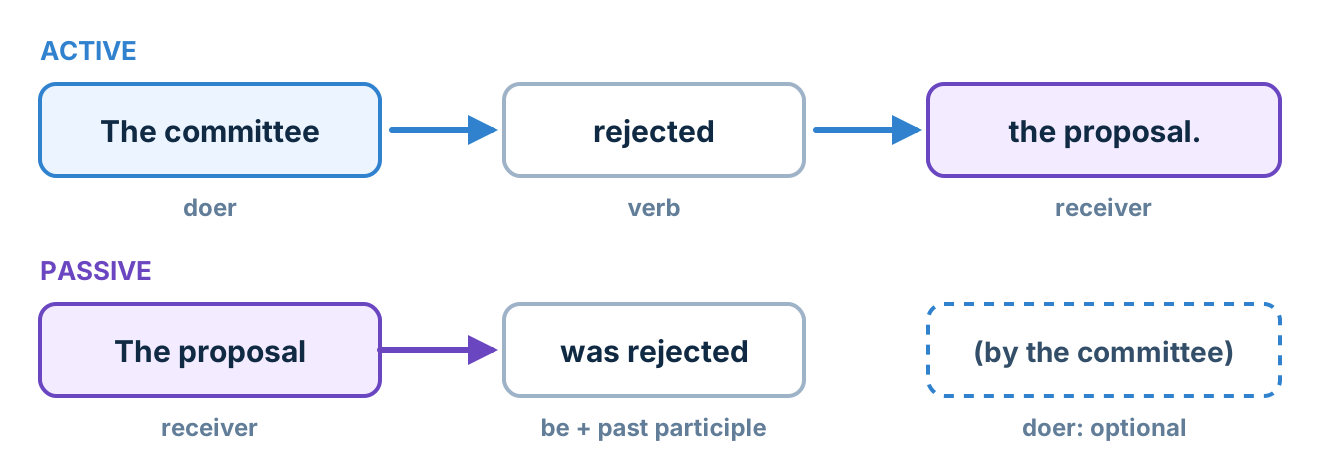
A ativa e a passiva são duas formas de organizar os mesmos fatos. Os fatos não mudam. O que muda é qual substantivo vem primeiro e, portanto, sobre o que é a frase.
| Voz | Estrutura | Exemplo | A frase é sobre |
|---|---|---|---|
| Ativa | quem faz + verbo + quem recebe | The committee rejected the proposal. | the committee |
| Passiva | quem recebe + be + particípio passado (+ by quem faz) | The proposal was rejected (by the committee). | the proposal |
- 1
A passiva sempre precisa de uma forma de be (is, are, was, were, been, being, be) seguida do particípio passado (rejected, written, taken). As duas metades são obrigatórias.
- 2
O tempo verbal fica em be. O particípio nunca muda.
- 3
A frase com by é opcional, e na escrita real ela é omitida na maior parte das vezes.
Só verbos que têm objeto podem ficar na passiva. Reject, write, build e give têm objeto. Happen, arrive, die e exist não têm, então não têm forma passiva (Parte 3).
Reconhecer a voz
Esta frase é passiva? O sujeito faz a ação ou a recebe?
A regra: Encontre o sujeito. Se ele recebe a ação, o verbo é be + particípio passado.
O sujeito faz a ação ou a recebe?
Encontre o sujeito e pergunte se ele faz a ação ou se recebe a ação. Se recebe, o verbo é be + particípio passado.
Duas formas parecidas que não são passiva
| Forma | Exemplo | Passiva? |
|---|---|---|
| be + -ing | Workers were painting the hall. | Não: contínuo ativo |
| be + being + past participle | The hall was being painted. | Sim: passiva contínua |
| be + adjective | The hall was empty. We were late. | Não: um estado |
| be + past participle | The windows were broken during the storm. | Sim: algo as quebrou |
Frases no limite
The door was locked pode descrever um estado (a porta não estava aberta) ou uma ação (alguém a trancou). O contexto decide, e as duas leituras são inglês normal.
Outras passivas que vale a pena reconhecer
| Forma | Exemplo |
|---|---|
| passiva com get (informal) | He got fired. My bike got stolen. |
| verbos com dois objetos | She was offered a promotion. |
| passivas de relato | It is believed that the bridge is medieval. He is said to be retiring. |
Erros comuns nesta parte
- Forma passiva para quem faz a ação
The students were discussed the article in groups.✓ The students discussed the article in groups.Foram os alunos que discutiram, então o verbo fica na ativa. - Forma ativa para quem recebe a ação
The new bridge will open by the mayor on Friday.✓ The new bridge will be opened by the mayor on Friday.A ponte recebe a ação, e a frase com by diz quem a faz. - be + -ing em vez de be + particípio passado
The kitchen is cleaning right now, so please wait outside.✓ The kitchen is being cleaned right now, so please wait outside.A cozinha é que está sendo limpa: is being cleaned.
Montar a forma
A passiva está bem montada neste tempo ou estrutura?
A regra: A passiva é be + particípio passado em todos os tempos e estruturas. Mude be de acordo com o tempo, o sujeito e a estrutura (be, been, being, to be). Mantenha o particípio passado.
A passiva em todos os tempos
| Tempo | Ativa | Passiva |
|---|---|---|
| presente simples | The university publishes the results in June. | The results are published in June. |
| presente contínuo | They are renovating the library. | The library is being renovated. |
| present perfect | Someone has canceled the meeting. | The meeting has been canceled. |
| passado simples | The chef cooked the meal. | The meal was cooked by the chef. |
| passado contínuo | Workers were repairing the road all week. | The road was being repaired all week. |
| past perfect | The team had finished the report before the deadline. | The report had been finished before the deadline. |
| will | The company will release a new phone. | A new phone will be released. |
| be going to | They are going to close the bridge. | The bridge is going to be closed. |
A passiva do futuro contínuo (will be being built) e do perfeito contínuo (has been being built) é possível, mas soa pesada. A maioria de quem escreve passa para a ativa.
Modais, infinitivos e formas em -ing
| Estrutura | Exemplo |
|---|---|
| modal + be + participle | The sample should be stored below four degrees. |
| modal + have been + participle | The error could have been avoided. |
| to be + participle | He wants to be included in the plan. |
| being + participle | She is tired of being asked the same question. |
Verbos com dois objetos
Com give, send, offer, show, tell, teach e pay, o inglês normalmente começa a passiva pela pessoa: She was offered a promotion. A outra versão (A promotion was offered to her) é possível, mas mais formal.
Confira três coisas, nesta ordem
O be está lá? É o be certo para o tempo e o sujeito? O verbo está na terceira forma?
Erros comuns nesta parte
- Falta be
The castle built in the 15th century.✓ The castle was built in the 15th century.Um particípio sozinho não é um verbo. - Particípio errado
The winners were chose by the audience.✓ The winners were chosen by the audience.Use a terceira forma: chosen. - Concordância errada
The new computers was installed last week.✓ The new computers were installed last week.be concorda com computers, que está no plural.
Verbos que não podem ficar na passiva
Este verbo tem forma passiva?
A regra: Se nada recebe a ação, o verbo não tem forma passiva.
Verbos sem passiva
A passiva leva o objeto para o início. Esses verbos nunca têm objeto, então não há nada para mover. Muitas línguas expressam essas ideias com uma terminação parecida com a passiva, e por isso esse erro é tão comum.
Mesma frase, verbos diferentes
| Tem objeto: passiva possível | Sem objeto: só ativa |
|---|---|
| The company was founded in 1987… | …and still exists today. |
| The concert was canceled… | …but the storm happened anyway. |
| The rest of the houses were rebuilt. | Two houses remained after the fire. |
Um teste rápido
Pergunte a quem ou a que a ação foi feita (what was it done to?). Se não houver resposta, não há passiva.
Erros comuns nesta parte
- Passiva com um verbo que não tem objeto
A strange thing was happened during the exam.✓ A strange thing happened during the exam.Happen não tem passiva. - Passiva com um verbo que não tem objeto
The team is consisted of five engineers.✓ The team consists of five engineers.Consist of fica sempre na ativa. - Forma ativa para quem recebe a ação
The old factory closed down and demolished in 2015.✓ The old factory closed down and was demolished in 2015.Close down não tem objeto, mas demolish tem.
Sentimentos e expressões fixas
O inglês precisa de be aqui, mesmo que a ideia pareça ativa?
A regra: Use -ed para a pessoa que tem o sentimento e -ing para o que o causa. Algumas expressões, como be born, be located e be married to, precisam de be em inglês.
-ed ou -ing?
| -ed: a pessoa que tem o sentimento | -ing: o que causa o sentimento |
|---|---|
| I am bored. | The class is boring. |
| The students were confused. | The lecture was confusing. |
| Even the researchers were surprised. | The findings were surprising. |
I am interesting in economics quer dizer que você desperta interesse nos outros. Diga I am interested in economics.
Revisão de gramática
Pares como bored e boring têm um guia próprio, com mais verbos e prática.
Expressões que são passivas em inglês
| Expressão | Exemplo |
|---|---|
| be born | She was born in Lagos. |
| be located / be situated | The campus is located near the station. |
| be based | The firm is based in Toronto. |
| be known as / be called | The street is known as the food alley. |
| be married to | He is married to a nurse. |
| be interested in / be involved in | She is involved in the debate club. |
He married a nurse também está correto: descreve o casamento como acontecimento. He is married to a nurse descreve o estado atual.
Erros comuns nesta parte
- -ing para a pessoa que sente
We were very boring during the long flight.✓ We were very bored during the long flight.Fomos nós que ficamos entediados, então use bored. - Falta be
My parents born in the same village.✓ My parents were born in the same village.Be born precisa de be. - Preposição errada
She is married with a pilot.✓ She is married to a pilot.A expressão fixa é married to.
Escolher a voz certa
Esta frase deveria ser passiva? É uma questão de julgamento, não uma regra.
A regra: Pergunte sobre o que é a frase. Se for sobre quem faz a ação, use a ativa. Se for sobre o que é afetado, use a passiva.
Use a passiva quando
| Motivo | Exemplo |
|---|---|
| Não se sabe quem fez a ação | My wallet was stolen on the subway. |
| Quem fez é óbvio ou pouco importante | The suspect was arrested yesterday. |
| O resultado importa mais do que quem o causou | Over 200 homes were destroyed in the fire. |
| Você descreve um processo ou método | The samples were heated to 90 degrees and then cooled slowly. |
| Você quer manter o mesmo assunto | The library opened in March. It was designed by a local firm. |
| Você quer evitar culpar alguém diretamente | A mistake was made in the invoice. |
Use a ativa quando
- Quem faz a ação é o ponto principal: Our team won the contract.
- Você conta o que as pessoas fizeram.
- A passiva esconderia uma informação de que o leitor precisa. “Mistakes were made” é um exemplo famoso de passiva usada para fugir da responsabilidade.
- Você escreve algo pessoal ou persuasivo, em que uma voz clara faz diferença.
A ativa nem sempre é melhor
O conselho de evitar a passiva é uma preferência de estilo, não uma regra gramatical. Na escrita científica, jurídica, jornalística e acadêmica, a passiva é normal. Se você não conseguir decidir, pergunte sobre o que é a frase. Se ainda não souber, use a ativa: ela é mais curta.
A frase com by
| Frase | Manter by? |
|---|---|
| Hamlet was written by Shakespeare. | Sim: quem fez é a informação. |
| The photo was taken by my grandmother in 1962. | Sim: específico e relevante. |
| The thief was arrested by the police. | Não: quem mais prenderia um ladrão? |
| English is spoken by people all over the world. | Não: não acrescenta nada. |
Registro: a passiva com get
Na fala, get muitas vezes substitui be, principalmente para coisas que acontecem com as pessoas de forma inesperada: He got fired. We get paid on the 25th. Isso é normal em conversas e e-mails informais. Em relatórios e redações, use be: He was dismissed.
Excesso de passiva
Difícil de ler
The survey was designed by our group. The questions were written by Lin. The data was collected by me and was analyzed by Omar.
Mais claro
Our group designed the survey. Lin wrote the questions, I collected the data, and Omar analyzed it.
Erros comuns nesta parte
- Frase com by desnecessária
Coffee is grown by farmers in the hills of Colombia.✓ Coffee is grown in the hills of Colombia.Quem mais plantaria café? A frase com by não acrescenta nada. - Passiva com get em texto formal
Annual report: The CEO got replaced in June.✓ Annual report: The CEO was replaced in June.A escrita formal usa be, não get. - Passivas demais com by
The poster was designed by Ana, and the photos were taken by me.✓ Ana designed the poster, and I took the photos.Quem fez cada coisa importa, então a ativa é mais clara.
Autoavaliação
Cada frase está correta? Toque para ver a resposta. O rótulo da parte mostra onde revisar se você não tiver certeza.
Parte 1The museum is being cleaned this week.
Correto. Is being cleaned é a passiva contínua: be, being e depois o particípio.
Parte 1We were late for the meeting, so we were missed the start.
Incorreto. Fomos nós que perdemos o início: we missed the start. Were late é be + adjetivo, não uma passiva.
Parte 2The new policy will be introduce next month.
Incorreto. Depois de be, use o particípio: will be introduced.
Parte 2Applicants are required to submit two references.
Correto. Are required é uma passiva no presente, comum em regras e instruções.
Parte 3The concert was took place in the park.
Incorreto. Take place não tem passiva: The concert took place in the park.
Parte 3Two people were injured, but the driver remained calm.
Correto. Injure tem objeto, então pode ficar na passiva. Remain não.
Parte 4I was so exciting to get my exam results.
Incorreto. Foi você que teve o sentimento: I was so excited to get my exam results.
Parte 4The hotel is located right next to the beach.
Correto. Be located precisa de be.
Parte 5Penicillin was discovered by Alexander Fleming in 1928.
Correto. Quem fez é a informação, então a frase com by fica.
Parte 5In a lab report: The solution got heated to 60 degrees.
Incorreto. A escrita formal usa be: The solution was heated to 60 degrees.
Prompt de prática com IA
Cole isto em uma ferramenta de chat com IA.