
Los modificadores son palabras, normalmente adverbios o adjetivos, que cambian o añaden significado a otra palabra. Pueden hacer una descripción más fuerte, más débil, más precisa o más cortés. Tres partes de este tema tratan de elegir el modificador correcto, y dos tratan de la forma y el orden. Esta guía tiene cinco partes, y coinciden exactamente con las cinco partes del diagnóstico.
Leer la guía en inglés → Esta página está traducida automáticamente y no la ha revisado un hablante nativo, por lo que puede contener errores. La versión en inglés es la de referencia.
Tu resultado del diagnóstico indica qué parte necesita repaso. Toca esa parte más abajo.
La idea central: ¿qué está modificando el modificador?
El modificador correcto depende de la palabra que modifica. La misma palabra puede ser correcta en un lugar e incorrecta en otro.
| La palabra modificada | Usa | Ejemplo |
|---|---|---|
| adjetivo graduable | very, really, quite, extremely | very tired |
| adjetivo extremo | absolutely, completely, totally | absolutely perfect |
| comparativo | much, far, a little, even | much friendlier |
| superlativo | by far, easily (antes de the) | by far the best |
| verbo | really, a lot, very much | really like, like it a lot |
- 1
¿Qué está modificando el modificador? Un adjetivo, una comparación, un verbo o un sustantivo.
- 2
¿Qué modificador encaja con esa palabra? Very para adjetivos graduables, absolutely para los extremos, much para comparativos, really para verbos (partes 1 a 3).
- 3
¿Son correctas la forma y la posición? Un adverbio, no un adjetivo, y no entre el verbo y su objeto. So o such, hard o hardly (partes 4 y 5).
Los modificadores pueden hacer una afirmación más fuerte, más débil, más precisa o más cortés. Las partes 1 a 3 tratan de elegir la palabra. Las partes 4 y 5 tratan de la forma y el orden.
¿Very, absolutely o too?
¿El adjetivo es graduable, ya es extremo o expresa más de lo que quieres?
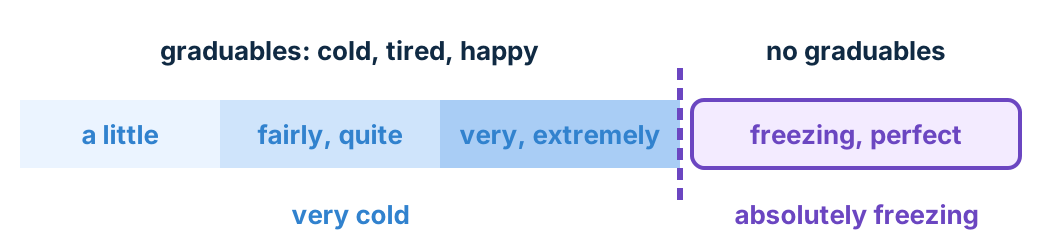
La regla: Usa very con adjetivos graduables (very cold) y absolutely con los extremos (absolutely freezing). Too significa más de lo que quieres. Enough va después del adjetivo.
¿Puede ser más o menos, o ya es extremo?
| Graduables | Extremos (no graduables) |
|---|---|
| cold, hot, tired, happy, sad, angry, big, small, interesting, boring, nice, difficult, tall, funny | freezing, boiling, exhausted, thrilled, furious, enormous, fascinating, terrifying, perfect, impossible, starving, spotless, tiny |
Graduable: very
It is very cold today.
I am so tired.
He is fairly confident.
Extremo: absolutely
That is an absolutely perfect answer.
I am completely exhausted.
That idea is utterly ridiculous.
Really funciona con ambos tipos: really cold, really freezing. En inglés americano, quite suele significar very. En inglés británico, a menudo significa fairly.
Too, very y enough
| Palabra | Significado | Ejemplo |
|---|---|---|
| very | fuerte, a menudo un elogio | The cake is very good. |
| too | más de lo que quieres, un problema | The tea is too hot to drink. |
| adjective + enough | tanto como necesitas | Is the room big enough for ten people? |
| enough + noun | tantos o tanto como necesitas | We have enough chairs. |
Muchos estudiantes usan too con el sentido de very, porque palabras como el coreano 너무 o el chino 太 pueden hacer las dos funciones. En inglés, too good o too delicious suena a problema, no a elogio.
Errores comunes en esta parte
- too usado como elogio
Your new haircut looks too nice!✓ Your new haircut looks really nice!Too significa más de lo que quieres, así que suena a queja. - very con un adjetivo no graduable
By midnight we were very starving.✓ By midnight we were absolutely starving.Starving ya es extremo. - enough en el lugar equivocado
Is the printer enough fast for the whole office?✓ Is the printer fast enough for the whole office?Enough va después del adjetivo.
Más: negaciones con adjetivos graduables
En las negaciones, el inglés suele suavizar el modificador: It’s not very warm outside. I’m not particularly hungry. That was not exactly thrilling.
Comparativos y superlativos
¿Es una comparación entre dos cosas, o de una cosa con todas las demás?
La regla: Con un comparativo, usa much, far, a lot, a little o even, no very ni so, y nunca añadas more a una forma en -er. Antes de the + superlativo, usa by far o easily. Very va después de the: the very best.
Comparativos
| Modificador | Diferencia | Ejemplo |
|---|---|---|
| much, a lot, far | grande | The train is much faster than the bus. |
| a little, slightly, a bit | pequeña | My room is slightly bigger than yours. |
| even | sorprendente | The sequel is even better than the first film. |
Usa -er o more, no los dos: much easier, no more easier. Better y worse ya son comparativos, así que nunca llevan more.
Superlativos
| Modificador | Posición | Ejemplo |
|---|---|---|
| by far, easily | antes de the | It is by far the oldest building in town. |
| very | después de the | This is the very best seat in the theater. |
| possibly | antes de the, añade cautela | This is possibly the cheapest flight this month. |
Usa un comparativo para dos cosas y un superlativo para tres o más: the taller of the two, the tallest in the class.
Errores comunes en esta parte
- very o so con un comparativo
The second hotel was very nicer.✓ The second hotel was much nicer.Very no modifica un comparativo. - un comparativo o superlativo doble
My grades are more better this year.✓ My grades are much better this year.Better ya es un comparativo. - very antes del superlativo
It was very the longest meeting of my life.✓ It was by far the longest meeting of my life.Very va después de the, no antes.
Más: very much con comparativos
Very solo no puede modificar un comparativo, pero very much sí, sobre todo en inglés británico: She feels very much better today.
Verbos y combinaciones naturales
¿El modificador va con un verbo, o con una palabra que tiene una pareja habitual?
La regla: Very no modifica un verbo: di really like o like it very much. Muchos modificadores tienen parejas habituales: highly recommended, strongly agree, deeply regret.
Very no va antes de un verbo
| Estructura | Ejemplo |
|---|---|
| really + verb | I really like this song. |
| verb + object + a lot or very much | I like this song a lot. I like it very much. |
| much + prefer | I much prefer tea to coffee. |
| un verbo con una pareja habitual | totally agree, strongly disagree, deeply regret, greatly appreciate |
El chino 很 puede ir antes de un verbo como 喜欢 (like), por eso los estudiantes a menudo escriben very like. En inglés, very no puede hacer esto.
Combinaciones naturales
| Natural | Evita | Significado |
|---|---|---|
| highly recommended | muy recomendado | |
| highly skilled | muy competente | |
| well known | conocido por mucha gente | |
| widely regarded | considerado en general | |
| deeply grateful | sinceramente agradecido | |
| strongly opposed | firmemente en contra | |
| bitterly cold | extremadamente frío |
Tono y registro
| Modificador | Registro | Ejemplo |
|---|---|---|
| so, really, pretty | informal | I’m so happy you came! |
| fairly, rather, somewhat | neutro o formal | The results were fairly encouraging. |
| extremely, incredibly | neutro pero fuerte | She worked incredibly hard. |
| highly, deeply, greatly | formal o escrito | I am deeply concerned. |
Errores comunes en esta parte
- very antes de un verbo
I very miss my family.✓ I really miss my family.Very no modifica un verbo. - una combinación de modificador poco natural
I highly agree with the new rules.✓ I strongly agree with the new rules.Agree se combina con strongly o totally. - too usado como elogio
I too much love this show.✓ I really love this show.Too much no es una forma de decir very.
Forma y posición del adverbio
¿Describe un verbo o un adjetivo, y dónde está el objeto?
La regla: Usa un adverbio para describir un verbo o un adjetivo (speak clearly, incredibly quiet). Ponlo antes del adjetivo, y después del verbo y su objeto, no entre ellos.
¿Adjetivo o adverbio?
| Adjetivo | Adverbio | Ejemplo |
|---|---|---|
| clear, careful, quick | clearly, carefully, quickly | She drives carefully. |
| good | well | He sings well. |
| fast, hard, late | fast, hard, late (no -ly) | They arrived late. |
Hardly y lately son palabras distintas: hardly significa casi no, y lately significa últimamente. En el habla informal algunas personas dicen real good o drive safe, pero usa el adverbio al escribir.
Posición
| Modifica a | Posición | Ejemplo |
|---|---|---|
| un adjetivo o adverbio | justo antes | She is extremely talented. He drove incredibly fast. |
| un verbo con objeto | después del objeto | He plays the piano well. |
| un verbo (really, completely, hardly) | normalmente antes del verbo principal | I completely forgot her birthday. |
Di
She speaks English very well.
I completely forgot her birthday.
He drove incredibly fast.
No digas
She speaks very well English.I forgot completely her birthday.He drove incredible fast.
Errores comunes en esta parte
- un adjetivo donde hace falta un adverbio
She finished the exercise very quick.✓ She finished the exercise very quickly.Quickly describe el verbo finished. - un adverbio entre el verbo y su objeto
My sister speaks fluently three languages.✓ My sister speaks three languages fluently.Pon el adverbio después del objeto. - un adjetivo donde hace falta un adverbio
Our new printer works very good.✓ Our new printer works very well.Well es el adverbio de good.
So, such y hardly
¿So o such? ¿Hard o hardly?
La regla: So + adjetivo, such (a) + adjetivo + sustantivo, y so much o so many + sustantivo. Hard significa con esfuerzo. Hardly significa casi no, así que no añadas not.
So y such
| Estructura | Ejemplo |
|---|---|
| so + adjective or adverb | The lake was so calm that we could see the bottom. |
| so much + uncountable noun, so many + plural noun | There was so much food that we took some home. |
| such a + adjective + singular noun | It was such a long flight. |
| such + adjective + plural or uncountable noun | They are such good friends. We had such bad luck. |
Para un resultado con that, usa so o such, no too: so tired that, no too tired that. En inglés formal también es posible so + adjetivo + a + sustantivo: so good a teacher.
Hard, hardly y otros modificadores negativos
| Palabra | Significado | Ejemplo |
|---|---|---|
| hard | con mucho esfuerzo | She studies hard. |
| hardly | casi no | She hardly studies. |
| barely, scarcely | casi no, apenas | We barely caught the train. |
| hardly ever | casi nunca | I hardly ever drive. |
Hardly, barely y scarcely ya son negativos, así que no añadas not. En la escritura formal, hardly puede empezar una oración con inversión, seguida de when: Hardly had the meeting started when the power went out. No sooner usa than en su lugar.
Errores comunes en esta parte
- so y such confundidos
We had so fun at the party.✓ We had so much fun at the party.Fun es un sustantivo, así que usa so much fun o such fun. - hard y hardly confundidos
Everyone on the team worked hardly to finish on time.✓ Everyone on the team worked hard to finish on time.Hard significa con esfuerzo. Hardly significa casi no. - una negación añadida a hardly, barely o scarcely
I can't hardly wait for the holidays.✓ I can hardly wait for the holidays.Hardly ya es negativo.
Autoevaluación
¿Es correcta cada oración? Toca para ver la respuesta. La etiqueta de la parte te indica dónde mirar si no estabas seguro.
Parte 1The water is too cold for swimming today.
Correcta. Too indica un problema: el agua está más fría de lo que quieres.
Parte 1The final exam was very impossible.
Incorrecta. The final exam was completely impossible. Impossible no es graduable.
Parte 2This laptop is a lot lighter than my old one.
Correcta. A lot indica una gran diferencia con un comparativo.
Parte 2Anna is the most kindest person I know.
Incorrecta. Anna is the kindest person I know. Kindest ya es un superlativo.
Parte 3I very enjoyed your presentation.
Incorrecta. I really enjoyed your presentation. Very no modifica un verbo.
Parte 3The chef is highly skilled.
Correcta. Highly skilled es una combinación natural.
Parte 4He drives very carefully at night.
Correcta. Carefully describe drives, y very va antes de carefully.
Parte 4She plays beautiful the violin.
Incorrecta. She plays the violin beautifully. Usa un adverbio y ponlo después del objeto.
Parte 5It was such a boring lecture that I left early.
Correcta. Such a va antes de un adjetivo más un sustantivo singular.
Parte 5She works hardly every day.
Incorrecta. She works hard every day. Hardly significa casi no.
Prompt de práctica con IA
Pega esto en una herramienta de chat con IA.