
TOEIC-style Part 5 gives a business sentence with one blank and four options. This guide groups Part 5 questions into eight common categories. Three parts are about word form, four are about sentence structure, and one is about meaning and collocation. Each part gives the key grammar (with a link to the full EnglishBridges lesson where one exists), followed by the test-taking strategy and a common trap for that category.
关于本指南: TOEIC 第五部分
TOEIC Part 5(不完整句子)在一个商务语境的句子里留出一个空格,配四个选项。本指南涵盖 TOEIC Part 5 的八个句子填空类别:词形、代词、动词时态与一致、介词、连词与转折词、关系从句、比较级和最高级,以及词语搭配。
你可以先做诊断测验,看看这个主题的哪些部分需要复习,也可以直接进入练习活动,其中包含复习幻灯片。
本指南本身为英文。这些翻译只是额外提供的便利,可能不够完美。
このガイドについて: TOEIC パート 5
TOEIC Part 5(短文穴埋め問題)は、ビジネスの文脈の文に空欄が 1 つあり、4 つの選択肢が与えられます。このガイドは、TOEIC Part 5 の 8 つの文完成カテゴリーを扱います:語形、代名詞、動詞の時制と一致、前置詞、接続詞と転換語、関係節、比較級と最上級、そして連語です。
まず診断テストを受けて、このテーマのどの部分を復習すべきか確認することもできますし、復習スライドを含む練習アクティビティにそのまま進むこともできます。
このガイド自体は英語です。これらの翻訳は補助として提供しているもので、完全とは限りません。
이 가이드 소개: TOEIC 파트 5
TOEIC Part 5(불완전한 문장)는 비즈니스 맥락의 문장에 빈칸 하나와 네 개의 선택지를 줍니다. 이 가이드는 TOEIC Part 5의 여덟 가지 문장완성 범주를 다룹니다: 단어 형태, 대명사, 동사 시제와 일치, 전치사, 접속사와 전환어, 관계절, 비교급과 최상급, 그리고 연어입니다.
먼저 진단 퀴즈로 이 주제에서 복습이 필요한 부분을 확인해도 되고, 복습 슬라이드가 포함된 연습 활동으로 바로 들어가도 됩니다.
가이드 자체는 영어로 되어 있습니다. 이 번역은 부가적으로 제공되는 것이며 완벽하지 않을 수 있습니다.
Giới thiệu hướng dẫn này: TOEIC Phần 5
TOEIC Part 5 (Câu chưa hoàn chỉnh) đưa ra một câu trong ngữ cảnh kinh doanh với một chỗ trống và bốn lựa chọn. Hướng dẫn này bao quát tám nhóm hoàn thành câu của TOEIC Part 5: dạng từ, đại từ, thì và sự hòa hợp động từ, giới từ, liên từ và từ chuyển tiếp, mệnh đề quan hệ, so sánh hơn và so sánh nhất, và collocation.
Bạn có thể bắt đầu bằng bài kiểm tra chẩn đoán để biết phần nào cần ôn lại, hoặc vào thẳng các hoạt động luyện tập, trong đó có cả slide ôn tập.
Đọc hướng dẫn bằng tiếng Việt →
Bản hướng dẫn này được viết bằng tiếng Anh. Các bản dịch chỉ là phần hỗ trợ thêm và có thể chưa hoàn hảo.
इस गाइड के बारे में: TOEIC पार्ट 5
TOEIC Part 5 (अधूरे वाक्य) व्यावसायिक संदर्भ के वाक्य में एक रिक्त स्थान और चार विकल्प देता है। यह गाइड TOEIC Part 5 की आठ वाक्य-पूर्ति श्रेणियों को कवर करता है: शब्द रूप, सर्वनाम, क्रिया काल और मेल, preposition, conjunction और transition, relative clause, comparative और superlative, और शब्द-युग्म।
आप निदान क्विज़ से शुरू करके जान सकते हैं कि इस विषय के कौन-से भाग दोहराने चाहिए, या सीधे अभ्यास गतिविधियों में जा सकते हैं, जिनमें दोहराव की स्लाइडें भी हैं।
गाइड स्वयं अंग्रेज़ी में है। ये अनुवाद अतिरिक्त सुविधा के रूप में हैं और पूरी तरह सटीक न भी हों।
نبذة عن هذا الدليل: الجزء الخامس من TOEIC
يقدم الجزء الخامس من اختبار TOEIC (الجمل الناقصة) جملة في سياق تجاري بها فراغ واحد وأربعة خيارات. يغطي هذا الدليل الفئات الثماني لإكمال الجمل في الجزء الخامس من TOEIC: صيغة الكلمة، والضمائر، وزمن الفعل ومطابقته، وحروف الجر، وحروف العطف والانتقالات، والجمل الموصولة، وصيغتي المقارنة والتفضيل العليا، والتلازم اللفظي.
يمكنك البدء بالاختبار التشخيصي لمعرفة الأجزاء التي تحتاج إلى مراجعة، أو الانتقال مباشرة إلى أنشطة التدريب، وتشمل شرائح مراجعة.
الدليل نفسه بالإنجليزية. هذه الترجمات مجرد خدمة إضافية وقد لا تكون دقيقة تمامًا.
Об этом руководстве: TOEIC часть 5
Часть 5 экзамена TOEIC (незаконченные предложения) даёт деловое предложение с одним пропуском и четырьмя вариантами ответа. Это руководство охватывает восемь категорий заполнения предложений в TOEIC Part 5: форму слова, местоимения, время и согласование глагола, предлоги, союзы и связки, придаточные определительные, сравнительную и превосходную степени, а также коллокации.
Можно начать с диагностического теста, чтобы узнать, какие части темы стоит повторить, или сразу перейти к упражнениям, в которые входят слайды для повторения.
Читать руководство на русском →
Само руководство написано на английском. Эти переводы — дополнительная помощь, и они могут быть неидеальными.
Acerca de esta guía: TOEIC Parte 5
La Parte 5 del TOEIC (oraciones incompletas) da una oración en un contexto de negocios con un espacio y cuatro opciones. Esta guía cubre las ocho categorías de completar oraciones de la Parte 5 del TOEIC: forma de la palabra, pronombres, tiempo verbal y concordancia, preposiciones, conjunciones y transiciones, cláusulas relativas, comparativos y superlativos, y colocaciones.
Puedes empezar con el cuestionario de diagnóstico para saber qué partes del tema conviene repasar, o ir directamente a las actividades de práctica, que incluyen diapositivas de repaso.
La guía en sí está en inglés. Estas traducciones son un añadido de cortesía y pueden no ser perfectas.
À propos de ce guide: TOEIC Partie 5
La Partie 5 du TOEIC (phrases incomplètes) présente une phrase en contexte professionnel avec un blanc et quatre choix. Ce guide couvre les huit catégories de complétion de phrases de la Partie 5 du TOEIC : la forme du mot, les pronoms, le temps et l'accord du verbe, les prépositions, les conjonctions et transitions, les propositions relatives, les comparatifs et superlatifs, et les collocations.
Vous pouvez commencer par le quiz de diagnostic pour savoir quelles parties du sujet réviser, ou passer directement aux activités d'entraînement, qui comprennent des diapositives de révision.
Le guide lui-même est en anglais. Ces traductions sont un complément offert et peuvent ne pas être parfaites.
Sobre este guia: TOEIC Parte 5
A Parte 5 do TOEIC (frases incompletas) apresenta uma frase em contexto de negócios com uma lacuna e quatro alternativas. Este guia cobre as oito categorias de completar frases da Parte 5 do TOEIC: forma da palavra, pronomes, tempo verbal e concordância, preposições, conjunções e transições, orações relativas, comparativos e superlativos, e colocações.
Você pode começar pelo teste diagnóstico para ver quais partes do tema precisam de revisão, ou ir direto para as atividades de prática, que incluem slides de revisão.
O guia em si está em inglês. Estas traduções são um recurso extra e podem não ser perfeitas.
Your diagnostic result says which part needs review. Tap that part below.
The core skill: triage the options before you read for meaning
Fast Part 5 test-takers glance at the four options first. Their shape (same part of speech or not) tells you which of the eight categories you are dealing with before you have even finished the sentence.
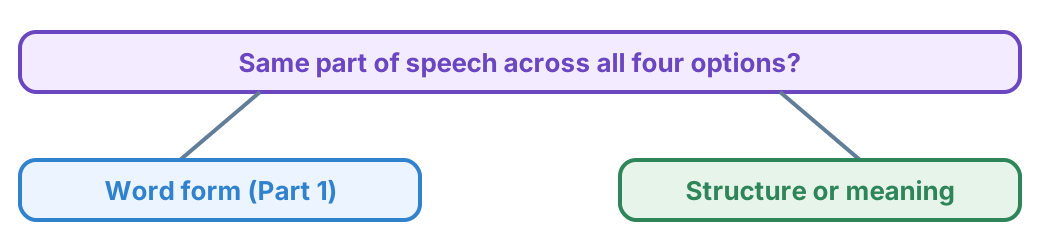
| Step | Question to ask |
|---|---|
| 1 | Are the four options a noun, a verb, an adjective, and an adverb? Word form (Part 1). Forms such as high, higher, and the highest? Comparatives (Part 7). |
| 2 | Same part of speech, but a pronoun? Check its job: subject, object, possessive, reflexive (Part 2). |
| 3 | Same part of speech, and a grammar structure question? Tense, prepositions, conjunctions, or relative clauses (Parts 3 to 6). |
| 4 | Do all four options fit the grammar, with only one fitting the meaning or the fixed phrase? Word choice and collocations (Part 8). |
- 1
Scan the four options first, before reading the sentence closely. Their shape tells you which of the eight categories you are in.
- 2
Only then read the sentence for the specific clue: a time word, a fixed pairing, what follows the blank, or how many things are compared.
- 3
Eliminate confidently. Wrong options are usually real words or phrases, and each one is wrong for a specific grammatical or lexical reason.
This triage order is what makes Part 5 fast. Grammar recognition, not translation, is the skill being tested.
Word form
Are the four options different parts of speech? Then this is a word-form question.
The rule: Decide which part of speech the slot needs, then check whether it needs a person or a thing, and singular or plural.
Decide the part of speech before you read for meaning
| Position | Needed form | Example |
|---|---|---|
| after an article or possessive | noun | The manager approved it. |
| before a noun, or after a linking verb | adjective | The report is accurate. |
| modifying a verb | adverb | She completed it accurately. |
| as the main action | verb | They approved the budget. |
Word-form options are usually real, correctly spelled words from one root. Spelling will not help; only the slot’s grammatical role decides.
Common errors in this part
- the wrong part of speech for the blank
The hotel's renovate will finish in May.✓ The hotel's renovation will finish in May.After the possessive, the blank needs a noun. - the wrong part of speech for the blank
Please check the figures accurate.✓ Please check the figures accurately.The verb check needs an adverb.
Pronouns
What job does the pronoun do: subject, object, possession, or emphasis?
The rule: Choose subject, object, possessive, or reflexive by the pronoun's job, then match it to its noun in number and gender.
Case first, then check for a matching subject
| Case | Job | Example |
|---|---|---|
| subject | does the action | She signed the contract. |
| object | receives the action, or follows a preposition | The manager thanked her. |
| possessive | shows ownership | Her proposal was approved. |
| reflexive | refers back to the subject | She reviewed it herself. |
A reflexive pronoun needs the same person as the subject of its own clause. If that subject is not there, use a plain object pronoun instead.
Common errors in this part
- the wrong pronoun case
The director invited my colleague and I to the dinner.✓ The director invited my colleague and me to the dinner.As the object of invited, the pronoun must be me. - a reflexive pronoun used without a matching subject
Please contact Mr. Diaz or myself with any questions.✓ Please contact Mr. Diaz or me with any questions.No I appears as the subject, so myself has nothing to refer back to.
Verb tense and agreement
What time-signal word is in the sentence, and does the verb agree with its true subject?
The rule: Find the time clue to choose the tense, then make the verb agree with its true subject, not a nearby noun.
Grammar recap
Signal words anchor a sentence to a tense: since and for anchor the present perfect, ago and specific past dates anchor the simple past.
Find the time clue, then check agreement
| Clue in the sentence | Tense it signals |
|---|---|
| since 2019, for ten years | present perfect |
| yesterday, last quarter, in 2020 | simple past |
| by the time, next month | future or future perfect |
| currently, right now, at the moment | present continuous |
A phrase like along with or together with is inserted, not a second subject, so it does not change the verb. After one of, the verb agrees with one.
Common errors in this part
- subject-verb agreement broken
The list of new clients are on your desk.✓ The list of new clients is on your desk.The true subject, the list, is singular. - the wrong verb tense for the time clue
We have signed the lease two weeks ago.✓ We signed the lease two weeks ago.Ago marks a finished past time, so the simple past is needed.
Prepositions
Which word does the blank pair with, and is that pairing fixed?
The rule: Many prepositions after a noun, verb, or adjective are fixed and must be memorized as a unit.
Grammar recap
A preposition pairs with a specific word by convention, not by logic, so memorize common pairings as fixed phrases.
Memorize the pairing as a unit
| Fixed pairing | Example |
|---|---|
| responsible for | He is responsible for staff training. |
| comply with | The factory must comply with the new rules. |
| prior to | Please arrive prior to the start of the session. |
| in accordance with | Refunds are issued in accordance with store policy. |
A synonym preposition can sound reasonable, especially translated from another language, and still be wrong. There are no partial-credit prepositions on Part 5.
Common errors in this part
- the wrong preposition for the fixed expression
The price depends of the size of the order.✓ The price depends on the size of the order.Depend pairs with on. - the wrong preposition for the fixed expression
Our manager is very good in negotiating contracts.✓ Our manager is very good at negotiating contracts.Good pairs with at when it describes a skill.
Conjunctions and transitions
Does a noun phrase or a full clause follow the blank?
The rule: A preposition takes a noun phrase and a conjunction takes a clause. A transition such as however starts a new sentence or follows a semicolon.
Check what follows the blank
| Word | Type | Followed by |
|---|---|---|
| because of, despite, during | preposition | a noun phrase |
| because, although, while | conjunction | a subject + verb |
| however, therefore, in addition | transition | a full sentence, usually after a period or semicolon |
However and therefore cannot join two clauses with only a comma between them, the way but or although can.
Common errors in this part
- a transitional adverb used like a conjunction
The venue was booked, therefore, we moved the event online.✓ The venue was booked, so we moved the event online.With only a comma, a conjunction such as so is needed. Therefore needs a period or semicolon before it. - a preposition used where a conjunction is needed, or the reverse
Despite the store was busy, service was fast.✓ Although the store was busy, service was fast.A full clause follows, so the conjunction although is needed.
Relative clauses
Does the pronoun refer to a person or a thing, and is it the subject or object of its own clause?
The rule: Use who or whom for people, which for things, and whose for possession. Use a relative pronoun, not it or they, to attach a clause to a noun.
Grammar recap
Choose the relative pronoun by what it refers to: a person, a thing, or an owner, and by whether it is the subject or object of its own clause.
Match the pronoun to what it replaces
| Pronoun | Refers to | Example |
|---|---|---|
| who | a person, as subject | the engineer who designed the system |
| whom | a person, as object | the candidate whom we interviewed |
| which | a thing | the order which was canceled |
| whose | possession | the firm whose profits doubled |
When a clause with its own verb follows a noun directly, a plain pronoun such as it or this cannot introduce it. A relative pronoun is needed.
Common errors in this part
- a plain noun or pronoun used where a relative clause is needed
The shipment, it left Busan on Monday, is now in Tokyo.✓ The shipment, which left Busan on Monday, is now in Tokyo.It cannot introduce a clause; which connects the extra information. - the wrong relative pronoun
The engineer which repaired the printer has left.✓ The engineer who repaired the printer has left.Who refers to a person.
Comparatives and superlatives
Are exactly two things being compared, or three or more?
The rule: Two things take a comparative with than; three or more take the with a superlative. A verb needs the adverb form.
Grammar recap
Comparatives compare exactly two things and often need than. Superlatives compare three or more and usually take the.
Count what is being compared
| Number compared | Form | Example |
|---|---|---|
| two | comparative + than | This tablet is more powerful than the old one. |
| three or more | the + superlative | This is the most powerful tablet we sell. |
If than follows the blank, you need a comparative, not a superlative. A superlative usually takes the. A verb needs the adverb form: more quickly, not more quick.
Common errors in this part
- a comparative without its matching than
Train travel is cheaper flying for short trips.✓ Train travel is cheaper than flying for short trips.The comparative needs than before the second thing compared. - the wrong degree of comparison
Of all our branches, the Seoul office is busier.✓ Of all our branches, the Seoul office is the busiest.More than two branches are compared, so the superlative is needed.
Word choice and collocations
Is there a fixed business pairing here that a synonym cannot replace?
The rule: Some verbs and nouns are fixed partners in business English, and a close synonym will not substitute.
Learn business collocations as pairs
| Fixed pairing | Example |
|---|---|
| make a decision | The board will make a decision tomorrow. |
| raise a concern | He raised a concern about the budget. |
| meet a deadline | The designers met every deadline this year. |
| place an order | The store placed an order for new shelves. |
Do is commonly confused with make, and rise with raise. Take a decision is also correct in British English. Read fixed pairings as single chunks, not separate words.
Common errors in this part
- a word that fits the meaning loosely but not the fixed pairing
The team did a mistake in the invoice.✓ The team made a mistake in the invoice.Make a mistake is the fixed pairing. - a near-synonym that does not fit this exact context
The company will rise salaries in January.✓ The company will raise salaries in January.Raise takes a direct object; rise does not.
More common Part 5 collocations
conduct a survey, reach an agreement, submit an application, address a problem, generate revenue, extend a deadline, attend a conference.
Self-check
Is each sentence correct? Tap to see the answer. The part label tells you where to look if you were not sure.
Part 1The team's performance improved noticeable this year.
Incorrect. The team’s performance improved noticeably this year. The verb improved needs an adverb.
Part 1The auditor's report was clear and detailed.
Correct. Report is the noun after the possessive, and clear and detailed are adjectives after was.
Part 2The manager gave the new keys to Tom and I.
Incorrect. The manager gave the new keys to Tom and me. After to, the object pronoun is needed.
Part 2The designers tested the prototype themselves.
Correct. Themselves refers back to the subject, the designers.
Part 3The cost of the repairs were higher than expected.
Incorrect. The cost of the repairs was higher than expected. The true subject, the cost, is singular.
Part 3He has managed the Tokyo branch since 2021.
Correct. Since points to the present perfect.
Part 4Staff must be aware about the fire exits.
Incorrect. Staff must be aware of the fire exits. Aware pairs with of.
Part 4The new rules apply to all employees.
Correct. Apply pairs with to when it means affect.
Part 5Because of the roads were icy, the meeting started late.
Incorrect. Because the roads were icy, the meeting started late. A full clause follows, so the conjunction because is needed.
Part 5The printer was broken; however, the copier still worked.
Correct. However follows a semicolon and starts a new clause.
AI practice prompt
Paste this into an AI chat tool and replace the bracket with your language.