
修饰语是改变或补充另一个词含义的词,通常是副词或形容词。它们可以让描述更强、更弱、更精确或更委婉。本主题有三个部分讲 选择 合适的修饰语,两个部分讲 形式和语序。本指南分为五个部分,与诊断测试的五个部分完全对应。
阅读英文版指南 → 本页为机器翻译,未经母语者审校,可能有不准确之处。以英文版为准。
诊断结果会告诉你哪个部分需要复习。点击下方对应的部分。
核心概念:修饰语修饰的是什么?
合适的修饰语取决于它所修饰的词。同一个词在一个地方正确,在另一个地方就可能错误。
| 被修饰的词 | 用法 | 例句 |
|---|---|---|
| 可分级形容词 | very, really, quite, extremely | very tired |
| 极端形容词 | absolutely, completely, totally | absolutely perfect |
| 比较级 | much, far, a little, even | much friendlier |
| 最高级 | by far, easily(放在 the 前面) | by far the best |
| 动词 | really, a lot, very much | really like, like it a lot |
- 1
修饰语修饰的是什么? 形容词、比较、动词,还是名词。
- 2
哪个修饰语适合这个词? 可分级形容词用 very,极端形容词用 absolutely,比较级用 much,动词用 really(第 1 到 3 部分)。
- 3
形式和位置对吗? 要用副词而不是形容词,而且不能放在动词和宾语之间。so 还是 such,hard 还是 hardly(第 4 和第 5 部分)。
修饰语可以让表达更强、更弱、更精确或更委婉。第 1 到 3 部分讲选词,第 4 和第 5 部分讲形式和语序。
very、absolutely 还是 too?
这个形容词可以分级,本身已经是极端意义,还是表示超出你想要的程度?
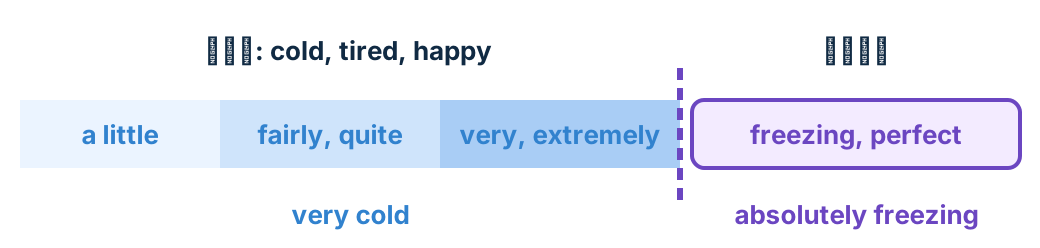
规则: 可分级形容词用 very(very cold),极端形容词用 absolutely(absolutely freezing)。too 表示超出你想要的程度。enough 放在形容词后面。
程度可以更高或更低,还是本身已经是极端?
| 可分级 | 极端(不可分级) |
|---|---|
| cold, hot, tired, happy, sad, angry, big, small, interesting, boring, nice, difficult, tall, funny | freezing, boiling, exhausted, thrilled, furious, enormous, fascinating, terrifying, perfect, impossible, starving, spotless, tiny |
可分级:very
It is very cold today.
I am so tired.
He is fairly confident.
极端:absolutely
That is an absolutely perfect answer.
I am completely exhausted.
That idea is utterly ridiculous.
really 两类都可以修饰:really cold, really freezing。在美式英语中,quite 通常表示 very;在英式英语中,它常常表示 fairly。
too、very 和 enough
| 单词 | 意思 | 例句 |
|---|---|---|
| very | 程度强,常用于称赞 | The cake is very good. |
| too | 超出你想要的程度,表示有问题 | The tea is too hot to drink. |
| adjective + enough | 达到你需要的程度 | Is the room big enough for ten people? |
| enough + noun | 数量达到你需要的程度 | We have enough chairs. |
很多学习者用 too 表示 very,因为韩语的 너무 或中文的 太 两种意思都有。在英语中,too good 或 too delicious 听起来像是在说问题,而不是称赞。
本部分常见错误
- 把 too 当作称赞
Your new haircut looks too nice!✓ Your new haircut looks really nice!too 表示超出你想要的程度,所以听起来像是在抱怨。 - very 修饰不可分级形容词
By midnight we were very starving.✓ By midnight we were absolutely starving.starving 本身已经是极端意义。 - enough 位置错误
Is the printer enough fast for the whole office?✓ Is the printer fast enough for the whole office?enough 放在形容词后面。
更多:否定句中的可分级形容词
在否定句中,英语常常把修饰语说得委婉一些: It’s not very warm outside. I’m not particularly hungry. That was not exactly thrilling.
比较级和最高级
是两者之间的比较,还是一者与其他所有的比较?
规则: 比较级前用 much、far、a lot、a little 或 even,不用 very 或 so,也不要在 -er 形式前再加 more。在 the + 最高级前用 by far 或 easily。very 放在 the 后面:the very best。
比较级
| 修饰语 | 差别 | 例句 |
|---|---|---|
| much, a lot, far | 大 | The train is much faster than the bus. |
| a little, slightly, a bit | 小 | My room is slightly bigger than yours. |
| even | 出乎意料 | The sequel is even better than the first film. |
用 -er 或 more,不要两个都用:much easier,不是 more easier。better 和 worse 本身就是比较级,所以前面从不加 more。
最高级
| 修饰语 | 位置 | 例句 |
|---|---|---|
| by far, easily | 在 the 前面 | It is by far the oldest building in town. |
| very | 在 the 后面 | This is the very best seat in the theater. |
| possibly | 在 the 前面,语气更谨慎 | This is possibly the cheapest flight this month. |
两者比较用比较级,三者或以上用最高级:the taller of the two, the tallest in the class。
本部分常见错误
- very 或 so 修饰比较级
The second hotel was very nicer.✓ The second hotel was much nicer.very 不能修饰比较级。 - 重复使用比较级或最高级
My grades are more better this year.✓ My grades are much better this year.better 本身就是比较级。 - very 放在最高级的 the 前面
It was very the longest meeting of my life.✓ It was by far the longest meeting of my life.very 放在 the 后面,而不是前面。
更多:very much 修饰比较级
单独的 very 不能修饰比较级,但 very much 可以,尤其是在英式英语中: She feels very much better today.
动词和自然搭配
这个修饰语是和动词连用,还是和一个有固定搭配的词连用?
规则: very 不能修饰动词:要说 really like 或 like it very much。很多修饰语有固定搭配:highly recommended, strongly agree, deeply regret。
very 不放在动词前面
| 句型 | 例句 |
|---|---|
| really + verb | I really like this song. |
| verb + object + a lot or very much | I like this song a lot. I like it very much. |
| much + prefer | I much prefer tea to coffee. |
| 有固定搭配的动词 | totally agree, strongly disagree, deeply regret, greatly appreciate |
中文的 很 可以放在 喜欢 (like) 这样的动词前面,所以学习者常写成 very like。在英语中,very 不能这样用。
自然搭配
| 自然 | 避免 | 意思 |
|---|---|---|
| highly recommended | 强烈推荐 | |
| highly skilled | 非常能干 | |
| well known | 很多人都知道 | |
| widely regarded | 普遍认为 | |
| deeply grateful | 由衷感谢 | |
| strongly opposed | 坚决反对 | |
| bitterly cold | 非常冷 |
语气和语域
| 修饰语 | 语域 | 例句 |
|---|---|---|
| so, really, pretty | 口语 | I’m so happy you came! |
| fairly, rather, somewhat | 中性或正式 | The results were fairly encouraging. |
| extremely, incredibly | 中性但语气强 | She worked incredibly hard. |
| highly, deeply, greatly | 正式或书面 | I am deeply concerned. |
本部分常见错误
- very 放在动词前面
I very miss my family.✓ I really miss my family.very 不能修饰动词。 - 不自然的修饰语搭配
I highly agree with the new rules.✓ I strongly agree with the new rules.agree 与 strongly 或 totally 搭配。 - 把 too 当作称赞
I too much love this show.✓ I really love this show.too much 不能用来表示 very。
副词的形式和位置
它描述的是动词还是形容词?宾语在哪里?
规则: 描述动词或形容词要用副词(speak clearly, incredibly quiet)。副词放在形容词前面,放在动词和宾语后面,而不是两者之间。
形容词还是副词?
| 形容词 | 副词 | 例句 |
|---|---|---|
| clear, careful, quick | clearly, carefully, quickly | She drives carefully. |
| good | well | He sings well. |
| fast, hard, late | fast, hard, late (no -ly) | They arrived late. |
hardly 和 lately 是不同的词:hardly 表示几乎不,lately 表示最近。在随意的口语中,有些人会说 real good 或 drive safe,但书面语要用副词。
位置
| 它修饰 | 位置 | 例句 |
|---|---|---|
| 形容词或副词 | 紧挨在它前面 | She is extremely talented. He drove incredibly fast. |
| 带宾语的动词 | 在宾语后面 | He plays the piano well. |
| 动词(really, completely, hardly) | 通常在主要动词前面 | I completely forgot her birthday. |
正确说法
She speaks English very well.
I completely forgot her birthday.
He drove incredibly fast.
错误说法
She speaks very well English.I forgot completely her birthday.He drove incredible fast.
本部分常见错误
- 该用副词却用了形容词
She finished the exercise very quick.✓ She finished the exercise very quickly.quickly 描述动词 finished。 - 副词放在动词和宾语之间
My sister speaks fluently three languages.✓ My sister speaks three languages fluently.把副词放在宾语后面。 - 该用副词却用了形容词
Our new printer works very good.✓ Our new printer works very well.well 是 good 的副词。
so、such 和 hardly
so 还是 such?hard 还是 hardly?
规则: so + 形容词,such (a) + 形容词 + 名词,so much 或 so many + 名词。hard 表示努力地。hardly 表示几乎不,所以不要再加 not。
so 和 such
| 结构 | 例句 |
|---|---|
| so + adjective or adverb | The lake was so calm that we could see the bottom. |
| so much + uncountable noun, so many + plural noun | There was so much food that we took some home. |
| such a + adjective + singular noun | It was such a long flight. |
| such + adjective + plural or uncountable noun | They are such good friends. We had such bad luck. |
表示带 that 的结果时,用 so 或 such,不用 too:so tired that,不是 too tired that。在正式英语中,也可以用 so + 形容词 + a + 名词:so good a teacher。
hard、hardly 和其他否定修饰语
| 单词 | 意思 | 例句 |
|---|---|---|
| hard | 很努力地 | She studies hard. |
| hardly | 几乎不 | She hardly studies. |
| barely, scarcely | 几乎不,勉强 | We barely caught the train. |
| hardly ever | 几乎从不 | I hardly ever drive. |
hardly、barely 和 scarcely 本身已经是否定意义,所以不要再加 not。在正式书面语中,hardly 可以放在句首并倒装,后接 when:Hardly had the meeting started when the power went out。No sooner 则用 than。
本部分常见错误
- 混淆 so 和 such
We had so fun at the party.✓ We had so much fun at the party.fun 是名词,所以要用 so much fun 或 such fun。 - 混淆 hard 和 hardly
Everyone on the team worked hardly to finish on time.✓ Everyone on the team worked hard to finish on time.hard 表示努力地。hardly 表示几乎不。 - 在 hardly、barely 或 scarcely 上再加否定词
I can't hardly wait for the holidays.✓ I can hardly wait for the holidays.hardly 本身已经是否定意义。
自我检测
每个句子都正确吗?点击查看答案。如果你不确定,部分标签会告诉你该看哪里。
第 1 部分The water is too cold for swimming today.
正确。 too 表示有问题:水比你想要的更冷。
第 1 部分The final exam was very impossible.
错误。 The final exam was completely impossible. impossible 是不可分级形容词。
第 2 部分This laptop is a lot lighter than my old one.
正确。 a lot 和比较级连用,表示差别很大。
第 2 部分Anna is the most kindest person I know.
错误。 Anna is the kindest person I know. kindest 本身已经是最高级。
第 3 部分I very enjoyed your presentation.
错误。 I really enjoyed your presentation. very 不能修饰动词。
第 3 部分The chef is highly skilled.
正确。 highly skilled 是自然搭配。
第 4 部分He drives very carefully at night.
正确。 carefully 描述 drives,very 放在 carefully 前面。
第 4 部分She plays beautiful the violin.
错误。 She plays the violin beautifully. 要用副词,并把它放在宾语后面。
第 5 部分It was such a boring lecture that I left early.
正确。 such a 放在形容词 + 单数名词前面。
第 5 部分She works hardly every day.
错误。 She works hard every day. hardly 表示几乎不。
AI 练习提示词
把这段话粘贴到 AI 聊天工具中。