
情态动词,如 can、must 和 should,会给另一个动词增添意义:能力、许可、义务,或说话人有多确定。本主题有三个部分讲 现在和将来,一个部分讲 过去,还有一个部分讲情态动词的 形式 。本指南分为五个部分,与诊断测验的五个部分完全对应。
阅读英文版指南 → 本页为机器翻译,未经母语者审校,可能有不准确之处。以英文版为准。
你的诊断结果会告诉你哪个部分需要复习。请点击下面对应的部分。
核心思路:情态动词在告诉你什么?
换一个情态动词,同一个句子的意思可能完全不同。准确的意思要靠语境判断,而不是只看情态动词。
| 用法 | 情态动词 | 例句 |
|---|---|---|
| 能力 | can, could, be able to | She can speak five languages. |
| 许可 | can, could, may | May I come in? |
| 义务 | must, have to | You have to wear a uniform. |
| 建议 | should, ought to | You should see a doctor. |
| 可能性 | might, may, could | It might rain later. |
| 确定性 | must, can’t | That can’t be true. |
| 过去 | had to, was able to, should have, must have | You should have called me. |
- 1
它说的是什么:能力、义务,还是确定性? 每一类都有自己的一组情态动词(第 1 至 3 部分)。
- 2
说的是过去吗? 说过去发生的事用 had to 或 was able to,做判断和猜测用“情态动词 + have + 过去分词”(第 4 部分)。
- 3
检查形式: 动词原形,不加 -s,不加 to(ought to 除外),不加 do(第 5 部分)。
同一个情态动词在不同语境中可以有不同意思,所以意思总是由语境决定。
能力与许可
这个人能做到,还是被允许做?能力和许可使用同样的情态动词。
规则: Can 和 could 表示能力,在其他形式中用 be able to 代替 can:will be able to、has been able to。Can、could 和 may 用来请求许可。Could 和 would 用来提出礼貌的请求。
能力和许可使用同样的情态动词
| 用法 | 例句 |
|---|---|
| 现在的能力 | She can speak five languages. |
| 过去的能力 | He could swim before he could walk. |
| 将来的能力 | You will be able to drive next year. |
| 许可 | Can I use your phone? May I come in? |
请求与建议
| 用法 | 例句 |
|---|---|
| 请求 | Could you open the window? Would you help me? |
| 建议 | Shall we leave now? Let’s get some coffee. |
本部分常见错误
- can、could 或 be able to 的构成搭配错了
I hope we will can meet again soon.✓ I hope we will be able to meet again soon.Can 不能跟在 will 后面,要用 will be able to。 - 情态动词的意思用错了
Could you mind waiting a moment?✓ Would you mind waiting a moment?表示礼貌请求的 mind 句型要用 would。 - can、could 或 be able to 的构成搭配错了
He is can cook very well.✓ He can cook very well.Can 不能和 be 一起用。
义务与必要
是必须、禁止,还是可做可不做?情态动词会告诉你。
规则: Must 和 have to 表示义务,但只有 have to 能用于过去和将来。Mustn’t 表示禁止,don’t have to 表示没有必要。Should 和 ought to 表示建议,had better 表示警告。
Must 与 have to 的区别
| 用法 | 例句 |
|---|---|
| 义务,出于自己的看法 | I must finish this today. |
| 义务,来自外部规定 | You have to wear a uniform at this school. |
| 禁止 | You mustn’t smoke in here. |
| 没有必要 | You don’t have to come if you’re busy. |
Should、ought to 和 had better
| 用法 | 例句 |
|---|---|
| 建议 | You should see a doctor. You ought to apologize. |
| 强烈警告 | You had better leave now, or you’ll miss the train. |
Have to 不是真正的情态动词,所以会随时态和人称变化:had to、will have to、has to。
本部分常见错误
- 混淆了 mustn’t 和 don’t have to
You mustn't pay for the tickets. They're free.✓ You don't have to pay for the tickets. They're free.Mustn’t 表示禁止,不是“没有必要”。 - 混淆了 must 和 have to
We must wait two hours at the airport yesterday.✓ We had to wait two hours at the airport yesterday.Must 没有过去式。 - 建议或义务的强度用错了
You would better check the time.✓ You had better check the time.固定说法永远是 had better。
补充:作为情态动词的 needn’t
在英式英语中,needn’t 可以像情态动词一样使用,后面不加 do: You needn’t worry. 在大多数其他英语变体中,更常用 don’t need to: You don’t need to worry.
可能性与确定性
说话人有多确定?情态动词会显示确定程度。
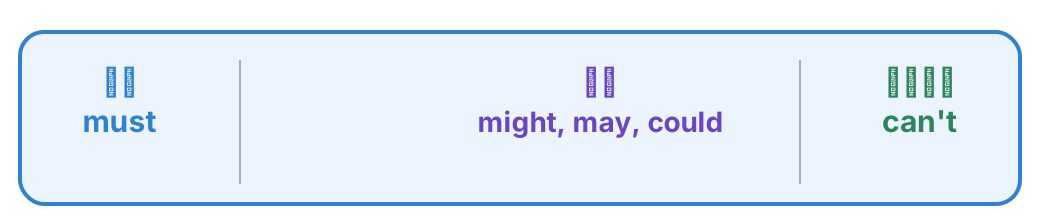
规则: Must 表示几乎肯定,might、may 和 could 表示可能,can’t 表示几乎肯定不是真的。Can 用于一般情况下的可能。
说话人有多确定?
| 确定程度 | 情态动词 | 例句 |
|---|---|---|
| 几乎肯定,是真的 | must | She must be tired after that flight. |
| 可能 | might, may, could | He might be at home. |
| 几乎肯定,不是真的 | can’t | That can’t be true. |
可能性的程度
| 情态动词 | 细微差别 |
|---|---|
| might | 有实际的可能 |
| may | 与 might 相近,稍微正式一些 |
| could | 几种选择之一:We could go to the beach, or we could stay home. |
| can | 一般情况下的可能,而不是某一次的机会:Winter here can be very cold. |
本部分常见错误
- 把 can 用于某一次情况中的可能性
Call Mia first. She can be busy right now.✓ Call Mia first. She might be busy right now.表示某一次情况中的可能性,用 might、may 或 could。 - 确定程度与情态动词不匹配
He might be rich. He owns three houses and a boat.✓ He must be rich. He owns three houses and a boat.证据充分时要用 must。 - 确定程度与情态动词不匹配
That must be Ken's car. Ken doesn't drive.✓ That can't be Ken's car. Ken doesn't drive.证据排除了这种可能时,用 can’t。
补充:用 must not 表示否定的推测
Must not 可以表示有把握的否定推测,在美式英语中尤其常见: He must not be home; his car is gone. Can’t 的语气更强,表示不可能。Mustn’t 是它的缩略形式,在这个意思上不太常用。
关于过去的情态动词
事情发生了吗?有必要吗?这是个好主意吗?情态动词的过去形式回答这些问题。
规则: 过去的义务用 had to,一次过去的成功用 was able to。Should have、must have、could have、can’t have 和 needn’t have 用来对过去做判断或猜测。
对过去做判断和猜测
| 用法 | 例句 |
|---|---|
| 本来是个好主意,但没有发生 | You should have called me. |
| 对过去的有把握的猜测 | She must have left already. |
| 本来可能,但没有发生 | We could have won the game. |
Couldn’t have 和 needn’t have
| 用法 | 例句 |
|---|---|
| 本来不可能 | I couldn’t have finished without your help. |
| 发生了,但没有必要 | You needn’t have brought a gift. |
Had to、didn’t need to 和 was able to
| 用法 | 例句 |
|---|---|
| 过去的义务 | I had to work late last night. |
| 没有必要,所以没有发生 | I didn’t need to buy a ticket; it was free. |
| 过去的一般能力 | She could read at four. |
| 一次过去的成功 | After two hours, we were able to fix the car. |
Should of 是对 should have 的听错,不要这样写。
本部分常见错误
- 把 could 用于一次过去的成功
After a long search, I could find my passport.✓ After a long search, I was able to find my passport.一次过去的成功要用 was able to 或 managed to。 - 过去情态动词的构成错了
They should of asked for directions.✓ They should have asked for directions.Should of 是 should have 的拼写错误。 - 过去情态动词与意思不匹配
I needn't have paid for parking; it was free, so I didn't.✓ I didn't need to pay for parking; it was free, so I didn't.Needn’t have 表示事情已经发生了。没有发生时用 didn’t need to。
补充:may have 和 might have
May have 和 might have 表示对过去不太确定的猜测。说话人不知道事情是否发生了: She may have missed the bus. Could have 也可以是这样的猜测,但它常常表示本来可能,却没有发生。
形式、否定与疑问
句子符合情态动词的固定形式吗?动词原形,不加 to,不加 -s,不加 do。
规则: 大多数情态动词后面接不带 to 的动词原形,自身不加 -s,也不用 do。Have to 和 be able to 会随人称和时态变化,并使用 do 或 does。
所有真正的情态动词共有的形式
| 规则 | 例句 |
|---|---|
| 情态动词后面不加 to | She can swim, not can to swim. |
| 情态动词本身不加 -s | He can swim, not he cans swim. |
| 否定:情态动词 + not,不用 do | She cannot swim. He should not go. |
Ought to 是唯一保留 to 的情态动词:You ought to rest.
疑问句与半情态动词
| 类型 | 例句 |
|---|---|
| 情态动词疑问句 | Can you help me? Should I call her? |
| have to 疑问句 | Does he have to work on Sundays? |
| be able to 疑问句 | Will she be able to come? |
本部分常见错误
- 真正的情态动词前误用 do 或 does
Do you can help me tomorrow?✓ Can you help me tomorrow?真正的情态动词构成疑问句时不用 do。 - 情态动词后面误加 -s
She should calls her mother.✓ She should call her mother.情态动词后面的动词不加 -s。 - 把 have to 或 be able to 当成真正的情态动词来构成
Does he has to wear a helmet?✓ Does he have to wear a helmet?在 does 后面,have 保持原形。
自测
每个句子正确吗?点击查看答案。部分标签会告诉你,如果拿不准,该去看哪一部分。
Part 1I'd like to can play the piano.
不正确。 I’d like to be able to play the piano. Can 没有 to 的形式。
Part 1May I leave a few minutes early today?
正确。 May 用来礼貌地请求许可。
Part 2You don't have to shout. I can hear you fine.
正确。 Don’t have to 表示没有必要。
Part 2You mustn't bring a gift, but it would be nice.
不正确。 You don’t have to bring a gift. Mustn’t 表示禁止。
Part 3It can snow tonight, so drive carefully.
不正确。 It might snow tonight. Can 表示一般情况下的可能。
Part 3She can't be at home. I just saw her at the bank.
正确。 Can’t 表示说话人确定这不是真的。
Part 4We could win the final last year.
不正确。 We were able to win the final. 一次过去的成功要用 was able to。
Part 4You should have seen his face!
正确。 Should have 后面接过去分词。
Part 5He must to wear glasses for driving.
不正确。 He must wear glasses. must 后面不加 to。
Part 5Does she have to work tomorrow?
正确。 Have to 的疑问句用 does。
AI 练习提示
把这段提示粘贴到 AI 聊天工具中。