
IELTS Reading uses a small set of question types again and again, and each has its own traps. This guide covers six of them with short extracts, so you can learn how each type works before you practice full-length passages.
关于本指南: 雅思阅读:题型
雅思阅读反复使用几种固定题型,每种题型都有自己的陷阱。本指南用简短的文段讲解其中六种:True/False/Not Given、Yes/No/Not Given、选择题、段落标题配对、信息与特征配对,以及句子和摘要填空。本指南分为六个部分,与诊断测验的六个部分一一对应。它讲的是每种题型怎么做,不能代替在限时条件下练习完整长文章。
你可以先做诊断测验,看看这个主题的哪些部分需要复习,也可以直接进入练习活动,其中包含复习幻灯片。
本指南本身为英文。这些翻译只是额外提供的便利,可能不够完美。
このガイドについて: IELTS リーディング:問題形式
IELTS リーディングでは決まった問題形式が繰り返し使われ、それぞれに特有の落とし穴があります。このガイドでは、短い抜粋を使ってそのうち 6 つを扱います。True/False/Not Given、Yes/No/Not Given、多肢選択、見出しの選択、情報と特徴の照合、文と要約の完成です。ガイドは 6 つのパートで、診断テストの 6 つのパートに対応しています。各形式の解き方を学ぶためのもので、時間を計って長文全体を読む練習の代わりにはなりません。
まず診断テストを受けて、このテーマのどの部分を復習すべきか確認することもできますし、復習スライドを含む練習アクティビティにそのまま進むこともできます。
このガイド自体は英語です。これらの翻訳は補助として提供しているもので、完全とは限りません。
이 가이드 소개: IELTS 리딩: 문제 유형
IELTS 리딩은 몇 가지 정해진 문제 유형을 반복해서 쓰며, 유형마다 고유한 함정이 있습니다. 이 가이드는 짧은 발췌문으로 그중 여섯 가지를 다룹니다. True/False/Not Given, Yes/No/Not Given, 객관식, 제목 고르기, 정보와 특징 연결, 문장과 요약 완성입니다. 가이드는 여섯 부분으로 되어 있으며 진단 퀴즈의 여섯 부분과 일치합니다. 각 유형을 푸는 방법을 가르칠 뿐, 시간 제한 속에서 긴 지문 전체를 읽는 연습을 대신하지는 않습니다.
먼저 진단 퀴즈로 이 주제에서 복습이 필요한 부분을 확인해도 되고, 복습 슬라이드가 포함된 연습 활동으로 바로 들어가도 됩니다.
가이드 자체는 영어로 되어 있습니다. 이 번역은 부가적으로 제공되는 것이며 완벽하지 않을 수 있습니다.
Giới thiệu hướng dẫn này: IELTS Reading: Các dạng câu hỏi
IELTS Reading dùng lặp lại một số dạng câu hỏi cố định, và mỗi dạng có bẫy riêng. Hướng dẫn này trình bày sáu dạng bằng các đoạn trích ngắn: True/False/Not Given, Yes/No/Not Given, trắc nghiệm, chọn tiêu đề cho đoạn, nối thông tin và đặc điểm, và hoàn thành câu và tóm tắt. Hướng dẫn gồm sáu phần, khớp với sáu phần của bài kiểm tra chẩn đoán. Nó dạy cách làm từng dạng, không thay thế việc luyện đọc bài dài đầy đủ có giới hạn thời gian.
Bạn có thể bắt đầu bằng bài kiểm tra chẩn đoán để biết phần nào cần ôn lại, hoặc vào thẳng các hoạt động luyện tập, trong đó có cả slide ôn tập.
Đọc hướng dẫn bằng tiếng Việt →
Bản hướng dẫn này được viết bằng tiếng Anh. Các bản dịch chỉ là phần hỗ trợ thêm và có thể chưa hoàn hảo.
इस गाइड के बारे में: IELTS रीडिंग: प्रश्नों के प्रकार
IELTS रीडिंग कुछ तय प्रश्न प्रकारों का बार-बार उपयोग करती है, और हर प्रकार के अपने जाल होते हैं। यह गाइड छोटे अंशों की मदद से इनमें से छह को समझाती है: True/False/Not Given, Yes/No/Not Given, बहुविकल्पीय प्रश्न, शीर्षक मिलाना, जानकारी और विशेषताओं का मिलान, तथा वाक्य और सारांश पूर्ति। इस गाइड के छह भाग हैं, जो निदान क्विज़ के छह भागों से मेल खाते हैं। यह हर प्रकार को हल करना सिखाती है, पर समय-सीमा में पूरे लंबे पाठ पढ़ने के अभ्यास की जगह नहीं लेती।
आप निदान क्विज़ से शुरू करके जान सकते हैं कि इस विषय के कौन-से भाग दोहराने चाहिए, या सीधे अभ्यास गतिविधियों में जा सकते हैं, जिनमें दोहराव की स्लाइडें भी हैं।
गाइड स्वयं अंग्रेज़ी में है। ये अनुवाद अतिरिक्त सुविधा के रूप में हैं और पूरी तरह सटीक न भी हों।
نبذة عن هذا الدليل: قراءة IELTS: أنواع الأسئلة
يستخدم اختبار القراءة في IELTS مجموعة ثابتة من أنواع الأسئلة، ولكل نوع فخاخه الخاصة. يتناول هذا الدليل ستة منها باستخدام مقتطفات قصيرة: True/False/Not Given و Yes/No/Not Given والاختيار من متعدد ومطابقة العناوين ومطابقة المعلومات والسمات وإكمال الجمل والملخصات. يتكون الدليل من ستة أجزاء تطابق أجزاء الاختبار التشخيصي الستة. وهو يعلّم طريقة حل كل نوع، لكنه لا يغني عن التدرب على نصوص كاملة طويلة ضمن وقت محدد.
يمكنك البدء بالاختبار التشخيصي لمعرفة الأجزاء التي تحتاج إلى مراجعة، أو الانتقال مباشرة إلى أنشطة التدريب، وتشمل شرائح مراجعة.
الدليل نفسه بالإنجليزية. هذه الترجمات مجرد خدمة إضافية وقد لا تكون دقيقة تمامًا.
Об этом руководстве: IELTS Reading: типы вопросов
В IELTS Reading повторяется небольшой набор типов вопросов, и у каждого свои ловушки. Это руководство разбирает шесть из них на коротких отрывках: True/False/Not Given, Yes/No/Not Given, выбор ответа, подбор заголовков, сопоставление информации и признаков, заполнение пропусков в предложениях и резюме. В руководстве шесть частей, и они соответствуют шести частям диагностического теста. Оно учит решать каждый тип, но не заменяет практику с полными длинными текстами на время.
Можно начать с диагностического теста, чтобы узнать, какие части темы стоит повторить, или сразу перейти к упражнениям, в которые входят слайды для повторения.
Читать руководство на русском →
Само руководство написано на английском. Эти переводы — дополнительная помощь, и они могут быть неидеальными.
Acerca de esta guía: IELTS Reading: tipos de pregunta
IELTS Reading usa un conjunto fijo de tipos de pregunta, y cada uno tiene sus propias trampas. Esta guía trata seis de ellos con fragmentos breves: True/False/Not Given, Yes/No/Not Given, opción múltiple, relacionar títulos, relacionar información y características, y completar oraciones y resúmenes. La guía tiene seis partes, que coinciden con las seis partes del diagnóstico. Enseña cómo resolver cada tipo, pero no sustituye la práctica con textos completos y largos bajo límite de tiempo.
Puedes empezar con el cuestionario de diagnóstico para saber qué partes del tema conviene repasar, o ir directamente a las actividades de práctica, que incluyen diapositivas de repaso.
La guía en sí está en inglés. Estas traducciones son un añadido de cortesía y pueden no ser perfectas.
À propos de ce guide: IELTS Reading : types de questions
IELTS Reading utilise un ensemble fixe de types de questions, et chacun a ses propres pièges. Ce guide en présente six à l'aide de courts extraits : True/False/Not Given, Yes/No/Not Given, questions à choix multiples, association de titres, association d'informations et de caractéristiques, et compléter des phrases et des résumés. Le guide comporte six parties, qui correspondent aux six parties du diagnostic. Il apprend à traiter chaque type, mais ne remplace pas l'entraînement sur des textes complets et longs en temps limité.
Vous pouvez commencer par le quiz de diagnostic pour savoir quelles parties du sujet réviser, ou passer directement aux activités d'entraînement, qui comprennent des diapositives de révision.
Le guide lui-même est en anglais. Ces traductions sont un complément offert et peuvent ne pas être parfaites.
Sobre este guia: IELTS Reading: tipos de questão
O IELTS Reading usa um conjunto fixo de tipos de questão, e cada um tem suas próprias armadilhas. Este guia trata de seis deles com trechos curtos: True/False/Not Given, Yes/No/Not Given, múltipla escolha, relacionar títulos, relacionar informações e características, e completar frases e resumos. O guia tem seis partes, que correspondem exatamente às seis partes do teste diagnóstico. Ele ensina como resolver cada tipo, mas não substitui a prática com textos completos e longos sob limite de tempo.
Você pode começar pelo teste diagnóstico para ver quais partes do tema precisam de revisão, ou ir direto para as atividades de prática, que incluem slides de revisão.
O guia em si está em inglês. Estas traduções são um recurso extra e podem não ser perfeitas.
Your diagnostic result says which part needs review. Tap that part below.
How IELTS Reading questions work
Every question type asks you to compare the question with the text. What changes is what you compare: a fact, an opinion, a main idea, or exact words.
| Question type | What it tests | Answers in text order? |
|---|---|---|
| True / False / Not Given | Facts in the text | Yes |
| Yes / No / Not Given | The writer’s views | Yes |
| Multiple choice | Details or main ideas | Yes |
| Matching headings | Main idea of each paragraph | Paragraphs are in order; the headings list is not |
| Matching information | Where a detail appears | No |
| Matching features | Which person, place, or date | Usually no |
| Sentence and summary completion | Exact words from the text | Usually yes |
A routine for any question
- 1
Read the instructions: the answer format, and any word limit.
- 2
Read the question and underline the key idea, not just key words.
- 3
Scan the text for that idea, expecting different words.
- 4
Read the sentences around it carefully before you answer.
- 5
Check qualifiers (most, only, may) and whose view it is.
The Academic Reading test is 60 minutes, 40 questions, and three long passages, with no extra time to transfer answers. General Training uses the same question types with different texts. This unit uses short extracts so each question type can be practiced on its own; it does not train reading speed across full passages.
True / False / Not Given
Does the text agree, say the opposite, or say nothing?
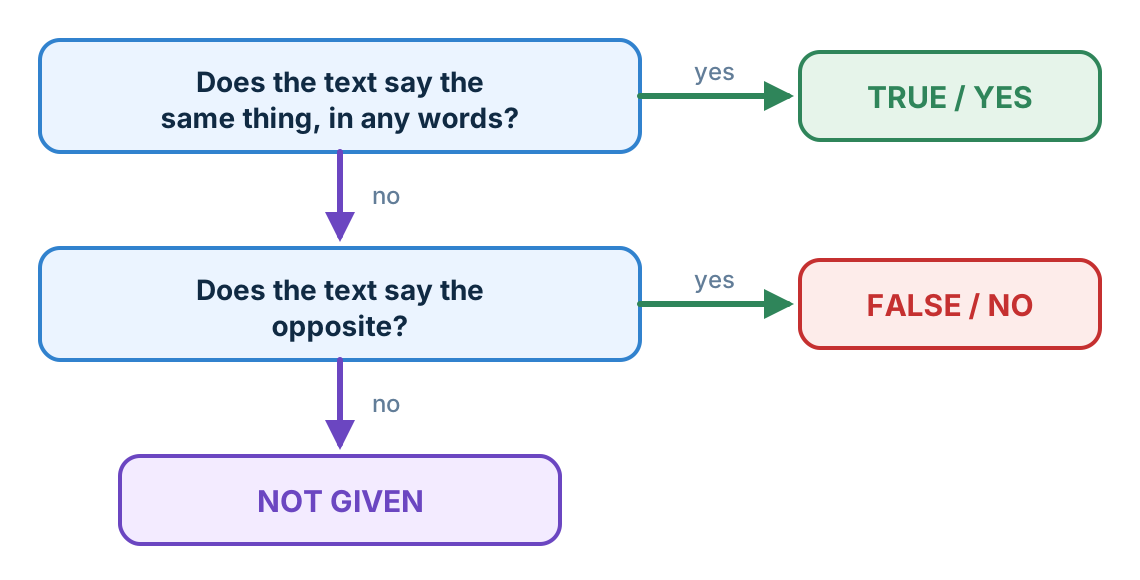
The rule: True means the text agrees, False means it says the opposite, and Not Given means it says nothing on the point.
Worked example
The gallery reopened in May after a two-year renovation. Entry remains free, but visitors are now asked to book a time slot online.
| Statement | Answer | Reason |
|---|---|---|
| Visitors must now pay to enter. | False | ‘Entry remains free’ contradicts it. |
| The renovation took longer than planned. | Not Given | No plan is mentioned. |
| Visitors need to reserve a time to visit. | True | ‘Book a time slot’ is reworded. |
Why Not Given is hard
A common error is marking a Not Given statement as False. If you cannot point to words in the text that say the opposite, it is not False.
Common errors in this part
- Not Given treated as False or No
The hotel is always full in summer: False✓ Not GivenText: 'The hotel has 40 rooms.' It says nothing about how busy the hotel is. - Missed a qualifying word
Most students choose online classes: True✓ FalseText: 'About a quarter of students choose online classes.' A quarter is not most.
Yes / No / Not Given
Is this what the writer thinks, or what someone else thinks?
The rule: Yes/No/Not Given asks what the writer thinks, not what is true or what other people believe.
Separate the voices
It is often claimed that city parks are a luxury. I disagree: they reduce heat, and cities that neglect them are storing up problems.
| Whose view? | What they think |
|---|---|
| Other people (it is often claimed) | Parks are a luxury. |
| The writer (I disagree) | Parks are useful; neglecting them causes problems. |
The same logic as True / False / Not Given
| Answer | Meaning |
|---|---|
| Yes | The statement matches the writer’s view. |
| No | The writer’s view is the opposite. |
| Not Given | The writer does not say what they think about this. |
Watch the contrast words
although, but, yet, however, and I would not go that far often mark the point where the writer’s own view begins.
Common errors in this part
- Someone else's view taken as the writer's
The writer thinks the plan is wasteful: Yes✓ NoText: 'Critics call the plan wasteful, but I think it is good value.' Wasteful is the critics' view. - A fact treated as an opinion
The writer thinks the bridge was too expensive: Yes✓ Not GivenText: 'The bridge cost 40 million dollars.' A cost figure is a fact, not an opinion.
Multiple choice
Which option answers the question, not just repeats the text?
The rule: An option can be true in the text and still be wrong, because it does not answer the question.
Four kinds of wrong option
| Trap | What it looks like |
|---|---|
| Word match | Repeats words from the text with a different meaning. |
| True but not the answer | Correct according to the text, but answers a different question. |
| Overstated | Uses all, never, completely, or proven where the text is careful. |
| Not in the text | Sounds reasonable, or is true in real life, but the text does not say it. |
- 1
Read the question stem and decide what it asks for: a reason, a result, a purpose, or an opinion.
- 2
Find the part of the text that answers that question.
- 3
Choose the option that matches it in meaning, then check the others against the four traps.
Common errors in this part
- True, but not the answer
Why did the shop close? It had opened in 1995.✓ It lost customers to a new mall.The opening date is true, but it is not a reason. - Goes further than the text
The scheme ended waste in the city.✓ The scheme cut the amount of waste.Text: 'The scheme reduced waste.' Reduced does not mean ended.
Matching headings
Which heading covers the whole paragraph?
The rule: The right heading covers the whole paragraph, not one example or one sentence inside it.
Worked example
Some residents welcome the new market because it brings visitors. Shop owners nearby fear lost sales, and others complain about weekend traffic.
| Heading | Verdict |
|---|---|
| Mixed reactions to the new market | Covers the whole paragraph |
| Weekend traffic problems | One detail |
| Shopping in the city | Too broad |
| Why visitors like markets | Word match: visitors, market |
How the task is set up
The list has more headings than paragraphs, so some are never used. Do the paragraphs you are sure of first, and cross those headings off.
Common errors in this part
- A detail, not the main idea
Heavy rain in March✓ Several causes of the floodThe paragraph gives three causes; heavy rain is only one of them. - Too broad for one paragraph
Transport in the modern world✓ A new way to cycle around the cityThe paragraph is about one city's bike-sharing scheme. The first heading could fit a whole book.
Matching information and features
Which paragraph, or which person, holds this idea?
The rule: The question uses different words from the paragraph, so match meaning, not vocabulary.
Two versions of the task
| Task | You match | Watch for |
|---|---|---|
| Matching information | A detail to the paragraph that contains it (A, B, C…) | The question paraphrases the paragraph; answers are not in text order. |
| Matching features | A statement to a person, place, or date | Two people may mention the same topic with different views. |
Paraphrases to expect
| Question wording | Possible text wording |
|---|---|
| a financial benefit | lower bills, saves money, cheaper |
| a limitation | still cannot, only works when, not yet |
| a change of opinion | once assumed, now suggests, has since |
Speed tip
For matching information, skim each paragraph once and note its topic in two or three words before you look at the questions.
Common errors in this part
- Right idea, wrong paragraph
A cost is mentioned in the paragraph that uses the word price✓ The paragraph about saving moneyLook for the idea of cost, not the word. The word price may be used in another sense. - Idea linked to the wrong person
The scientist who produced the results doubts them✓ The scientist who questions the methodMatch the view to the person who holds it.
Sentence and summary completion
Which exact words from the text fit the gap and the limit?
The rule: Copy the exact words from the text, spelled correctly, within the word limit, so that the completed sentence is grammatical.
Three checks before you write
- 1
Are the words exactly as they appear in the text, spelled correctly?
- 2
Is the answer within the word limit, counting a and the?
- 3
Is the completed sentence grammatical, especially singular and plural?
Worked example
The ancient road was paved with flat stones and lined with small shrines for travelers.
NO MORE THAN TWO WORDS: The road was covered with ___.
| Answer | Marked |
|---|---|
| flat stones | Correct |
| the flat stones | Wrong: three words |
| smooth stones | Wrong: not the text’s words |
| flat stone | Wrong: ‘covered with flat stone’ changes the form |
Summary completion
Sometimes you choose words from a box instead of the text. Then the word limit does not apply, but grammar still does.
Common errors in this part
- Too many words
ONE WORD ONLY: The birds eat small insects.✓ The birds eat insects.Two words break a one-word limit. - Not the text's words
The farm's main crop is grain.✓ The farm's main crop is barley.Text: 'the farm's main crop is barley.' Use the text's word, not a more general one.
Self-check
Is each sentence correct? Tap to see the answer. The part label tells you where to look if you were not sure.
Part 1If the text does not mention something, the answer is False.
Incorrect. That is Not Given. False needs the text to say the opposite.
Part 1A True statement can use completely different words from the text.
Correct. True statements are usually paraphrases.
Part 2Yes/No/Not Given questions ask about the writer's opinions, not facts.
Correct. Other people’s views in the text are not the writer’s view.
Part 3In multiple choice, an option that is true according to the text is always the answer.
Incorrect. It must also answer the question that was asked.
Part 4Every heading in the list is used once.
Incorrect. There are usually more headings than paragraphs.
Part 5In matching information, the answers follow the order of the text.
Incorrect. They do not, and a paragraph can sometimes be used more than once.
Part 6In sentence completion, the words a and the do not count toward the word limit.
Incorrect. Every word counts.
Part 6Spelling mistakes in completion answers are marked wrong.
Correct. The answer must be spelled correctly.
AI practice prompt
Paste this into an AI chat tool and replace the bracket with your language.