

Level: B2. Reading at B2. The word lists range from B1 to C1 on purpose; frequency scores show which words are common.
Introduction | Word Family | Collocations | Patterns | Expressions | Synonyms and Antonyms | Activities | Speed Challenge | Shadow Reading and Typing | Quotations | Discussion | AI Prompt | Resources
Printable: Student activity handout (PDF) | Teacher’s key (PDF)
Progress: Moving Forward, One Step at a Time
Progress plays a surprisingly large role in our happiness. We often imagine that we will feel good once we finally reach a goal, but the joy of arriving usually fades quickly. What tends to stay with us is the feeling of moving forward: understanding something that confused us last week, finishing a task we had been avoiding, or noticing that a skill is getting easier.
Progress is rarely smooth or steady, though. Most journeys have stages. Sometimes we are stuck: we hit a plateau, tread water, or hit a snag that slows everything down. Sometimes we are just starting out, taking baby steps and hoping we are on the right track. Then, often without warning, we turn the corner, make strides, and occasionally even break new ground. Looking back, we realize we have come a long way, even if we still have a long way to go.
This page explores the idea of progress and the language we use to talk about it. You will find word forms, common collocations, useful expressions from “stuck” to “breakthrough,” synonyms and antonyms, interactive activities, discussion questions, and a practice text for shadow reading and typing.
Word Family
Translations throughout this page are in this order: Chinese | Japanese | Korean | Hindi | Arabic | Russian | Spanish | French. Single words show a frequency score and rank. How to read the scores and ranks.
progress (noun, uncountable) US /ˈprɑːɡres/, UK /ˈprəʊɡres/: movement toward a goal, or gradual improvement over time.
Frequency: 4.78 | Rank: 1,724
She has made real progress with her English this year.
Translations: 进步 | 進歩 | 진전, 발전 | प्रगति | تقدّم | прогресс | progreso | progrès
progress (verb) /prəˈɡres/: to move forward or develop over time.
As the meeting progressed, the mood improved.
Translations: 进展 | 進む, 進行する | 진행되다, 진전하다 | प्रगति करना | يتقدّم | продвигаться | progresar, avanzar | progresser, avancer
progressive (1) (adjective) /prəˈɡresɪv/: happening or increasing step by step.
Frequency: 4.34 | Rank: 4,015
The course has a progressive increase in difficulty.
Translations: 逐步的 | 漸進的な | 점진적인 | क्रमिक | تدريجي | постепенный | progresivo, gradual | progressif
progressive (2) (adjective) /prəˈɡresɪv/: supporting new ideas and social reform.
The city is known for its progressive transport policies.
Translations: 进步的 | 進歩的な | 진보적인 | प्रगतिशील | تقدّمي | прогрессивный | progresista | progressiste
progressively (adverb) /prəˈɡresɪvli/: more and more, over time.
Frequency: 3.48 | Rank: 15,368
The exercises get progressively harder.
Translations: 逐渐地 | 次第に | 점점, 점진적으로 | उत्तरोत्तर | تدريجيًا | всё более, постепенно | progresivamente | progressivement
progression (noun) /prəˈɡreʃən/: the process of moving from one stage to the next.
Frequency: 3.90 | Rank: 8,266
There is a natural progression from beginner to intermediate courses.
Translations: 进程, 发展 | 進行, 推移 | 진행, 진전 | क्रम, आगे बढ़ना | تسلسل, تطوّر | последовательность, развитие | progresión | progression
Common mistakes
- Progress is uncountable. Say make progress or make a lot of progress, not make a progress or many progresses. For one step forward, use an advance or a step forward.
- In progress, not on progress. The exam is in progress means it is happening now. But progress on a task is correct: We made progress on the report.
- The stress moves. Noun: a PROgress report. Verb: talks are proGRESSing. The same shift happens with REgress (rare noun) and reGRESS (verb).
- Progressive has two meanings. A progressive illness gets worse step by step. A progressive party supports reform. Context decides which one is meant.
- Progress is not process. The application process is the set of steps. Your progress is how far you have moved through them.
Collocations
Collocations are words that often go together. For a longer list, see progress on OZDIC, a free collocation dictionary.
Verb + progress
make progress: to improve or move closer to a goal.
We made good progress on the design today.
Translations: 取得进展 | 進歩する, 前進する | 진전을 이루다 | प्रगति करना | يحرز تقدّمًا | добиваться прогресса | hacer progresos | faire des progrès
track progress: to follow and record how much has been done.
The app tracks your progress with a weekly chart.
Translations: 跟踪进度 | 進捗を記録する | 진행 상황을 추적하다 | प्रगति पर नज़र रखना | يتابع التقدّم | отслеживать прогресс | seguir el progreso | suivre les progrès
hinder progress (formal): to make progress slower or more difficult.
Poor internet access hindered progress in rural schools.
Translations: 阻碍进展 | 進歩を妨げる | 진전을 방해하다 | प्रगति में बाधा डालना | يعيق التقدّم | препятствовать прогрессу | obstaculizar el progreso | freiner les progrès
accelerate progress (formal): to make progress happen faster.
More funding could accelerate progress on cleaner batteries.
Translations: 加快进展 | 進展を加速させる | 진전을 가속화하다 | प्रगति को तेज़ करना | يسرّع التقدّم | ускорять прогресс | acelerar el progreso | accélérer les progrès
halt progress: to stop progress completely.
A strike halted progress on the new bridge.
Translations: 使进展停止 | 進展を止める | 진전을 멈추게 하다 | प्रगति रोक देना | يوقف التقدّم | остановить продвижение | detener el progreso | stopper les progrès
Adjective + progress
These describe speed and amount.
rapid progress: very fast improvement.
Children often make rapid progress in a new language.
Translations: 快速进步 | 急速な進歩 | 급속한 진전 | तीव्र प्रगति | تقدّم سريع | быстрый прогресс | progreso rápido | progrès rapides
steady progress: regular improvement without big jumps or stops.
He made steady progress after the operation.
Translations: 稳步进展 | 着実な進歩 | 꾸준한 진전 | स्थिर प्रगति | تقدّم مطّرد | стабильный прогресс | progreso constante | progrès réguliers
slow progress: improvement that takes a long time.
The two sides made slow progress in the talks.
Translations: 进展缓慢 | 遅々とした進歩 | 더딜 진전 | धीमी प्रगति | تقدّم بطيء | медленный прогресс | progreso lento | progrès lents
substantial progress (formal): a large, important amount of progress.
Both sides reported substantial progress after the meeting.
Translations: 重大进展 | 大幅な進展 | 상당한 진전 | उल्लेखनीय प्रगति | تقدّم كبير | существенный прогресс | progreso sustancial | progrès substantiels
lack of progress: a situation where little or nothing improves.
Parents complained about the lack of progress on the new school.
Translations: 缺乏进展 | 進展のなさ | 진전 부족 | प्रगति का अभाव | انعدام التقدّم | отсутствие прогресса | falta de progreso | manque de progrès
Progress + noun
progress report: a document that describes how much of a task is done.
Teachers send a progress report home each term.
Translations: 进度报告 | 進捗報告書 | 진행 보고서 | प्रगति रिपोर्ट | تقرير مرحلي | отчёт о ходе работы | informe de progreso | rapport d’avancement
progress review: a meeting or check to judge how well work is going.
New staff have a progress review after three months.
Translations: 进度评估 | 進捗レビュー | 진행 상황 검토 | प्रगति समीक्षा | مراجعة التقدّم | оценка хода работы | revisión del progreso | bilan d’étape
Kinds of progress
economic progress: growth in a country’s wealth and living standards.
Economic progress has lifted millions out of poverty in some regions.
Translations: 经济进步 | 経済的進歩 | 경제 발전 | आर्थिक प्रगति | التقدّم الاقتصادي | экономический прогресс | progreso económico | progrès économique
social progress: improvement in people’s health, rights, and quality of life.
Social progress is harder to measure than income.
Translations: 社会进步 | 社会的進歩 | 사회 발전 | सामाजिक प्रगति | التقدّم الاجتماعي | социальный прогресс | progreso social | progrès social
technological progress: advances in technology and invention.
Technological progress has changed how people study.
Translations: 技术进步 | 技術の進歩 | 기술 발전 | तकनीकी प्रगति | التقدّم التكنولوجي | технический прогресс | progreso tecnológico | progrès technologique
human progress: the improvement of human life over history.
Some writers see science as the main engine of human progress.
Translations: 人类进步 | 人類の進歩 | 인류의 진보 | मानव प्रगति | التقدّم البشري | прогресс человечества | progreso humano | progrès humain
Progressive + noun
progressive tax: a tax where people with higher incomes pay a higher rate.
Many countries use a progressive tax on income.
Translations: 累进税 | 累進課税 | 누진세 | प्रगामी कर | ضريبة تصاعدية | прогрессивный налог | impuesto progresivo | impôt progressif
progressive education: teaching based on learning by doing and students’ interests.
The school follows the ideas of progressive education.
Translations: 进步主义教育 | 進歩主義教育 | 진보주의 교육 | प्रगतिशील शिक्षा | التعليم التقدّمي | прогрессивное образование | educación progresista | éducation progressiste
the Progressive Era: a period of political and social reform in the United States, roughly the 1890s to the 1910s.
Food safety laws were passed during the Progressive Era.
Translations: 进步时代 | 革新主義時代 | 진보주의 시대 | प्रगतिशील युग | الحقبة التقدّمية | эра прогрессивизма | Era Progresista | ère progressiste
progressive disease: an illness that gets worse over time.
Parkinson’s is a progressive disease.
Translations: 进行性疾病 | 進行性疾患 | 진행성 질환 | बढ़ती जाने वाली बीमारी | مرض متفاقم | прогрессирующее заболевание | enfermedad progresiva | maladie évolutive
Preposition Patterns
These patterns use progress as a noun (progress on) or a verb (progress to).
in progress: happening now; not finished.
Please be quiet: an exam is in progress.
Translations: 正在进行中 | 進行中 | 진행 중인 | जारी | جارٍ, قيد التنفيذ | в процессе | en curso | en cours
progress on (a task): progress with a particular task or project.
Have you made any progress on your essay?
Translations: 在…上的进展 | …の進捗 | …에 대한 진전 | … पर प्रगति | التقدّم في … | продвижение в работе над … | avances en … | progrès sur …
progress with (an activity): progress in an activity or skill; often interchangeable with on.
How is your progress with the piano?
Translations: 在…方面的进步 | …の上達 | …의 진척 | … में प्रगति | التقدّم في … | успехи в … | progresos con … | progrès en …
progress toward (a goal): movement closer to a goal; towards in British English.
The country has made progress toward cleaner energy.
Translations: 向…迈进 | …に向けた進展 | …을 향한 진전 | … की ओर प्रगति | التقدّم نحو … | продвижение к … | avances hacia … | progrès vers …
progress from … to …: to move from one stage or position to another.
She progressed from part-time assistant to manager.
Translations: 从…发展到… | …から…へ進む | …에서 …로 발전하다 | … से … तक पहुँचना | ينتقل من … إلى … | пройти путь от … до … | pasar de … a … | passer de … à …
progress to: to move on to the next, higher stage.
After Level 2, students progress to Level 3.
Translations: 升到, 进入 | …に進む | …로 나아가다 | … तक आगे बढ़ना | ينتقل إلى … | переходить к … | pasar a … | passer à …
progress through: to move through a series of stages.
The case progressed slowly through the courts.
Translations: 逐步经过 | …を経て進む | …을 거쳐 나아가다 | … से होकर आगे बढ़ना | يمرّ عبر … | проходить через … | avanzar por … | passer par …
progress beyond: to get past a level or limit.
The conversation never progressed beyond small talk.
Translations: 超越, 超出 | …より先に進む | …을 넘어서다 | … से आगे बढ़ना | يتجاوز … | выйти за рамки … | ir más allá de … | dépasser …
Expressions: From Stuck to Breakthrough
These idioms and phrases describe different amounts of progress, from none at all to something completely new.
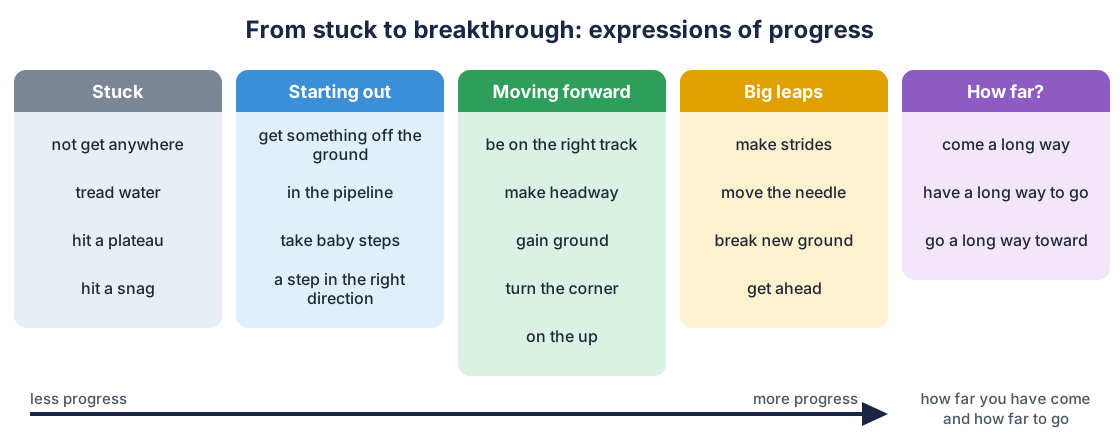
Stuck
No movement, or a sudden problem
not get anywhere: to make no progress at all.
I’ve tried for hours, but I’m not getting anywhere.
Translations: 毫无进展 | 全然はかどらない | 전혀 진전이 없다 | कोई प्रगति न होना | لا يحرز أي تقدّم | не сдвигаться с места | no llegar a ninguna parte | n’avancer à rien
tread water: to stay at the same level without improving.
Sales have been treading water all year.
Translations: 原地踏步 | 足踏みする | 제자리걸음하다 | जहाँ के तहाँ रहना | يراوح مكانه | топтаться на месте | estar estancado | faire du surplace
hit a plateau: to stop improving after a period of growth.
My running times hit a plateau in March.
Translations: 进入停滞期 | 伸び悩む | 정체기에 접어들다 | ठहराव आ जाना | يصل إلى مرحلة ثبات | выйти на плато | estancarse | stagner
hit a snag: to meet an unexpected problem.
The project hit a snag when a key supplier closed.
Translations: 遇到障碍 | 思わぬ障害にぶつかる | 난관에 부딪히다 | अड़चन आना | يواجه عقبة | столкнуться с загвоздкой | toparse con un obstáculo | rencontrer un obstacle
Starting out
Small, early steps
get something off the ground: to start something successfully.
They need more money to get the café off the ground.
Translations: 使…起步 | 軌道に乗せる | …을 괤도에 올리다 | … की शुरुआत करना | يُطلق مشروعًا | запустить … | poner en marcha | lancer, faire décoller
in the pipeline: being planned but not finished yet.
Two new courses are in the pipeline.
Translations: 在筹备中 | 準備中で | 준비 중인 | तैयारी में | قيد الإعداد | в разработке | en preparación | en préparation
take baby steps: to make very small, careful progress.
I’m taking baby steps with Spanish: five new words a day.
Translations: 一小步一小步地前进 | 少しずつ進む | 조금씩 나아가다 | छोटे-छोटे कदम उठाना | يخطو خطوات صغيرة | делать маленькие шаги | dar pasitos | avancer à petits pas
a step in the right direction: an action likely to lead to a good result.
The new bike lanes are a step in the right direction.
Translations: 朝正确方向迈出的一步 | 正しい方向への一歩 | 올바른 방향으로의 한 걸음 | सही दिशा में एक कदम | خطوة في الاتجاه الصحيح | шаг в правильном направлении | un paso en la dirección correcta | un pas dans la bonne direction
Moving forward
Steady improvement
be on the right track: to be doing something in a way likely to succeed.
Your answer isn’t finished, but you’re on the right track.
Translations: 走在正确的路上 | 正しい方向に進んでいる | 제대로 가고 있다 | सही राह पर होना | على الطريق الصحيح | быть на правильном пути | ir por buen camino | être sur la bonne voie
make headway: to make progress, especially slowly or with effort.
Frequency: 3.04 | Rank: 27,462
Rescue teams made little headway in the deep snow.
Translations: 取得进展 | はかどる | 진척을 보이다 | आगे बढ़ना | يشقّ طريقه | продвигаться | avanzar | progresser
gain ground: to become more popular or successful.
Electric cars are gaining ground in many markets.
Translations: 逐渐普及 | 勢力を伸ばす | 입지를 넓히다 | पकड़ मज़बूत करना | يكسب أرضًا | набирать силу | ganar terreno | gagner du terrain
turn the corner: to get past the worst part and start to improve.
After two bad years, the club has turned the corner.
Translations: 渡过难关 | 峠を越す | 고비를 넘기다 | संकट से उबरना | يتجاوز المرحلة الأصعب | пройти худшее | superar lo peor | passer le cap
on the up (British, informal): improving or becoming more successful.
The town’s economy is on the up.
Translations: 在好转 | 上向きで | 상승세인 | उन्नति पर | في تحسّن | на подъёме | en alza | en hausse
Big leaps
Large or new progress
make strides: to make important progress.
Researchers have made great strides in battery design.
Translations: 取得长足进步 | 大きく前進する | 큰 발전을 이루다 | बड़ी प्रगति करना | يخطو خطوات واسعة | делать большие успехи | dar grandes pasos | faire de grands progrès
move the needle (informal): to have a noticeable effect.
Small price cuts didn’t move the needle on sales.
Translations: 产生明显影响 | 目に見える変化をもたらす | 눈에 띄는 변화를 가져오다 | उल्लेखनीय असर डालना | يُحدث فرقًا ملموسًا | заметно повлиять | marcar la diferencia | faire bouger les choses
break new ground: to do something that has not been done before.
The film broke new ground in animation.
Translations: 开辟新天地 | 新境地を開く | 새로운 지평을 열다 | नई राह खोलना | يفتح آفاقًا جديدة | открыть новые горизонты | abrir nuevos caminos | ouvrir de nouvelles voies
get ahead: to become more successful, especially in a career.
Many people take evening classes to get ahead.
Translations: 出人头地 | 出世する | 앞서 나가다 | आगे निकलना | يتقدّم في حياته | преуспеть | progresar, destacar | réussir, prendre de l’avance
How far?
How far you have come, and how far you still have to go
come a long way: to have improved a lot over time.
Phone cameras have come a long way since 2005.
Translations: 今非昔比 | 大きく進歩した | 많이 발전하다 | काफ़ी आगे आ जाना | قطع شوطًا طويلًا | пройти долгий путь | haber avanzado mucho | avoir fait beaucoup de chemin
have a long way to go: to still need to make a lot of progress.
My Japanese is improving, but I have a long way to go.
Translations: 任重道远 | まだ先は長い | 갈 길이 멀다 | अभी लंबा रास्ता तय करना है | أمامه طريق طويل | впереди долгий путь | quedar mucho camino | il reste beaucoup de chemin
a work in progress: something that is still being developed or improved.
My speaking is still a work in progress.
Translations: 尚在完善中的事 | 発展途上のもの | 아직 진행 중인 일 | अभी जारी काम | عمل قيد التطوير | незавершённая работа | un trabajo en curso | un travail en cours
go a long way toward: to help a lot in achieving something.
A short apology can go a long way toward fixing a friendship.
Translations: 大有助于 | …に大いに役立つ | …에 크게 도움이 되다 | … में बहुत मदद करना | يساهم كثيرًا في … | во многом помочь | contribuir mucho a … | contribuer grandement à …
Synonyms and Antonyms
No synonym means exactly the same as progress. The notes explain the differences.
Synonyms
advance (noun, countable): a single important step forward, often in science or technology.
Unlike progress, it is countable: a major advance, recent advances.
Frequency: 4.65 | Rank: 2,253
The vaccine was a major advance in medicine.
Translations: 进展, 突破 | 進歩, 前進 | 진보, 발전 | उन्नति | تقدّم, إنجاز | достижение | avance | avancée
advancement (noun): promotion at work, or the development of a field or cause.
More formal than progress; common in career advancement.
Frequency: 3.81 | Rank: 9,463
The job offers good opportunities for career advancement.
Translations: 晋升, 发展 | 昇進, 向上 | 승진, 발전 | पदोन्नति | ترقٍّ | продвижение | ascenso | avancement
development (noun): the process of growing or changing into something more advanced.
Describes growth or change; it does not always mean improvement. It can also mean a new event: the latest developments.
Frequency: 5.31 | Rank: 494
Early childhood is a key period for language development.
Translations: 发展 | 発展, 発達 | 발전, 발달 | विकास | تنمية, تطوّر | развитие | desarrollo | développement
improvement (noun): a change that makes something better.
Countable: an improvement, several improvements. Progress is the overall movement; improvements are the individual changes.
Frequency: 4.49 | Rank: 3,052
There has been a clear improvement in the air quality.
Translations: 改善 | 改善, 向上 | 개선 | सुधार | تحسين | улучшение | mejora | amélioration
growth (noun): an increase in size, amount, or importance.
Growth is about getting bigger. More is not always better, so growth and progress are not the same thing.
Frequency: 5.03 | Rank: 996
The city’s rapid growth has put pressure on housing.
Translations: 增长 | 成長 | 성장 | वृद्धि | نموّ | рост | crecimiento | croissance
evolution (noun): slow, gradual change over a long time.
In biology it means change through natural selection, with no fixed direction toward “better”.
Frequency: 4.41 | Rank: 3,558
The evolution of the smartphone took less than twenty years.
Translations: 演变, 进化 | 進化, 発展 | 진화 | क्रमिक विकास | تطوّر | эволюция | evolución | évolution
Antonyms
regress (v), regression (n) (verb, noun): to go back to an earlier or worse state; the act of doing this.
Stress on the second syllable in the verb: reGRESS.
Frequency: 3.50 | Rank: 14,928 (for regression)
Without practice, skills can regress quickly.
Translations: 倒退, 退步 | 後退(する) | 퇴보(하다) | पीछे जाना | يتراجع, تراجُع | регрессировать, регресс | retroceder, retroceso | régresser, régression
decline (noun, verb): a gradual loss of strength, amount, or quality.
Often followed by in: a decline in sales.
Frequency: 4.40 | Rank: 3,612
The town saw a slow decline after the factory closed.
Translations: 衰退, 下降 | 衰退, 減少 | 쇠퇴, 감소 | गिरावट | انحدار | упадок, спад | declive | déclin
stagnation (noun): a state of no growth, change, or movement.
Common with economies and careers: economic stagnation.
Frequency: 3.19 | Rank: 22,651
Years of stagnation left wages where they were a decade earlier.
Translations: 停滞 | 停滞 | 정체, 침체 | ठहराव | ركود | застой | estancamiento | stagnation
deterioration (noun): the process of becoming worse.
Formal; often used for health, buildings, and relations: a deterioration in relations.
Frequency: 3.43 | Rank: 16,455
Doctors noted a slow deterioration in her eyesight.
Translations: 恶化 | 悪化 | 악화 | ह्रास, बिगाड़ | تدهور | ухудшение | deterioro | détérioration
setback (noun): a problem that delays progress or makes things worse.
One word as a noun; the verb is two words: The storm set us back a week.
Frequency: 3.37 | Rank: 17,813
Losing the main sponsor was a serious setback.
Translations: 挫折 | 挫折, つまずき | 차질 | झटका | انتكاسة | неудача, откат | revés | revers
Activity Page
Five activities: Expressions, Collocations, Forward or Stuck, Error Correction, and Fill in the Blank. Open the activity page in a new tab
Speed Challenge
Answer 12 questions against the clock. Every wrong answer adds 5 seconds, and the lowest score wins. Open the speed challenge in a new tab.
Shadow Reading and Typing: One Year of Progress
This short story uses many of the expressions on this page. Use it for shadow reading (reading aloud along with a model) and for typing practice.
A year ago, I decided to improve my English. At first, I made rapid progress. I learned new words every day, and I felt like I was on the right track. Then, after about three months, I hit a plateau. I was studying just as hard, but I wasn’t getting anywhere. For weeks, I was treading water.
Then I hit a snag. I got sick and missed a month of classes. It was a real setback, and I almost gave up. My teacher told me to take baby steps instead of trying to do everything at once. So I started small: ten minutes of listening a day and one short paragraph a week. It wasn’t much, but it was a step in the right direction.
Slowly, I started to make headway again. I began to track my progress in a notebook, and seeing the pages fill up kept me going. By the summer, I felt like I had turned the corner. My listening got progressively better, and I could finally follow a movie without subtitles.
Looking back, I’ve come a long way. I still have a long way to go, and my speaking is very much a work in progress. But I’ve learned that steady progress matters more than rapid progress. Small changes may not move the needle right away, but they add up.
How to practice
- Read the text silently once and check any expressions you are unsure of.
- Read it aloud slowly, one sentence at a time. On the typing page, the Listen button reads each line with your device’s voice, so you can listen first and then repeat.
- Shadow: read aloud again at a natural speed, trying to keep a steady rhythm without stopping.
- Record yourself, listen back, and note one sentence to practice again.
- Type it on the typing page below and check your speed and accuracy.
Open the typing practice in a new tab
Quotations
Use these as warm-ups. Read the quotation, then discuss the question.
“Progress is impossible without change; and those who cannot change their minds cannot change anything.”
George Bernard Shaw, Everybody’s Political What’s What? (1944)
Shaw links progress to being willing to change your own opinions, not only the world around you.
Warm-up: What is one opinion you have changed in the last few years? Was that change a kind of progress?
Translations: 没有改变就不可能进步;无法改变自己想法的人,什么也改变不了。 | 変化なくして進歩はない。考えを変えられない者は、何も変えられない。 | 변화 없이는 진보도 없다. 자기 생각을 바꾸지 못하는 사람은 아무것도 바꿀 수 없다. | परिवर्तन के बिना प्रगति असंभव है; और जो अपना मन नहीं बदल सकते, वे कुछ भी नहीं बदल सकते। | التقدّم مستحيل بلا تغيير، ومن لا يستطيعون تغيير آرائهم لا يستطيعون تغيير أي شيء. | Прогресс невозможен без перемен, а те, кто не может изменить своё мнение, не могут изменить ничего. | El progreso es imposible sin cambio, y quienes no pueden cambiar de opinión no pueden cambiar nada. | Le progrès est impossible sans changement, et ceux qui ne peuvent pas changer d’avis ne peuvent rien changer.
“Human progress never rolls in on wheels of inevitability.”
Martin Luther King Jr., Letter from Birmingham Jail (April 16, 1963)
King argues that progress is not automatic. It happens only when people work for it.
Warm-up: Name something that has improved in your community. Who worked to make it happen?
Translations: 人类的进步从来不会乘着必然性的车轮自动到来。 | 人類の進歩が、必然という車輪に乗ってひとりでにやって来ることは決してない。 | 인류의 진보는 결코 필연이라는 바퀴를 타고 저절로 굴러오지 않는다. | मानव प्रगति कभी भी अनिवार्यता के पहियों पर अपने आप नहीं आती। | التقدّم الإنساني لا يأتي أبدًا محمولًا على عجلات الحتمية. | Человеческий прогресс никогда не приходит сам собой на колёсах неизбежности. | El progreso humano nunca llega rodando sobre las ruedas de lo inevitable. | Le progrès humain n’arrive jamais sur les roues de l’inévitable.
“There is no progress in evolution.”
Stephen Jay Gould, interview in John Brockman, The Third Culture (1995)
Gould argues that species change and adapt, but they do not climb toward a “higher” form. Other biologists dispute how far this is true.
Warm-up: Do you think technology improves steadily, or does it just change?
Translations: 进化中没有进步。 | 進化に進歩はない。 | 진화에는 진보가 없다. | क्रमिक विकास में कोई प्रगति नहीं होती। | لا يوجد تقدّم في التطوّر. | В эволюции нет прогресса. | En la evolución no hay progreso. | Il n’y a pas de progrès dans l’évolution.
Discussion Questions
Your own progress
- Do you agree that happiness comes more from making progress than from reaching a goal? Why or why not?
- Think of a goal you reached. How long did the good feeling last?
- How do you measure your progress in different parts of your life, such as health, study, work, friendships, and money?
- What habits stop you from making progress in the things you care about most?
- In what ways have you made progress in the past twelve months?
- What kind of progress are you most focused on this week? This year?
- What is a goal you have had for a long time but never seem to reach? Why do you think that is?
- Whose idea of progress are you following: your own, or your family’s? How similar are they?
- How much do other people’s expectations shape what counts as progress for you?
- How does social media affect the way you see your own progress?
- What has helped you make the most progress in learning English?
- Does making progress feel different from simply being busy? How can you tell the difference?
Using the language of progress
- Have you ever hit a plateau? What did you do to start moving forward again?
- Describe a time you hit a snag while working toward a goal. How did you deal with it?
- In which areas of your life do you feel you are treading water right now?
- When did you feel you had finally turned the corner on something difficult?
- What baby steps could you take this week toward a long-term goal?
- In what area have you come a long way? Where do you still have a long way to go?
- Can a setback ever be a step in the right direction? Give an example.
- When have you made rapid progress with something? What made it so fast?
- Is it better to make steady progress in one area or some progress in several?
- What small change could really move the needle in your daily life?
- Who in your life helps you make progress, and who hinders it?
- Do you feel you are on the right track with your life goals? What tells you that you are, or are not?
- How do you celebrate when you make headway on something difficult?
- Name one area where the world has made great strides and one where there has been a lack of progress.
AI Practice Prompt
Copy this prompt into an AI chat tool to practice.
I am a B2 English learner studying the word “progress” and related expressions. Ask me one question at a time. Mix multiple-choice, true or false, and short sentence-writing tasks. Use these words and phrases: make progress, steady progress, hinder progress, in progress, progress toward, progressive, progressively, progression, setback, stagnation, make headway, hit a plateau, hit a snag, tread water, take baby steps, turn the corner, make strides, move the needle, break new ground, come a long way, a long way to go. If I make a mistake, explain it briefly in [your language] and give a correct example in English. After ten questions, tell me which items I should review.
Recommended Resources
- The arrival fallacy: why we should decouple our happiness from our goals (Ness Labs). Why reaching a goal often feels less satisfying than we expect, and what to do about it.
- The Power of Small Wins (Harvard Business Review, 2011). A study of thousands of workday diaries that links good days to small steps forward. May require a free account.
- The Goal-Gradient Hypothesis Resurrected (Columbia Business School). A short summary of a coffee-card study: people speed up when they feel close to a goal.
- The Pattern of Life’s History (Edge). The biologist behind the third quotation explains why he did not see evolution as progress. Challenging but readable.