
Level: B2
Reading | Vocabulary | Activities | Speed Challenge | Shadow Reading and Typing | Questions | AI Prompts | Discussion | Language Focus | Resources
Printable: Student handout (PDF) | Teacher’s key (PDF)
Reading
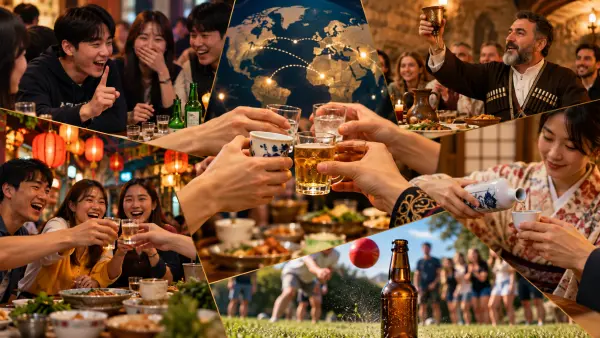
Almost every culture has some version of the same idea: a shared drink, a simple set of rules, and a group of people who become a little closer by the end of the evening. Anthropologists describe drinking games and toasting customs as social rituals, repeated, rule-based behaviors that help a group move from formality to informality. The specific rules differ enormously from country to country, but the underlying social work they do is strikingly similar.
Part of that work is a kind of leveling. In South Korea, a university welcome dinner often includes Baskin Robbins 31, in which players count upward in turns, and whoever is forced to say “31” must drink, alongside nunchi games that reward players for reading the room correctly. For the length of the game, a first-year student and a senior follow exactly the same rule, and for a few minutes the usual seniority that shapes so much of Korean social life is quietly set aside.
In the country of Georgia, the leveling works differently, through structure rather than luck. At a feast called a supra, a toastmaster known as the tamada leads dozens of toasts, to parents, to guests, to peace, and everyone must wait for the tamada’s toast before raising a glass. A guest may be given an alaverdi, an invitation to add to the toast just given, and certain toasts are drunk bolomde, to the very bottom, as a mark of respect. The rules are strict, but a stranger who is handed an alaverdi has, for a moment, been pulled fully inside the group.
Elsewhere, the emphasis falls less on rules and more on synchrony. In Vietnam, a table of friends will often count together, “Một, hai, ba, dô!”, one, two, three, cheers, before drinking at exactly the same instant. In China, the toast “gānbēi”, meaning “dry glass,” serves a similar purpose at business banquets built around baijiu, a strong grain spirit, and encouraging a guest to drink more is widely understood as generosity rather than pressure, though a foreign guest may experience it quite differently.
Some customs, meanwhile, are built almost entirely around etiquette rather than games. In mainland Japan, it is traditionally considered impolite to fill your own glass, so guests attentively watch each other’s cups and pour for one another instead. On Miyako Island in Okinawa, a related but distinct custom called otōri turns pouring into a ceremony. A leader called the oya makes a short speech, fills and drains their own glass, pours a round for everyone else in the circle, and then chooses the next oya, so the gathering resembles a chain of small speeches more than ordinary table manners. In Germany, by contrast, the outdoor team game Flunkyball turns drinking into something closer to sport: two teams try to knock over a bottle with a thrown ball, and the throwing team may drink only until the other side resets the bottle and shouts “stop.”
These customs are not without real problems. The same rules that create belonging can also create implicit pressure that is hard for an outsider, or a shy insider, to resist, and the line between generous encouragement and outright coercion is not always obvious in the moment. Some groups have responded by changing the ritual rather than abandoning it. In 2025, The Korea Herald reported that many younger Koreans were treating penalty drinks as optional, and that a dance department at Yongin University had deliberately held its group retreat without any alcohol. Habits are shifting elsewhere too: in a 2026 Gallup poll, only half of American adults aged 18 to 34 said they drink at all, down from 58 percent in 2023.
What makes these customs worth studying is not really the alcohol itself. Whether it is a Korean counting game, a Georgian toastmaster, a Vietnamese chant, or a German bottle-and-ball contest, each custom answers the same basic human question in a locally specific way: how does a group turn strangers, or unequal ranks, into something closer to equals, at least for one evening? The answer a culture gives hints at how it handles status and trust more broadly, and it suggests a simple test for any of these customs: when one person at the table chooses not to drink, does the ritual still include them?
Vocabulary
Each word has a frequency score, a rank, and a tag. The score shows how common the word is in modern English: higher means more common, and each full point means roughly ten times more common. The rank is the word’s position on a list of about 321,000 English word forms, from most to least common. The tag shows where you are most likely to meet the word: Current, Formal, Literary, or Dated. The paragraph number shows where the word first appears in the reading. The labels are information, not instructions. Deciding which words are worth your time is up to you. How to read the scores, ranks, and tags.
rituals (noun, plural): regular, repeated actions that carry social or symbolic meaning.
Frequency: 3.67 | Rank: 11,685 | Formal | Paragraph 1
Translations: 仪式 | 儀式 | 의식 | अनुष्ठान | طقوس | ритуалы | rituales | rituels
- Drinking games and toasting customs act as social rituals.
- Many families have holiday rituals that repeat every year.
underlying (adjective): forming the hidden basis or cause of something, without being openly stated.
Frequency: 4.17 | Rank: 5,407 | Formal | Paragraph 1
Translations: 潜在的 | 根底にある | 근본적인 | अंतर्निहित | كامن | лежащий в основе | subyacente | sous-jacent
- The underlying social work these customs do is strikingly similar.
- There is an underlying reason for her sudden change in mood.
leveling (noun): the process of making people more equal, especially by reducing differences in status.
Frequency: 3.22 | Rank: 21,798 | Formal | Paragraph 2
Translations: 平等化 | 平準化 | 평등화 | बराबरी | المساواة | уравнивание | nivelación | nivellement
- Part of the game’s social work is a kind of leveling.
- Team sports can have a leveling effect between managers and staff.
seniority (noun): a higher rank or position, usually gained through age, experience, or years of service.
Frequency: 3.16 | Rank: 23,536 | Formal | Paragraph 2
Translations: 资历 | 年功 | 연공서열 | वरिष्ठता | أقدمية | старшинство | antigüedad | ancienneté
- For a few minutes, the usual seniority of Korean social life is set aside.
- Promotions were based partly on seniority.
toastmaster (noun): a person whose role is to announce and lead a series of toasts at a formal meal or feast.
Frequency: 1.99 | Rank: 95,993 | Formal | Paragraph 3
Translations: 祝酒司仪 | 乾杯の司会者 | 축배 사회자 | टोस्टमास्टर | قائد النخب | тамада | maestro de brindis | maître des toasts
- At a Georgian supra, a toastmaster called the tamada leads dozens of toasts.
- The toastmaster asked everyone to raise their glasses.
synchrony (noun): the state of two or more things happening at exactly the same time.
Frequency: 2.40 | Rank: 59,387 | Formal | Paragraph 4
Translations: 同步 | 同期性 | 동시성 | तालमेल | تزامن | синхронность | sincronía | synchronie
- In some cultures the emphasis falls more on synchrony than on rules.
- The dancers moved in perfect synchrony.
generosity (noun): the quality of being willing to give more time, money, or attention than is expected.
Frequency: 3.62 | Rank: 12,578 | Current | Paragraph 4
Translations: 慷慨 | 気前の良さ | 관대함 | उदारता | كرم | щедрость | generosidad | générosité
- Encouraging a guest to drink more is understood as generosity, not pressure.
- The host’s generosity impressed every guest.
etiquette (noun): the accepted rules of polite behavior in a society or group.
Frequency: 3.40 | Rank: 17,122 | Formal | Paragraph 5
Translations: 礼仪 | エチケット | 예절 | शिष्टाचार | آداب السلوك | этикет | etiqueta | étiquette
- Some customs are built almost entirely around etiquette rather than games.
- Table etiquette differs a great deal between cultures.
attentively (adverb): with careful, focused attention to someone or something.
Frequency: 2.51 | Rank: 52,337 | Formal | Paragraph 5
Translations: 专心地 | 注意深く | 주의 깊게 | ध्यानपूर्वक | بانتباه | внимательно | atentamente | attentivement
- Guests attentively watch each other’s cups and pour for one another.
- She listened attentively to every word of the toast.
distinct (adjective): clearly different or separate from something else, even if related to it.
Frequency: 4.29 | Rank: 4,365 | Current | Paragraph 5
Translations: 截然不同的 | 明確に異なる | 뚜렷이 다른 | अलग | متمايز | отличающийся | distinto | distinct
- On Miyako Island, a related but distinct custom called otōri turns pouring into a ceremony.
- The two dialects are distinct, though related.
resembles (verb, third person): looks like or is similar to something else.
Frequency: 3.71 | Rank: 11,015 | Formal | Paragraph 5
Translations: 类似于 | 似ている | 닮았다 | मिलता-जुलता है | يشابه | напоминает | se parece a | ressemble à
- The gathering resembles a chain of small speeches more than ordinary table manners.
- The new game resembles an older regional tradition.
belonging (noun): the feeling of being accepted and included as part of a group.
Frequency: 4.05 | Rank: 6,565 | Current | Paragraph 6
Translations: 归属感 | 帰属意識 | 소속감 | अपनापन | الانتماء | чувство принадлежности | sentido de pertenencia | sentiment d’appartenance
- The same rules that create belonging can also create pressure.
- Shared rituals give people a sense of belonging.
implicit (adjective): suggested or understood without being directly or openly stated.
Frequency: 3.45 | Rank: 16,005 | Formal | Paragraph 6
Translations: 隐含的 | 暗黙の | 암묵적인 | अप्रत्यक्ष | ضمني | неявный | implícito | implicite
- The same rules that create belonging can also create implicit pressure.
- There was an implicit expectation that everyone would join in.
coercion (noun): the act of forcing someone to do something through pressure or threats.
Frequency: 3.27 | Rank: 20,356 | Formal | Paragraph 6
Translations: 强迫 | 強制 | 강요 | जबरदस्ती | إكراه | принуждение | coacción | coercition
- The line between encouragement and outright coercion is not always obvious.
- Good teamwork depends on cooperation, not coercion.
deliberately (adverb): done on purpose, as a planned and intentional choice.
Frequency: 4.02 | Rank: 6,884 | Current | Paragraph 6
Translations: 故意地 | 意図的に | 의도적으로 | जानबूझकर | عمدًا | намеренно | deliberadamente | délibérément
- A dance department had deliberately held its group retreat without any alcohol.
- She deliberately avoided the topic during dinner.
Activity Page
Open the activity page in a new tab
Speed Challenge
Answer 12 questions against the clock. Every wrong answer adds 5 seconds, and the lowest score wins. Open the speed challenge in a new tab.
Shadow Reading and Typing: The Glass of Juice
This short text uses many of the words from this lesson. Use it for shadow reading (reading aloud along with a model) and for typing practice.
During my first year at university, I went to a department welcome dinner that I remember clearly. I was nervous, because I had heard stories about drinking games and strict seniority. At first, everyone was polite and formal, and the older students seemed distant. Then someone suggested a counting game, and the mood began to change.
For a few minutes, the game worked as a kind of leveling. A senior student lost twice in a row, and everyone laughed, including him. At the end of each round, we raised our glasses in synchrony, and I started to feel part of the group. I realized that these little rituals were not really about the alcohol. The underlying goal was to give strangers a sense of belonging.
Still, I felt some implicit pressure. I did not want to drink much that night, and I was worried about looking rude. Nobody used open coercion, but the cheering after each loss made saying no feel difficult. Then one of the older students attentively noticed my full glass. She quietly poured me some juice and told the group that I was on her team tonight.
Since then, I have been to dinners with very distinct customs, including one where a friend acted as our toastmaster. Each time, the etiquette was different, but the feeling resembled that first night. Now, when I host a gathering myself, I deliberately offer drinks without alcohol too. For me, real generosity means making sure everyone at the table is included.
How to practice
- Read the text silently once and check any words you are unsure of.
- Read it aloud slowly, one sentence at a time. On the typing page, the Listen button reads each line with your device’s voice, so you can listen first and then repeat.
- Shadow: read aloud again at a natural speed, trying to keep a steady rhythm without stopping.
- Record yourself, listen back, and note one sentence to practice again.
- Type it on the typing page below and check your speed and accuracy.
Open the typing practice in a new tab
Comprehension Questions
- What common social function do drinking games and toasting customs share, according to the reading?
- Compare the Korean and Georgian examples. How does each create a leveling effect in a different way?
- Explain the Vietnamese and Chinese examples. What role does synchrony or generosity play in each?
- Compare mainland Japanese etiquette with the Okinawan custom of otōri. Why does the reading call them related but distinct?
- Describe how Flunkyball works. How is it different in style from the other customs described?
- What real problems does the reading raise about these customs? What has developed as a response?
- Why does the reading say the alcohol itself is not really the point of studying these customs?
- Choose two customs from different regions and explain what each might reveal about how that culture treats status or trust.
- Evaluate the range of examples the reading uses. Which examples feel most concrete and specific, and which feel more general?
IELTS-Style Questions
- True, False, or Not Given: “Every culture in the reading uses the same drinking game.” Explain your answer using evidence from the reading.
- Yes, No, or Not Given: “The writer suggests that encouraging a guest to drink more is always a form of generosity.” Explain your answer using evidence from the reading.
- Author’s purpose: Why does the writer include examples from several different countries rather than focusing on just one? What effect does this have on the reader?
AI Discussion Prompt
I just read a B2 English lesson called Drinking Games and Customs Around the World. It covered Korean games like Baskin Robbins 31, the Georgian supra and tamada, Vietnamese and Chinese toasting customs, Japanese and Okinawan etiquette, the German game Flunkyball, and concerns about implicit pressure and coercion, as well as alcohol-free alternatives. I am an adult English learner at about B2 level. Please have a friendly conversation with me about social customs and drinking culture in different countries, presenting more than one perspective and asking one question at a time. Encourage me to use words like ritual, etiquette, generosity, implicit, and belonging. Respond to my ideas first, then briefly point out one or two language errors.
AI Vocabulary Prompt
I want to practice vocabulary from a lesson about drinking games and customs around the world. Please quiz me on the following words one at a time, using a mix of question types: multiple choice, true/false, and sentence completion. Give me feedback after each answer before moving on, and bring back the words I miss later. Here are the words: rituals, underlying, leveling, seniority, toastmaster, synchrony, generosity, etiquette, attentively, distinct, resembles, belonging, implicit, coercion, deliberately.
Discussion Questions
- Which custom in the reading did you find most interesting or surprising, and why?
- The reading says drinking games can create a leveling effect between people of different status. Have you seen this happen, with or without alcohol?
- Compare the Korean counting game and the Georgian toastmaster tradition. Which style, luck-based or structured, appeals to you more?
- The Vietnamese and Chinese examples both involve group synchrony or generosity. Are there similar customs in your own culture?
- In mainland Japan, filling your own glass is considered impolite. Is there a similar unwritten rule in your culture around food or drink?
- Flunkyball turns drinking into something closer to a sport. Do you think games like this change how people feel about drinking, compared to simply drinking without a game?
- The reading distinguishes between generous encouragement and coercion. Where would you personally draw that line?
- Some university groups now hold their retreats without alcohol. Do you think events like these can create the same sense of belonging?
- If a foreign visitor came to your country, what one social custom around food or drink would you want to explain to them first?
- The reading says these customs hint at how a culture handles status and trust. Do you agree, or do you think this is too big a claim for a drinking game?
- Have you ever felt pressure, subtle or direct, to drink more than you wanted? How did you respond?
- Do you think drinking customs are becoming more similar across the world, or still very different from country to country?
- Some people say visitors should join local drinking customs out of respect; others say personal choice always comes first. Which view do you find more convincing?
- If fewer young adults drink, as the Gallup poll in the reading suggests, how might social customs change over the next ten years?
Language Focus: Comparing and Contrasting Across Examples
What it is: When comparing several examples, writers use structures such as while, whereas, by contrast, elsewhere, and in the same way to show whether two things work similarly or differently. These words let a reader follow several examples without losing track of how each one relates to the others.
Why writers use it: A reading that moves through many countries needs clear signals for when an idea repeats and when it changes. Contrast and comparison language lets you track the deeper pattern (the leveling effect) even as its surface form (a counting game, a toastmaster, a chant) keeps changing.
Examples from the reading:
- “In the country of Georgia, the leveling works differently, through structure rather than luck.”
- “Elsewhere, the emphasis falls less on rules and more on synchrony.”
- “…so the gathering resembles a chain of small speeches more than ordinary table manners. In Germany, by contrast, the outdoor team game Flunkyball turns drinking into something closer to sport.”
- “Whether it is a Korean counting game, a Georgian toastmaster, a Vietnamese chant, or a German bottle-and-ball contest, each custom answers the same basic human question…”
Practice task: Combine these two sentences using by contrast: “In one country, guests fill each other’s glasses. In another country, each guest fills their own.”
(Example answer: “In one country, guests fill each other’s glasses; by contrast, in another country, each guest fills their own.”)
Recommended Resources
- Tamada (Wikipedia). An overview of the Georgian toastmaster role and the etiquette of the supra.
- Otōri (Wikipedia). A description of the Okinawan round-pouring custom mentioned in the reading.
- Flunkyball (Wikipedia). The rules of the German outdoor team drinking game.
- Politeness without pressure: How Korean Gen Zers rewrite drinking norms (The Korea Herald). Young Koreans describe how penalty drinks and drinking etiquette are changing on campus.
- Americans’ Drinking Remains at Record Low (Gallup). Poll results on how many American adults drink, with figures by age group.