
A noun clause is a clause that does the job of a noun: I know that she left, What he said was true. A complex sentence joins a main clause to one or more subordinate clauses with words such as because, although, and when. Two parts of this topic are about noun clauses, two are about sentence structure, and one combines both. This guide has five parts, and they match the five parts of the diagnostic exactly.
关于本指南: 名词从句与复合句
名词从句是起名词作用的从句,以 that、what、whether 或疑问词开头。复合句把一个主句和一个或多个从句连在一起。本主题有两个部分讲名词从句,两个部分讲句子结构,一个部分两者兼有。本指南分为五个部分,与诊断测试的五个部分完全对应。
你可以先做诊断测验,看看这个主题的哪些部分需要复习,也可以直接进入练习活动,其中包含复习幻灯片。
本指南本身为英文。这些翻译只是额外提供的便利,可能不够完美。
このガイドについて: 名詞節と複文
名詞節は名詞の働きをする節で、that、what、whether、疑問詞で始まります。複文は主節に 1 つ以上の従属節をつないだ文です。このテーマでは 2 つのパートが名詞節、2 つのパートが文の構造を扱い、1 つのパートは両方を扱います。このガイドは 5 つのパートで、診断テストの 5 つのパートと完全に対応しています。
まず診断テストを受けて、このテーマのどの部分を復習すべきか確認することもできますし、復習スライドを含む練習アクティビティにそのまま進むこともできます。
このガイド自体は英語です。これらの翻訳は補助として提供しているもので、完全とは限りません。
이 가이드 소개: 명사절과 복문
명사절은 명사 역할을 하는 절로, that, what, whether, 또는 의문사로 시작합니다. 복문은 주절에 하나 이상의 종속절을 연결한 문장입니다. 이 주제에서 두 부분은 명사절, 두 부분은 문장 구조를 다루고, 한 부분은 둘 다 다룹니다. 이 가이드는 다섯 부분으로 되어 있으며, 진단 테스트의 다섯 부분과 정확히 일치합니다.
먼저 진단 퀴즈로 이 주제에서 복습이 필요한 부분을 확인해도 되고, 복습 슬라이드가 포함된 연습 활동으로 바로 들어가도 됩니다.
가이드 자체는 영어로 되어 있습니다. 이 번역은 부가적으로 제공되는 것이며 완벽하지 않을 수 있습니다.
Giới thiệu hướng dẫn này: Mệnh đề danh từ và câu phức
Mệnh đề danh từ là mệnh đề đóng vai trò danh từ, bắt đầu bằng that, what, whether hoặc một từ để hỏi. Câu phức nối một mệnh đề chính với một hay nhiều mệnh đề phụ. Trong chủ đề này, hai phần nói về mệnh đề danh từ, hai phần nói về cấu trúc câu, và một phần kết hợp cả hai. Hướng dẫn này gồm năm phần, khớp chính xác với năm phần của bài kiểm tra chẩn đoán.
Bạn có thể bắt đầu bằng bài kiểm tra chẩn đoán để biết phần nào cần ôn lại, hoặc vào thẳng các hoạt động luyện tập, trong đó có cả slide ôn tập.
Đọc hướng dẫn bằng tiếng Việt →
Bản hướng dẫn này được viết bằng tiếng Anh. Các bản dịch chỉ là phần hỗ trợ thêm và có thể chưa hoàn hảo.
इस गाइड के बारे में: संज्ञा उपवाक्य और मिश्र वाक्य
संज्ञा उपवाक्य वह उपवाक्य है जो संज्ञा का काम करता है और that, what, whether या किसी प्रश्नवाचक शब्द से शुरू होता है। मिश्र वाक्य एक मुख्य उपवाक्य को एक या अधिक आश्रित उपवाक्यों से जोड़ता है। इस विषय के दो भाग संज्ञा उपवाक्यों पर, दो भाग वाक्य संरचना पर हैं, और एक भाग दोनों को मिलाता है। इस गाइड के पाँच भाग हैं, जो निदान परीक्षा के पाँच भागों से ठीक मेल खाते हैं।
आप निदान क्विज़ से शुरू करके जान सकते हैं कि इस विषय के कौन-से भाग दोहराने चाहिए, या सीधे अभ्यास गतिविधियों में जा सकते हैं, जिनमें दोहराव की स्लाइडें भी हैं।
गाइड स्वयं अंग्रेज़ी में है। ये अनुवाद अतिरिक्त सुविधा के रूप में हैं और पूरी तरह सटीक न भी हों।
نبذة عن هذا الدليل: الجمل الاسمية والجمل المركبة
الجملة الاسمية جملة تعمل عمل الاسم، وتبدأ بكلمة that أو what أو whether أو بأداة استفهام. والجملة المركبة تربط جملة رئيسية بجملة تابعة أو أكثر. في هذا الموضوع جزءان عن الجمل الاسمية، وجزءان عن بنية الجملة، وجزء يجمع بين الاثنين. يتكون هذا الدليل من خمسة أجزاء تطابق تمامًا الأجزاء الخمسة في الاختبار التشخيصي.
يمكنك البدء بالاختبار التشخيصي لمعرفة الأجزاء التي تحتاج إلى مراجعة، أو الانتقال مباشرة إلى أنشطة التدريب، وتشمل شرائح مراجعة.
الدليل نفسه بالإنجليزية. هذه الترجمات مجرد خدمة إضافية وقد لا تكون دقيقة تمامًا.
Об этом руководстве: Придаточные-дополнения и сложные предложения
Придаточное-дополнение или подлежащее выполняет роль существительного и начинается с that, what, whether или вопросительного слова. Сложное предложение соединяет главную часть с одним или несколькими придаточными. Две части темы посвящены таким придаточным, две части структуре предложения, а одна сочетает оба аспекта. В этом руководстве пять частей, и они точно соответствуют пяти частям диагностического теста.
Можно начать с диагностического теста, чтобы узнать, какие части темы стоит повторить, или сразу перейти к упражнениям, в которые входят слайды для повторения.
Читать руководство на русском →
Само руководство написано на английском. Эти переводы — дополнительная помощь, и они могут быть неидеальными.
Acerca de esta guía: Oraciones sustantivas y oraciones complejas
Una oración sustantiva es una cláusula que funciona como un sustantivo y empieza con that, what, whether o una palabra interrogativa. Una oración compleja une una cláusula principal con una o más subordinadas. En este tema, dos partes tratan de las oraciones sustantivas, dos de la estructura de la oración y una combina ambas. Esta guía tiene cinco partes, y coinciden exactamente con las cinco partes del diagnóstico.
Puedes empezar con el cuestionario de diagnóstico para saber qué partes del tema conviene repasar, o ir directamente a las actividades de práctica, que incluyen diapositivas de repaso.
La guía en sí está en inglés. Estas traducciones son un añadido de cortesía y pueden no ser perfectas.
À propos de ce guide: Propositions nominales et phrases complexes
Une proposition nominale joue le rôle d'un nom et commence par that, what, whether ou un mot interrogatif. Une phrase complexe relie une principale à une ou plusieurs subordonnées. Dans ce thème, deux parties portent sur les propositions nominales, deux sur la structure de la phrase, et une combine les deux. Ce guide comporte cinq parties, qui correspondent exactement aux cinq parties du diagnostic.
Vous pouvez commencer par le quiz de diagnostic pour savoir quelles parties du sujet réviser, ou passer directement aux activités d'entraînement, qui comprennent des diapositives de révision.
Le guide lui-même est en anglais. Ces traductions sont un complément offert et peuvent ne pas être parfaites.
Sobre este guia: Orações substantivas e períodos compostos
Uma oração substantiva é uma oração que funciona como um substantivo e começa com that, what, whether ou uma palavra interrogativa. Um período composto liga uma oração principal a uma ou mais orações subordinadas. Neste tema, duas partes tratam das orações substantivas, duas da estrutura da frase e uma combina as duas coisas. Este guia tem cinco partes, que correspondem exatamente às cinco partes do teste diagnóstico.
Você pode começar pelo teste diagnóstico para ver quais partes do tema precisam de revisão, ou ir direto para as atividades de prática, que incluem slides de revisão.
O guia em si está em inglês. Estas traduções são um recurso extra e podem não ser perfeitas.
Your diagnostic result says which part needs review. Tap that part below.
The core idea: a clause inside a sentence
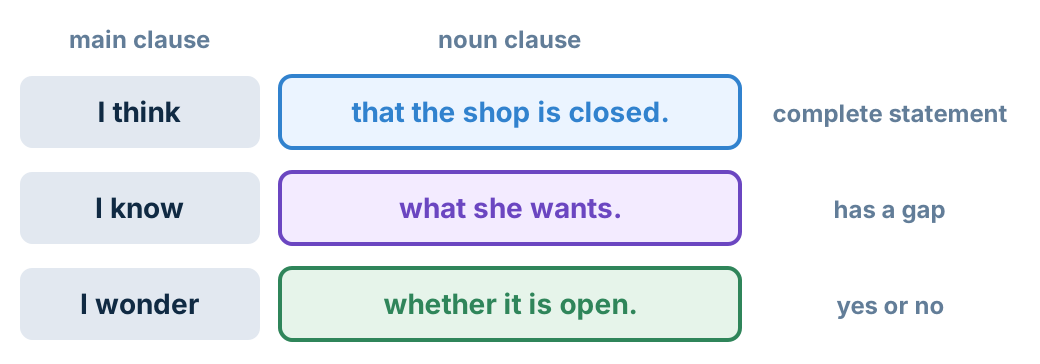
The word that starts a noun clause tells the reader what kind of clause follows: a complete statement, a thing, or a question.
| Clause word | Use | Example |
|---|---|---|
| that | a complete statement | I think that the shop is closed. |
| what | the thing that | I know what she wants. |
| whether, if | a yes or no question | I wonder whether it is open. |
| who, where, why, how | an open question | Nobody knows why she left. |
| because, although, when | a subordinate clause linked to a main clause | We left early because it was late. |
- 1
Is the clause a statement, a thing, or a question? Choose that, what, whether, or a question word (Part 1).
- 2
Is it a question inside a sentence? Use statement order and no do (Part 2).
- 3
Does every sentence have a main clause? Join clauses with one linking word, or with a period or semicolon (Parts 4 and 5).
A noun clause does the job of a noun inside a bigger sentence. Part 3 shows what happens when the whole clause is the subject.
That, what, or whether?
Is the clause a statement, a thing, or a question?
The rule: That starts a complete statement, what means the thing that and leaves a gap in its clause, and whether or if turns a yes or no question into a clause. Other question words keep their meaning: why, how, when, where.
Choose the word by the kind of clause
| Clause word | What follows | Example |
|---|---|---|
| that | a complete statement; often left out in speech | He said that the bus was late. |
| what | a clause with a missing object or subject | Tell me what happened. |
| whether, if | a yes or no question | Ask her whether she is free. |
| why, how, when, where | an open question | I know where they live. |
A useful test: if you can put the thing that in place of the word, it is what. If the clause still makes a full sentence on its own, it is that.
Whether, not if
| Position | Example |
|---|---|
| after a preposition | It depends on whether it rains. |
| before to plus a verb | She can’t decide whether to stay. |
| at the start of a sentence | Whether he comes is up to him. |
| directly before or not | I’ll go whether or not you come. |
Common errors in this part
- that and what mixed up
She showed me that she had bought.✓ She showed me what she had bought.Bought has no object, so use what. - that used for a yes or no question
I'm not sure that the train stops here.✓ I'm not sure whether the train stops here.Not sure means a yes or no question: whether or if. - if where only whether works
We talked about if we should sell the car.✓ We talked about whether we should sell the car.After a preposition, use whether.
More: noun clause or relative clause?
That can also start a relative clause, which describes a noun: the book that I bought. A noun clause is the object or subject itself: I know that I bought it. For relative clauses, see the Relative Clauses guide.
Questions inside sentences
Is the question direct, or is it inside another sentence?
The rule: A question inside a sentence uses statement order and no do, does, or did. Only a direct question, including the main clause and a quotation, keeps question order.
Turn the question back into a statement
| Direct question | Inside a sentence |
|---|---|
| Where is the station? | Do you know where the station is? |
| What time does the film start? | I’d like to know what time the film starts. |
| Did she pass? | I wonder whether she passed. |
| Who called? | I don’t know who called. |
When the question word is the subject (who called, what happened), the order is the same in both forms. Punctuation follows the whole sentence: I wonder where she lives ends with a period.
Question order stays in three places
| Place | Example |
|---|---|
| a direct question | Where do you live? |
| the main clause | Do you know where she lives? |
| quotation marks | She asked, “Where do you live?” |
| with do you think | Where do you think she lives? |
Common errors in this part
- question word order inside a sentence
Do you know what is her phone number?✓ Do you know what her phone number is?Inside a sentence, the subject comes before the verb. - do, does, or did inside the clause
I wonder how much does a ticket cost.✓ I wonder how much a ticket costs.Drop does, and add -s to the verb. - statement order in a direct question
He asked me, "Where you are going?"✓ He asked me, "Where are you going?"A quoted question keeps question order.
More: reported questions and tense
After a past reporting verb, the tense in the clause often moves back: “Where do you work?” She asked me where I worked. If the fact is still true, the present is also fine: She asked me where I work.
Clauses as subjects
What happens when a whole clause is the subject?
The rule: A clause used as a subject takes a singular verb. A that-clause subject usually moves to the end with it. After suggest, insist, and essential, use the base verb.
A whole clause as the subject
| Pattern | Example |
|---|---|
| what-clause + singular verb | What surprised me was the price. |
| whether-clause + singular verb | Whether we go depends on the weather. |
| it + be + adjective + that-clause | It is strange that nobody called. |
| verb + it + adjective + that-clause | I find it odd that he left. |
That after nouns, adjectives, and suggest
| Word | Example |
|---|---|
| the fact, the idea, the news | The news that she won spread fast. |
| sure, afraid, glad, aware | I’m glad that you came. |
| suggest, insist, recommend + base verb | We recommend that he apply early. |
| essential, important, vital + base verb | It is vital that she be on time. |
After suggest and similar verbs, British English often uses should (that he should apply) or a normal present form. The base verb is correct in both American and British English. Suggest cannot take an object plus to: not suggested him to apply.
Common errors in this part
- a missing subject
Is obvious that she loves her job.✓ It is obvious that she loves her job.The that-clause is at the end, so it is the subject. - a plural verb after a clause subject
What worries me are the cost.✓ What worries me is the cost.A what-clause subject takes a singular verb. - the wrong form after suggest or essential
The coach suggested us to stretch first.✓ The coach suggested that we stretch first.Suggest does not take an object plus to.
Main and subordinate clauses
Which linking word fits the meaning, and does a clause or a noun follow it?
The rule: Use one linking word for one link, and choose it by meaning. Although, because, and while take a clause; despite, because of, and during take a noun or an -ing form.
Same meaning, different structure
| Before a clause | Before a noun or -ing | Example |
|---|---|---|
| because, since, as (reason) | because of, due to | We stayed in because of the storm. |
| although, even though (contrast) | despite, in spite of | Even though it was late, we kept going. |
| while, when, after (time) | during, after | She slept during the flight. |
| whereas, while (comparison) | unlike | He likes tea, whereas I prefer coffee. |
Three kinds of link
| Type | Words | Punctuation |
|---|---|---|
| subordinating | because, although, when, if, unless | comma if the clause comes first |
| coordinating | and, but, so, or | comma before the word |
| transition | however, therefore, as a result | period or semicolon before, comma after |
Some languages, such as Chinese and Vietnamese, mark both halves of a contrast or a reason. English marks only one: although or but, because or so. For if and unless, see the Conditionals guide.
Common errors in this part
- two linking words for one link
Although the hotel was cheap, but it was clean.✓ Although the hotel was cheap, it was clean.Use although or but, not both. - a preposition before a clause
Despite he was tired, he finished the report.✓ Although he was tired, he finished the report.A clause follows although; a noun follows despite. - however used to join clauses
The road was icy, therefore we drove slowly.✓ The road was icy, so we drove slowly.Therefore cannot join clauses after a comma.
Complete sentences
Does every sentence have its own main clause?
The rule: In standard writing, every sentence needs a main clause with a subject and a verb. Join two sentences with a period, a semicolon, or a linking word, not with a comma alone.
Five common problems
| Problem | Example | Fix |
|---|---|---|
| fragment | We went home because the shop was closed. | |
| comma splice | The shop was closed, so we went home. | |
| run-on | The shop was closed. We went home. | |
| missing subject | It is too cold to swim. | |
| double subject | My sister works in Lima. |
Fragments are common in advertising, text messages, and fiction, and a short fragment can be fine in informal writing. In essays, emails at work, and exams, use complete sentences.
Common errors in this part
- an incomplete sentence
I couldn't sleep. Because my neighbor was playing music.✓ I couldn't sleep because my neighbor was playing music.A because-clause needs a main clause. - two sentences joined with a comma
My phone died, I couldn't call you.✓ My phone died, so I couldn't call you.Add a linking word, or use a period. - an extra word
The woman who lives next door she is a pilot.✓ The woman who lives next door is a pilot.The subject is already there: do not repeat it with she.
Self-check
Is each sentence correct? Tap to see the answer. The part label tells you where to look if you were not sure.
Part 1I can't believe what he told us.
Correct. What he told us has a gap: told us what.
Part 1Let me know that you can come to the party.
Incorrect. Let me know whether you can come to the party. Can you come or not? Use whether or if.
Part 2Could you tell me where the ticket office is?
Correct. Statement order inside the question: where the ticket office is.
Part 2I don't remember where did I park the car.
Incorrect. I don’t remember where I parked the car. Drop did and use statement order.
Part 3It is a pity that the museum is closed today.
Correct. It stands for the that-clause at the end.
Part 3Whether he agrees are not important.
Incorrect. Whether he agrees is not important. A clause subject takes a singular verb.
Part 4Even though the film was long, nobody left early.
Correct. One linking word, followed by a clause.
Part 4Because of it was late, we took a taxi.
Incorrect. Because it was late, we took a taxi. A clause follows because, not because of.
Part 5The meeting ended early; as a result, we caught the earlier train.
Correct. As a result follows a semicolon.
Part 5Feeling hungry after the long walk.
Incorrect. Feeling hungry after the long walk, we stopped at a café. An -ing phrase needs a main clause.
AI practice prompt
Paste this into an AI chat tool and replace the bracket with your language.