
संज्ञा उपवाक्य (noun clause) ऐसा उपवाक्य है जो संज्ञा का काम करता है: I know that she left, What he said was true। मिश्र वाक्य because, although और when जैसे शब्दों से एक मुख्य उपवाक्य को एक या अधिक आश्रित उपवाक्यों से जोड़ता है। इस विषय के दो भाग संज्ञा उपवाक्योंके बारे में हैं, दो भाग वाक्य संरचनाके बारे में हैं, और एक भाग दोनों को मिलाता है। इस गाइड के पाँच भाग हैं, जो निदान परीक्षा के पाँच भागों से ठीक मेल खाते हैं।
अंग्रेज़ी गाइड पढ़ें → यह पेज मशीन अनुवाद है और किसी मूल भाषी ने इसकी जाँच नहीं की है, इसलिए इसमें गलतियाँ हो सकती हैं। अंग्रेज़ी संस्करण ही आधार है।
निदान परीक्षा का परिणाम बताता है कि किस भाग को दोहराना है। नीचे उस भाग पर टैप करें।
मुख्य विचार: वाक्य के अंदर एक उपवाक्य
संज्ञा उपवाक्य शुरू करने वाला शब्द पाठक को बताता है कि आगे किस तरह का उपवाक्य आएगा: पूरा कथन, कोई चीज़, या कोई प्रश्न।
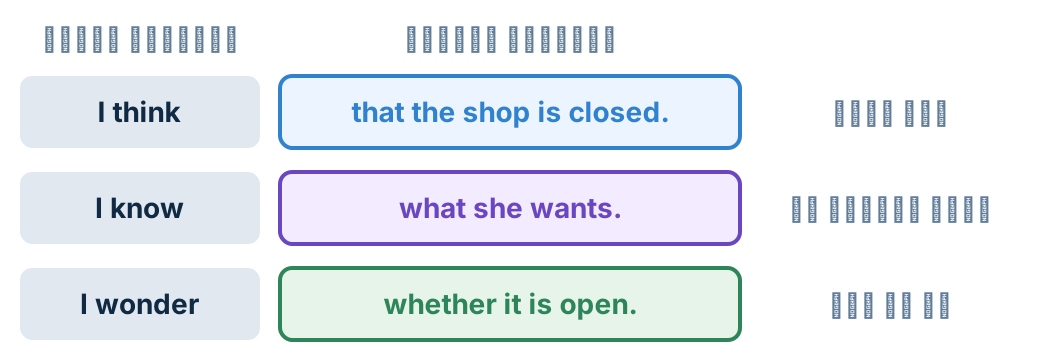
| उपवाक्य शब्द | प्रयोग | उदाहरण |
|---|---|---|
| that | पूरा कथन | I think that the shop is closed. |
| what | वह चीज़ जो (the thing that) | I know what she wants. |
| whether, if | हाँ या ना वाला प्रश्न | I wonder whether it is open. |
| who, where, why, how | खुला प्रश्न | Nobody knows why she left. |
| because, although, when | मुख्य उपवाक्य से जुड़ा आश्रित उपवाक्य | We left early because it was late. |
- 1
उपवाक्य कथन है, कोई चीज़ है या प्रश्न? that, what, whether या कोई प्रश्नवाचक शब्द चुनें (भाग 1)।
- 2
क्या यह वाक्य के अंदर का प्रश्न है? कथन वाला क्रम रखें और do न लगाएँ (भाग 2)।
- 3
क्या हर वाक्य में मुख्य उपवाक्य है? उपवाक्यों को एक जोड़ने वाले शब्द से जोड़ें, या पूर्ण विराम या अर्धविराम लगाएँ (भाग 4 और 5)।
संज्ञा उपवाक्य किसी बड़े वाक्य के अंदर संज्ञा का काम करता है। भाग 3 दिखाता है कि जब पूरा उपवाक्य कर्ता हो तो क्या होता है।
that, what या whether?
उपवाक्य कथन है, कोई चीज़ है या प्रश्न?
नियम: that पूरा कथन शुरू करता है, what का अर्थ “वह चीज़ जो” है और यह अपने उपवाक्य में एक खाली जगह छोड़ता है, और whether या if हाँ या ना वाले प्रश्न को उपवाक्य बना देता है। बाकी प्रश्नवाचक शब्द अपना अर्थ रखते हैं: why, how, when, where।
उपवाक्य के प्रकार से शब्द चुनें
| उपवाक्य शब्द | आगे क्या आता है | उदाहरण |
|---|---|---|
| that | पूरा कथन; बोलचाल में अक्सर छोड़ दिया जाता है | He said that the bus was late. |
| what | ऐसा उपवाक्य जिसमें कर्म या कर्ता नहीं है | Tell me what happened. |
| whether, if | हाँ या ना वाला प्रश्न | Ask her whether she is free. |
| why, how, when, where | खुला प्रश्न | I know where they live. |
एक आसान जाँच: अगर उस शब्द की जगह the thing that रखा जा सके, तो what लगेगा। अगर उपवाक्य अपने आप में पूरा वाक्य बनता है, तो that लगेगा।
if नहीं, whether
| स्थान | उदाहरण |
|---|---|
| preposition के बाद | It depends on whether it rains. |
| to + क्रिया से पहले | She can’t decide whether to stay. |
| वाक्य की शुरुआत में | Whether he comes is up to him. |
| or not से ठीक पहले | I’ll go whether or not you come. |
इस भाग की आम गलतियाँ
- that और what में गड़बड़ी
She showed me that she had bought.✓ She showed me what she had bought.bought का कोई कर्म नहीं है, इसलिए what लगाएँ। - हाँ या ना वाले प्रश्न के लिए that
I'm not sure that the train stops here.✓ I'm not sure whether the train stops here.not sure हाँ या ना वाला प्रश्न बताता है: whether या if। - जहाँ केवल whether चलता है वहाँ if
We talked about if we should sell the car.✓ We talked about whether we should sell the car.preposition के बाद whether लगाएँ।
और जानें: संज्ञा उपवाक्य या संबंधवाचक उपवाक्य?
that किसी संज्ञा का वर्णन करने वाला संबंधवाचक उपवाक्य (relative clause) भी शुरू कर सकता है: the book that I bought। संज्ञा उपवाक्य खुद ही कर्म या कर्ता होता है: I know that I bought it। संबंधवाचक उपवाक्यों के लिए देखें: Relative Clauses गाइड (अंग्रेज़ी में).
वाक्य के अंदर प्रश्न
प्रश्न सीधा है, या किसी दूसरे वाक्य के अंदर है?
नियम: वाक्य के अंदर का प्रश्न कथन वाला क्रम लेता है और do, does या did नहीं लगाता। केवल सीधा प्रश्न, मुख्य उपवाक्य और उद्धरण वाले प्रश्न समेत, प्रश्न वाला क्रम रखता है।
प्रश्न को फिर से कथन में बदलें
| सीधा प्रश्न | वाक्य के अंदर |
|---|---|
| Where is the station? | Do you know where the station is? |
| What time does the film start? | I’d like to know what time the film starts. |
| Did she pass? | I wonder whether she passed. |
| Who called? | I don’t know who called. |
जब प्रश्नवाचक शब्द ही कर्ता हो (who called, what happened), तो दोनों रूपों में क्रम एक जैसा होता है। विराम चिह्न पूरे वाक्य के अनुसार होता है: I wonder where she lives पूर्ण विराम से खत्म होता है।
तीन जगहों पर प्रश्न वाला क्रम बना रहता है
| स्थान | उदाहरण |
|---|---|
| सीधा प्रश्न | Where do you live? |
| मुख्य उपवाक्य | Do you know where she lives? |
| उद्धरण चिह्नों में | She asked, “Where do you live?” |
| do you think के साथ | Where do you think she lives? |
इस भाग की आम गलतियाँ
- वाक्य के अंदर प्रश्न वाला शब्द क्रम
Do you know what is her phone number?✓ Do you know what her phone number is?वाक्य के अंदर कर्ता क्रिया से पहले आता है। - उपवाक्य के अंदर do, does या did
I wonder how much does a ticket cost.✓ I wonder how much a ticket costs.does हटाएँ और क्रिया में -s जोड़ें। - सीधे प्रश्न में कथन वाला क्रम
He asked me, "Where you are going?"✓ He asked me, "Where are you going?"उद्धृत प्रश्न अपना प्रश्न वाला क्रम रखता है।
और जानें: बताए गए प्रश्न और काल
भूतकाल वाली बताने की क्रिया के बाद उपवाक्य का काल अक्सर एक कदम पीछे चला जाता है: “Where do you work?” She asked me where I worked. अगर बात अब भी सच है, तो वर्तमान काल भी ठीक है: She asked me where I work.
कर्ता के रूप में उपवाक्य
जब पूरा उपवाक्य कर्ता हो तो क्या होता है?
नियम: कर्ता के रूप में आया उपवाक्य एकवचन क्रिया लेता है। that वाला कर्ता उपवाक्य आमतौर पर it के साथ अंत में चला जाता है। suggest, insist और essential के बाद क्रिया का मूल रूप लगाएँ।
पूरा उपवाक्य कर्ता के रूप में
| ढाँचा | उदाहरण |
|---|---|
| what उपवाक्य + एकवचन क्रिया | What surprised me was the price. |
| whether उपवाक्य + एकवचन क्रिया | Whether we go depends on the weather. |
| it + be + विशेषण + that उपवाक्य | It is strange that nobody called. |
| क्रिया + it + विशेषण + that उपवाक्य | I find it odd that he left. |
संज्ञाओं, विशेषणों और suggest के बाद that
| शब्द | उदाहरण |
|---|---|
| the fact, the idea, the news | The news that she won spread fast. |
| sure, afraid, glad, aware | I’m glad that you came. |
| suggest, insist, recommend + क्रिया का मूल रूप | We recommend that he apply early. |
| essential, important, vital + क्रिया का मूल रूप | It is vital that she be on time. |
suggest जैसी क्रियाओं के बाद ब्रिटिश अंग्रेज़ी में अक्सर should (that he should apply) या सामान्य वर्तमान रूप भी आता है। क्रिया का मूल रूप अमेरिकी और ब्रिटिश दोनों अंग्रेज़ी में सही है। suggest के बाद कर्म + to नहीं आता: suggested him to apply नहीं।
इस भाग की आम गलतियाँ
- कर्ता गायब
Is obvious that she loves her job.✓ It is obvious that she loves her job.that उपवाक्य अंत में है, इसलिए it कर्ता है। - उपवाक्य कर्ता के बाद बहुवचन क्रिया
What worries me are the cost.✓ What worries me is the cost.what उपवाक्य कर्ता हो तो एकवचन क्रिया आती है। - suggest या essential के बाद गलत रूप
The coach suggested us to stretch first.✓ The coach suggested that we stretch first.suggest के बाद कर्म + to नहीं आता।
मुख्य और आश्रित उपवाक्य
कौन सा जोड़ने वाला शब्द अर्थ से मेल खाता है, और उसके बाद उपवाक्य आता है या संज्ञा?
नियम: एक जोड़ के लिए एक ही जोड़ने वाला शब्द लगाएँ, और उसे अर्थ से चुनें। although, because और while के बाद उपवाक्य आता है; despite, because of और during के बाद संज्ञा या -ing रूप।
अर्थ एक, संरचना अलग
| उपवाक्य से पहले | संज्ञा या -ing से पहले | उदाहरण |
|---|---|---|
| because, since, as (कारण) | because of, due to | We stayed in because of the storm. |
| although, even though (विरोध) | despite, in spite of | Even though it was late, we kept going. |
| while, when, after (समय) | during, after | She slept during the flight. |
| whereas, while (तुलना) | unlike | He likes tea, whereas I prefer coffee. |
जोड़ के तीन प्रकार
| प्रकार | शब्द | विराम चिह्न |
|---|---|---|
| आश्रित करने वाले | because, although, when, if, unless | उपवाक्य पहले आए तो अल्पविराम |
| बराबरी से जोड़ने वाले | and, but, so, or | शब्द से पहले अल्पविराम |
| संक्रमण शब्द | however, therefore, as a result | पहले पूर्ण विराम या अर्धविराम, बाद में अल्पविराम |
कुछ भाषाएँ, जैसे चीनी और वियतनामी, विरोध या कारण के दोनों हिस्सों में शब्द लगाती हैं। अंग्रेज़ी केवल एक में लगाती है: although या but, because या so। if और unless के लिए देखें: Conditionals गाइड (अंग्रेज़ी में).
इस भाग की आम गलतियाँ
- एक जोड़ के लिए दो जोड़ने वाले शब्द
Although the hotel was cheap, but it was clean.✓ Although the hotel was cheap, it was clean.although या but लगाएँ, दोनों नहीं। - उपवाक्य से पहले preposition
Despite he was tired, he finished the report.✓ Although he was tired, he finished the report.although के बाद उपवाक्य आता है; despite के बाद संज्ञा। - however से उपवाक्य जोड़ना
The road was icy, therefore we drove slowly.✓ The road was icy, so we drove slowly.therefore अल्पविराम के बाद उपवाक्यों को नहीं जोड़ सकता।
पूरे वाक्य
क्या हर वाक्य का अपना मुख्य उपवाक्य है?
नियम: मानक लेखन में हर वाक्य को कर्ता और क्रिया वाला मुख्य उपवाक्य चाहिए। दो वाक्यों को पूर्ण विराम, अर्धविराम या जोड़ने वाले शब्द से जोड़ें, केवल अल्पविराम से नहीं।
पाँच आम समस्याएँ
| समस्या | उदाहरण | सुधार |
|---|---|---|
| अधूरा वाक्य | We went home because the shop was closed. | |
| अल्पविराम से जोड़ना | The shop was closed, so we went home. | |
| बिना विराम जुड़े वाक्य | The shop was closed. We went home. | |
| कर्ता गायब | It is too cold to swim. | |
| दोहरा कर्ता | My sister works in Lima. |
अधूरे वाक्य विज्ञापनों, संदेशों और कथा-साहित्य में आम हैं, और अनौपचारिक लेखन में छोटा अधूरा वाक्य ठीक हो सकता है। निबंधों, दफ़्तर के ईमेल और परीक्षाओं में पूरे वाक्य लिखें।
इस भाग की आम गलतियाँ
- अधूरा वाक्य
I couldn't sleep. Because my neighbor was playing music.✓ I couldn't sleep because my neighbor was playing music.because उपवाक्य को मुख्य उपवाक्य चाहिए। - दो वाक्यों को अल्पविराम से जोड़ना
My phone died, I couldn't call you.✓ My phone died, so I couldn't call you.जोड़ने वाला शब्द लगाएँ, या पूर्ण विराम लगाएँ। - एक फालतू शब्द
The woman who lives next door she is a pilot.✓ The woman who lives next door is a pilot.कर्ता पहले से है: उसे she से दोबारा न दोहराएँ।
स्व-जाँच
क्या हर वाक्य सही है? उत्तर देखने के लिए टैप करें। अगर आप निश्चित नहीं थे, तो भाग का लेबल बताता है कि कहाँ देखना है।
भाग 1I can't believe what he told us.
सही। what he told us में एक खाली जगह है: told us what।
भाग 1Let me know that you can come to the party.
गलत। Let me know whether you can come to the party. आप आ सकते हैं या नहीं? whether या if लगाएँ।
भाग 2Could you tell me where the ticket office is?
सही। प्रश्न के अंदर कथन वाला क्रम: where the ticket office is।
भाग 2I don't remember where did I park the car.
गलत। I don’t remember where I parked the car. did हटाएँ और कथन वाला क्रम रखें।
भाग 3It is a pity that the museum is closed today.
सही। it अंत वाले that उपवाक्य की जगह आता है।
भाग 3Whether he agrees are not important.
गलत। Whether he agrees is not important. उपवाक्य कर्ता एकवचन क्रिया लेता है।
भाग 4Even though the film was long, nobody left early.
सही। एक जोड़ने वाला शब्द, उसके बाद उपवाक्य।
भाग 4Because of it was late, we took a taxi.
गलत। Because it was late, we took a taxi. because के बाद उपवाक्य आता है, because of के बाद नहीं।
भाग 5The meeting ended early; as a result, we caught the earlier train.
सही। as a result अर्धविराम के बाद आता है।
भाग 5Feeling hungry after the long walk.
गलत। Feeling hungry after the long walk, we stopped at a café. -ing वाक्यांश को मुख्य उपवाक्य चाहिए।
AI अभ्यास प्रॉम्प्ट
इसे किसी AI चैट टूल में पेस्ट करें।