
名詞節とは、名詞の働きをする節です: I know that she left, What he said was true。複文は、because、although、when などの語で、主節に 1 つ以上の従属節をつなぎます。このテーマでは、2 つのパートが 名詞節を、2 つのパートが 文の構造を扱い、1 つのパートは両方を組み合わせています。このガイドは 5 つのパートで、診断テストの 5 つのパートと完全に対応しています。
英語版ガイドを読む → このページは機械翻訳で、ネイティブスピーカーによる確認は受けていません。不正確な点があるかもしれません。英語版が基準です。
診断結果で、どのパートを復習すべきかがわかります。下の該当するパートをタップしてください。
基本の考え方:文の中の節
名詞節を始める語は、後にどんな節が来るかを読み手に伝えます。完全な文か、ものか、問いかです。
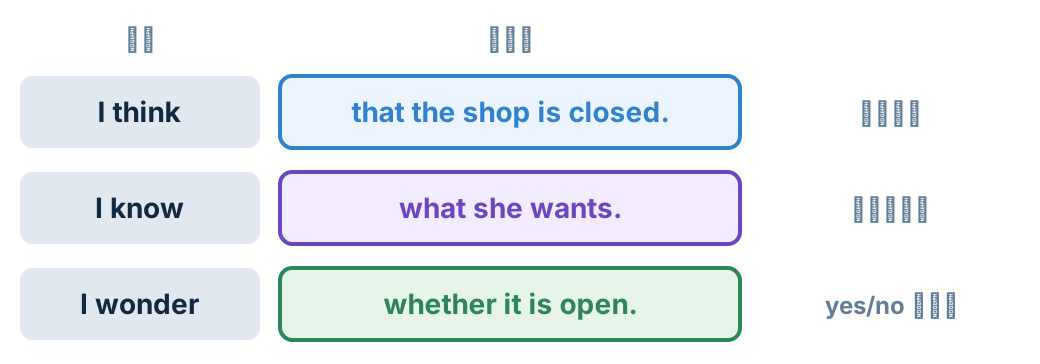
| 節を始める語 | 使い方 | 例 |
|---|---|---|
| that | 完全な文 | I think that the shop is closed. |
| what | 〜のもの(the thing that) | I know what she wants. |
| whether, if | yes/no の問い | I wonder whether it is open. |
| who, where, why, how | 開かれた問い | Nobody knows why she left. |
| because, although, when | 主節につながる従属節 | We left early because it was late. |
- 1
その節は文か、ものか、問いか? that、what、whether、または疑問詞を選びます(パート 1)。
- 2
文の中に入った問いか? 平叙文の語順にし、do は使いません(パート 2)。
- 3
どの文にも主節があるか? 接続語 1 つで節をつなぐか、ピリオドかセミコロンを使います(パート 4 と 5)。
名詞節は、大きな文の中で名詞の働きをします。パート 3 では、節全体が主語になるときにどうなるかを見ます。
that、what、それとも whether?
その節は文か、ものか、問いか?
ルール: that は完全な文を導き、what は「〜のもの」という意味で節に空所を残し、whether や if は yes/no の問いを節に変えます。ほかの疑問詞は意味をそのまま保ちます:why、how、when、where。
節の種類で語を選ぶ
| 節を始める語 | 後に続くもの | 例 |
|---|---|---|
| that | 完全な文。話し言葉ではよく省略される | He said that the bus was late. |
| what | 目的語か主語が欠けた節 | Tell me what happened. |
| whether, if | yes/no の問い | Ask her whether she is free. |
| why, how, when, where | 開かれた問い | I know where they live. |
便利な確かめ方:その語の代わりに the thing that を入れられるなら what。節だけで完全な文になるなら that です。
if ではなく whether
| 位置 | 例 |
|---|---|
| 前置詞の後 | It depends on whether it rains. |
| to + 動詞の前 | She can’t decide whether to stay. |
| 文頭 | Whether he comes is up to him. |
| or not の直前 | I’ll go whether or not you come. |
このパートのよくある誤り
- that と what の混同
She showed me that she had bought.✓ She showed me what she had bought.bought に目的語がないので what を使います。 - yes/no の問いに that を使った
I'm not sure that the train stops here.✓ I'm not sure whether the train stops here.not sure は yes/no の問いを表します:whether か if。 - whether しか使えない所で if を使った
We talked about if we should sell the car.✓ We talked about whether we should sell the car.前置詞の後は whether を使います。
もっと詳しく:名詞節か関係節か?
that は、名詞を説明する関係節を始めることもあります: the book that I bought。名詞節はそれ自体が目的語や主語です: I know that I bought it。関係節については、 関係詞節のガイド(英語).
文の中の疑問文
その問いは直接疑問文か、それとも別の文の中にあるか?
ルール: 文の中の疑問は平叙文の語順で、do、does、did を使いません。疑問文の語順を保つのは直接疑問文だけで、主節や引用符の中の疑問も含みます。
疑問文を平叙文の形に戻す
| 直接疑問文 | 文の中 |
|---|---|
| Where is the station? | Do you know where the station is? |
| What time does the film start? | I’d like to know what time the film starts. |
| Did she pass? | I wonder whether she passed. |
| Who called? | I don’t know who called. |
疑問詞自体が主語のとき(who called、what happened)は、どちらの形でも語順は同じです。句読点は文全体に合わせます:I wonder where she lives はピリオドで終わります。
疑問文の語順が残る 3 つの場所
| 場所 | 例 |
|---|---|
| 直接疑問文 | Where do you live? |
| 主節 | Do you know where she lives? |
| 引用符の中 | She asked, “Where do you live?” |
| do you think と一緒に | Where do you think she lives? |
このパートのよくある誤り
- 文中で疑問文の語順を使った
Do you know what is her phone number?✓ Do you know what her phone number is?文の中では、主語を動詞の前に置きます。 - 節の中に do / does / did を入れた
I wonder how much does a ticket cost.✓ I wonder how much a ticket costs.does を取り、動詞に -s を付けます。 - 直接疑問文で平叙文の語順を使った
He asked me, "Where you are going?"✓ He asked me, "Where are you going?"引用された疑問文は疑問文の語順を保ちます。
もっと詳しく:伝えられた疑問文と時制
伝達動詞が過去形のとき、節の中の時制はよく 1 つ過去にずれます: “Where do you work?” She asked me where I worked. 今も事実なら、現在形でもかまいません: She asked me where I work.
主語になる節
節全体が主語になるとどうなるか?
ルール: 主語になる節は単数扱いの動詞をとります。that 節が主語のときは、ふつう it を使って文末に移します。suggest、insist、essential の後は動詞の原形を使います。
節全体が主語になる
| パターン | 例 |
|---|---|
| what 節 + 単数扱いの動詞 | What surprised me was the price. |
| whether 節 + 単数扱いの動詞 | Whether we go depends on the weather. |
| it + be + 形容詞 + that 節 | It is strange that nobody called. |
| 動詞 + it + 形容詞 + that 節 | I find it odd that he left. |
名詞・形容詞・suggest の後の that
| 語 | 例 |
|---|---|
| the fact, the idea, the news | The news that she won spread fast. |
| sure, afraid, glad, aware | I’m glad that you came. |
| suggest、insist、recommend + 動詞の原形 | We recommend that he apply early. |
| essential、important、vital + 動詞の原形 | It is vital that she be on time. |
suggest などの動詞の後、イギリス英語では should(that he should apply)や普通の現在形もよく使います。動詞の原形はアメリカ英語でもイギリス英語でも正しい形です。suggest は目的語 + to をとりません:suggested him to apply とは言いません。
このパートのよくある誤り
- 主語の欠落
Is obvious that she loves her job.✓ It is obvious that she loves her job.that 節が文末にあるので、it が主語です。 - 節が主語なのに複数形の動詞
What worries me are the cost.✓ What worries me is the cost.what 節が主語のときは単数扱いの動詞です。 - suggest や essential の後の形の誤り
The coach suggested us to stretch first.✓ The coach suggested that we stretch first.suggest は目的語 + to をとりません。
主節と従属節
意味に合う接続語はどれか?後に来るのは節か名詞か?
ルール: 1 つのつなぎには接続語を 1 つだけ使い、意味で選びます。although、because、while の後は節、despite、because of、during の後は名詞か -ing 形です。
意味は同じ、構造が違う
| 節の前 | 名詞か -ing の前 | 例 |
|---|---|---|
| because, since, as(理由) | because of, due to | We stayed in because of the storm. |
| although, even though(対比) | despite, in spite of | Even though it was late, we kept going. |
| while, when, after(時) | during, after | She slept during the flight. |
| whereas, while(比較) | unlike | He likes tea, whereas I prefer coffee. |
3 種類のつなぎ
| 種類 | 語 | 句読点 |
|---|---|---|
| 従属接続詞 | because, although, when, if, unless | 節が先に来るときはコンマ |
| 等位接続詞 | and, but, so, or | その語の前にコンマ |
| つなぎの副詞 | however, therefore, as a result | 前にピリオドかセミコロン、後にコンマ |
中国語やベトナム語のように、対比や理由の両側に印を付ける言語もあります。英語では片方だけです:although か but、because か so。if と unless については、 条件文のガイド(英語).
このパートのよくある誤り
- 1 つのつなぎに 2 つの接続語
Although the hotel was cheap, but it was clean.✓ Although the hotel was cheap, it was clean.although か but のどちらか一方を使います。 - 節の前に前置詞を使った
Despite he was tired, he finished the report.✓ Although he was tired, he finished the report.although の後は節、despite の後は名詞です。 - however で節をつないだ
The road was icy, therefore we drove slowly.✓ The road was icy, so we drove slowly.therefore はコンマの後で節をつなげません。
完全な文
どの文にも独自の主節があるか?
ルール: 標準的な書き言葉では、どの文にも主語と動詞のある主節が必要です。2 つの文は、ピリオド、セミコロン、または接続語でつなぎ、コンマだけではつなぎません。
よくある 5 つの問題
| 問題 | 例 | 直し方 |
|---|---|---|
| 断片文 | We went home because the shop was closed. | |
| コンマ接続 | The shop was closed, so we went home. | |
| 連続文 | The shop was closed. We went home. | |
| 主語の欠落 | It is too cold to swim. | |
| 主語の重複 | My sister works in Lima. |
断片文は広告、メッセージ、小説ではよく見られ、くだけた文章では短い断片文も問題ありません。論文、仕事のメール、試験では完全な文を使いましょう。
このパートのよくある誤り
- 不完全な文
I couldn't sleep. Because my neighbor was playing music.✓ I couldn't sleep because my neighbor was playing music.because の節には主節が必要です。 - 2 つの文をコンマでつないだ
My phone died, I couldn't call you.✓ My phone died, so I couldn't call you.接続語を加えるか、ピリオドを使います。 - 余分な語
The woman who lives next door she is a pilot.✓ The woman who lives next door is a pilot.主語はすでにあるので、she で繰り返しません。
セルフチェック
それぞれの文は正しいでしょうか?タップすると答えが表示されます。迷ったときは、パートのラベルを見ればどこを読めばよいかがわかります。
パート 1I can't believe what he told us.
正しい。 what he told us には空所があります:told us what。
パート 1Let me know that you can come to the party.
誤り。 Let me know whether you can come to the party. 来られるかどうか?whether か if を使います。
パート 2Could you tell me where the ticket office is?
正しい。 疑問の中は平叙文の語順です:where the ticket office is。
パート 2I don't remember where did I park the car.
誤り。 I don’t remember where I parked the car. did を取り、平叙文の語順にします。
パート 3It is a pity that the museum is closed today.
正しい。 it は文末の that 節の代わりです。
パート 3Whether he agrees are not important.
誤り。 Whether he agrees is not important. 主語になる節は単数扱いの動詞をとります。
パート 4Even though the film was long, nobody left early.
正しい。 接続語は 1 つで、後に節が続きます。
パート 4Because of it was late, we took a taxi.
誤り。 Because it was late, we took a taxi. because の後は節で、because of ではありません。
パート 5The meeting ended early; as a result, we caught the earlier train.
正しい。 as a result はセミコロンの後に来ます。
パート 5Feeling hungry after the long walk.
誤り。 Feeling hungry after the long walk, we stopped at a café. -ing の句には主節が必要です。
AI 練習プロンプト
これを AI チャットツールに貼り付けてください。