
English has no single future tense. Will, be going to, the present continuous, the present simple, and the continuous and perfect forms of will each say something different about a future event: when it was decided, whether it is arranged or scheduled, and whether it will be in progress or finished at a given moment.
关于本指南: 将来时形式
英语没有单一的将来时。选择哪种形式,取决于你想表达的意思:是现在才决定的,还是早已计划好的?是已安排的,还是按时刻表进行的?到那时是正在进行,还是已经完成?本指南分为五个部分,与诊断测试的五个部分完全对应。
你可以先做诊断测验,看看这个主题的哪些部分需要复习,也可以直接进入练习活动,其中包含复习幻灯片。
本指南本身为英文。这些翻译只是额外提供的便利,可能不够完美。
このガイドについて: 未来を表す形
英語には未来形が一つだけあるわけではありません。どの形を選ぶかは伝えたい意味で決まります。今決めたのか、前から計画していたのか。取り決めか、時刻表か。その時点で進行中か、完了しているか。このガイドは 5 つのパートで、診断テストの 5 つのパートと完全に対応しています。
まず診断テストを受けて、このテーマのどの部分を復習すべきか確認することもできますし、復習スライドを含む練習アクティビティにそのまま進むこともできます。
このガイド自体は英語です。これらの翻訳は補助として提供しているもので、完全とは限りません。
이 가이드 소개: 미래 표현 형태
영어에는 하나의 미래 시제만 있는 것이 아닙니다. 어떤 형태를 고를지는 전하려는 의미에 달려 있습니다. 지금 정했는가, 미리 계획했는가? 약속된 일정인가, 시간표인가? 그 시점에 진행 중인가, 끝났는가? 이 가이드는 다섯 부분으로 되어 있으며, 진단 테스트의 다섯 부분과 정확히 일치합니다.
먼저 진단 퀴즈로 이 주제에서 복습이 필요한 부분을 확인해도 되고, 복습 슬라이드가 포함된 연습 활동으로 바로 들어가도 됩니다.
가이드 자체는 영어로 되어 있습니다. 이 번역은 부가적으로 제공되는 것이며 완벽하지 않을 수 있습니다.
Giới thiệu hướng dẫn này: Các hình thức tương lai
Tiếng Anh không có một thì tương lai duy nhất. Hình thức bạn chọn tùy vào điều bạn muốn nói: quyết định ngay bây giờ hay đã lên kế hoạch từ trước, đã sắp xếp hay theo lịch trình, đang diễn ra hay đã xong vào thời điểm đó? Hướng dẫn này gồm năm phần, khớp chính xác với năm phần của bài kiểm tra chẩn đoán.
Bạn có thể bắt đầu bằng bài kiểm tra chẩn đoán để biết phần nào cần ôn lại, hoặc vào thẳng các hoạt động luyện tập, trong đó có cả slide ôn tập.
Đọc hướng dẫn bằng tiếng Việt →
Bản hướng dẫn này được viết bằng tiếng Anh. Các bản dịch chỉ là phần hỗ trợ thêm và có thể chưa hoàn hảo.
इस गाइड के बारे में: भविष्य के रूप
अंग्रेज़ी में कोई एक भविष्य काल नहीं है। आप कौन-सा रूप चुनते हैं, यह इस पर निर्भर है कि आप क्या कहना चाहते हैं: अभी तय किया या पहले से योजना थी, तय व्यवस्था है या समय-सारणी, उस समय चल रहा है या पूरा हो चुका? इस गाइड के पाँच भाग हैं, जो निदान परीक्षा के पाँच भागों से ठीक मेल खाते हैं।
आप निदान क्विज़ से शुरू करके जान सकते हैं कि इस विषय के कौन-से भाग दोहराने चाहिए, या सीधे अभ्यास गतिविधियों में जा सकते हैं, जिनमें दोहराव की स्लाइडें भी हैं।
गाइड स्वयं अंग्रेज़ी में है। ये अनुवाद अतिरिक्त सुविधा के रूप में हैं और पूरी तरह सटीक न भी हों।
نبذة عن هذا الدليل: صيغ المستقبل
ليس في الإنجليزية زمن مستقبل واحد. الصيغة التي تختارها تعتمد على ما تريد قوله: هل قررت الآن أم خططت مسبقًا، هل هو موعد مرتب أم جدول، هل سيكون جاريًا أم مكتملًا في ذلك الوقت؟ يتكون هذا الدليل من خمسة أجزاء تطابق تمامًا الأجزاء الخمسة في الاختبار التشخيصي.
يمكنك البدء بالاختبار التشخيصي لمعرفة الأجزاء التي تحتاج إلى مراجعة، أو الانتقال مباشرة إلى أنشطة التدريب، وتشمل شرائح مراجعة.
الدليل نفسه بالإنجليزية. هذه الترجمات مجرد خدمة إضافية وقد لا تكون دقيقة تمامًا.
Об этом руководстве: Формы будущего времени
В английском нет одного будущего времени. Выбор формы зависит от того, что вы хотите сказать: решено сейчас или запланировано заранее, договорённость это или расписание, будет ли действие в процессе или уже завершено к тому моменту? В этом руководстве пять частей, и они точно соответствуют пяти частям диагностического теста.
Можно начать с диагностического теста, чтобы узнать, какие части темы стоит повторить, или сразу перейти к упражнениям, в которые входят слайды для повторения.
Читать руководство на русском →
Само руководство написано на английском. Эти переводы даются как дополнительная помощь, и они могут быть неидеальными.
Acerca de esta guía: Formas del futuro
El inglés no tiene un único tiempo futuro. La forma que eliges depende de lo que quieres decir: ¿lo decides ahora o ya estaba planeado?, ¿es un plan acordado o un horario?, ¿estará en curso o terminado en ese momento? Esta guía tiene cinco partes, y coinciden exactamente con las cinco partes del diagnóstico.
Puedes empezar con el cuestionario de diagnóstico para saber qué partes del tema conviene repasar, o ir directamente a las actividades de práctica, que incluyen diapositivas de repaso.
La guía en sí está en inglés. Estas traducciones son un añadido de cortesía y pueden no ser perfectas.
À propos de ce guide: Formes du futur
L'anglais n'a pas un seul temps du futur. La forme choisie dépend de ce que vous voulez dire : décidé maintenant ou prévu à l'avance, rendez-vous fixé ou horaire, en cours ou terminé à ce moment-là ? Ce guide comporte cinq parties, qui correspondent exactement aux cinq parties du diagnostic.
Vous pouvez commencer par le quiz de diagnostic pour savoir quelles parties du sujet réviser, ou passer directement aux activités d'entraînement, qui comprennent des diapositives de révision.
Le guide lui-même est en anglais. Ces traductions sont un complément offert et peuvent ne pas être parfaites.
Sobre este guia: Formas do futuro
O inglês não tem um único tempo futuro. A forma que você escolhe depende do que quer dizer: foi decidido agora ou já estava planejado, é um combinado ou um horário fixo, estará em andamento ou concluído naquele momento? Este guia tem cinco partes, que correspondem exatamente às cinco partes do teste diagnóstico.
Você pode começar pelo teste diagnóstico para ver quais partes do tema precisam de revisão, ou ir direto para as atividades de prática, que incluem slides de revisão.
O guia em si está em inglês. Estas traduções são um recurso extra e podem não ser perfeitas.
Your diagnostic result says which part needs review. Tap that part below.
One future, several forms
Choose the form by what you want to say about the event, not by how far away it is.
| What you want to say | Form | Example |
|---|---|---|
| A decision made right now, an offer, a promise | will | It’s dark in here. I’ll turn on the light. |
| A plan decided before now | be going to | I’m going to repaint my bedroom this summer. |
| A prediction from present evidence | be going to | The battery is at 2 percent. My phone is going to die. |
| A prediction from opinion | will | I think the price of coffee will go up. |
| A personal arrangement | present continuous | We’re having a video call with the client at ten. |
| A timetable or official schedule | present simple | The exam starts at 9:30 on Tuesday. |
| Something within moments | be about to | Quiet, please. The speech is about to begin. |
| In progress at a future moment | will be + -ing | At noon tomorrow, I’ll be sitting in a job interview. |
| Finished before a future moment | will have + past participle | By Monday, the office will have moved to the new building. |
| How long, up to a future moment | will have been + -ing | By August, he’ll have been training for a year. |
A common shortcut says will is for facts and be going to is for plans. It is a simplification: both forms can predict, and both can describe intentions. The more reliable question is whether the decision or the evidence already exists at the moment of speaking.
Continuous, perfect, and perfect continuous
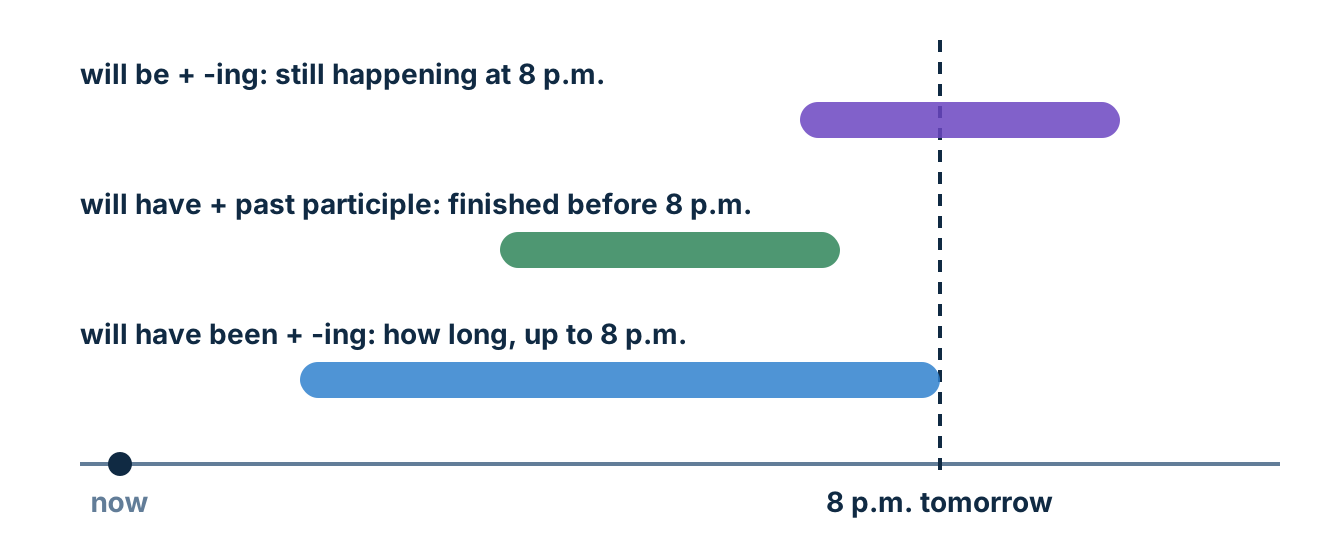
All three look at the same future moment. The difference is where the action sits in relation to it.
Unreal futures
For futures that depend on an unlikely or imagined condition (If I won the scholarship, I would study abroad), see the second conditional. Conditionals guide →
Possible futures
For a future that is possible but not certain (It might rain later, She may be late), use a modal verb. Modal verbs guide →
Shall appears mainly in offers and suggestions (Shall I open the window? Shall we start?) and in formal or legal writing. In everyday statements, will is the normal choice.
Will or be going to
Did you decide just now or before? Is the prediction based on evidence or opinion?
The rule: Use will for decisions made while speaking, offers, promises, and predictions based on opinion. Use be going to for plans made earlier and predictions based on present evidence.
When was the decision made?
| Clue in the context | Form | Example |
|---|---|---|
| Reacting to something you just heard or saw | will | A: The bin is full. B: I’ll take it out. |
| Offering or promising | will | I’ll send you the notes tonight. I won’t tell anyone. |
| Already decided, bought, booked, or promised earlier | be going to | I’ve downloaded the app. I’m going to learn Italian. |
What is the prediction based on?
| Basis | Form | Example |
|---|---|---|
| Something visible or known now | be going to | He’s running very fast on ice. He’s going to slip. |
| Opinion, often with I think, probably, I’m sure, I expect | will | I expect the meeting will be short. |
When both are possible
Many predictions accept either form (It will rain later / It’s going to rain later). The contrast matters most for decisions: a decision made before speaking sounds odd with will, and one made while speaking sounds odd with be going to.
Common errors in this part
- be going to for a decision made now
A: The printer's jammed. B: I'm going to fix it.✓ A: The printer's jammed. B: I'll fix it.B decides the moment they hear about the problem. - will for a plan made earlier
I bought a guitar last week because I'll learn to play.✓ I bought a guitar last week because I'm going to learn to play.The intention existed before the guitar was bought. - present simple for a plan or prediction
Look at him. He falls off that ladder!✓ Look at him. He's going to fall off that ladder!Present evidence predicts the fall; the present simple cannot.
Arrangements, timetables, and be about to
Is it booked, on a timetable, or about to happen? Is the story set in the past?
The rule: Use the present continuous for personal arrangements, the present simple for timetables, be about to for the next few moments, and was going to or was about to in a story about the past.
| Meaning | Form | Example |
|---|---|---|
| Personal arrangement (agreed, booked) | present continuous | I’m having my hair cut on Saturday. |
| Timetable, program, opening hours | present simple | The next ferry departs at 4:20. |
| Within moments | be about to | Turn off your phone. The plane is about to take off. |
| A plan seen from the past | was / were going to | We were going to eat outside, but it rained. |
| Just before something in the past | was / were about to | I was about to leave when my boss called. |
Present simple for a personal plan
A personal plan in the present simple (I study tonight) sounds like a fixed fact of the world rather than an intention. Use be going to or the present continuous. Some business and travel itineraries do use the present simple (We fly to Osaka on Monday), because they read like a schedule.
How soon is about to?
Be about to normally means seconds or minutes away. In casual speech it can stretch to very soon, but it does not combine with a stated later time such as next month or next year.
Common errors in this part
- present simple for a plan or prediction
I play tennis with Leo tomorrow at six.✓ I'm playing tennis with Leo tomorrow at six.An agreed plan with a set time takes the present continuous. - be about to with a later time
My cousin is about to get married in October.✓ My cousin is getting married in October.October is not within moments. - present form in a past story
He said he is going to call, but he never did.✓ He said he was going to call, but he never did.The plan is seen from a past point.
Time clauses
Is the blank after when, until, or as soon as, or in the main clause?
The rule: After when, before, after, until, once, as soon as, and by the time, use a present form (present simple or present perfect) for the future. Put will in the main clause.
Grammar recap
If follows the same pattern: If it rains, we will stay inside (not If it will rain). The first conditional is covered in full, with unless and other connectors, in the Conditionals guide. Conditionals guide →
Time words that take a present form
Which clause is the blank in?
| Time clause | Main clause |
|---|---|
| As soon as the parcel arrives, | I‘ll let you know. |
| Until the bridge reopens, | drivers will need a detour. |
| Once you‘ve paid, | you‘ll get a receipt by email. |
The time clause can come first or second. The rule depends on which clause the verb is in, not on the order.
Common errors in this part
- will after when, until, or as soon as
We'll start as soon as everyone will arrive.✓ We'll start as soon as everyone arrives.After as soon as, the verb stays in the present. - present form where the future is needed
Once the box office opens, I buy the tickets.✓ Once the box office opens, I'll buy the tickets.The main clause needs will. - will after when, until, or as soon as
I won't leave until I will have finished.✓ I won't leave until I've finished.No will in the time clause, even in the perfect.
In progress or finished?
At that future moment, is the action still happening or already done?
The rule: Will be + -ing shows an action in progress at a future moment. Will have + past participle shows it finished before then. Stative verbs keep the simple form.
| Question | Form | Example |
|---|---|---|
| Still happening at that moment? | will be + -ing | When the guests arrive, we’ll still be cooking. |
| Already done by that moment? | will have + past participle | When the guests arrive, we’ll have finished cooking. |
| A stative verb (know, be, own, need)? | will + base form | By tonight, we’ll know the answer. |
Clues
In progress: this time tomorrow, at that moment, when you arrive, all afternoon. Finished: by, by the time, already, before.
Polite questions
Will you be using the car tonight? asks about someone’s plans without sounding like a request. Will you use the car? can sound like asking them to do it.
Common errors in this part
- plain will where aspect is needed
At 3 a.m., most of the city will sleep.✓ At 3 a.m., most of the city will be sleeping.Sleeping is in progress at that moment. - in progress and finished mixed up
By the time we get there, the show will be starting already.✓ By the time we get there, the show will have started already.By the time and already point to completion. - stative verb in the continuous
Tomorrow you will be understanding the plan better.✓ Tomorrow you will understand the plan better.Understand is a stative verb.
Duration up to a future point
Are you measuring how long, or counting how many?
The rule: Will have been + -ing measures how long up to a future point. Use will have + past participle for how many, for stative verbs, and in the passive.
| Question | Form | Example |
|---|---|---|
| How long, up to that point? | will have been + -ing | By June, I’ll have been teaching for twenty years. |
| How many, by that point? | will have + past participle | By June, I’ll have taught over 3,000 classes. |
| Stative verb | will have + past participle | By June, I’ll have had this job for twenty years. |
| Passive | will have been + past participle | By June, the old school will have been demolished. |
Three parts
The future perfect continuous has three helpers before the -ing form: will + have + been. Leaving out been (will have working) is a common slip.
Negatives and questions are possible (How long will you have been living here?), but the form is most common in statements.
Common errors in this part
- will have + -ing without been
In May, we will have dating for two years.✓ In May, we will have been dating for two years.Duration needs will have been + -ing. - continuous with a number of finished things
By noon, I will have been answering 50 emails.✓ By noon, I will have answered 50 emails.Fifty emails is a count of finished things. - present perfect for a future point
Next year, he has worked here for a decade.✓ Next year, he will have worked here for a decade.Next year is a future point, so will is needed.
Self-check
Is each sentence correct? Tap to see the answer. The part label tells you where to look if you were not sure.
Part 1Oh no, I've spilled my coffee! Don't worry, I'll get a cloth.
Correct. A decision made at the moment of speaking takes will.
Part 1I've decided. I'm going to take the job in Chicago.
Correct. The decision came before speaking, so be going to fits.
Part 2The festival opens on Friday at noon.
Correct. An official program takes the present simple.
Part 2I'm about to move to a new city next spring.
Incorrect. About to means within moments. Use: I’m going to move (or I’m moving) to a new city next spring.
Part 3I'll send you the photos when I will get home.
Incorrect. After when, use the present: I’ll send you the photos when I get home.
Part 3Once you've tried this recipe, you'll never buy the store version again.
Correct. The present perfect in the once-clause, will in the main clause.
Part 4When you call at nine, I'll be driving to work.
Correct. The driving will be in progress when you call.
Part 4By the end of the week, the painters will be finishing the whole house.
Incorrect. By the end of the week points to completion: the painters will have finished the whole house.
Part 5By 2028, she will have been living abroad for a decade.
Correct. Duration up to a future point takes will have been + -ing.
Part 5By Sunday, I will have been reading four books.
Incorrect. Four books is a count: By Sunday, I will have read four books.
AI practice prompt
Paste this into an AI chat tool and replace the bracket with your language.