
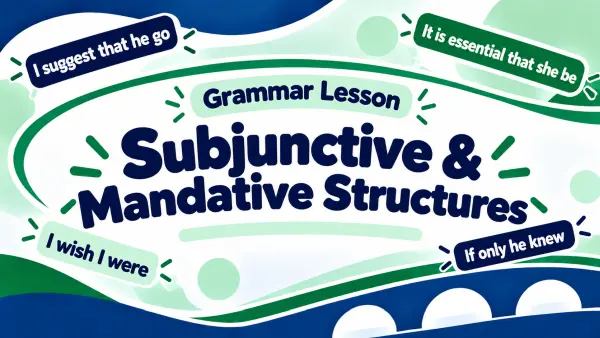
Some words in English call for a special verb form. After a demand or suggestion, the verb is the plain base form: I suggest that he go, it is essential that she be there. In unreal situations, English uses were and other past forms: if I were you, it’s time we left. These structures are small but frequent in formal and academic English.
关于本指南: 虚拟语气与表示要求的句型
在正式英语和学术英语中,有些词要求使用特殊的动词形式。在 suggest、recommend、insist、essential 或 the requirement that 之后,动词用单纯的动词原形(I suggest that he go; it is essential that she be there)。在非真实的情况中,英语用 were 和其他过去形式(if I were you; it's time we left),还有少数固定表达保留了古老的形式(be that as it may)。本指南分为五个部分,与诊断测试的五个部分完全对应。
你可以先做诊断测验,看看这个主题的哪些部分需要复习,也可以直接进入练习活动,其中包含复习幻灯片。
本指南本身为英文。这些翻译只是额外提供的便利,可能不够完美。
このガイドについて: 仮定法と要求・提案を表す構文
改まった英語や学術的な英語では、特別な動詞の形を必要とする語があります。suggest、recommend、insist、essential、the requirement that の後では、動詞は原形そのままです(I suggest that he go; it is essential that she be there)。非現実の状況では、英語は were やほかの過去形を使い(if I were you; it's time we left)、いくつかの決まった表現は古い形を残しています(be that as it may)。このガイドは五つのパートに分かれていて、診断テストの五つのパートとそのまま対応しています。
まず診断テストを受けて、このテーマのどの部分を復習すべきか確認することもできますし、復習スライドを含む練習アクティビティにそのまま進むこともできます。
このガイド自体は英語です。これらの翻訳は補助として提供しているもので、完全とは限りません。
이 가이드 소개: 가정법과 요구·제안을 나타내는 구조
격식 있는 영어와 학술 영어에서는 일부 단어 뒤에 특별한 동사 형태가 옵니다. suggest, recommend, insist, essential, the requirement that 뒤에서는 동사가 동사원형 그대로 쓰입니다(I suggest that he go; it is essential that she be there). 비현실 상황에서는 were와 그 밖의 과거형을 쓰며(if I were you; it's time we left), 몇몇 고정 표현에는 옛 형태가 남아 있습니다(be that as it may). 이 가이드는 다섯 부분으로 되어 있으며, 진단 퀴즈의 다섯 부분과 정확히 일치합니다.
먼저 진단 퀴즈로 이 주제에서 복습이 필요한 부분을 확인해도 되고, 복습 슬라이드가 포함된 연습 활동으로 바로 들어가도 됩니다.
가이드 자체는 영어로 되어 있습니다. 이 번역은 부가적으로 제공되는 것이며 완벽하지 않을 수 있습니다.
Giới thiệu hướng dẫn này: Thức giả định và các cấu trúc diễn tả yêu cầu, đề xuất
Trong tiếng Anh trang trọng và học thuật, một số từ đòi hỏi một dạng động từ đặc biệt. Sau suggest, recommend, insist, essential hoặc the requirement that, động từ ở dạng nguyên mẫu (I suggest that he go; it is essential that she be there). Trong tình huống không có thật, tiếng Anh dùng were và các dạng quá khứ khác (if I were you; it's time we left), và một vài cụm cố định vẫn giữ dạng cổ (be that as it may). Hướng dẫn này có năm phần, khớp chính xác với năm phần của bài chẩn đoán.
Bạn có thể bắt đầu bằng bài kiểm tra chẩn đoán để biết phần nào cần ôn lại, hoặc vào thẳng các hoạt động luyện tập, trong đó có cả slide ôn tập.
Đọc hướng dẫn bằng tiếng Việt →
Bản hướng dẫn này được viết bằng tiếng Anh. Các bản dịch chỉ là phần hỗ trợ thêm và có thể chưa hoàn hảo.
इस गाइड के बारे में: संभावनार्थ रूप (subjunctive) और माँग व अनिवार्यता की संरचनाएँ
औपचारिक और शैक्षणिक अंग्रेज़ी में कुछ शब्दों के बाद क्रिया का एक खास रूप आता है। suggest, recommend, insist, essential या the requirement that के बाद क्रिया अपने सादे मूल रूप (base form) में आती है (I suggest that he go; it is essential that she be there)। अवास्तविक स्थितियों में अंग्रेज़ी were और भूतकाल के दूसरे रूप इस्तेमाल करती है (if I were you; it's time we left), और कुछ तय अभिव्यक्तियों में पुराने रूप आज भी बचे हैं (be that as it may)। इस गाइड के पाँच भाग हैं, जो निदान क्विज़ के पाँच भागों से पूरी तरह मेल खाते हैं।
आप निदान क्विज़ से शुरू करके जान सकते हैं कि इस विषय के कौन-से भाग दोहराने चाहिए, या सीधे अभ्यास गतिविधियों में जा सकते हैं, जिनमें दोहराव की स्लाइडें भी हैं।
गाइड स्वयं अंग्रेज़ी में है। ये अनुवाद अतिरिक्त सुविधा के रूप में हैं और पूरी तरह सटीक न भी हों।
نبذة عن هذا الدليل: صيغة الالتماس (subjunctive) وتراكيب الطلب والإلزام
في الإنجليزية الرسمية والأكاديمية، تستدعي بعض الكلمات صيغة فعل خاصة. فبعد suggest أو recommend أو insist أو essential أو the requirement that، يأتي الفعل في صيغته الأساسية المجردة (I suggest that he go; it is essential that she be there). وفي المواقف غير الواقعية تستخدم الإنجليزية were وصيغ ماضٍ أخرى (if I were you; it's time we left)، وتحتفظ بعض التعابير الثابتة بصيغ قديمة (be that as it may). يتكون هذا الدليل من خمسة أجزاء تطابق تمامًا الأجزاء الخمسة للاختبار التشخيصي.
يمكنك البدء بالاختبار التشخيصي لمعرفة الأجزاء التي تحتاج إلى مراجعة، أو الانتقال مباشرة إلى أنشطة التدريب، وتشمل شرائح مراجعة.
الدليل نفسه بالإنجليزية. هذه الترجمات مجرد خدمة إضافية وقد لا تكون دقيقة تمامًا.
Об этом руководстве: Сослагательное наклонение и конструкции требования
В формальном и академическом английском некоторые слова требуют особой формы глагола. После suggest, recommend, insist, essential или the requirement that глагол стоит в простой базовой форме (I suggest that he go; it is essential that she be there). В нереальных ситуациях английский использует were и другие формы прошедшего времени (if I were you; it's time we left), а несколько устойчивых выражений сохраняют старые формы (be that as it may). Это руководство состоит из пяти частей, которые точно соответствуют пяти частям диагностического теста.
Можно начать с диагностического теста, чтобы узнать, какие части темы стоит повторить, или сразу перейти к упражнениям, в которые входят слайды для повторения.
Читать руководство на русском →
Само руководство написано на английском. Эти переводы — дополнительная помощь, и они могут быть неидеальными.
Acerca de esta guía: El subjuntivo y las estructuras de exigencia
En el inglés formal y académico, algunas palabras exigen una forma verbal especial. Después de suggest, recommend, insist, essential o the requirement that, el verbo va en la forma base sin más (I suggest that he go; it is essential that she be there). En situaciones irreales, el inglés usa were y otras formas de pasado (if I were you; it's time we left), y algunas expresiones fijas conservan formas antiguas (be that as it may). Esta guía tiene cinco partes, que corresponden exactamente a las cinco partes del diagnóstico.
Puedes empezar con el cuestionario de diagnóstico para saber qué partes del tema conviene repasar, o ir directamente a las actividades de práctica, que incluyen diapositivas de repaso.
La guía en sí está en inglés. Estas traducciones son un añadido de cortesía y pueden no ser perfectas.
À propos de ce guide: Le subjonctif et les structures d'exigence
En anglais formel et universitaire, certains mots appellent une forme verbale particulière. Après suggest, recommend, insist, essential ou the requirement that, le verbe est à la forme de base nue (I suggest that he go ; it is essential that she be there). Dans les situations irréelles, l'anglais utilise were et d'autres formes du passé (if I were you ; it's time we left), et quelques expressions figées gardent des formes anciennes (be that as it may). Ce guide comporte cinq parties, qui correspondent exactement aux cinq parties du diagnostic.
Vous pouvez commencer par le quiz de diagnostic pour savoir quelles parties du sujet réviser, ou passer directement aux activités d'entraînement, qui comprennent des diapositives de révision.
Le guide lui-même est en anglais. Ces traductions sont un complément offert et peuvent ne pas être parfaites.
Sobre este guia: Subjuntivo e estruturas de exigência
No inglês formal e acadêmico, algumas palavras pedem uma forma verbal especial. Depois de suggest, recommend, insist, essential ou the requirement that, o verbo fica na forma base pura (I suggest that he go; it is essential that she be there). Em situações irreais, o inglês usa were e outras formas do passado (if I were you; it's time we left), e algumas expressões fixas mantêm formas antigas (be that as it may). Este guia tem cinco partes, que correspondem exatamente às cinco partes do diagnóstico.
Você pode começar pelo teste diagnóstico para ver quais partes do tema precisam de revisão, ou ir direto para as atividades de prática, que incluem slides de revisão.
O guia em si está em inglês. Estas traduções são um recurso extra e podem não ser perfeitas.
Your diagnostic result says which part needs review. Tap that part below.
One idea, two forms
The mandative subjunctive (base form) is for demands and proposals. The unreal past (were, past forms) is for things that are imagined or untrue.

| What you want to say | Form | Example |
|---|---|---|
| A demand, proposal, or requirement (verb) | that + base form | The board proposed that the plan be delayed. |
| Something essential or important (adjective) | that + base form or for + to | It is crucial that every voter bring ID. |
| Something imagined or not true now | were / past form | If I were in charge, I would hire more staff. |
| Regret about the past | had + past participle | I wish we had left earlier. |
| A formal condition without if | Should / Had / Were + subject | Should the flight be canceled, you will get a voucher. |
British English often uses should in the mandative pattern (that he should go), and in informal speech a normal tense (that he goes). Both are correct in their context. The base form is accepted everywhere and is the standard choice in formal and academic writing, so this guide teaches it.
Suggest, recommend, insist: verb patterns
Which pattern does this verb take?
The rule: After suggest, recommend, insist, demand, and propose, use that + subject + base form. Suggest and recommend can also take -ing. Want, urge, and encourage take object + to-infinitive.
Grammar recap
Suggest and recommend + -ing, and the difference between verbs that take -ing and verbs that take to-infinitive, are covered in full in the Gerunds and Infinitives guide. Gerunds and Infinitives guide →
Verbs that trigger that + base form
Which pattern does the verb take?
| Verb | that + base form | -ing | object + to |
|---|---|---|---|
| suggest, recommend | ✓ | ✓ | ✗ |
| insist | ✓ | on + -ing | ✗ |
| demand | ✓ | ✗ | ✗ |
| ask, advise, require, urge | ✓ | ✗ | ✓ |
| want, encourage, expect, allow | ✗ | ✗ | ✓ |
The nurse suggested that I rest. / The nurse suggested resting.
The nurse wanted me to rest.
Want looks similar in meaning to suggest, but its grammar is different. This is the most common error in this part.
Common errors in this part
- wrong pattern after suggest, recommend, or insist
Our tutor suggested us to join a study group.✓ Our tutor suggested that we join a study group.Suggest does not take an object + to. - wrong pattern after want, urge, or encourage
My boss wants that I travel less.✓ My boss wants me to travel less.Want takes an object + to-infinitive. - to-infinitive inside the that-clause
The bank asks that customers to show ID.✓ The bank asks that customers show ID.No to after that.
Essential, vital, the requirement that
Is the trigger an adjective or a noun, and is the clause that or for + to?
The rule: After essential, vital, important, and similar adjectives, and after nouns such as requirement and proposal, use that + base form. With an adjective you can also use for + person + to-infinitive.
Adjectives
Two patterns, same meaning
| Pattern | Example |
|---|---|
| It is + adjective + that + base form | It is essential that the fridge stay closed. |
| It is + adjective + for + person + to-infinitive | It is essential for the fridge to stay closed. |
Do not mix them
That goes with a base-form clause. For goes with a to-infinitive. A sentence with for and no to, or that and to, is broken.
Nouns
We accepted the condition that the loan be repaid within a year.
Before that, check the word form. Her insistence that, not her insist that. The request that, not the requested that.
Common errors in this part
- that-clause and for + to mixed up
It is important for children get enough sleep.✓ It is important for children to get enough sleep.For + person needs to. - -ing form inside the that-clause
It is essential that the team leaving on time.✓ It is essential that the team leave on time.That + base form, not -ing. - verb or adjective where a noun is needed
The require that applicants be over 18 is new.✓ The requirement that applicants be over 18 is new.Before that, use a noun.
The base form: negatives, passives, past time
Is it a demand, and if so, is it negative or passive?
The rule: The base form does not change: no -s, no tense, not before the verb, be + past participle for the passive. When suggest or insist reports a fact, use a normal tense.
One form for every subject and every time
| Type | Pattern | Example |
|---|---|---|
| Positive | base form | The panel recommended that she apply again. |
| Negative | not + base form | The panel recommended that she not apply again. |
| Passive | be + past participle | The panel recommended that her file be reviewed. |
| Negative passive | not be + past participle | The panel recommended that her file not be closed. |
The main verb can be present or past. The verb in the that-clause does not change.
Demand or fact?
Ask whether someone wants something to happen. If yes, use the base form. If the sentence only reports what is true, use a normal tense.
| Meaning | Example |
|---|---|
| suggest = propose | The tutor suggested that we start earlier. |
| suggest = show | The tests suggested that the water was safe. |
| insist = demand | My aunt insisted that I take the larger room. |
| insist = claim | My aunt insisted that she had locked the door. |
Common errors in this part
- wrong negative form
We ask that you don't to park here.✓ We ask that you not park here.Not + base form. - wrong passive form
The rules require that all bags be check.✓ The rules require that all bags be checked.Be + past participle. - subjunctive where a fact is reported
The tests suggest that the bridge be unsafe.✓ The tests suggest that the bridge is unsafe.Suggest means 'show' here.
Were and the unreal past
Is the situation imagined, and is it about now or the past?
The rule: For something imagined or untrue, use were or another past form; for an unreal past, use had + past participle. It's time and would rather also take a past form.
Grammar recap
Second and third conditionals, wish, and if only are covered in full in the Conditionals guide. This part focuses on were and the other places where a past form describes something unreal. Conditionals guide →
Past forms that do not mean past time
| Expression | Unreal present | Unreal past |
|---|---|---|
| if | If we lived closer, we would visit more. | If we had lived closer, we would have visited more. |
| wish / if only | I wish it were Friday. | If only I had saved the file. |
| as if / as though | She speaks as if she owned the place. | He looked as though he had run a marathon. |
| it’s time | It’s time we cleaned the garage. | |
| would rather | I’d rather you called first. | I’d rather you had told me. |
Were or was?
In conversation many speakers say if I was. In formal writing, and in the fixed phrase if I were you, use were for every subject.
I wish the printer would work. (someone or something else)
I wish I could fix it. (yourself)
Common errors in this part
- would in the unreal clause
If I would have more money, I would buy a bike.✓ If I had more money, I would buy a bike.No would after if. - present or future form in an unreal clause
It's time we start the meeting.✓ It's time we started the meeting.It's time + past form. - wrong time in an unreal clause
I wish I went to the concert last night.✓ I wish I had gone to the concert last night.Unreal past: had + past participle.
Fixed expressions and formal inversion
Is this a fixed phrase or a formal condition without if?
The rule: Formal conditions can start with Should, Had, or Were instead of if. Fixed expressions such as be that as it may and if need be keep their old form.
Inverted conditions
| With if | Formal inversion | Note |
|---|---|---|
| If you have questions, … | Should you have questions, … | Should + subject + base form |
| If I had known, … | Had I known, … | Had + subject + past participle |
| If it were not for …, … | Were it not for …, … | Were + subject + not for |
| If prices were to rise, … | Were prices to rise, … | Were + subject + to-infinitive |
Negatives do not contract in this pattern: Had it not been for, not Hadn’t it been for.
Fixed expressions
The roads were icy. Be that as it may, the bus left on time.
Label every cable lest someone unplug the wrong one.
Lest is formal and fairly rare. In everyday English, so that … not or in case is more common.
Common errors in this part
- broken formal inversion
Should you needed help, call me.✓ Should you need help, call me.Should + base form. - fixed expression changed
Come what will, we won't give up.✓ Come what may, we won't give up.The phrase is fixed. - broken formal inversion
Had I knew the risk, I wouldn't have invested.✓ Had I known the risk, I wouldn't have invested.Had + past participle.
Self-check
Is each sentence correct? Tap to see the answer. The part label tells you where to look if you were not sure.
Part 1The librarian recommended that I renew the book online.
Correct. Recommend that + base form.
Part 1The website encourages users that they create strong passwords.
Incorrect. Encourage takes object + to: encourages users to create strong passwords.
Part 2It is vital that the bandage be changed every day.
Correct. It is vital that + be + past participle.
Part 2It is necessary for the room be quiet during the exam.
Incorrect. For + noun needs to: for the room to be quiet.
Part 3The manager asked that every report to be sent by Friday.
Incorrect. No to after that: asked that every report be sent by Friday.
Part 3Early results suggest that the plan is working.
Correct. Suggest means ‘show’, so a normal tense is right.
Part 4If she were here, she would know what to do.
Correct. Were for an unreal present.
Part 4I wish I would be taller.
Incorrect. For yourself, use wish + past: I wish I were taller.
Part 5Had it not been for the map, we would have gotten lost.
Correct. Had + subject + not been for.
Part 5If need is, we can hire a second driver.
Incorrect. The fixed phrase is if need be.
AI practice prompt
Paste this into an AI chat tool and replace the bracket with your language.