
The present continuous is am, is, or are plus the -ing form. It describes what is happening now, what is true only for now, what is changing, and what is already arranged. This guide shows how to build it, when to choose it over the present simple, which verbs resist it, and how to use it to describe a picture.
关于本指南: 现在进行时
现在进行时是描述此刻正在发生的事情的时态,因此是描述照片的核心。本主题有一个部分讲形式,三个部分讲用法,还有一个部分两者同时需要。本指南分为五个部分,与诊断测试的五个部分完全对应。
你可以先做诊断测验,看看这个主题的哪些部分需要复习,也可以直接进入练习活动,其中包含复习幻灯片。
本指南本身为英文。这些翻译只是额外提供的便利,可能不够完美。
このガイドについて: 現在進行形
現在進行形は今まさに起きていることを述べる時制で、写真を描写するときの中心になります。このテーマの 1 つのパートは形について、3 つは用法について、1 つは両方を同時に必要とします。このガイドは 5 つのパートで、診断テストの 5 つのパートと完全に対応しています。
まず診断テストを受けて、このテーマのどの部分を復習すべきか確認することもできますし、復習スライドを含む練習アクティビティにそのまま進むこともできます。
このガイド自体は英語です。これらの翻訳は補助として提供しているもので、完全とは限りません。
이 가이드 소개: 현재진행형
현재진행형은 지금 일어나고 있는 일을 말하는 시제로, 사진을 묘사할 때 핵심이 됩니다. 이 주제의 한 영역은 형태에 관한 것이고, 세 영역은 용법에 관한 것이며, 한 영역은 둘 다 동시에 필요합니다. 이 가이드는 다섯 부분으로 되어 있으며, 진단 테스트의 다섯 부분과 정확히 일치합니다.
먼저 진단 퀴즈로 이 주제에서 복습이 필요한 부분을 확인해도 되고, 복습 슬라이드가 포함된 연습 활동으로 바로 들어가도 됩니다.
가이드 자체는 영어로 되어 있습니다. 이 번역은 부가적으로 제공되는 것이며 완벽하지 않을 수 있습니다.
Giới thiệu hướng dẫn này: Hiện tại tiếp diễn
Hiện tại tiếp diễn là thì dùng cho điều đang xảy ra ngay lúc này, nên nó là nền tảng để mô tả một bức ảnh. Một phần của chủ đề này nói về hình thức, ba phần nói về cách dùng, và một phần cần cả hai cùng lúc. Hướng dẫn này gồm năm phần, khớp chính xác với năm phần của bài kiểm tra chẩn đoán.
Bạn có thể bắt đầu bằng bài kiểm tra chẩn đoán để biết phần nào cần ôn lại, hoặc vào thẳng các hoạt động luyện tập, trong đó có cả slide ôn tập.
Đọc hướng dẫn bằng tiếng Việt →
Bản hướng dẫn này được viết bằng tiếng Anh. Các bản dịch chỉ là phần hỗ trợ thêm và có thể chưa hoàn hảo.
इस गाइड के बारे में: वर्तमान सतत
वर्तमान सतत वह काल है जो अभी हो रही बात के लिए आता है, इसलिए फ़ोटो का वर्णन करने में यही आधार है। इस विषय का एक भाग रूप के बारे में है, तीन भाग प्रयोग के बारे में, और एक भाग में दोनों एक साथ चाहिए। इस गाइड के पाँच भाग हैं, जो निदान परीक्षा के पाँच भागों से ठीक मेल खाते हैं।
आप निदान क्विज़ से शुरू करके जान सकते हैं कि इस विषय के कौन-से भाग दोहराने चाहिए, या सीधे अभ्यास गतिविधियों में जा सकते हैं, जिनमें दोहराव की स्लाइडें भी हैं।
गाइड स्वयं अंग्रेज़ी में है। ये अनुवाद अतिरिक्त सुविधा के रूप में हैं और पूरी तरह सटीक न भी हों।
نبذة عن هذا الدليل: المضارع المستمر
المضارع المستمر هو زمن ما يحدث الآن، ولهذا فهو أساس وصف الصور. جزء واحد من هذا الموضوع عن الصيغة، وثلاثة أجزاء عن الاستخدام، وجزء واحد يحتاج إلى الاثنين معًا. يتكون هذا الدليل من خمسة أجزاء تطابق تمامًا الأجزاء الخمسة في الاختبار التشخيصي.
يمكنك البدء بالاختبار التشخيصي لمعرفة الأجزاء التي تحتاج إلى مراجعة، أو الانتقال مباشرة إلى أنشطة التدريب، وتشمل شرائح مراجعة.
الدليل نفسه بالإنجليزية. هذه الترجمات مجرد خدمة إضافية وقد لا تكون دقيقة تمامًا.
Об этом руководстве: Present continuous
Present continuous — это время для того, что происходит прямо сейчас, поэтому оно основа описания фотографии. Одна часть этой темы посвящена форме, три — употреблению, а одна требует и того и другого одновременно. В этом руководстве пять частей, и они точно соответствуют пяти частям диагностического теста.
Можно начать с диагностического теста, чтобы узнать, какие части темы стоит повторить, или сразу перейти к упражнениям, в которые входят слайды для повторения.
Читать руководство на русском →
Само руководство написано на английском. Эти переводы — дополнительная помощь, и они могут быть неидеальными.
Acerca de esta guía: Presente continuo
El presente continuo es el tiempo de lo que ocurre ahora mismo, por lo que es la base para describir una fotografía. Una parte de este tema trata de la forma, tres del uso, y una necesita ambas a la vez. Esta guía tiene cinco partes, y coinciden exactamente con las cinco partes del diagnóstico.
Puedes empezar con el cuestionario de diagnóstico para saber qué partes del tema conviene repasar, o ir directamente a las actividades de práctica, que incluyen diapositivas de repaso.
La guía en sí está en inglés. Estas traducciones son un añadido de cortesía y pueden no ser perfectas.
À propos de ce guide: Présent continu
Le présent continu est le temps de ce qui se passe en ce moment, ce qui en fait la base de la description d'une photo. Une partie de ce sujet porte sur la forme, trois sur l'emploi, et une demande les deux à la fois. Ce guide comporte cinq parties, qui correspondent exactement aux cinq parties du diagnostic.
Vous pouvez commencer par le quiz de diagnostic pour savoir quelles parties du sujet réviser, ou passer directement aux activités d'entraînement, qui comprennent des diapositives de révision.
Le guide lui-même est en anglais. Ces traductions sont un complément offert et peuvent ne pas être parfaites.
Sobre este guia: Presente contínuo
O presente contínuo é o tempo do que acontece agora mesmo, por isso é a base para descrever uma fotografia. Uma parte deste tema trata da forma, três tratam do uso, e uma precisa de ambos ao mesmo tempo. Este guia tem cinco partes, que correspondem exatamente às cinco partes do teste diagnóstico.
Você pode começar pelo teste diagnóstico para ver quais partes do tema precisam de revisão, ou ir direto para as atividades de prática, que incluem slides de revisão.
O guia em si está em inglês. Estas traduções são um recurso extra e podem não ser perfeitas.
Your diagnostic result says which part needs review. Tap that part below.
The core idea
The present continuous puts you inside a stretch of time that includes now. The present simple steps back and states what is generally true.
Happening now
in progress at this moment
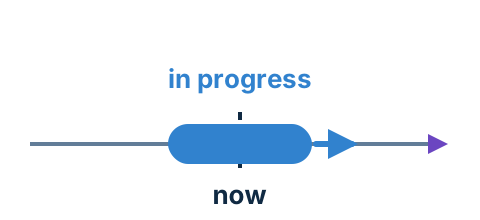
She is writing an email.
True for now
a temporary period around now
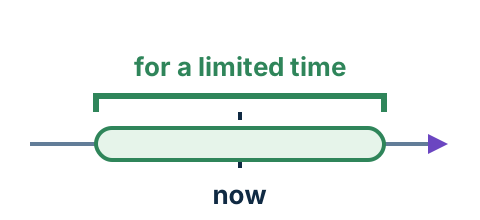
I‘m staying with my aunt this month.
Generally true
present simple, for contrast
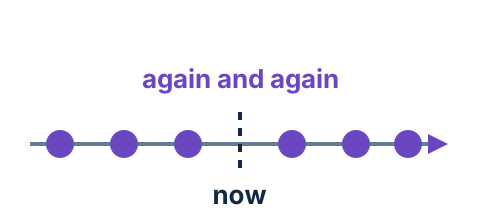
She writes a blog post every week.
- 1
Both halves are required. be carries the subject, the tense, the question, and the negative. The -ing form carries the meaning.
- 2
The tense covers more than this second: a period around now, a change in progress, and plans already arranged for the future.
- 3
Verbs that name a state, such as know, want, and belong, normally stay in the simple even when the state is true right now.
Building the form
How do you build it, and what does be have to agree with?
The rule: The present continuous is am, is, or are plus the -ing form. Be matches the subject and does the work in questions and negatives.
be plus the -ing form
| Subject | Positive | Negative | Question |
|---|---|---|---|
| I | I am working | I‘m not working | Am I working? |
| he / she / it | she is working | she isn’t working | Is she working? |
| we / you / they | they are working | they aren’t working | Are they working? |
For a wh- question, put the question word first, then be, then the subject: What are you doing? When the question word is the subject, no other subject follows: What is happening?
Watch the real subject
| Subject | be | Why |
|---|---|---|
| Everyone | is | everyone, someone, and nobody are singular |
| The price of the tickets | is | the head noun is price, not tickets |
| The manager, along with two assistants, | is | along with does not add to the subject |
| The police | are | police is always plural |
Spelling the -ing form
| Rule | Examples |
|---|---|
| Most verbs: add -ing | wait → waiting, play → playing, study → studying |
| Drop a silent e | write → writing, come → coming, rise → rising |
| Double the final consonant after one short stressed vowel | sit → sitting, get → getting, begin → beginning |
| No doubling when the last syllable is not stressed | visit → visiting, happen → happening, open → opening |
| -ie becomes y | lie → lying, die → dying, tie → tying |
American and British spelling differ for a few verbs such as travel: US traveling, UK travelling. This guide uses US spelling.
Common errors in this part
- -ing form with no be verb
My brother working from home today.✓ My brother is working from home today.The -ing form needs am, is, or are in front of it. - wrong form of be
The police is searching the building.✓ The police are searching the building.Police is always plural in English. - -ing spelling error
They are geting ready for the trip.✓ They are getting ready for the trip.Get has one short stressed vowel, so the t doubles. - question or negative built wrongly
Where you are going?✓ Where are you going?In a question, be comes before the subject.
Related
The same be plus -ing pattern works in the past: was or were plus the -ing form. The Past Tense Verb Forms guide covers the past continuous.
Present continuous versus present simple
Is it happening now, or is it generally true?
The rule: Use the continuous for what is happening now, and the simple for habits, routines, and general facts.
| Continuous: now or around now | Simple: generally |
|---|---|
| Look, it is snowing. | It snows a lot here in January. |
| Tom is playing in the garden. | Tom plays tennis on Saturdays. |
| Why are you wearing a coat? | I wear a coat from November to March. |
| Bees make honey. Water boils at 100 degrees Celsius. |
Time expressions: clues, not rules
Often with the continuous
now, right now, at the moment, today, this week, these days, Look!, Listen!
Often with the simple
always, usually, often, never, every day, on Mondays, twice a month
The meaning still decides. Every day goes with a change in progress too: It is getting warmer every day. And many sentences use both forms on purpose: He usually rides his bike, but this week he is taking the train.
Common errors in this part
- simple form used where the continuous is needed
Can you help me? I look for the station.✓ Can you help me? I am looking for the station.The search is happening now. - continuous used for a habit or a general fact
My parents are eating dinner at seven every evening.✓ My parents eat dinner at seven every evening.Every evening marks a routine. - continuous used for a habit or a general fact
The Nile is flowing into the Mediterranean Sea.✓ The Nile flows into the Mediterranean Sea.A permanent fact about geography takes the simple.
Stative verbs
Does the verb name an action or a state?
The rule: State verbs normally stay in the simple. A verb used with an action meaning can take the continuous.
| Group | Common verbs |
|---|---|
| thinking and knowing | know, understand, believe, remember, forget, mean, recognize |
| wanting and needing | want, need, prefer, wish |
| having and being | own, belong, contain, cost, seem, weigh, consist of |
| senses and liking | hear, see, like, love, hate |
Verbs that work both ways
| Verb | State: simple | Action: continuous |
|---|---|---|
| have | I have two brothers. | We are having lunch. |
| think | I think you are right. | I am thinking about it. |
| taste, smell | The soup tastes salty. | The cook is tasting the soup. |
| see | I see what you mean. | I am seeing the dentist at four. |
| look | She looks tired. | She is looking at the screen. |
| weigh | The bag weighs ten kilos. | The nurse is weighing the baby. |
Where the rule bends
With look or feel describing appearance or health, both forms are common: She looks tired and She’s looking tired are both fine. In informal speech you will also hear I’m loving this. These are real usage, not errors, but in writing and in tests the simple is the safe choice for state verbs.
Common errors in this part
- stative verb put in the continuous
I am preferring the window seat.✓ I prefer the window seat.Prefer is a state verb. - verbs that change meaning in the continuous
He is having a car, but he rarely drives it.✓ He has a car, but he rarely drives it.Have meaning own is a state. - verbs that change meaning in the continuous
Sorry, they have dinner right now.✓ Sorry, they are having dinner right now.Have dinner is an activity in progress. - stative verb put in the continuous
This bottle is containing a liter of water.✓ This bottle contains a liter of water.Contain is a state verb.
Describing a photo
How do you say what a picture shows?
The rule: Describe actions with is or are plus -ing, count the noun before there is or there are, choose wear, carry, or hold by meaning, and keep state verbs simple.
| Number | Frame | Example |
|---|---|---|
| one | There is + a/an/someone + -ing | There is a man standing by the door. |
| more than one | There are + number/some + plural + -ing | There are two women sitting at a table. |
Not It is a man standing, They are three bicycles, or There have two women. You can also start with the person: A man is standing by the door.
wear, carry, hold
| Verb | Meaning | Example |
|---|---|---|
| wear | on the body: clothes, glasses, a hat, a watch | The waiter is wearing an apron. |
| carry | moving something with you | Two men are carrying a sofa up the stairs. |
| hold | in the hand or hands at this moment | She is holding a cup of tea. |
A sentence frame for any picture
[Who] + is / are + [-ing verb] + [what] + [where]
A mechanic is repairing a bicycle on the sidewalk. Two travelers are checking a map in front of the station.
Position phrases: in the foreground, in the background, on the left, on the right, in the middle, next to, behind, in front of, across from.
State verbs still stay simple
A description mixes actions and states. The woman seems to be waiting. The sign says Closed. The box contains books.
In tests
Picture-description tasks use exactly this language. In the TOEIC Writing test, Questions 1 to 5 ask for one sentence about a picture using two given words, and each sentence is scored on grammar and on relevance to the picture.
Common errors in this part
- wrong form of be
There is two taxis waiting outside the hotel.✓ There are two taxis waiting outside the hotel.Two taxis is plural. - photo description frame or word choice
It is a man fixing a flat tire.✓ There is a man fixing a flat tire.The frame is there is, not it is. - photo description frame or word choice
The girl is carrying a necklace.✓ The girl is wearing a necklace.Jewelry on the body is wear. - simple form used where the continuous is needed
A worker paints the wall of the building.✓ A worker is painting the wall of the building.A photo shows an action in progress.
Extended uses
What else can the continuous describe besides this moment?
The rule: The continuous also covers temporary situations, change in progress, complaints with always, and personal arrangements. Permanent situations and timetables take the simple.
| Use | Continuous | Compare: simple |
|---|---|---|
| temporary | I‘m staying with my aunt until June. | My aunt lives in Lyon. (permanent) |
| change in progress | The ice is melting. It‘s getting darker. | Ice melts at zero degrees. (fact) |
| always + -ing: annoyance or surprise | He‘s always checking his phone. | She always takes the stairs. (neutral habit) |
| personal arrangement | I‘m meeting my advisor at two tomorrow. | The last bus leaves at 11:45. (timetable) |
Compare I live in Madrid (where I live) with I‘m living in Madrid this year (for now, not forever).
Arrangement or intention?
The continuous is for plans already fixed with other people or with a set time. Will and be going to are also possible for many future plans, so the contrast tested here is mainly continuous versus simple: the simple alone makes a personal plan sound like a timetable.
Common errors in this part
- temporary or changing situation missed
My car is at the garage, so I use my sister's car this week.✓ My car is at the garage, so I am using my sister's car this week.This week marks a temporary situation. - temporary or changing situation missed
The city's population grows quickly these days.✓ The city's population is growing quickly these days.A change in progress takes the continuous. - arrangement or timetable confused
I meet the landlord at ten tomorrow to sign the lease.✓ I am meeting the landlord at ten tomorrow to sign the lease.A fixed personal appointment is an arrangement. - always with -ing used wrongly
You always are losing your keys!✓ You are always losing your keys!Always goes between be and the -ing form.
Self-check
Is each sentence correct? Tap to see the answer. The part label tells you where to look if you were not sure.
Part 1The dog barking at the mail carrier.
Incorrect. The dog is barking at the mail carrier. The -ing form needs be.
Part 1Are your parents visiting this weekend?
Correct. Be comes first in the question, and parents takes are.
Part 1He is stoping at the gas station.
Incorrect. He is stopping. One short stressed vowel, so the p doubles.
Part 2I usually walk to school, but today I am taking the bus.
Correct. Usually marks the habit. Today marks what is different now.
Part 2The moon is going around the Earth.
Incorrect. The moon goes around the Earth. A permanent fact takes the simple.
Part 2Look! The children build a snowman.
Incorrect. Look! The children are building a snowman. Look points to this moment.
Part 3I am needing a bigger desk.
Incorrect. I need a bigger desk. Need is a state verb.
Part 3The doctor is seeing another patient at the moment.
Correct. See meaning meet with is an action, so the continuous works.
Part 3This laptop is belonging to the school.
Incorrect. This laptop belongs to the school. Belong is a state verb.
Part 4There are some children flying kites on the hill.
Correct. Some children is plural, so there are.
Part 4The man is wearing a heavy suitcase down the stairs.
Incorrect. The man is carrying a heavy suitcase. He is moving it with him.
Part 4It is a woman feeding pigeons in the square.
Incorrect. There is a woman feeding pigeons in the square.
Part 5We're having a party on Saturday, and everyone is invited.
Correct. A planned event with a set day is an arrangement.
Part 5My sister works in Berlin this year, then she's coming home.
Incorrect. My sister is working in Berlin this year. This year marks a temporary situation.
Part 5He always is forgetting his password.
Incorrect. He is always forgetting his password. Always goes between be and -ing.
AI practice prompt
Paste this into an AI chat tool and replace the bracket with your language.