
Level: B2
Reading | Vocabulary | Activities | Speed Challenge | Shadow Reading and Typing | Questions | AI Prompts | Discussion | Language Focus | Resources
Printable: Student handout (PDF) | Teacher’s key (PDF)
Reading
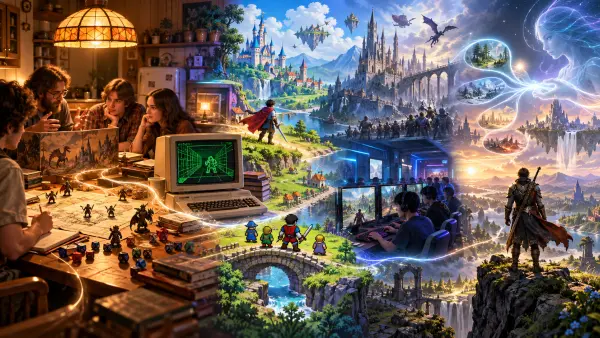
In a role-playing game, or RPG, you do not just control a hero. You become one. You make choices, your character grows stronger, and the story changes around you. Since the 1970s, the genre has moved from kitchen tables to home computers, game consoles, online worlds, and phones. Its history is also a story of borrowing: designers in one country have taken ideas from another and adapted them for new players.
The starting point is usually credited to Dungeons & Dragons (D&D), which Gary Gygax and Dave Arneson published in the United States in January 1974. It grew out of wargames, in which players moved model soldiers across a table. D&D replaced armies with single characters. One player, the Dungeon Master, described the world, and dice decided whether a sword hit its target. The first print run of 1,000 copies, sold for 10 dollars each, took about ten months to sell out. D&D was not the only game of its kind, but it became the model that most later RPGs followed.
Computer programmers were among the first fans. Around 1981, two American games for the Apple II computer, Wizardry and Ultima, turned the tabletop rules into software. The computer took over the Dungeon Master’s job. It calculated every attack and kept track of each character’s statistics, such as strength and health. These games were difficult, and they were played mainly by computer enthusiasts.
Japan changed that. In 1983, the designer Yuji Horii visited a computer show in San Francisco and discovered Wizardry. He wanted to bring the experience to people who had never played an RPG, so he simplified it. Dragon Quest, released in 1986 for Nintendo’s Famicom console, replaced complicated keyboard commands with simple menus and added a clear story and characters drawn by the manga artist Akira Toriyama. It sold more than two million copies in Japan. Together with Final Fantasy, which appeared in 1987, it created a template for what are now called Japanese RPGs.
The next big change came from South Korea. In 1998, the company NCSoft launched Lineage, an online RPG in which thousands of players shared one world, formed groups, and fought over castles. Much of its early growth happened in PC bangs, the internet cafés that were spreading quickly across the country at the time. According to NCSoft, Lineage reached one million members within 15 months, and the company later reported more than three million subscribers, most of them in Korea. That was years before World of Warcraft, released in 2004, made online RPGs a mass hobby in the West.
The borrowing has continued. Baldur’s Gate 3, made by Larian Studios in Belgium and released in 2023, uses the fifth-edition rules of D&D, so a 1974 tabletop game still shapes one of the most successful RPGs of the decade. It won Game of the Year at The Game Awards in 2023, and in late 2025 Larian’s founder, Swen Vincke, told Bloomberg that its sales had surpassed 20 million copies. Two years after Baldur’s Gate 3, a small French studio, Sandfall Interactive, won the same award with Clair Obscur: Expedition 33, a game inspired by classic Japanese RPGs. The studio has said that it sold five million copies in its first five months.
The future of RPGs may depend on artificial intelligence. In 2019, the American developer Nick Walton released AI Dungeon, a text game in which players type any action and a language model writes what happens next, doing the Dungeon Master’s job. Some companies now hope to create characters that can hold real conversations. Many game makers are skeptical, however. In a 2026 survey by the Game Developers Conference, 52 percent of the more than 2,300 industry workers who answered said generative AI was having a negative impact on the industry, up from 18 percent two years earlier. Just over half of the respondents were based in the United States, so the result may not reflect the whole world. Vincke has said that Larian’s next Divinity game will contain no AI-generated content. What nobody has tested yet is whether players want characters who can say anything, or stories that a person has written.
Vocabulary
Each word has a frequency score, a rank, and a tag. The score shows how common the word is in modern English: higher means more common, and each full point means roughly ten times more common. The rank is the word’s position on a list of about 321,000 English word forms, from most to least common. The tag shows where you are most likely to meet the word: Current, Formal, Literary, or Dated. The paragraph number shows where the word first appears in the reading. The labels are information, not instructions. Deciding which words are worth your time is up to you. How to read the scores, ranks, and tags.
genre (noun): a type or category of art, music, writing, film, or games, with its own typical features.
Frequency: 4.17 | Rank: 5,407 | Current | Paragraph 1
Translations: 类型 | ジャンル | 장르 | शैली | نوع فني | жанр | género | genre
- The RPG genre began at the kitchen table and moved to computers and phones.
- Science fiction is my favorite film genre.
adapted (verb, past participle): changed something so that it suits a new use, place, or group of people.
Frequency: 4.17 | Rank: 5,407 | Current | Paragraph 1
Translations: 改编 | 作り変えた | 맞게 바꾼 | अनुकूलित किया | كيّفوا | адаптировали | adaptado | adapté
- Designers have adapted RPG ideas from other countries for new players.
- The novel was adapted for television in a six-part series.
credited (verb, past participle): named as the person or thing that created, started, or caused something.
Frequency: 3.88 | Rank: 8,542 | Formal | Paragraph 2
Translations: 归功于 | 功績とされる | 공으로 여겨지는 | श्रेय दिया गया | يُنسب إلى | приписывается | atribuido | attribué
- The start of the RPG genre is usually credited to Dungeons & Dragons.
- The discovery of penicillin is usually credited to Alexander Fleming.
print run (noun phrase): the number of copies of a book, magazine, or game printed at one time.
Frequency: no score (phrase) | Current | Paragraph 2
Translations: 印数 | 発行部数 | 인쇄 부수 | मुद्रण संख्या | عدد النسخ المطبوعة | тираж | tirada | tirage
- D&D’s first print run was only 1,000 copies.
- The publisher increased the print run after the book became popular online.
took over (phrasal verb, past tense): started doing a job or duty that someone or something else did before.
Frequency: no score (phrase) | Current | Paragraph 3
Translations: 接管 | 引き継いだ | 넘겨받았다 | संभाल लिया | تولّى | взял на себя | asumió | a pris en charge
- In early computer RPGs, the computer took over the Dungeon Master’s job.
- When the manager retired, her assistant took over the team.
statistics (noun, plural): in games, the numbers that describe a character’s abilities, such as strength, speed, and health.
Frequency: 4.60 | Rank: 2,487 | Current | Paragraph 3
Translations: 属性数值 | ステータス | 능력치 | क्षमता के आँकड़े | الخصائص الرقمية | характеристики | estadísticas | caractéristiques
- Early computer RPGs tracked each character’s statistics, such as strength and health.
- Before a match, the players compared their characters’ statistics.
enthusiasts (noun, plural): people who are very interested in a particular activity or subject and spend a lot of time on it.
Frequency: 3.56 | Rank: 13,695 | Current | Paragraph 3
Translations: 爱好者 | 愛好家 | 애호가 | उत्साही लोग | هواة | энтузиасты | aficionados | passionnés
- Early computer RPGs were played mainly by computer enthusiasts.
- The old train station is popular with railway enthusiasts.
simplified (verb, past tense): made something easier to understand, learn, or use.
Frequency: 3.69 | Rank: 11,373 | Current | Paragraph 4
Translations: 简化 | 簡略化した | 단순화했다 | सरल बनाया | بسّط | упростил | simplificó | a simplifié
- Yuji Horii simplified the RPG so that beginners could enjoy it.
- The bank simplified its app, and older customers found it easier to use.
template (noun): a model or pattern that others follow or copy.
Frequency: 3.71 | Rank: 11,015 | Current | Paragraph 4
Translations: 模板 | ひな形 | 본보기 | साँचा | قالب | шаблон | modelo | modèle
- Dragon Quest created a template that many Japanese RPGs followed.
- Her first successful shop became the template for all her later stores.
launched (verb, past tense): made a new product or service available to the public for the first time.
Frequency: 4.63 | Rank: 2,339 | Current | Paragraph 5
Translations: 推出 | リリースした | 출시했다 | लॉन्च किया | أطلقت | запустила | lanzó | a lancé
- NCSoft launched Lineage in 1998.
- The company launched its new phone with a large online event.
subscribers (noun, plural): people who pay regularly, often every month, to use a service or receive a product.
Frequency: 4.00 | Rank: 7,121 | Current | Paragraph 5
Translations: 订阅用户 | 加入者 | 가입자 | ग्राहक | المشتركون | подписчики | suscriptores | abonnés
- NCSoft reported more than three million Lineage subscribers.
- The streaming service lost many subscribers after it raised its prices.
surpassed (verb, past participle): went above a particular amount, level, or standard.
Frequency: 3.62 | Rank: 12,578 | Formal | Paragraph 6
Translations: 超过 | 上回った | 넘어섰다 | पार कर गई | تجاوزت | превысили | superaron | ont dépassé
- Sales of Baldur’s Gate 3 surpassed 20 million copies.
- The number of visitors surpassed the museum’s expectations.
skeptical (adjective): having doubts about whether something is true, useful, or good.
Frequency: 3.68 | Rank: 11,541 | Current | Paragraph 7
Translations: 怀疑的 | 懐疑的な | 회의적인 | संशयी | متشكك | скептически настроенный | escéptico | sceptique
- Many game developers are skeptical about generative AI.
- I was skeptical about the diet, but I decided to try it for a month.
generative AI (noun phrase): artificial intelligence that produces new text, images, sound, or video based on patterns in its training data.
Frequency: no score (phrase) | Current | Paragraph 7
Translations: 生成式人工智能 | 生成AI | 생성형 AI | जनरेटिव एआई | الذكاء الاصطناعي التوليدي | генеративный ИИ | IA generativa | IA générative
- AI Dungeon uses generative AI to write what happens next in a story.
- Some teachers ask students to say when they have used generative AI in an essay.
respondents (noun, plural): people who answer a survey, questionnaire, or set of questions.
Frequency: 3.78 | Rank: 9,878 | Formal | Paragraph 7
Translations: 受访者 | 回答者 | 응답자 | उत्तरदाता | المستجيبون | респонденты | encuestados | répondants
- Just over half of the survey respondents worked in the United States.
- Most respondents said they would prefer a four-day working week.
Activity Page
Open the activity page in a new tab
Speed Challenge
Answer 12 questions against the clock. Every wrong answer adds 5 seconds, and the lowest score wins. Open the speed challenge in a new tab.
Shadow Reading and Typing: My Cousin, the Dungeon Master
This short text uses many of the words from this lesson. Use it for shadow reading (reading aloud along with a model) and for typing practice.
When I was twelve, my older cousin introduced me to Dungeons & Dragons. He was one of those real enthusiasts. He had adapted the rules for younger players, and he simplified the dice rolls. He also took over the job of Dungeon Master himself. Every Saturday afternoon, four of us sat around his kitchen table with pencils, paper, and a bag of dice.
I loved writing down my character’s statistics. My elf had low strength but high intelligence, and I checked those numbers before every fight. I did not know then that the whole genre had started with a small print run in the 1970s.
Later, I moved on to video games. I played Japanese RPGs on a console, and then an online game that my friends and I paid for every month. We were loyal subscribers for three years, and the template never changed. We fought, we leveled up, and we saved the world.
Now I read about companies that have launched games with AI characters, and I am a little skeptical. My cousin never followed a script, but he always knew when to surprise us. I am not sure a machine can do that yet. For now, I would rather sit at a table with real people and roll the dice.
How to practice
- Read the text silently once and check any words you are unsure of.
- Read it aloud slowly, one sentence at a time. On the typing page, the Listen button reads each line with your device’s voice, so you can listen first and then repeat.
- Shadow: read aloud again at a natural speed, trying to keep a steady rhythm without stopping.
- Record yourself, listen back, and note one sentence to practice again.
- Type it on the typing page below and check your speed and accuracy.
Open the typing practice in a new tab
Comprehension Questions
- What makes a role-playing game different from simply controlling a hero, according to the first paragraph?
- Who created Dungeons & Dragons, when was it published, and what kind of game did it grow out of?
- What did the Dungeon Master and the dice do in D&D?
- How did Wizardry and Ultima change the way people played RPGs?
- Why did Yuji Horii simplify the RPG, and what changes did Dragon Quest make?
- What role did PC bangs play in the success of Lineage?
- How do Baldur’s Gate 3 and Clair Obscur: Expedition 33 show that the borrowing between countries has continued?
- What is AI Dungeon, and why does the writer mention it in a paragraph about the future?
- The writer points out a limit of the GDC survey. What is it, and why is it important when reading survey results?
IELTS-Style Questions
- True, False, or Not Given: “Dragon Quest sold more copies in Japan than Final Fantasy.” Explain your answer using evidence from the reading.
- Yes, No, or Not Given: “The writer believes that D&D was the only role-playing game of the 1970s.” Explain your answer using evidence from the reading.
- Author’s purpose: Why does the writer end with a question about whether players want characters who can say anything or stories that a person has written? Is the aim to predict the future, to criticize AI, or something else?
AI Discussion Prompt
I just read an article about the history and future of role-playing games (RPGs). It covered Dungeons & Dragons in 1974, early computer RPGs such as Wizardry and Ultima, Dragon Quest and Japanese RPGs, the Korean online game Lineage and PC bangs, Baldur’s Gate 3 and Clair Obscur: Expedition 33, and the debate about AI characters and generative AI in games. I am an English learner at about B2 level. Please ask me one question at a time, starting with which games, if any, I have played. Respond to my ideas first, then briefly correct any language errors, and ask follow-up questions that make me explain my reasons.
AI Vocabulary Prompt
I want to practice vocabulary from an article about the history of role-playing games. Please quiz me on the following words one at a time, using a mix of question types: multiple choice, true/false, and sentence completion. Give me feedback after each answer before moving on, and bring back the words I miss later. Here are the words: genre, adapted, credited, print run, took over, statistics, enthusiasts, simplified, template, launched, subscribers, surpassed, skeptical, generative AI, respondents.
Discussion Questions
- Have you ever played a role-playing game, on a table, a computer, a console, or a phone? Which one do you remember best?
- What kind of character do you usually choose in games: a fighter, a magic user, a healer, or something else? Why?
- Which game genres are most popular among people you know? Why do you think that is?
- Did you or your friends ever play games in PC bangs, internet cafes, or arcades? What was the atmosphere like?
- Would you rather play an RPG alone with a strong story or online with thousands of other players? Explain your choice.
- D&D needs a group of people sitting at one table. What can face-to-face games offer that online games cannot?
- Dragon Quest succeeded by making RPGs simpler. Is it good for games, apps, or school subjects to be simplified for beginners, or does something important get lost?
- The reading shows ideas moving from the US to Japan, Korea, Belgium, and France. Can you think of other examples, such as food, music, or films, where a borrowed idea became something new?
- Some online games earn money from monthly subscriptions, and others are free but sell items inside the game. Which model do you think is fairer to players?
- Would you enjoy talking to a game character controlled by generative AI? What would you ask it?
- Why might game artists, writers, and designers be more worried about generative AI than business executives?
- Larian says its next game will contain no AI-generated content. Should games tell players when AI has been used to make them?
- Many people believe games can teach useful skills, such as teamwork or planning. Which skills, if any, have you learned from games?
- In 20 years, do you think the most popular RPGs will be written by people, by AI, or by a mix of both? What would be gained and lost?
Language Focus: Past Simple and Present Perfect
What it is: The past simple describes finished events at a stated or understood time in the past (published in 1974, visited in 1983). The present perfect (has or have plus a past participle) connects the past to the present, often with since, yet, or no time at all.
Why writers use it: History writing mixes both: the past simple tells what happened at a particular time, and the present perfect shows that a trend or result continues now. Choosing the wrong one is a common error, especially with since and specific years.
Examples from the reading:
- “Since the 1970s, the genre has moved from kitchen tables to home computers, game consoles, online worlds, and phones.”
- “…which Gary Gygax and Dave Arneson published in the United States in January 1974.”
- “In 1983, the designer Yuji Horii visited a computer show in San Francisco and discovered Wizardry.”
- “The borrowing has continued.”
Practice task: Choose the correct form of the verb and explain why: “NCSoft (launch) Lineage in 1998. Since then, the series (grow) to include several mobile games.”
(Example answer: “NCSoft launched Lineage in 1998 (a finished event at a stated time). Since then, the series has grown to include several mobile games (a change that continues up to now).”)
Recommended Resources
- 14 Fun Facts About Dungeons & Dragons (Smithsonian Magazine). An illustrated history of how D&D began, including the partnership between Gygax and Arneson and the first print run.
- Dragon Quest (The Strong National Museum of Play). A short museum page on why Dragon Quest matters, with details about its music, art, and simple menu system.
- Clair Obscur: Expedition 33 wins big at The Game Awards 2025 (GadgetGuy). A news report on the French RPG that won Game of the Year in 2025 and the other games it competed against.
- GDC 2026 State of the Game Industry Reveals Impact of Layoffs, Generative AI, and More (Game Developers Conference). The organizer’s summary of the 2026 survey described in paragraph 7, including views on generative AI by job type.
- 2019: A.I. Dungeon (50 Years of Text Games, Aaron A. Reed). A longer essay on how AI Dungeon was made, what early players experienced, and the problems it faced.