
Le présent continu est am, isou are plus la forme -ing du verbe. Il décrit ce qui se passe maintenant, ce qui est vrai seulement pour le moment, ce qui change et ce qui est déjà organisé. Ce guide montre comment le construire, quand le choisir plutôt que le présent simple, quels verbes lui résistent et comment l’utiliser pour décrire une image.
Lire le guide en anglais → Cette page est traduite automatiquement et n’a pas été relue par un locuteur natif ; elle peut contenir des erreurs. La version anglaise fait référence.
Votre résultat au diagnostic indique quelle partie doit être revue. Touchez cette partie ci-dessous.
L’idée centrale
Le présent continu vous place à l’intérieur d’une période qui comprend le moment présent. Le présent simple prend du recul et énonce ce qui est vrai en général.
En train de se passer
en cours en ce moment
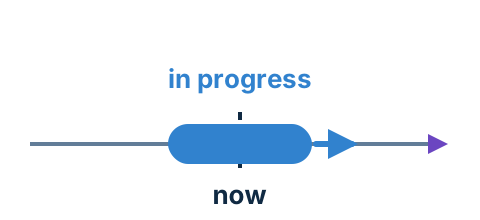
She is writing an email.
Vrai pour le moment
une période temporaire autour du moment présent
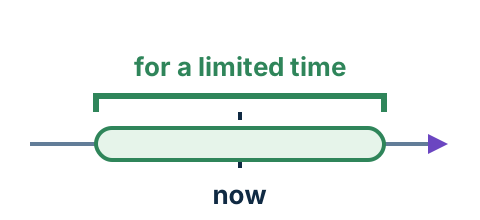
I‘m staying with my aunt this month.
Vrai en général
présent simple, pour comparer
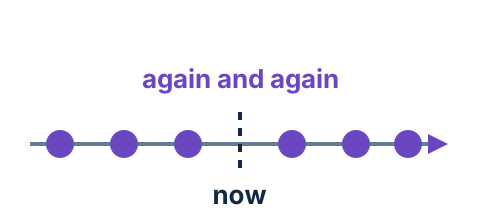
She writes a blog post every week.
- 1
Les deux moitiés sont nécessaires. be porte le sujet, le temps, la question et la négation. La forme -ing porte le sens.
- 2
Ce temps couvre plus que cet instant : une période autour du présent, un changement en cours et des projets déjà arrangés pour l’avenir.
- 3
Les verbes qui expriment un état, comme know, wantet belong, restent normalement au présent simple même quand l’état est vrai maintenant.
Construire la forme
Comment le construire, et avec quoi be doit-il s’accorder ?
La règle : Le présent continu est am, is ou are plus la forme -ing. Be s’accorde avec le sujet et fait le travail dans les questions et les négations.
be plus la forme -ing
| Sujet | Affirmatif | Négatif | Question |
|---|---|---|---|
| I | I am working | I‘m not working | Am I working? |
| he / she / it | she is working | she isn’t working | Is she working? |
| we / you / they | they are working | they aren’t working | Are they working? |
Pour une question avec wh-, placez d’abord le mot interrogatif, puis be, puis le sujet : What are you doing? Quand le mot interrogatif est le sujet, aucun autre sujet ne suit : What is happening?
Repérez le vrai sujet
| Sujet | be | Pourquoi |
|---|---|---|
| Everyone | is | everyone, someone et nobody sont au singulier |
| The price of the tickets | is | le nom principal est price, pas tickets |
| The manager, along with two assistants, | is | along with n’ajoute rien au sujet |
| The police | are | police est toujours pluriel |
Orthographe de la forme -ing
| Règle | Exemples |
|---|---|
| La plupart des verbes : ajoutez -ing | wait → waiting, play → playing, study → studying |
| Supprimez le e muet | write → writing, come → coming, rise → rising |
| Doublez la consonne finale après une seule voyelle brève accentuée | sit → sitting, get → getting, begin → beginning |
| Pas de doublement quand la dernière syllabe n’est pas accentuée | visit → visiting, happen → happening, open → opening |
| -ie devient y | lie → lying, die → dying, tie → tying |
L’orthographe américaine et britannique diffère pour quelques verbes comme travel : américain traveling, britannique travelling. Ce guide utilise l’orthographe américaine.
Erreurs fréquentes dans cette partie
- forme -ing sans verbe be
My brother working from home today.✓ My brother is working from home today.La forme -ing a besoin de am, is ou are devant elle. - mauvaise forme de be
The police is searching the building.✓ The police are searching the building.Police est toujours pluriel en anglais. - erreur d’orthographe de la forme -ing
They are geting ready for the trip.✓ They are getting ready for the trip.Get a une seule voyelle brève accentuée, donc le t est doublé. - question ou négation mal construite
Where you are going?✓ Where are you going?Dans une question, be se place avant le sujet.
À lire aussi
Le même schéma be plus -ing fonctionne au passé : was ou were plus la forme -ing. Le guide Past Tense Verb Forms traite le passé continu.
Présent continu et présent simple
Est-ce en train de se passer, ou vrai en général ?
La règle : Utilisez le continu pour ce qui se passe maintenant, et le simple pour les habitudes, les routines et les faits généraux.
| Continu : maintenant ou autour du présent | Simple : en général |
|---|---|
| Look, it is snowing. | It snows a lot here in January. |
| Tom is playing in the garden. | Tom plays tennis on Saturdays. |
| Why are you wearing a coat? | I wear a coat from November to March. |
| Bees make honey. Water boils at 100 degrees Celsius. |
Expressions de temps : des indices, pas des règles
Souvent avec le continu
now, right now, at the moment, today, this week, these days, Look!, Listen!
Souvent avec le simple
always, usually, often, never, every day, on Mondays, twice a month
C’est quand même le sens qui décide. Every day va aussi avec un changement en cours : It is getting warmer every day. Et beaucoup de phrases emploient les deux formes volontairement : He usually rides his bike, but this week he is taking the train.
Erreurs fréquentes dans cette partie
- présent simple employé là où le continu est nécessaire
Can you help me? I look for the station.✓ Can you help me? I am looking for the station.La recherche se passe maintenant. - continu employé pour une habitude ou un fait général
My parents are eating dinner at seven every evening.✓ My parents eat dinner at seven every evening.Every evening marque une routine. - continu employé pour une habitude ou un fait général
The Nile is flowing into the Mediterranean Sea.✓ The Nile flows into the Mediterranean Sea.Un fait permanent de géographie prend le présent simple.
Verbes d’état
Le verbe exprime-t-il une action ou un état ?
La règle : Les verbes d’état restent normalement au présent simple. Un verbe employé avec un sens d’action peut se mettre au continu.
| Groupe | Verbes courants |
|---|---|
| penser et savoir | know, understand, believe, remember, forget, mean, recognize |
| vouloir et avoir besoin | want, need, prefer, wish |
| posséder et être | own, belong, contain, cost, seem, weigh, consist of |
| sens et goûts | hear, see, like, love, hate |
Verbes qui fonctionnent dans les deux sens
| Verbe | État : simple | Action : continu |
|---|---|---|
| have | I have two brothers. | We are having lunch. |
| think | I think you are right. | I am thinking about it. |
| taste, smell | The soup tastes salty. | The cook is tasting the soup. |
| see | I see what you mean. | I am seeing the dentist at four. |
| look | She looks tired. | She is looking at the screen. |
| weigh | The bag weighs ten kilos. | The nurse is weighing the baby. |
Quand la règle s’assouplit
Avec look ou feel pour décrire l’apparence ou la santé, les deux formes sont courantes : She looks tired et She’s looking tired sont toutes deux correctes. À l’oral informel, vous entendrez aussi I’m loving this. Ce sont des emplois réels, pas des erreurs, mais à l’écrit et aux examens, le présent simple est le choix sûr pour les verbes d’état.
Erreurs fréquentes dans cette partie
- verbe d’état mis au continu
I am preferring the window seat.✓ I prefer the window seat.Prefer est un verbe d’état. - verbes qui changent de sens au continu
He is having a car, but he rarely drives it.✓ He has a car, but he rarely drives it.Have au sens de posséder est un état. - verbes qui changent de sens au continu
Sorry, they have dinner right now.✓ Sorry, they are having dinner right now.Have dinner est une activité en cours. - verbe d’état mis au continu
This bottle is containing a liter of water.✓ This bottle contains a liter of water.Contain est un verbe d’état.
Décrire une photo
Comment dire ce que montre une image ?
La règle : Décrivez les actions avec is ou are plus -ing, comptez le nom avant de choisir there is ou there are, choisissez wear, carry ou hold selon le sens et gardez les verbes d’état au simple.
| Nombre | Structure | Exemple |
|---|---|---|
| un | There is + a/an/someone + -ing | There is a man standing by the door. |
| plus d’un | There are + number/some + plural + -ing | There are two women sitting at a table. |
Ne dites pas It is a man standing, They are three bicyclesou There have two women. Vous pouvez aussi commencer par la personne : A man is standing by the door.
wear, carry, hold
| Verbe | Sens | Exemple |
|---|---|---|
| wear | sur le corps : vêtements, lunettes, chapeau, montre | The waiter is wearing an apron. |
| carry | déplacer quelque chose avec soi | Two men are carrying a sofa up the stairs. |
| hold | dans la main ou les mains en ce moment | She is holding a cup of tea. |
Une structure de phrase pour n’importe quelle image
[Qui] + is / are + [verbe en -ing] + [quoi] + [où]
A mechanic is repairing a bicycle on the sidewalk. Two travelers are checking a map in front of the station.
Expressions de position : in the foreground, in the background, on the left, on the right, in the middle, next to, behind, in front of, across from.
Les verbes d’état restent au simple
Une description mêle actions et états. The woman seems to be waiting. The sign says Closed. The box contains books.
Aux examens
Les tâches de description d’image utilisent exactement ce langage. Au TOEIC Writing, les questions 1 à 5 demandent une phrase sur une image avec deux mots donnés, et chaque phrase est notée sur la grammaire et sur sa pertinence par rapport à l’image.
Erreurs fréquentes dans cette partie
- mauvaise forme de be
There is two taxis waiting outside the hotel.✓ There are two taxis waiting outside the hotel.Two taxis est pluriel. - structure de description de photo ou choix du mot
It is a man fixing a flat tire.✓ There is a man fixing a flat tire.La structure est there is, pas it is. - structure de description de photo ou choix du mot
The girl is carrying a necklace.✓ The girl is wearing a necklace.Les bijoux portés sur le corps prennent wear. - présent simple employé là où le continu est nécessaire
A worker paints the wall of the building.✓ A worker is painting the wall of the building.Une photo montre une action en cours.
Emplois élargis
Que peut décrire d’autre le continu en plus de ce moment ?
La règle : Le continu couvre aussi les situations temporaires, les changements en cours, les reproches avec always et les arrangements personnels. Les situations permanentes et les horaires prennent le présent simple.
| Emploi | Continu | Comparaison : simple |
|---|---|---|
| temporaire | I‘m staying with my aunt until June. | My aunt lives in Lyon. (permanent) |
| changement en cours | The ice is melting. It‘s getting darker. | Ice melts at zero degrees. (fact) |
| always + -ing : agacement ou surprise | He‘s always checking his phone. | She always takes the stairs. (neutral habit) |
| arrangement personnel | I‘m meeting my advisor at two tomorrow. | The last bus leaves at 11:45. (timetable) |
Comparez I live in Madrid (où j’habite) avec I‘m living in Madrid this year (pour le moment, pas pour toujours).
Arrangement ou intention ?
Le continu sert aux projets déjà fixés avec d’autres personnes ou à une heure précise. Will et be going to sont aussi possibles pour beaucoup de projets futurs, donc le contraste évalué ici est surtout continu contre simple : le simple seul fait sonner un projet personnel comme un horaire.
Erreurs fréquentes dans cette partie
- situation temporaire ou changeante non repérée
My car is at the garage, so I use my sister's car this week.✓ My car is at the garage, so I am using my sister's car this week.This week marque une situation temporaire. - situation temporaire ou changeante non repérée
The city's population grows quickly these days.✓ The city's population is growing quickly these days.Un changement en cours prend le continu. - arrangement et horaire confondus
I meet the landlord at ten tomorrow to sign the lease.✓ I am meeting the landlord at ten tomorrow to sign the lease.Un rendez-vous personnel fixé est un arrangement. - always avec -ing mal employé
You always are losing your keys!✓ You are always losing your keys!Always se place entre be et la forme -ing.
Autoévaluation
Chaque phrase est-elle correcte ? Touchez pour voir la réponse. L’étiquette de la partie vous indique où regarder si vous n’étiez pas sûr.
Partie 1The dog barking at the mail carrier.
Incorrecte. The dog is barking at the mail carrier. La forme -ing a besoin de be.
Partie 1Are your parents visiting this weekend?
Correcte. Be vient en premier dans la question, et parents prend are.
Partie 1He is stoping at the gas station.
Incorrecte. He is stopping. Une seule voyelle brève accentuée, donc le p est doublé.
Partie 2I usually walk to school, but today I am taking the bus.
Correcte. Usually marque l’habitude. Today marque ce qui est différent maintenant.
Partie 2The moon is going around the Earth.
Incorrecte. The moon goes around the Earth. Un fait permanent prend le présent simple.
Partie 2Look! The children build a snowman.
Incorrecte. Look! The children are building a snowman. Look renvoie à ce moment.
Partie 3I am needing a bigger desk.
Incorrecte. I need a bigger desk. Need est un verbe d’état.
Partie 3The doctor is seeing another patient at the moment.
Correcte. See au sens de rencontrer est une action, donc le continu fonctionne.
Partie 3This laptop is belonging to the school.
Incorrecte. This laptop belongs to the school. Belong est un verbe d’état.
Partie 4There are some children flying kites on the hill.
Correcte. Some children est pluriel, donc there are.
Partie 4The man is wearing a heavy suitcase down the stairs.
Incorrecte. The man is carrying a heavy suitcase. Il la déplace avec lui.
Partie 4It is a woman feeding pigeons in the square.
Incorrecte. There is a woman feeding pigeons in the square.
Partie 5We're having a party on Saturday, and everyone is invited.
Correcte. Un événement prévu avec un jour fixé est un arrangement.
Partie 5My sister works in Berlin this year, then she's coming home.
Incorrecte. My sister is working in Berlin this year. This year marque une situation temporaire.
Partie 5He always is forgetting his password.
Incorrecte. He is always forgetting his password. Always se place entre be et -ing.
Consigne pour s’entraîner avec une IA
Collez ceci dans un outil de discussion avec une IA.