
Level: B2
Reading | Vocabulary | Activities | Speed Challenge | Questions | AI Prompts | Discussion | Language Focus | Resources
Printable: Student handout (PDF) | Teacher’s key (PDF)
Reading
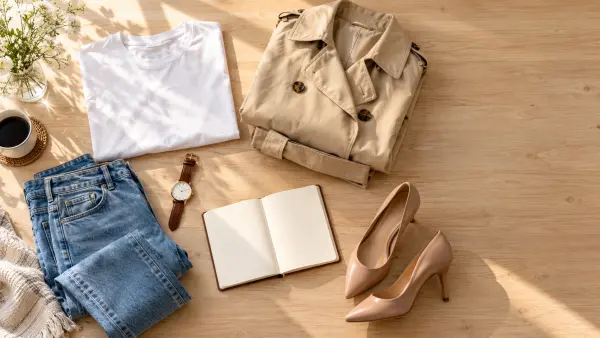
Most of us dress without thinking about where our clothes came from. Yet many everyday items originate in surprising places, including army camps, battlefields, a royal court, and the site of a nuclear test. Some famous stories about clothing are simplified or uncertain, and this reading says so where the evidence is weak.
Before 1873, work pants often tore at the pockets. A tailor in Reno, Nevada, named Jacob Davis solved the problem by adding metal rivets to make sturdy work pants. Davis could not afford the fee for a patent, so he wrote to Levi Strauss, the San Francisco merchant who sold him his cloth. On May 20, 1873, the two men received the patent, and their company began to sell what it called waist overalls. According to Levi Strauss & Co., the name jeans did not become common until about 1960.
The T-shirt began as underwear. In 1913, the U.S. Navy began to issue white cotton undershirts with short sleeves and a round neck. For decades, the T-shirt was mostly worn under other clothes. During World War II, American servicemen in the Pacific started wearing theirs as outerwear because of the heat. The big change in image came in the 1950s. After Marlon Brando wore one in A Streetcar Named Desire (1951) and James Dean wore one in Rebel Without a Cause (1955), the T-shirt became a symbol of youthful rebellion.
The trench coat is named after the trenches of World War I, but it was not invented for that war. Rain coats for officers had existed since the 1800s, and both Burberry and Aquascutum claim to have created the trench coat. Nobody can say which company was first. What is clear is that the coat took its modern shape during the war, when designers added shoulder straps and metal rings on the belt. Officers paid for their own waterproof coats, which helped make them a sign of status.
Wristwatches followed a similar path. In the 1800s, watches worn on the wrist had been made mainly for women, while gentlemen carried pocket watches. Some soldiers strapped pocket watches to their wrists in the Boer War (1899 to 1902), but the real change came in World War I. In the trenches, pulling a watch out of a pocket was impractical, and officers needed exact timing to coordinate attacks. By the 1920s, wristwatches were being sold to ordinary men.
High heels were first a men’s fashion in Europe. The Bata Shoe Museum in Toronto says that heeled footwear had been worn in Western Asia for hundreds of years before it reached Europe, and that it was linked to horseback riding, because a heel helped a rider keep his foot in the stirrup. Its exact origin is still unknown. Around 1600, Europeans were impressed by Persia’s powerful cavalry. Men were quick to adopt heels, and they wore them as a sign of power and prestige for more than 130 years. In the 1700s, heels fell out of men’s fashion, and they later became associated mainly with women.
The word cravat comes from the French word for Croatian. In the 1650s, French fashion copied the linen scarves worn by light cavalry, including many paid mercenary soldiers, who had fought in the Thirty Years’ War (1618 to 1648). Louis XIV was fond of the cravat, and from Paris it spread across Europe. The modern necktie, however, appeared only in the 19th century.
On July 5, 1946, the French engineer Louis Réard decided to unveil a two-piece swimsuit at a pool in Paris. It was so small that professional models refused to wear it, so he hired Micheline Bernardini, a dancer at the Casino de Paris. He named the suit after Bikini Atoll, where the United States had tested a nuclear weapon four days earlier, because he hoped it would cause a similar sensation. Many people found it scandalous, and Spain and Italy banned it from public beaches. By the 1950s, however, it was common in Europe.
War appears again and again in these stories: the T-shirt, trench coat, wristwatch, necktie, and even the high heel all have military connections. Several items also changed who wore them, with heels moving from men to women and wristwatches from women to men. Clothes continue to evolve in this way. The stories also show how uncertain popular history can be. For the trench coat, the first inventor cannot be proved, and for the high heel, even the origin is unknown.
Vocabulary
Each word has a frequency score, a rank, and a tag. The score shows how common the word is in modern English: higher means more common, and each full point means roughly ten times more common. The rank is the word’s position on a list of about 321,000 English word forms, from most to least common. The tag shows where you are most likely to meet the word: Current, Formal, Literary, or Dated. The paragraph number shows where the word first appears in the reading. The labels are information, not instructions. Deciding which words are worth your time is up to you. How to read the scores, ranks, and tags.
originate (verb): to begin or come from a particular place or situation.
Frequency: 3.37 | Rank: 17,813 | Formal | Paragraph 1
Translations: 起源于 | 起源する | 유래하다 | उत्पन्न होना | ينشأ | происходить | originarse | tirer son origine
- Many everyday items originate in surprising places.
- The tradition originated in the 19th century.
sturdy (adjective): strong, solid, and made to last.
Frequency: 3.44 | Rank: 16,228 | Current | Paragraph 2
Translations: 结实的 | 頑丈な | 튼튼한 | मज़बूत | متين | прочный | resistente | robuste
- Davis added rivets to make sturdy work pants.
- Buy a sturdy bag if you carry heavy books.
patent (noun): an official right to be the only person or company that makes or sells an invention.
Frequency: 4.18 | Rank: 5,309 | Formal | Paragraph 2
Translations: 专利 | 特許 | 특허 | पेटेंट | براءة اختراع | патент | patente | brevet
- Davis could not afford the fee for a patent.
- The company holds a patent on the new battery.
issue (verb): to give out something officially, such as equipment or documents.
Frequency: 5.23 | Rank: 591 | Current | Paragraph 3
Translations: 发放 | 支給する | 지급하다 | जारी करना | يصرف | выдавать | entregar | délivrer
- In 1913, the U.S. Navy began to issue white cotton undershirts.
- The school will issue new ID cards next week.
rebellion (noun): the act of fighting against authority, rules, or a government.
Frequency: 3.94 | Rank: 7,797 | Current | Paragraph 3
Translations: 反叛 | 反抗 | 반항 | विद्रोह | تمرد | бунт | rebeldía | rébellion
- The T-shirt became a symbol of youthful rebellion.
- The rebellion against the king lasted three years.
waterproof (adjective): not allowing water to pass through.
Frequency: 3.55 | Rank: 13,897 | Current | Paragraph 4
Translations: 防水的 | 防水の | 방수의 | जलरोधक | مقاوم للماء | водонепроницаемый | impermeable | imperméable
- Officers paid for their own waterproof coats.
- Take a waterproof jacket in case it rains.
impractical (adjective): not sensible or useful in real situations.
Frequency: 3.28 | Rank: 20,101 | Current | Paragraph 5
Translations: 不实用的 | 実用的でない | 비실용적인 | अव्यावहारिक | غير عملي | непрактичный | poco práctico | peu pratique
- In the trenches, pulling a watch out of a pocket was impractical.
- High heels are impractical for hiking.
coordinate (verb): to organize people or actions so that they work well together.
Frequency: 3.82 | Rank: 9,313 | Formal | Paragraph 5
Translations: 协调 | 調整する | 조율하다 | समन्वय करना | ينسّق | координировать | coordinar | coordonner
- Officers needed exact timing to coordinate attacks.
- The manager coordinates the work of three teams.
adopt (verb): to start using a new idea, style, or method.
Frequency: 4.19 | Rank: 5,206 | Current | Paragraph 6
Translations: 采用 | 採用する | 채택하다 | अपनाना | يعتمد | перенимать | adoptar | adopter
- Men were quick to adopt heels in the early 1600s.
- The school adopted a new uniform last year.
prestige (noun): the high respect and status that people give to someone or something.
Frequency: 3.75 | Rank: 10,358 | Formal | Paragraph 6
Translations: 威望 | 威信 | 위신 | प्रतिष्ठा | هيبة | престиж | prestigio | prestige
- Men wore heels as a sign of power and prestige.
- The university has a great deal of prestige.
mercenary (adjective, noun): a soldier who is paid to fight for any country or group.
Frequency: 3.26 | Rank: 20,629 | Formal | Paragraph 7
Translations: 雇佣兵 | 傭兵 | 용병 | भाड़े का सैनिक | مرتزق | наёмник | mercenario | mercenaire
- The king hired mercenary soldiers to defend the city.
- The mercenary was paid to fight for a foreign army.
unveil (verb): to show or announce something publicly for the first time.
Frequency: 3.20 | Rank: 22,362 | Formal | Paragraph 8
Translations: 首次公布 | 披露する | 공개하다 | अनावरण करना | يكشف النقاب عن | представлять | presentar | dévoiler
- Louis Réard decided to unveil a two-piece swimsuit in Paris.
- The company will unveil its new phone next week.
sensation (noun): a state of great excitement or interest among many people.
Frequency: 3.90 | Rank: 8,266 | Current | Paragraph 8
Translations: 轰动 | センセーション | 큰 화제 | सनसनी | ضجة | сенсация | sensación | sensation
- He hoped the suit would cause a similar sensation.
- The young singer became an overnight sensation.
scandalous (adjective): shocking and seen as morally wrong.
Frequency: 3.28 | Rank: 20,101 | Formal | Paragraph 8
Translations: 丑闻般的 | 有伤风化的 | 스캔들이 될 만한 | अपमानजनक | فاضح | скандальный | escandaloso | scandaleux
- Many people found the bikini scandalous.
- The politician’s behavior was described as scandalous.
evolve (verb): to change gradually over time, often becoming more complex.
Frequency: 3.80 | Rank: 9,594 | Current | Paragraph 9
Translations: 演变 | 進化する | 진화하다 | विकसित होना | يتطور | эволюционировать | evolucionar | évoluer
- Clothes continue to evolve as they find new meanings.
- Mobile phones have evolved rapidly since the 1990s.
Activity Page
Open the activity page in a new tab
Speed Challenge
Answer 12 questions against the clock. Every wrong answer adds 5 seconds, and the lowest score wins. Open the speed challenge in a new tab.
Comprehension Questions
- According to Levi Strauss & Co., how did jeans begin, and when did the name jeans become common?
- How did the T-shirt change from underwear to a symbol of youthful rebellion? Name two events or people from the reading.
- Why does the reading say that the trench coat was ‘not invented for that war’? What changed during the war?
- Compare the paths of the trench coat and the wristwatch. What did they have in common?
- Why does the reading say that the exact origin of the high heel is unknown, and what does the Bata Shoe Museum say about heels in Western Asia?
- Explain how the meaning of high heels changed between the 1600s and later centuries.
- How are the words cravat and necktie related, and how do they differ?
- Describe how the bikini got its name, and explain why the reading says Louis Réard hoped for a similar sensation.
- The final paragraph says that popular history can be uncertain. Which examples from the reading support this, and what patterns does the writer see across the stories?
IELTS-Style Questions
- True, False, or Not Given: “The trench coat was first made by Burberry.” Explain your answer using evidence from the reading.
- Yes, No, or Not Given: “The writer believes that fashion history is mostly about war.” Explain your answer using evidence from the reading.
- Author’s purpose: Why does the writer end with two examples of uncertain origins, the trench coat and the high heel? What is the effect on the reader?
AI Discussion Prompt
I just read a B2 English lesson called The Surprising Histories of Everyday Clothes. It covered jeans, T-shirts, trench coats, wristwatches, high heels, cravats and neckties, and the bikini, and it pointed out where the popular stories are uncertain. I am an English learner at about B2 level. Please have a friendly conversation with me about these histories and about clothes in my own life. Use clear English and ask one question at a time, starting with something accessible. Encourage me to use words like originate, sturdy, impractical, prestige, and evolve. Respond to my ideas first, then gently correct one or two mistakes in my English.
AI Vocabulary Prompt
I want to practice vocabulary from a lesson about the histories of everyday clothes. Please quiz me on the following words one at a time, using a mix of question types: multiple choice, true/false, and sentence completion. Give me feedback after each answer before moving on, and bring back the words I miss later. Here are the words: originate, sturdy, patent, issue, rebellion, waterproof, impractical, coordinate, adopt, prestige, mercenary, unveil, sensation, scandalous, evolve.
Discussion Questions
- Which clothing history surprised you most, and why?
- Many clothes in the reading have military connections. Why do you think military clothing so often becomes everyday fashion?
- Jeans and T-shirts began as work clothes and underwear. What clothes today might become fashionable in the future?
- High heels moved from men to women, and wristwatches moved from women to men. Can you think of other clothes whose meaning has changed?
- Several stories in the reading are uncertain. Why do you think popular fashion stories spread even when they may not be true?
- The bikini was once considered scandalous, and some countries banned it from public beaches. What clothing is considered shocking today? Will it still be shocking in fifty years?
- Heels were once a sign of power and prestige for men. Do clothes still show status today? Give examples.
- Which item in the reading do you wear most often? Did you know its history before?
- Does the history of a piece of clothing matter to you when you buy it, or do comfort and price matter more?
- Companies such as Levi Strauss & Co. and Burberry tell their own histories. How far should we trust a company’s account of its own past?
- Do you prefer practical clothes or fashionable clothes? Can clothes be both?
- The reading says that a patent protected the design of jeans. Should companies be able to own ideas about clothing designs? Why or why not?
- Are there any clothing items with interesting histories in your country? What stories do you know, and how could you check whether they are true?
- How do you think clothes will change in the next twenty years?
Language Focus: Past Perfect for Earlier Events
What it is: The past perfect (had plus the past participle) shows that one past event happened before another past event or before a point in the past. The other event is usually in the past simple.
Why writers use it: History writing often moves between different times. The past perfect helps readers see what already existed or had already happened when the main events took place.
Examples from the reading:
- “Rain coats for officers had existed since the 1800s…”
- “…watches worn on the wrist had been made mainly for women…”
- “…heeled footwear had been worn in Western Asia for hundreds of years before it reached Europe…”
- “…where the United States had tested a nuclear weapon four days earlier…”
Practice task: Complete the sentence with the past perfect: “By the time he wrote to Levi Strauss, Davis ____ (add) rivets to work pants.”
(Example answer: “By the time he wrote to Levi Strauss, Davis had added rivets to work pants.”)
Recommended Resources
- The History of Denim (Levi Strauss & Co.). The company’s own account of the 1873 patent and the name jeans. Read it as the account of an interested party.
- Tees-R-Us: From Underwear to Everywhere (The Henry Ford museum). A museum history of the T-shirt, from the Navy undershirt of 1913 to graphic T-shirts.
- The Classy Rise of the Trench Coat (Smithsonian Magazine). A magazine article that explains why the trench coat was not simply invented for World War I.
- Standing Tall: The Curious History of Men in Heels (Bata Shoe Museum, Google Arts & Culture). The museum’s own online exhibition about men in heels, including its statement that the origin of the heel is unknown.
- Bikini Introduced, July 5, 1946 (HISTORY). A short article about Louis Réard, Micheline Bernardini, and the first bikini.