
Level: C1
Reading | Vocabulary | Activities | Speed Challenge | Shadow Reading and Typing | Questions | AI Prompts | Discussion | Language Focus | Resources
Printable: Student handout (PDF) | Teacher’s key (PDF)
Reading
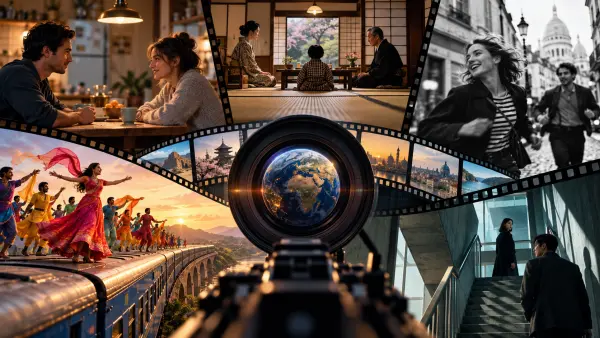
You settle in for a Hollywood thriller. Two characters argue across a kitchen table, and the camera cuts between their faces so smoothly that you never think about it. A week later you watch a Japanese family drama from the 1950s. The camera sits barely a meter above the floor and hardly moves at all. Both films show you where to look and how to feel, yet they speak in different visual accents. Cinematography, the craft of choosing where the camera goes, how it moves, and how light falls, works like a language, and languages have regional habits.
Start with the accent most of us know best. Early in cinema’s history, American studios settled on a way of framing and cutting scenes that aims to be seamless. Shots are matched so that you always know who is where, and the camera stays on one side of an imaginary line between the characters. Rarely does a viewer notice any of this, which is exactly the point. The pace has quickened, too: one study of popular English-language films found that the average shot shrank from about ten seconds in the 1930s to under four seconds after 2000. Some critics call the system formulaic, others admire its clarity, and opinions differ on whether its polish is a strength or a trap.
Much of European cinema has defined itself against that polish, though Europe holds many traditions. When Raoul Coutard, a former war photographer, shot Breathless (1960) for Jean-Luc Godard, he used a light camera held in his hands and mostly natural light, partly because the budget was tiny. The result looked rough and restless, and it helped make gritty realism a style that others copied. In 1995, two Danish directors went further. Their manifesto, Dogme 95, demanded filming on location, a handheld camera, and no special lighting. Not only did the founders write the rules; they also admitted, in their first Dogme films, to breaking a few of them.
India is usually counted as the world’s largest producer of feature films, in dozens of languages, and Hindi-language Bollywood is only one part, so it is risky to speak of a single Indian look. Two traditions stand out. One is the quiet realism of Satyajit Ray, whose first film, Pather Panchali (1955), was shot by Subrata Mitra, a stills photographer who had never operated a movie camera. Mitra is widely credited with the pioneering use of bounce lighting, in which lamps are aimed at a white cloth so that the light spreads softly, like daylight. The diffused look suited Ray’s love of naturalistic light. The other tradition is the song sequence of popular Hindi cinema, where realism gives way to a deliberately stylized world. In “Chaiyya Chaiyya”, from the 1998 film Dil Se, dancers perform choreographed steps on top of a moving train, and the cinematographer Santosh Sivan says that what you see is exactly what was filmed. Some writers argue that such numbers are not filler at all, because the spectacle carries emotion and story in its own way.
Korean directors such as Bong Joon-ho and Park Chan-wook are known for precise, carefully designed images. Bong, who made Parasite, drew a storyboard for every shot, a sign of his meticulous planning. The film’s two houses were built from scratch, and staircases return again and again as a motif for the gap between rich and poor. Park’s Oldboy (2003) contains a famous action set piece: a hallway fight of about three minutes that appears to be one unbroken shot. At no point does the camera seem to cut away, and it glides sideways along the corridor like the view in a side-scrolling video game.
Yet these accents are tendencies, not borders, and filmmakers keep crossing them. Yasujiro Ozu’s austere style in Tokyo Story (1953) is often called distinctly Japanese: a camera placed at the eye level of someone sitting on a tatami mat. Hardly ever does it move, and Ozu often broke the Hollywood rule about staying on one side of the action. But the film itself was inspired by an American movie. The Mexican cinematographer Emmanuel Lubezki, famous for long takes and natural light, won three Oscars in a row in the mid-2010s for films from Hollywood studios. Film cultures are porous, and the scholar David Bordwell argues that mass-audience films worldwide still follow the principles of Hollywood’s continuity system. That shared baseline may be why deliberate rule-breaking stands out.
Try a small experiment. Count the seconds before the first cut in a conversation scene from a film you know well, and notice where the camera sits and whether the light looks natural or arranged. Then repeat it with a film from somewhere else. Whether the differences come from culture, budget, technology, or one director’s taste is open to debate.
Vocabulary
Each word has a frequency score, a rank, and a tag. The score shows how common the word is in modern English: higher means more common, and each full point means roughly ten times more common. The rank is the word’s position on a list of about 321,000 English word forms, from most to least common. The tag shows where you are most likely to meet the word: Current, Formal, Literary, or Dated. The paragraph number shows where the word first appears in the reading. The labels are information, not instructions. Deciding which words are worth your time is up to you. How to read the scores, ranks, and tags.
seamless (adjective): smooth and continuous, with no visible break or join.
Frequency: 3.31 | Rank: 19,336 | Current | Paragraph 2
Translations: 无缝衔接的 | 継ぎ目のない | 끊김 없는 | निर्बाध | سلس | плавный | fluido | fluide
- Hollywood’s continuity style aims to be seamless, so that you never notice the cuts.
- The two bands made a seamless move from a slow song to a fast one.
formulaic (adjective): following a fixed pattern, so that the result feels predictable and unoriginal.
Frequency: 2.74 | Rank: 39,832 | Formal | Paragraph 2
Translations: 公式化的 | 型にはまった | 틀에 박힌 | रूढ़िबद्ध | نمطي | шаблонный | formulaico | stéréotypé
- Some critics call Hollywood’s polished style formulaic.
- After the tenth episode, the show’s plots started to feel formulaic.
gritty (adjective): showing life in a harsh, realistic way, without glamour or polish.
Frequency: 3.39 | Rank: 17,342 | Current | Paragraph 3
Translations: 粗粝写实的 | ざらついた | 거친 | कठोर यथार्थवादी | واقعي خشن | суровый | crudo | cru
- Breathless helped make gritty realism a style that others copied.
- The series gives a gritty picture of life in a busy port town.
manifesto (noun): a public statement of the aims and beliefs of a person or group.
Frequency: 3.65 | Rank: 12,045 | Formal | Paragraph 3
Translations: 宣言 | 宣言書 | 선언문 | घोषणापत्र | بيان | манифест | manifiesto | manifeste
- The Dogme 95 manifesto set out ten rules for filmmakers.
- The young architects wrote a manifesto explaining how cities should treat pedestrians.
pioneering (adjective): being among the first to develop or use a new idea or method.
Frequency: 3.54 | Rank: 14,106 | Formal | Paragraph 4
Translations: 开创性的 | 先駆的な | 선구적인 | अग्रणी | رائد | новаторский | pionero | pionnier
- Mitra is widely credited with the pioneering use of bounce lighting.
- The scientist’s pioneering work on solar cells opened a new field of research.
diffused (adjective): spread out softly instead of being concentrated in one hard beam.
Frequency: 2.73 | Rank: 40,267 | Formal | Paragraph 4
Translations: 漫射的 | 拡散した | 확산된 | विसरित | منتشر | рассеянный | difuso | diffus
- The diffused look suited Ray’s love of naturalistic light.
- A thin white curtain turned the harsh afternoon sun into soft, diffused light.
stylized (adjective): presented in a deliberately artificial way that follows an artistic style rather than real life.
Frequency: 3.06 | Rank: 26,776 | Formal | Paragraph 4
Translations: 风格化的 | 様式化された | 양식화된 | शैलीबद्ध | مؤسلب | стилизованный | estilizado | stylisé
- Song sequences take place in a deliberately stylized world.
- The play uses stylized gestures instead of everyday movement.
choreographed (adjective): planned and arranged in careful detail, like the steps of a dance.
Frequency: 3.07 | Rank: 26,420 | Current | Paragraph 4
Translations: 精心编排的 | 振り付けされた | 안무된 | कोरियोग्राफ किया हुआ | مُصمَّم رقصياً | хореографированный | coreografiado | chorégraphié
- In the song, dancers perform choreographed steps on top of a moving train.
- The marching band’s choreographed entrance began exactly on the drumbeat.
spectacle (noun): an impressive, eye-catching display or show, especially a large one.
Frequency: 3.61 | Rank: 12,764 | Current | Paragraph 4
Translations: 奇观 | スペクタクル | 볼거리 | भव्य दृश्य | استعراض | зрелище | espectáculo | spectacle
- Some writers say the spectacle of a song sequence carries emotion and story.
- The opening ceremony was a spectacle of lights, drums, and fireworks.
meticulous (adjective): showing great care and attention to every small detail.
Frequency: 3.24 | Rank: 21,209 | Formal | Paragraph 5
Translations: 一丝不苟的 | 細心の | 꼼꼼한 | बारीकी से ध्यान देने वाला | دقيق | скрупулёзный | meticuloso | méticuleux
- Bong’s storyboards for every shot show his meticulous planning.
- The restorer was meticulous, checking each small crack under a magnifying glass.
motif (noun): an idea, image, or pattern that is repeated through a work of art.
Frequency: 3.40 | Rank: 17,122 | Formal | Paragraph 5
Translations: 母题 | モチーフ | 모티프 | आवर्ती प्रतीक | ثيمة | мотив | motivo | motif
- Staircases return as a motif for the gap between rich and poor.
- Water appears again and again as a motif in the poet’s work.
set piece (noun phrase): a scene or sequence in a film that is elaborately staged to impress the audience.
Frequency: no score (phrase) | Current | Paragraph 5
Translations: 重头戏场面 | 見せ場 | 명장면 | प्रमुख दृश्य | مشهد رئيسي | эффектная сцена | secuencia espectacular | morceau de bravoure
- Oldboy contains a famous action set piece in a narrow hallway.
- The car chase is the biggest set piece in the whole film.
austere (adjective): plain and strict, with no decoration, comfort, or luxury.
Frequency: 3.00 | Rank: 28,918 | Formal | Paragraph 6
Translations: 简朴严谨的 | 簡素な | 절제된 | कठोर सादगी भरा | متقشف | аскетичный | austero | austère
- Ozu’s austere style uses a still camera and almost no music.
- The monk’s austere room held only a bed and a small table.
porous (adjective): not firmly closed, so that ideas and influences pass through easily.
Frequency: 3.37 | Rank: 17,813 | Formal | Paragraph 6
Translations: 界限模糊的 | 境界のあいまいな | 경계가 모호한 | भेद्य | نفّاذ | проницаемый | permeable | poreux
- Film cultures are porous, and styles travel across borders.
- In a porous organization, ideas move easily between departments.
baseline (noun): a standard or starting point used for comparison.
Frequency: 3.70 | Rank: 11,198 | Formal | Paragraph 6
Translations: 基线 | 基準線 | 기준선 | आधार रेखा | خط أساس | базовый уровень | punto de referencia | base de référence
- That shared baseline may be why deliberate rule-breaking stands out.
- The nurses recorded a baseline heart rate before the exercise began.
Activity Page
Open the activity page in a new tab
Speed Challenge
Answer 12 questions against the clock. Every wrong answer adds 5 seconds, and the lowest score wins. Open the speed challenge in a new tab.
Shadow Reading and Typing: My Year of Watching Films From Everywhere
This short text uses many of the words from this lesson. Use it for shadow reading (reading aloud along with a model) and for typing practice.
For years I thought I disliked slow films. Then a friend put on an old family drama with an austere look: a still camera, a quiet room, and almost no music. At first I felt restless. By the end I was surprised to find that I had stopped checking my phone.
That evening changed how I watch movies. I used to prefer the seamless style of big thrillers, where every cut is easy to follow. Now I also notice when a film feels formulaic, as if every scene had been built from the same template.
Lately I try to watch one film from a different country each month. A gritty street drama taught me to enjoy rough, handheld images. A musical with a huge spectacle and a bright, stylized dance number made me smile. One director’s meticulous planning showed in a staircase motif, and I only noticed it the second time.
I no longer think there is one correct way to film a story. Film cultures are porous, and ideas travel from place to place. Still, every shared baseline leaves room for surprises. My favorite set piece is whichever one makes me forget the camera exists. I am slowly learning to enjoy the ones that remind me it is there.
How to practice
- Read the text silently once and check any words you are unsure of.
- Read it aloud slowly, one sentence at a time. On the typing page, the Listen button reads each line with your device’s voice, so you can listen first and then repeat.
- Shadow: read aloud again at a natural speed, trying to keep a steady rhythm without stopping.
- Record yourself, listen back, and note one sentence to practice again.
- Type it on the typing page below and check your speed and accuracy.
Open the typing practice in a new tab
Comprehension Questions
- What differences does the writer describe between the two films in the opening scene, and what do they have in common?
- What does the writer mean by saying that Hollywood’s continuity style aims to be “seamless”?
- How did Raoul Coutard’s way of shooting Breathless differ from the Hollywood style described earlier, and what was one reason for it?
- Which rules did the founders of Dogme 95 set, and what does the reading say happened to those rules?
- Which two traditions of Indian cinema does the writer describe, and how does each one look?
- How does bounce lighting work, according to the reading, and why might it suit realistic films?
- What evidence does the writer give that Bong Joon-ho and Park Chan-wook design their images carefully?
- The writer says these accents are “tendencies, not borders.” Which examples in the reading support that claim?
- The writer ends with an experiment and says the causes of the differences are “open to debate.” Why might the writer have chosen this ending, and what could explain the differences besides culture?
IELTS-Style Questions
- True, False, or Not Given: “Raoul Coutard used artificial studio lighting throughout Breathless.” Explain your answer using evidence from the reading.
- Yes, No, or Not Given: “The writer believes that film styles are fixed by national borders.” Explain your answer using evidence from the reading.
- Author’s purpose: Why does the writer begin with two films that a viewer watches a week apart? Is the purpose to show that Hollywood is better, to make a general idea feel familiar, or something else?
AI Discussion Prompt
I just read an article about how cinematography differs across film cultures. It covered Hollywood’s smooth continuity style and the rise of faster cutting, handheld and natural-light filmmaking in Europe, bounce lighting and song sequences in Indian cinema, the carefully planned images of Korean films such as Parasite and Oldboy, Ozu’s low and still camera, and the idea that film cultures borrow from each other. I am an English learner at about C1 level. Please ask me one question at a time, starting with a film from another country that I have watched. Respond to my ideas first, then briefly correct any language errors, and challenge my assumptions when it is useful.
AI Vocabulary Prompt
I want to practice vocabulary from an article about how film styles and cinematography differ around the world. Please quiz me on the following words one at a time, using a mix of question types: multiple choice, true/false, and sentence completion. Give me feedback after each answer before moving on, and bring back the words I miss later. Here are the words: seamless, formulaic, gritty, manifesto, pioneering, diffused, stylized, choreographed, spectacle, meticulous, motif, set piece, austere, porous, baseline.
Discussion Questions
- What was the last film or series you watched from another country? What did you notice about how it looked, compared with what you usually watch?
- Do you prefer films where you never notice the camera, or films that show off their style? Why?
- Think of a film you know well. Can you describe one shot, such as a camera position or movement, that you still remember?
- Do you enjoy musical numbers in films? When do they add to a story, and when do they interrupt it?
- Why do you think older films often feel slower than recent ones? Is a faster pace always better?
- Have you ever watched a film with a very still camera or long, quiet shots? How did it affect your patience and your feelings?
- Does your country have a recognizable look in its films, series, or advertisements? What are its features?
- Bong Joon-ho drew a storyboard for every shot. How much of a creative project should be planned in advance, and how much left to chance?
- Film styles sometimes begin as solutions to money problems, such as the handheld look of Breathless. Can limits make art better?
- Why might Hollywood’s continuity style have spread to so many countries? Is it a natural way to tell stories, or a result of business and power?
- Is it fair to describe a country’s films with one word or one style? What do such generalizations help us see, and what do they hide?
- Subtitles and dubbing change how we experience a film. How much of a film’s visual style survives translation?
- Do you think global streaming will make films from different countries look more alike, or will local styles survive? Why?
- If a film follows every rule perfectly, can it still be original? What does a filmmaker gain or risk by breaking a rule?
Language Focus: Negative Inversion for Emphasis
What it is: After some negative or limiting adverbials, such as rarely, hardly ever, not only, and at no point, English puts the auxiliary verb before the subject, as in a question. The unusual word order adds emphasis and a polished tone.
Why writers use it: Writers use inversion to spotlight a surprising or important point. It is common in magazines, speeches, and formal writing, but it sounds heavy if it is overused, so one or two examples in a text are enough.
Examples from the reading:
- “Rarely does a viewer notice any of this, which is exactly the point.”
- “Not only did the founders write the rules; they also admitted, in their first Dogme films, to breaking a few of them.”
- “At no point does the camera seem to cut away…”
- “Hardly ever does it move…”
Practice task: Rewrite this sentence so that it begins with a negative adverbial and uses inversion: “Directors seldom allow the camera to cut away during a fight scene like this one.”
(Example answer: “Seldom do directors allow the camera to cut away during a fight scene like this one.”)
Online Resources
- Intensified Continuity Revisited (David Bordwell, Observations on Film Art). A film scholar compares a 1940 film with its remake to show how editing has sped up, and explains why continuity editing is used worldwide (paragraphs 2 and 6).
- Quicker, Faster, Darker: Changes in Hollywood Film over 75 Years (i-Perception, open access). A research article that measured shot lengths in 160 popular English-language films, the source of the figures in paragraph 2.
- Santosh Sivan Recalls Shooting SRK in Chaiyya Chaiyya From Dil Se (The Hollywood Reporter India). The cinematographer describes filming a song on top of a moving train, as mentioned in paragraph 4.
- Parasite: How Director Bong Joon-ho Used Staircases to Magnify the Social Divide (South China Morning Post). An article on the staircase motif and the houses that were built for the film, linked to paragraph 5.
- Tokyo Story (RogerEbert.com). A critic explains Ozu’s low, almost motionless camera and his unusual way of framing conversations (paragraph 6).