
Level: B2
Reading | Vocabulary | Activities | Speed Challenge | Shadow Reading and Typing | Questions | AI Prompts | Discussion | Language Focus | Resources
Printable: Student handout (PDF) | Teacher’s key (PDF)
Reading
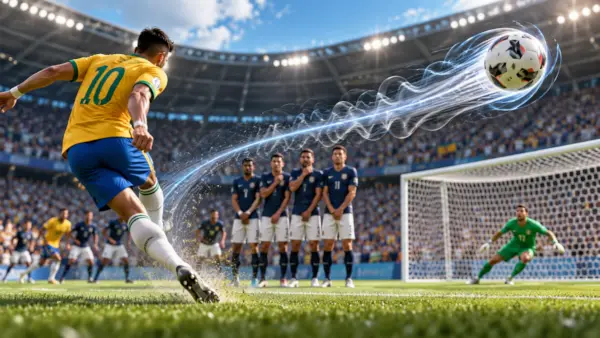
Thirty-five meters from the goal, the Brazilian defender Roberto Carlos takes a run-up and strikes a free kick with the outside of his left foot. At first the ball seems to be heading wide. Then it bends, sharply and almost impossibly, back into the net, while the French goalkeeper stands motionless. That was Lyon in June 1997, and for years the goal looked as if it must defy the laws of physics. Many people assumed it was a fluke, a lucky accident that nobody could repeat.
The first part of the explanation is spin. When a ball spins, its surface pulls the air around with it, and the air leaves the ball at different points on each side. That creates a sideways push, known as the Magnus effect, and it makes the ball swerve. Hit a ball slightly off center and it starts to spin; the faster it spins, the more it curves. The second part arrived in 2010, when French physicists studied spinning balls in water. As a spinning ball slows down, the sideways push matters more and more, so its path tightens into a spiral, like the shell of a snail. On a short kick you barely notice this. On a long kick it becomes pronounced: the longer the flight, the more of the spiral you see. The researchers argued that the great distance was part of the secret.
Some of the most feared kicks do the opposite and carry almost no spin. You might expect a ball without spin to fly in a straight line, but it often does not. The air flows unevenly over the seams, so the sideways forces keep changing, and the ball can drift, dip, or rise in an erratic way. This is called the knuckleball effect. Goalkeepers often say that such a ball is impossible to read, because when it starts to wobble in mid-air there is no smooth curve to follow. To kick one, strike the ball through its center, so that it leaves your foot with very little spin.
Then there is drag, the air resistance that slows the ball down. It does not change smoothly with speed. At a certain point the air flowing around the ball switches from smooth to turbulent, and the drag falls abruptly. The rougher the surface, the lower the speed at which this switch happens, which is why golf balls have dimples. At the 2010 World Cup in South Africa, the Jabulani, a ball with only eight panels and a very smooth surface, caused an uproar. Goalkeepers described its flight as deceptive, and wind-tunnel tests suggested a reason: once it slowed below a certain speed, it lost speed faster than players expected.
Designers have learned from that criticism. Later balls have fewer panels than the classic 32-panel design, but more texture. The ball for the 2026 World Cup, made by Adidas, has just four panels, with deep grooves cut into each one. A wind-tunnel study by researchers in Japan and the United States suggests that the design behaves more steadily at lower speeds, but there is a trade-off: at high speeds it has more drag, so very long kicks may fall a few meters shorter. That is one set of tests, not a season of matches, so players’ own verdicts will matter too.
Even the air matters. Mexico City, one of the host cities of the 2026 World Cup, lies about 2,200 meters above sea level, and La Paz, where Bolivia has long played many of its home games, is much higher still. At that height the air is less dense, so the ball meets less resistance. The thinner the air, the less drag: passes and shots travel farther and faster, and spinning balls may bend a little differently from what visiting goalkeepers expect. Visiting teams have to adjust both their breathing and their judgment of the ball.
Penalties show how little time anyone has to deal with all this. A hard shot from 11 meters can reach the goal line in around four tenths of a second, and researchers estimate that a goalkeeper needs about 0.6 seconds to reach either side of the goal at full stretch. Waiting to see where the ball goes is not an option. Keepers have to anticipate: they study the kicker’s run-up and body, pick a side, and dive on a gamble. Even a correct guess is sometimes not enough, because a dive to the top corner can take a full second.
Vocabulary
Each word has a frequency score, a rank, and a tag. The score shows how common the word is in modern English: higher means more common, and each full point means roughly ten times more common. The rank is the word’s position on a list of about 321,000 English word forms, from most to least common. The tag shows where you are most likely to meet the word: Current, Formal, Literary, or Dated. The paragraph number shows where the word first appears in the reading. The labels are information, not instructions. Deciding which words are worth your time is up to you. How to read the scores, ranks, and tags.
defy (verb): to seem to break a rule or a law of nature, or to refuse to obey it.
Frequency: 3.42 | Rank: 16,687 | Current | Paragraph 1
Translations: 违背 | 逆らう | 거스르다 | अवहेलना करना | يتحدى | бросать вызов | desafiar | défier
- Roberto Carlos’s goal seemed to defy the laws of physics.
- Some teenagers defy their parents just to prove that they are independent.
fluke (noun): something good that happens by pure luck and is unlikely to happen again.
Frequency: 3.14 | Rank: 24,170 | Current | Paragraph 1
Translations: 侥幸 | まぐれ | 요행 | तुक्का | ضربة حظ | случайная удача | golpe de suerte | coup de chance
- Many people thought Roberto Carlos’s free kick was a fluke.
- She passed the test by a fluke: the only topic she had studied came up.
swerve (verb): to change direction suddenly while moving, often to avoid something or because of a force.
Frequency: 2.95 | Rank: 30,789 | Current | Paragraph 2
Translations: 急转 | それる | 방향을 급히 틀다 | अचानक मुड़ना | ينحرف | резко отклоняться | desviarse | dévier
- The Magnus effect makes a spinning ball swerve in the air.
- The cyclist had to swerve to miss a hole in the road.
spiral (noun): a curve that winds around a central point, getting closer to it or farther from it.
Frequency: 3.85 | Rank: 8,918 | Current | Paragraph 2
Translations: 螺旋 | らせん | 나선 | सर्पिल | حلزوني | спираль | espiral | spirale
- The path of a long free kick can tighten into a spiral.
- The staircase in the old tower is a tight spiral.
pronounced (adjective): very noticeable, easy to see or measure.
Frequency: 4.06 | Rank: 6,456 | Formal | Paragraph 2
Translations: 明显的 | 顕著な | 뚜렷한 | स्पष्ट | ملحوظ | выраженный | marcado | prononcé
- On a long kick the curve of the ball becomes pronounced.
- He speaks with a pronounced accent from the north of the country.
erratic (adjective): changing direction or behaving in an irregular way, without any clear pattern.
Frequency: 3.34 | Rank: 18,537 | Formal | Paragraph 3
Translations: 不规则的 | 不規則な | 불규칙한 | अनियमित | غير منتظم | хаотичный | errático | irrégulier
- A ball without spin can follow an erratic path through the air.
- The old bus runs on an erratic schedule, so I never know when it will arrive.
wobble (verb): to move unsteadily from side to side.
Frequency: 3.02 | Rank: 28,214 | Current | Paragraph 3
Translations: 摇晃 | ぐらぐらする | 흔들리다 | डगमगाना | يتذبذب | шататься | tambalearse | vaciller
- A ball with no spin may wobble in mid-air.
- The table began to wobble because one leg was shorter than the others.
drag (noun): the force of the air that slows down an object moving through it.
Frequency: 4.29 | Rank: 4,365 | Current | Paragraph 4
Translations: 阻力 | 抗力 | 항력 | वायु प्रतिरोध | قوة السحب | лобовое сопротивление | resistencia aerodinámica | traînée
- The Jabulani had less drag than older balls at high speeds.
- Cyclists bend low over the handlebars to reduce drag.
abruptly (adverb): in a sudden and unexpected way, often with no warning.
Frequency: 3.56 | Rank: 13,695 | Formal | Paragraph 4
Translations: 突然地 | 急に | 갑자기 | अचानक | فجأة | резко | bruscamente | brusquement
- At a certain speed the drag on the ball falls abruptly.
- The conversation ended abruptly when the teacher walked in.
deceptive (adjective): likely to give you a false idea of what is real or what will happen.
Frequency: 3.34 | Rank: 18,537 | Formal | Paragraph 4
Translations: 具有迷惑性的 | 惑わせる | 기만적인 | भ्रामक | مضلل | обманчивый | engañoso | trompeur
- Goalkeepers described the flight of the Jabulani as deceptive.
- The calm surface of the sea can be deceptive, because strong currents run below it.
grooves (noun, plural): long, narrow cuts or channels in a surface.
Frequency: 3.25 | Rank: 20,906 | Current | Paragraph 5
Translations: 凹槽 | 溝 | 홈 | खांचे | أخاديد | желобки | ranuras | rainures
- The 2026 World Cup ball has deep grooves cut into its panels.
- Fine grooves in a vinyl record guide the needle.
trade-off (noun): a situation in which you must accept less of one good thing in order to have more of another.
Frequency: no score (hyphenated compound) | Current | Paragraph 5
Translations: 取舍 | トレードオフ | 상충 관계 | समझौता | مفاضلة | компромисс | contrapartida | compromis
- The ball has a trade-off: steadier flight, but shorter very long kicks.
- There is a trade-off between living near the center and paying low rent.
dense (adjective): containing a lot of matter or many things packed closely together.
Frequency: 3.98 | Rank: 7,338 | Current | Paragraph 6
Translations: 稠密的 | 密度の高い | 밀도가 높은 | घना | كثيف | плотный | denso | dense
- At high altitude the air is less dense, so there is less drag.
- The fog was so dense that we could not see the road.
anticipate (verb): to expect something and act in advance to prepare for it.
Frequency: 3.73 | Rank: 10,680 | Formal | Paragraph 7
Translations: 预料 | 予測する | 예상하다 | पूर्वानुमान लगाना | يتوقع | предугадывать | anticipar | anticiper
- Goalkeepers have to anticipate where a penalty will go.
- Good drivers anticipate problems before they happen.
gamble (noun): a risky choice made when you cannot know what the result will be.
Frequency: 3.79 | Rank: 9,735 | Current | Paragraph 7
Translations: 赌一把 | 賭け | 도박 | जुआ | مجازفة | рискованная ставка | apuesta | pari
- A goalkeeper who dives early is taking a gamble.
- Putting all your savings into one company is a big gamble.
Activity Page
Open the activity page in a new tab
Speed Challenge
Answer 12 questions against the clock. Every wrong answer adds 5 seconds, and the lowest score wins. Open the speed challenge in a new tab.
Shadow Reading and Typing: My Free Kick Experiment
This short text uses many of the words from this lesson. Use it for shadow reading (reading aloud along with a model) and for typing practice.
Last Saturday I tried to curve a free kick around my friends, who stood in a wall. I had watched videos for weeks, and I thought I could make the ball swerve like the professionals do. My first attempt was a disaster. The ball flew straight into the fence, and everyone laughed.
Then I remembered that the ball has to spin. I hit it slightly off center and followed through. This time the ball started wide and began to bend. The effect was not very pronounced, but it was there. My friend in goal tried to anticipate where it would go, and he guessed wrong.
Later I tried a different kick, with almost no spin. The ball began to wobble and its flight became erratic. It was a gamble, because I could not control where it would land. One shot even looked deceptive: it seemed to be heading wide, and then it dipped into the corner. My friends said it was a fluke, and I agreed.
I still cannot copy Roberto Carlos, and I never will. His goal seems to defy the rules of the game, but I understand now that it follows the rules of physics. There is a trade-off, because the more I understand, the less magical a goal seems. Still, practice is more fun now. Next Saturday I will try again, and this time I will watch the ball carefully from the first touch to the last.
How to practice
- Read the text silently once and check any words you are unsure of.
- Read it aloud slowly, one sentence at a time. On the typing page, the Listen button reads each line with your device’s voice, so you can listen first and then repeat.
- Shadow: read aloud again at a natural speed, trying to keep a steady rhythm without stopping.
- Record yourself, listen back, and note one sentence to practice again.
- Type it on the typing page below and check your speed and accuracy.
Open the typing practice in a new tab
Comprehension Questions
- What happens in the free kick described at the start of the reading, and why did some people call it a fluke?
- How does spin make a ball curve, according to the reading?
- What did the French physicists add to the explanation in 2010?
- What is a knuckleball, and why do goalkeepers find it hard to read?
- What is drag, and what happens to it when the air around a ball switches from smooth to turbulent?
- Why does the writer mention golf balls?
- What went wrong with the Jabulani at the 2010 World Cup, and how have designers responded?
- How does altitude change the way a ball flies, and why might this matter for visiting teams?
- Why can a goalkeeper not simply wait and watch the ball during a penalty, and what do keepers do instead?
IELTS-Style Questions
- True, False, or Not Given: “Roberto Carlos practiced long-range free kicks every week.” Explain your answer using evidence from the reading.
- Yes, No, or Not Given: “The writer believes that one wind-tunnel study can settle how the 2026 ball will perform.” Explain your answer using evidence from the reading.
- Author’s purpose: Why does the writer end with the example of a penalty kick? Is the aim to show how little time a goalkeeper has, to argue that penalties should change, or something else?
AI Discussion Prompt
I just read an article about the physics of football. It covered Roberto Carlos’s famous free kick in 1997, the Magnus effect and the spiral path of a spinning ball, the knuckleball effect, drag and how a ball’s surface changes it, the criticism of the Jabulani ball in 2010, the four-panel ball of the 2026 World Cup, the effect of altitude, and the very short time a goalkeeper has at a penalty. I am an English learner at about B2 level. Please ask me one question at a time, starting with whether I play or watch football. Respond to my ideas first, then briefly correct any language errors, and ask follow-up questions that make me explain my reasons.
AI Vocabulary Prompt
I want to practice vocabulary from an article about the physics of football. Please quiz me on the following words one at a time, using a mix of question types: multiple choice, true/false, and sentence completion. Give me feedback after each answer before moving on, and bring back the words I miss later. Here are the words: defy, fluke, swerve, spiral, pronounced, erratic, wobble, drag, abruptly, deceptive, grooves, trade-off, dense, anticipate, gamble.
Discussion Questions
- Do you play or watch football? If yes, what do you enjoy about it? If not, which sport do you prefer?
- Have you ever tried to curve a ball in football or in another sport? What happened?
- Which famous goal, shot, or kick, in any sport, do you remember best? What made it special?
- Roberto Carlos’s goal looked impossible, but physics explained it. Can you think of something else that seems like magic but has a scientific explanation?
- Do you think a skilled player understands the physics of a kick, or does the body simply learn through practice? Why?
- A goalkeeper has less than a second to react to a penalty. Which other jobs or sports demand very fast decisions, and how do people prepare for them?
- Would you rather be the penalty taker or the goalkeeper in a shoot-out? Why?
- Some players complained about the Jabulani, while others adapted. How do you react when a tool or piece of equipment you use suddenly changes?
- Players at the 2026 World Cup had to play in cities at different altitudes. How can athletes prepare for conditions that are very different from home?
- Is it fair that some teams play at high altitude all the time while others rarely do? Why or why not?
- The reading says that one set of wind-tunnel tests is not the same as a season of matches. How much should we trust laboratory results about sport?
- Data and measurement now shape many sports. Do you think more science makes sport fairer and more interesting, or does it take away some of the magic?
- Football is played almost everywhere in the world. Why do you think one simple game with a ball appeals to people in so many different cultures?
- If you could ask a physicist one question about a sport you love, what would it be?
Language Focus: Comparative Correlatives: The More…, the More…
What it is: A comparative correlative uses two comparative phrases, each beginning with the, to show that two things change together. When the first thing increases or decreases, the second changes with it.
Why writers use it: This pattern is common in science writing and in everyday speech because it expresses cause and effect in a short, balanced sentence. Each part has the + a comparative (the faster, the more, the less), and the two parts are usually separated by a comma. There is no verb be in the short forms: “the sooner, the better.”
Examples from the reading:
- “…the faster it spins, the more it curves.”
- “…the longer the flight, the more of the spiral you see.”
- “The rougher the surface, the lower the speed at which this switch happens…”
- “The thinner the air, the less drag…”
Practice task: Combine these two ideas into one sentence with a comparative correlative: “A goalkeeper is closer to the ball. He has less time to react.”
(Example answer: “The closer the goalkeeper is to the ball, the less time he has to react.”)
Online Resources
- Why this year’s World Cup ball may not fly as far (MIT Technology Review). A readable report on the 2026 ball, the drag crisis, and the trade-off described in paragraph 5.
- Carlos ’97 free kick no fluke, say French physicists (ScienceDaily, from the Institute of Physics). A short press summary of the spinning ball spiral study behind paragraph 2.
- What Science Says About The World Cup Ball (NPR). A 2010 radio report in which physicists explain why the Jabulani and its knuckling worried goalkeepers, linked to paragraphs 3 and 4.
- Physics in football, science at the 2026 World Cup (Eniscuola). An article for students on how thin air at altitude changes drag and the flight of the ball (paragraph 6).
- Penalty rates: the science of World Cup football (Cosmos Magazine). A look at the timing of penalties and how little time a goalkeeper has (paragraph 7).