
Level: C1
Before You Read | Reading | Vocabulary | Word Partners | Activities | Speed Challenge | Quick Reading | Questions | AI Prompts | Discussion | Language Focus | Resources
Printable: Student handout (PDF | Word) | Teacher’s key (PDF | Word)
Before You Read
Think about these questions or discuss them with a partner.
- Have you ever played badminton or another racket sport? Was it a relaxed game or a serious contest?
- What do you know about where badminton comes from, or about famous badminton players?
- How might the way people play or watch badminton differ from one country or age group to another?
Reading
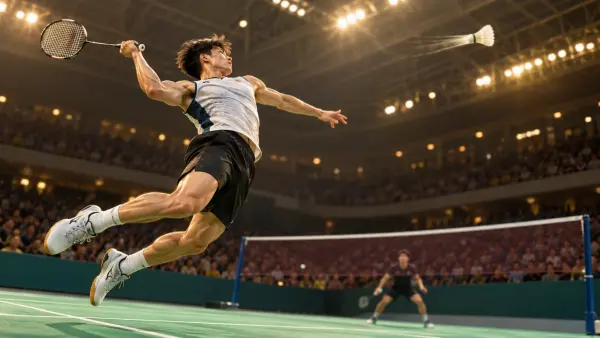
Think of badminton and you may picture a lazy summer afternoon: a net strung between two trees, a family hitting a shuttlecock back and forth, nobody keeping score. Now picture an indoor arena in Jakarta, Copenhagen, or Hyderabad, where a player leaps, snaps a wrist, and sends the shuttle off the racket faster than a Formula One car at full speed. Few sports span such a range, from leisurely garden pastime to fiercely competitive professional sport, and the game’s history turns out to be just as wide.
Long before anyone painted lines on a court, people in many parts of the world were keeping feathered objects in the air. In China, jianzi, in which players kick a weighted shuttlecock with their feet, is thought to have been played for around two thousand years. In Japan, hanetsuki is a New Year game played with decorated wooden paddles, and a player who lets the shuttle drop may get a mark of ink on the face. In Europe, children played battledore and shuttlecock, in which the goal was simply to keep a rally going. Most of these were games of cooperation rather than competition: success meant keeping the shuttle aloft together.
The competitive version took shape in British India in the mid-1800s, when army officers stretched a net across the middle and started counting points. For a while the game was simply called “Poona,” after the garrison town now known as Pune, where one of the first sets of rules is said to have been drawn up in 1873. The name the world uses today comes from Badminton House, the Duke of Beaufort’s estate in England. It is widely believed that officers back from India played the game there, but the details are murky, and nobody can say exactly how or when the name stuck. Confusingly, a London toy seller published a booklet called Badminton Battledore in 1860, years before the Poona rules, although no copy is known to survive.
The British soon organized the sport, and the All England Championships, first held in 1899, are still among its most prestigious titles. When the International Badminton Federation was set up in 1934, all nine founding members were in Europe or the British Commonwealth. Yet the game’s center of gravity soon moved east. Malaya won the first Thomas Cup, the men’s world team championship, in 1949, and Indonesia and China have won it more than twenty times between them since. When badminton became a full Olympic medal sport in 1992, Susi Susanti and Alan Budikusuma won Indonesia’s first Olympic gold medals in any sport. At Paris 2024, players from China, South Korea, and Chinese Taipei took four of the five titles. The exception was Denmark’s Viktor Axelsen, who won the men’s singles for the second Games in a row, a sign that Europe has not relinquished its place at the top.
What happens in the air is just as unusual. When a racket hits the cork, the shuttle briefly flies backward, feathers first, then flips over in about two hundredths of a second. Its feathered skirt works like a small parachute, creating enormous drag, and that drag explains the sport’s great paradox. In 2023, India’s Satwiksairaj Rankireddy set a Guinness World Record with a hit measured at 565 kilometers per hour, and Malaysia’s Pearly Tan set the women’s record at 438. Both figures came from a controlled test at a racket maker’s factory in Japan, not from a match. Yet no shuttle keeps that speed for long. One recent analysis found that a smash loses roughly half its speed every three to four meters. That is why a well-placed defender can return a shot that left the racket faster than a racing car.
All of this depends on a fragile object. Under the official laws, a shuttle has 16 feathers fixed in a cork base and weighs about as much as a sheet of printer paper. It is often claimed that the feathers must all come from a goose’s left wing, so that they overlap in the same direction and make every shuttle spin the same way. Taking feathers from one wing makes sense, but the left-wing detail is open to question, since at least one engineering text names the right wing instead. As feather prices have risen, the sport’s governing body, now the Badminton World Federation, began testing synthetic shuttles at junior and lower-level events in 2026, with no fixed timeline for the top level. Whether elite players, many of them attached to the feel of real feathers, will embrace a manufactured replacement is the next question the sport has to settle.
Vocabulary
Each word has a frequency score, a rank, and a tag. The score shows how common the word is in modern English: higher means more common, and each full point means roughly ten times more common. The rank is the word’s position on a list of about 321,000 English word forms, from most to least common. The tag shows where you are most likely to meet the word: Current, Formal, Literary, or Dated. The paragraph number shows where the word first appears in the reading. The labels are information, not instructions. Deciding which words are worth your time is up to you. How to read the scores, ranks, and tags.
span (verb): to cover or reach across a whole range, area, or period of time.
Frequency: 4.07 | Rank: 6,347 | Current | Paragraph 1
Translations: 跨越 | またがる | 걸치다 | फैला होना | يمتد عبر | охватывать | abarcar | couvrir
- Few sports span such a wide range of players as badminton.
- Her career spanned four decades and three continents.
leisurely (adjective): relaxed and unhurried, done for enjoyment rather than with effort or speed.
Frequency: 3.05 | Rank: 27,150 | Current | Paragraph 1
Translations: 悠闲的 | のんびりした | 느긋한 | इत्मीनान भरा | مريح وهادئ | неторопливый | pausado | tranquille
- For many families, badminton is a leisurely game played in the garden.
- We had a leisurely breakfast and left the hotel at noon.
pastime (noun): an activity that someone does regularly for enjoyment in their free time.
Frequency: 3.10 | Rank: 25,367 | Current | Paragraph 1
Translations: 消遣 | 娯楽 | 취미 | शौक | هواية | времяпрепровождение | pasatiempo | passe-temps
- Badminton began as a garden pastime for many families.
- Fishing is his favorite pastime on Sundays.
aloft (adverb): up in the air, above the ground, often while moving or being held up.
Frequency: 3.08 | Rank: 26,092 | Literary | Paragraph 2
Translations: 在空中 | 空中に | 공중에 | हवा में | في الهواء | в воздухе | en el aire | en l’air
- The children tried to keep the shuttle aloft for as long as possible.
- The winner held the trophy aloft for the cameras.
took shape (verb phrase, past tense): began to develop into a clear, definite form.
Frequency: no score (phrase) | Current | Paragraph 3
Translations: 成形 | 形になった | 구체화되었다 | आकार लिया | تبلور | обрёл форму | tomó forma | a pris forme
- The modern game took shape in British India in the mid-1800s.
- The plan for the new park slowly took shape over the summer.
garrison (noun): a group of soldiers living in a town or fort to defend it, or the place where they live.
Frequency: 3.67 | Rank: 11,685 | Formal | Paragraph 3
Translations: 驻军 | 駐屯地 | 주둔군 | छावनी | حامية | гарнизон | guarnición | garnison
- Poona was a garrison town where British officers were based.
- The garrison was moved to a new base after the war.
murky (adjective): unclear and difficult to understand or know the truth about.
Frequency: 3.12 | Rank: 24,745 | Current | Paragraph 3
Translations: 模糊不清的 | 不明瞭な | 불분명한 | अस्पष्ट | غامض | туманный | turbio | trouble
- The details of how badminton got its name are murky.
- The water in the river was too murky to see the bottom.
prestigious (adjective): admired and respected because of high quality, success, or long history.
Frequency: 3.86 | Rank: 8,784 | Current | Paragraph 4
Translations: 享有盛誉的 | 名誉ある | 권위 있는 | प्रतिष्ठित | مرموق | престижный | prestigioso | prestigieux
- The All England Championships are among the most prestigious titles in badminton.
- She won a place at a prestigious music school.
center of gravity (noun phrase): here, the place or group where most of the activity, power, or interest is found.
Frequency: no score (phrase) | Current | Paragraph 4
Translations: 重心 | 重心 | 중심 | गुरुत्व केंद्र | مركز الثقل | центр тяжести | centro de gravedad | centre de gravité
- The center of gravity of world badminton moved from Europe to Asia.
- The company’s center of gravity has shifted from making phones to selling services.
relinquished (verb, past participle): given up something such as power, a position, or a claim, often unwillingly.
Frequency: 2.99 | Rank: 29,270 | Formal | Paragraph 4
Translations: 放弃 | 手放した | 내주었다 | त्याग दिया | تخلى عن | уступил | renunciado a | renoncé à
- Denmark has not relinquished its place among the top badminton nations.
- The president relinquished control of the company to his daughter.
drag (noun): the force of air or water that pushes against a moving object and slows it down.
Frequency: 4.29 | Rank: 4,365 | Current | Paragraph 5
Translations: 阻力 | 空気抵抗 | 항력 | वायु प्रतिरोध | مقاومة الهواء | аэродинамическое сопротивление | resistencia aerodinámica | traînée
- The feathers create so much drag that the shuttle slows down quickly.
- Cyclists bend low to reduce drag when they ride fast.
paradox (noun): a situation or fact that seems impossible because it combines two opposite things, but is true.
Frequency: 3.63 | Rank: 12,397 | Current | Paragraph 5
Translations: 悖论 | 逆説 | 역설 | विरोधाभास | مفارقة | парадокс | paradoja | paradoxe
- The paradox of badminton is that the fastest shot slows down so quickly.
- It is a paradox that more choice can make people less happy.
fragile (adjective): easily broken or damaged.
Frequency: 3.86 | Rank: 8,784 | Current | Paragraph 6
Translations: 易碎的 | 壊れやすい | 깨지기 쉬운 | नाज़ुक | هش | хрупкий | frágil | fragile
- A feathered shuttle is fragile, and players often need a new one.
- Please be careful with that box. The glasses inside are fragile.
synthetic (adjective): made by people from chemicals or artificial materials, not grown or found in nature.
Frequency: 3.95 | Rank: 7,672 | Current | Paragraph 6
Translations: 合成的 | 合成の | 합성의 | कृत्रिम | اصطناعي | синтетический | sintético | synthétique
- Some tournaments have tested synthetic shuttles instead of feathered ones.
- This jacket is made of a synthetic material that dries quickly.
embrace (verb): to accept a new idea, change, or product willingly and with enthusiasm.
Frequency: 4.16 | Rank: 5,496 | Current | Paragraph 6
Translations: 欣然接受 | 受け入れる | 받아들이다 | अपनाना | يتبنى | принять | aceptar | adopter
- Not all players will embrace synthetic shuttles.
- Older workers were quick to embrace the new software.
Word Partners
Collocations. Match the two halves to make common phrases. Then use three of the phrases in sentences of your own.
| 1. at a leisurely | a. waters |
| 2. span | b. pace |
| 3. a garrison | c. award |
| 4. murky | d. town |
| 5. a prestigious | e. economy |
| 6. relinquish | f. change |
| 7. a fragile | g. three decades |
| 8. embrace | h. a claim |
Answers
- at a leisurely pace (b)
- span three decades (g)
- a garrison town (d)
- murky waters (a)
- a prestigious award (c)
- relinquish a claim (h)
- a fragile economy (e)
- embrace change (f)
Word families. Complete each sentence with the correct form of the word in brackets.
- Winning the All England title brings great __________. (prestigious)
- The shuttle’s __________ means it must be replaced often. (fragile)
- It seems __________, but the fastest shot in sport is also one of the slowest to arrive. (paradox)
- Scientists can __________ many materials that once came only from animals. (synthetic)
- For many families in the 1870s, badminton was a __________ activity, played on summer lawns. (leisurely)
- After the rain stopped, the river slowly lost its __________ and became clear again. (murky)
Answers
- prestige
- fragility
- paradoxical
- synthesize / synthesise
- leisure
- murkiness
Activity Page
Open the activity page in a new tab
Speed Challenge
Answer 12 questions against the clock. Every wrong answer adds 5 seconds, and the lowest score wins. Open the speed challenge in a new tab.
Quick Reading and Typing: Badminton in Brief
A shorter version of the reading that uses the lesson vocabulary. Read it for a quick introduction to the topic, or use it for reading aloud, shadowing (reading along with a model), and typing practice.
Badminton can be a leisurely pastime in a garden or a fierce professional sport. Few sports span such a wide range. People have kept feathered objects aloft for a very long time. In China, a kicking game called jianzi is thought to have been played for around two thousand years. In Japan, hanetsuki is a New Year game played with wooden paddles. In Europe, children played battledore and shuttlecock, a game of cooperation rather than competition.
The competitive version took shape in British India in the mid-1800s, when army officers added a net and started counting points. For a while the game was called “Poona,” after the garrison town now known as Pune. One of the first sets of rules is said to have been drawn up there in 1873. The name comes from Badminton House, an estate in England. It is widely believed that officers back from India played the game there, but the details are murky.
The British organized the sport, and the All England Championships became one of its most prestigious titles. Yet the center of gravity soon moved east. Malaya won the first Thomas Cup in 1949. When badminton became an Olympic medal sport in 1992, Indonesia won its first Olympic gold medals. At Paris 2024, Asian players took four of the five titles. Denmark’s Viktor Axelsen won the men’s singles, so Europe has not relinquished its place.
In 2023, a player from India set a world record with a hit of 565 kilometers per hour. It was set in a test, not in a match. Yet the feathers create so much drag that a smash loses about half its speed every three to four meters. That is the paradox of badminton: the fastest shot slows down quickly, so a good defender can still return it.
All of this depends on a fragile object with 16 feathers and a cork base. It is often claimed that the feathers must come from a goose’s left wing, but this detail is open to question. At least one engineering text names the right wing. Feathers are expensive, so in 2026 the sport’s governing body began testing synthetic shuttles at smaller events. Whether top players will embrace them is still an open question.
How to practice
- Read the text silently once and check any words you are unsure of.
- Read it aloud slowly, one sentence at a time. On the typing page, the Listen button reads each line with your device’s voice, so you can listen first and then repeat.
- Shadow: read aloud again at a natural speed, trying to keep a steady rhythm without stopping.
- Record yourself, listen back, and note one sentence to practice again.
- Type it on the typing page below and check your speed and accuracy.
Open the typing practice in a new tab
Comprehension Questions
- What two kinds of badminton does the writer describe in the first paragraph?
- How were most early shuttlecock games different from modern badminton?
- Why was the game once called “Poona”?
- What is known, and what is unclear, about how badminton got its English name?
- What evidence does the writer give that the sport’s center of gravity moved east?
- Why does the writer mention Viktor Axelsen?
- Why can a defender return a smash that left the racket at very high speed?
- Why does the writer treat the claim about a goose’s left wing with caution?
- Do you think synthetic shuttles will replace feathered ones at the top level? Give reasons.
IELTS-Style Questions
- True, False, or Not Given: “The world record of 565 kilometers per hour was set in an Olympic final.” Explain your answer using the reading.
- Yes, No, or Not Given: “The writer thinks the story of how badminton got its name is fully understood.” Explain your answer using the reading.
- Author’s purpose: Why does the writer open with a family playing in a garden and a player in an arena? Is it (a) to show how wide the range of the sport is, (b) to argue that garden badminton is better than professional badminton, or (c) to explain the official rules of the game?
AI Discussion Prompt
I just read an article about the history of badminton. It covered ancient shuttlecock games in China, Japan, and Europe, how the competitive game took shape in British India and was named after Badminton House in England, how the sport’s strongest nations moved from Europe to Asia, the physics of a shuttle that can leave the racket at 565 kilometers per hour but loses about half its speed every three to four meters, and the 2026 trials of synthetic shuttles. I am an English learner at about C1 level. Please ask me one question at a time, starting with my own experience of badminton or another racket sport. Respond to my ideas first, then briefly point out any language errors, and ask follow-up questions that push me to give reasons and examples.
AI Vocabulary Prompt
I want to practice vocabulary from an article about the history of badminton. Please quiz me on the following words one at a time, using a mix of question types: multiple choice, true/false, and sentence completion. Give me feedback after each answer before moving on, and bring back the words I miss later. Here are the words: span, leisurely, pastime, aloft, took shape, garrison, murky, prestigious, center of gravity, relinquished, drag, paradox, fragile, synthetic, embrace.
Discussion Questions
- What sports or games did you play as a child? Which ones did you play just for fun?
- Would you rather play badminton in a park with friends or watch a professional match? Why?
- Which sports are most popular in your country, and why do you think they became popular there?
- What traditional games are played during holidays or festivals where you live?
- Many sports were organized and given rules by the British. Why do you think this happened?
- Why do you think some countries become very strong in one particular sport?
- How important is national success in sport, such as an Olympic gold medal, to people in your country?
- Would you watch a sport more often if you understood the science behind it? Why or why not?
- Should records set in tests, not in matches, count as world records?
- Many stories about the origins of sports are not fully proven. Does it matter if a popular story is not true?
- Would you accept a synthetic version of something traditionally made from animals, such as feathers, leather, or wool? Why?
- Should sports change their equipment when natural materials become expensive or hard to find?
- How does the success of a sport at the Olympics change how many people play it?
- Is it fair that some sports receive much more money and media attention than others? Why?
Language Focus: Passive Reporting Structures
What it is: Passive reporting structures let a writer report what people say, think, or believe without naming who says it. There are two common patterns: It is + past participle + that (It is said that…, It is believed that…) and subject + is + past participle + to-infinitive (The game is thought to be…, The rules are said to have been written…). Use a perfect infinitive (to have + past participle) for an earlier time.
Why writers use it: History is full of stories that are popular but not fully proven. These structures let the writer report a belief or claim while showing that it is not the writer’s own certain knowledge, which is useful for origins, legends, and claims that may be wrong.
Examples from the reading:
- “In China, jianzi… is thought to have been played for around two thousand years…”
- “…where one of the first sets of rules is said to have been drawn up in 1873.”
- “It is widely believed that officers back from India played the game there, but the details are murky…”
- “It is often claimed that the feathers must all come from a goose’s left wing…”
Part A. Sentence starters Finish each sentence so that it is true for you or your country.
It is + past participle + that
- In my country, it is often said that …
- It is widely believed that people who …
- In my family, it is generally thought that …
Subject + is + past participle + to
- My hometown is known to …
- A popular food in my country is said to …
Model answers
- In my country, it is often said that the first snow of the year brings good luck.
- It is widely believed that people who eat breakfast do better at work.
- In my family, it is generally thought that my uncle is the best cook.
- My hometown is known to have the best seafood in the region.
- A popular food in my country is said to help people recover from colds.
Part B. Questions Answer each question in a full sentence. Try to answer using a passive reporting structure (It is said that… or …is thought to…). Then ask a partner.
- What is a traditional food in your country said to be good for?
- Which sport is thought to be the most popular in your country?
- What is commonly believed about people who stay up very late?
- Is there a place in your country that is said to be lucky, unlucky, or haunted?
- Which city or region in your country is known to have the best food?
Model answers
- Ginseng soup is said to be good for your energy in hot weather.
- Football is thought to be the most popular sport in my country.
- It is commonly believed that people who stay up late are more creative.
- An old hotel near the coast is said to be haunted.
- The southern region is known to have the best food in the country.
Online Resources
- Badminton (Wikipedia). A detailed overview of the sport’s history, rules, equipment, and strongest nations, with notes on what is still unclear about its name.
- Badminton at the Olympics: A Timeline (Badminton World Federation). The official timeline of Olympic badminton, from the 1972 demonstration to the full medal events.
- Fastest badminton hit (male) (Guinness World Records). How the 565 kilometers per hour record was measured, with a high-speed camera, in paragraph 5.
- Shuttlecock velocity decay after smash and slice shots in badminton (arXiv). A physics paper on how fast a shuttle loses its speed after a smash. The summary at the top is the easiest part to read.
- BWF to trial synthetic shuttlecocks as costs of feather shuttles rise (Malay Mail (Reuters)). A news report on why the sport began testing synthetic shuttles in 2026.