
Level: B2
Before You Read | Reading | Vocabulary | Word Partners | Activities | Speed Challenge | Quick Reading | Questions | AI Prompts | Discussion | Language Focus | Resources
Printable: Student handout (PDF | Word) | Teacher’s key (PDF | Word)
Before You Read
Think about these questions or discuss them with a partner.
- How many hours do you usually sleep, and where and how do you like to sleep best?
- Which animals have you seen sleeping, for example pets, farm animals, or animals in a zoo? What did they look like?
- How might sleeping habits differ between animals that hunt and animals that are hunted, or between animals on land and in the sea?
Reading
It is late and you are tired. You lie down somewhere safe, close both eyes, and drift off for seven or eight hours. For most adults, that is the normal pattern: one long block of sleep at night, with the whole brain switching into sleep mode together. It feels so natural that we rarely question it. Yet across the animal world, the human way of sleeping is only one option, and for many species it would be risky or simply impossible.
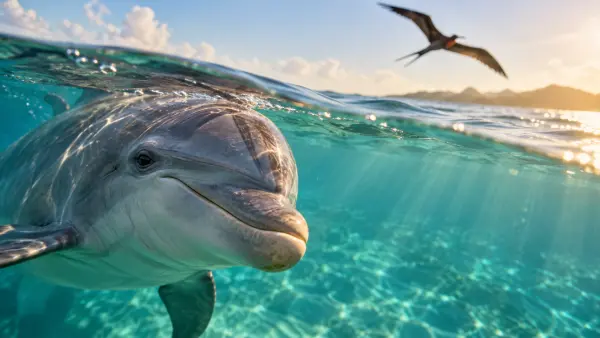
Take dolphins. They breathe air, so they must keep coming up to the surface, even while they rest. Their solution is to sleep with half of the brain at a time. One hemisphere sleeps while the other stays alert, and the eye controlled by the awake half often stays open. This way the animal can keep swimming, breathing, and checking what is around it. Some seals and many birds can do something similar. In a well-known experiment with mallard ducks resting in a row, the birds at the two ends slept with one eye open far more often than the birds in the middle, and the open eye usually faced away from the group, where predators were most likely to appear.
Birds that spend long periods airborne face an even stranger problem. Great frigatebirds from the Galápagos Islands can fly over the ocean for up to ten days without landing. When researchers fitted some of them with small devices that recorded brain activity, they found that the birds did sleep in the air, mostly after dark, but only for about 42 minutes a day, in episodes of seconds to minutes. Much of this sleep happened while the birds were circling upward on rising air. Back on land, the same birds slept more than 12 hours a day. Common swifts are such skilled fliers that some stay in the air for about ten months at a time. Researchers suspect that swifts sleep as they glide slowly down from great heights, but nobody has yet recorded their brain activity in flight to prove it.
Chinstrap penguins in Antarctica have found another way to stay safe. While one parent is away feeding at sea, the other guards the eggs or chicks, and it cannot afford a deep sleep, because other birds may attack the nest. Instead, it falls asleep more than 10,000 times a day, in tiny bursts that last about four seconds each. These microsleeps add up to more than 11 hours a day. Because the penguins still raise their chicks successfully, scientists think the microsleeps may give them at least some of the benefits of normal sleep, although exactly which benefits is not yet clear.
Other animals sleep so little that it is hard to see how they cope. Two wild African elephants tracked in Botswana slept only about two hours a day on average, and on several occasions they went 46 hours without sleeping at all. The researchers linked those long nights to disturbances such as lions, poachers, or an aggressive male elephant. Sperm whales, meanwhile, hang upright in the water near the surface for stretches of roughly ten to fifteen minutes, and they seem to spend only around 7 percent of their time this way. For both animals there may be a trade-off: every minute spent asleep is a minute not spent finding food or watching for danger.
At the other end of the scale are the champion sleepers. The little brown bat, common across much of North America, can sleep close to 20 hours a day, hanging upside down in a cave or an attic. It flies out to hunt insects for a few hours after dark, then returns to its roost. Sleeping through the rest of the day may help it conserve energy at times when there is little food to find.
Perhaps the most surprising sleeper has no brain at all. Upside-down jellyfish, which rest on shallow sea floors, pulse more slowly at night and take longer to react when they are disturbed. When scientists kept them from resting at night, they were sluggish the next day, much as a tired person would be. If even an animal without a brain needs something like sleep, sleep may be far older and more basic than anyone expected. That leaves scientists with a simple question that is still hard to answer: what does sleep do that is so important that dolphins, penguins, and jellyfish all find a way to fit it in?
Vocabulary
Each word has a frequency score, a rank, and a tag. The score shows how common the word is in modern English: higher means more common, and each full point means roughly ten times more common. The rank is the word’s position on a list of about 321,000 English word forms, from most to least common. The tag shows where you are most likely to meet the word: Current, Formal, Literary, or Dated. The paragraph number shows where the word first appears in the reading. The labels are information, not instructions. Deciding which words are worth your time is up to you. How to read the scores, ranks, and tags.
drift off (phrasal verb): to fall asleep slowly and gently, often without noticing.
Frequency: no score (phrase) | Current | Paragraph 1
Translations: 渐渐入睡 | うとうと眠りに落ちる | 스르르 잠들다 | धीरे-धीरे सो जाना | يغفو | задремать | quedarse dormido | s’assoupir
- Most adults drift off for seven or eight hours at night.
- I always drift off during long train journeys.
hemisphere (noun): one of the two halves of the brain, the left or the right.
Frequency: 3.69 | Rank: 11,373 | Formal | Paragraph 2
Translations: 大脑半球 | 大脳半球 | 대뇌 반구 | मस्तिष्क गोलार्ध | نصف الكرة المخية | полушарие | hemisferio | hémisphère
- A dolphin can rest one hemisphere of its brain while the other stays awake.
- The left hemisphere of the brain is important for language.
alert (adjective): awake, paying attention, and ready to notice danger or change.
Frequency: 4.33 | Rank: 4,076 | Current | Paragraph 2
Translations: 警觉的 | 油断のない | 경계하는 | सतर्क | يقظ | бдительный | alerta | vigilant
- Half of a dolphin’s brain stays alert while the other half sleeps.
- A cup of coffee helps me stay alert in the afternoon.
predators (noun, plural): animals that hunt, kill, and eat other animals.
Frequency: 3.74 | Rank: 10,519 | Current | Paragraph 2
Translations: 捕食者 | 捕食者 | 포식자 | शिकारी जानवर | حيوانات مفترسة | хищники | depredadores | prédateurs
- Ducks at the end of a row keep one eye open to watch for predators.
- Foxes and owls are common predators of mice.
airborne (adjective): flying or moving through the air, not touching the ground.
Frequency: 3.67 | Rank: 11,685 | Current | Paragraph 3
Translations: 在空中的 | 空中にある | 공중에 떠 있는 | हवा में उड़ता हुआ | محمول جوًا | находящийся в воздухе | en el aire | en vol
- Common swifts can stay airborne for about ten months.
- The plane was airborne a few seconds after it left the runway.
suspect (verb): to think that something is probably true, without being able to prove it.
Frequency: 4.51 | Rank: 2,941 | Current | Paragraph 3
Translations: 怀疑 | ~ではないかと思う | 짐작하다 | संदेह होना | يشتبه | подозревать | sospechar | soupçonner
- Researchers suspect that swifts sleep in the air.
- I suspect that the shop will be closed on the holiday.
glide (verb): to move smoothly and quietly through the air or over a surface, using little effort.
Frequency: 3.33 | Rank: 18,811 | Current | Paragraph 3
Translations: 滑翔 | 滑空する | 활공하다 | सरकना | ينزلق | парить | planear | planer
- Swifts may sleep as they glide down from great heights.
- The skaters seemed to glide across the ice.
bursts (noun, plural): short, sudden periods of an activity, often repeated.
Frequency: 3.50 | Rank: 14,928 | Current | Paragraph 4
Translations: 短暂的一阵 | 短い一瞬 | 짧은 순간 | छोटे-छोटे दौर | نوبات قصيرة | короткие вспышки | ráfagas | courtes périodes
- Chinstrap penguins sleep in bursts of about four seconds.
- I study better in short bursts of twenty minutes.
add up (phrasal verb): to grow, little by little, into a larger total.
Frequency: no score (phrase) | Current | Paragraph 4
Translations: 累计达到 | 合計で~になる | 합계가 ~이 되다 | जुड़कर बनना | يصل مجموعه إلى | складываться | sumar | s’additionner
- The penguins’ tiny naps add up to more than 11 hours a day.
- Small daily costs like coffee can add up quickly.
upright (adverb): in a vertical position, standing or sitting straight up.
Frequency: 3.74 | Rank: 10,519 | Current | Paragraph 5
Translations: 直立地 | まっすぐ立って | 똑바로 선 채 | सीधा खड़ा | منتصبًا | вертикально | en posición vertical | à la verticale
- Sperm whales hang upright in the water while they sleep.
- Please sit upright and do not lean back in your chair.
stretches (noun, plural): continuous periods of time without a break.
Frequency: 3.70 | Rank: 11,198 | Current | Paragraph 5
Translations: 一段时间 | ひと続きの時間 | 한동안 | लगातार समय | فترات متواصلة | промежутки | períodos seguidos | périodes d’affilée
- Sperm whales sleep in stretches of about ten to fifteen minutes.
- In summer, I work long stretches without a day off.
trade-off (noun): a situation in which you accept losing one thing in order to gain another.
Frequency: no score (hyphenated compound) | Current | Paragraph 5
Translations: 权衡取舍 | トレードオフ | 맞바꿈 | समझौता | مقايضة | компромисс | compensación | compromis
- For elephants there may be a trade-off between sleep and safety.
- Living in the city is a trade-off: more jobs, but higher rents.
roost (noun): a place where birds or bats rest or sleep.
Frequency: 3.00 | Rank: 28,918 | Current | Paragraph 6
Translations: 栖息处 | ねぐら | 보금자리 | बसेरा | مجثم | насест | percha | perchoir
- The bat returns to its roost before sunrise.
- Hundreds of birds gather at the same roost every evening.
conserve (verb): to use something carefully so that it is not wasted or used up.
Frequency: 3.37 | Rank: 17,813 | Current | Paragraph 6
Translations: 节约 | 温存する | 아끼다 | संरक्षित करना | يحافظ على | сберегать | conservar | économiser
- Long sleep may help bats conserve energy.
- We turn off the lights to conserve electricity.
sluggish (adjective): moving or reacting more slowly than usual, without energy.
Frequency: 3.25 | Rank: 20,906 | Current | Paragraph 7
Translations: 迟缓的 | だるい | 느릿느릿한 | सुस्त | خامل | вялый | lento | mou
- Jellyfish kept awake at night were sluggish the next day.
- I always feel sluggish after a big lunch.
Word Partners
Collocations. Match the two halves to make common phrases. Then use three of the phrases in sentences of your own.
| 1. drift off | a. upright |
| 2. natural | b. trade-off |
| 3. a sudden | c. stretch of road |
| 4. a long | d. hemisphere of the brain |
| 5. conserve | e. burst of laughter |
| 6. make a difficult | f. predators |
| 7. sit | g. your strength |
| 8. the left | h. to sleep |
Answers
- drift off to sleep (h)
- natural predators (f)
- a sudden burst of laughter (e)
- a long stretch of road (c)
- conserve your strength (g)
- make a difficult trade-off (b)
- sit upright (a)
- the left hemisphere of the brain (d)
Word families. Complete each sentence with the correct form of the word in brackets.
- Some __________ birds attack penguin nests to steal eggs. (predators)
- I have a __________ that my cat sleeps more than I do. (suspect)
- Coffee can increase your __________ for a few hours. (alert)
- Energy __________ may be one reason why bats sleep so much. (conserve)
- The pilot flew a __________, a light aircraft with no engine. (glide)
- The traffic moved __________ through the city center. (sluggish)
Answers
- predatory
- suspicion
- alertness
- conservation
- glider
- sluggishly
Activity Page
Open the activity page in a new tab
Speed Challenge
Answer 12 questions against the clock. Every wrong answer adds 5 seconds, and the lowest score wins. Open the speed challenge in a new tab.
Quick Reading and Typing: How Animals Sleep in Brief
A shorter version of the reading that uses the lesson vocabulary. Read it for a quick introduction to the topic, or use it for reading aloud, shadowing (reading along with a model), and typing practice.
Most adults drift off for seven or eight hours at night, with the whole brain asleep at once. It feels so natural that we rarely question it. But for many animals, sleeping like a human would be risky or impossible.
Dolphins must come up to the surface to breathe, even while they rest. So they sleep with one hemisphere of the brain at a time, while the other half stays alert. Some birds do this too. Ducks at the ends of a row often keep one eye open, facing away from the group, to watch for predators.
Some birds even sleep while airborne. Great frigatebirds can fly over the ocean for up to ten days. In the air, they sleep only about 42 minutes a day, often while circling on rising air. On land, they sleep more than 12 hours a day. Common swifts are such skilled fliers that some stay in the air for about ten months. Researchers suspect that they sleep as they glide, but nobody has proved it yet.
Chinstrap penguins guarding their nests fall asleep more than 10,000 times a day, in bursts of about four seconds. These microsleeps add up to more than 11 hours a day. Other animals sleep very little. Two wild African elephants in one study slept only about two hours a day. Sperm whales sleep upright near the surface, in stretches of about ten to fifteen minutes. For these animals, there may be a trade-off between sleep and finding food or staying safe.
Little brown bats are the opposite. They can sleep close to 20 hours a day in their roost, which may help them conserve energy. Even upside-down jellyfish, which have no brain, seem to sleep. When scientists kept them from resting at night, they were sluggish the next day. Sleep may be so basic that even an animal without a brain needs it.
How to practice
- Read the text silently once and check any words you are unsure of.
- Read it aloud slowly, one sentence at a time. On the typing page, the Listen button reads each line with your device’s voice, so you can listen first and then repeat.
- Shadow: read aloud again at a natural speed, trying to keep a steady rhythm without stopping.
- Record yourself, listen back, and note one sentence to practice again.
- Type it on the typing page below and check your speed and accuracy.
Open the typing practice in a new tab
Comprehension Questions
- How long do most adults sleep at night, and what happens to the brain?
- Why can dolphins not sleep the way humans do, and how do they solve the problem?
- Why do ducks at the ends of a row keep one eye open?
- How does frigatebird sleep in the air compare with their sleep on land?
- What do researchers suspect about common swifts, and why is it not certain?
- How do chinstrap penguins guarding a nest get enough sleep?
- What trade-off might elephants and sperm whales face?
- Why might little brown bats sleep so much?
- Why is the jellyfish finding surprising, and what does it suggest about sleep?
IELTS-Style Questions
- True, False, or Not Given: “Common swifts sleep for about 42 minutes a day while flying.” Explain your answer using the reading.
- Yes, No, or Not Given: “The writer believes that the human way of sleeping is the safest way for every animal.” Explain your answer using the reading.
- Author’s purpose: Why does the writer describe the jellyfish at the end? Is it (a) to suggest that sleep may be very old and basic, (b) to show that jellyfish sleep more than bats, or (c) to explain how jellyfish find food at night?
AI Discussion Prompt
I just read an article about how animals sleep. It described dolphins and ducks that sleep with half the brain at a time, frigatebirds that sleep about 42 minutes a day while flying, chinstrap penguins that take more than 10,000 four-second microsleeps a day, wild elephants that sleep about two hours a day, sperm whales that sleep upright, little brown bats that sleep close to 20 hours, and brainless jellyfish that seem to sleep. I am an English learner at about B2 level. Please ask me one question at a time, starting with my own sleep habits. Respond to my ideas first, then briefly correct any language errors, and ask follow-up questions that make me compare animals and explain my reasons.
AI Vocabulary Prompt
I want to practice vocabulary from an article about how animals sleep. Please quiz me on the following words one at a time, using a mix of question types: multiple choice, true/false, and sentence completion. Give me feedback after each answer before moving on, and bring back the words I miss later. Here are the words: drift off, hemisphere, alert, predators, airborne, suspect, glide, bursts, add up, upright, stretches, trade-off, roost, conserve, sluggish.
Discussion Questions
- Are you a light sleeper or a heavy sleeper? What usually wakes you up?
- Which animal in the reading has the most surprising sleep habit, in your opinion? Why?
- Have you ever slept in a strange place, such as a bus, a plane, or a classroom? How well did you sleep?
- Do you sleep differently in a new or unfamiliar place? What do you notice?
- If you could sleep like one of the animals in the reading for a week, which would you choose and why?
- Do you take naps? Are short bursts of sleep during the day useful for you?
- What trade-offs do people make between sleep and other things, such as work, study, or social life?
- Many students sleep very little before exams. Is this a sensible trade-off? Why or why not?
- How do people in your country think about sleep? Is sleeping a lot seen as healthy or as lazy?
- Should schools or workplaces change their hours so that people can sleep more? What might happen?
- Scientists study animals with small devices attached to their bodies. Is this research fair to the animals?
- Why do you think scientists still cannot fully explain why we need sleep?
- Humans can use alarms, lights, and coffee to control their sleep. Has this made our lives better or worse?
- If a pill could safely remove the need for sleep, would you take it? What would be gained and lost?
Language Focus: Result Clauses with So … That and Such … That
What it is: We use so and such with that to show a strong cause and its result. Use so + adjective or adverb (or so little, so much, so many) + that + result. Use such + (a/an) + adjective + noun + that + result.
Why writers use it: The pattern lets the writer show how extreme something is and what follows from it in one sentence, which keeps surprising facts clear and easy to follow.
Examples from the reading:
- “It feels so natural that we rarely question it.”
- “Common swifts are such skilled fliers that some stay in the air for about ten months at a time.”
- “Other animals sleep so little that it is hard to see how they cope.”
- “…what does sleep do that is so important that dolphins, penguins, and jellyfish all find a way to fit it in?”
Part A. Sentence starters Finish each sentence so that it is true for you.
so + adjective or adverb + that
- Last night I was so tired that …
- My phone is so important to me that …
- Once I was so nervous that …
such + (a/an) + adjective + noun + that
- I once had such a busy day that …
- I once read such an interesting book that …
Model answers
- Last night I was so tired that I fell asleep before ten o’clock.
- My phone is so important to me that I take it everywhere, even to the bathroom.
- Once I was so nervous that I forgot my own phone number in an interview.
- I once had such a busy day that I forgot to eat lunch.
- I once read such an interesting book that I finished it in one night.
Part B. Questions Answer each question in a full sentence. Try to answer using so … that or such … that. Then ask a partner.
- Have you ever been so tired that you fell asleep somewhere unusual? What happened?
- What is the most boring class or meeting you remember? Why?
- What is the best place you have ever visited? Why do you remember it?
- Have you ever had a bad night’s sleep that changed your whole next day? What happened?
- Which animal would you most like to see in the wild? Why?
Model answers
- Yes, I was so tired that I fell asleep standing on the subway.
- It was a statistics lecture. It was so boring that half the class fell asleep.
- It was such a beautiful beach that I did not want to go home.
- Yes. It was such a noisy night that I could not concentrate at work the next day.
- A dolphin. Dolphins are such clever animals that I would love to watch them play.
Online Resources
- First evidence of sleep in flight (Max Planck Society). The frigatebird study from paragraph 3: how much the birds slept in the air and on land.
- Meet the Animals That Literally Sleep with One Eye Open (Scientific American). Dolphins, seals, ducks, and other animals that rest half of the brain at a time, as in paragraph 2.
- Chinstrap Penguins Meet Sleep Needs in Four-Second Bursts (Sleep Review). More about the penguin microsleeps in paragraph 4 and why parents sleep this way.
- Shortest-Sleeping Mammal? African Elephants Sleep Only Two Hours Per Day (Sci.News). How researchers tracked two wild elephants in Botswana and what they found, as in paragraph 5.
- Even Without a Brain, Jellyfish Still Need Sleep (Smithsonian Magazine). How scientists tested whether brainless jellyfish sleep, as in paragraph 7.