
Level: C2
Before You Read | Reading | Vocabulary | Word Partners | Activities | Speed Challenge | Quick Reading | Questions | AI Prompts | Discussion | Language Focus | Resources
Printable: Student handout (PDF | Word) | Teacher’s key (PDF | Word)
Before You Read
Think about these questions or discuss them with a partner.
- Who do you send photos to most often, and how far away are they?
- What do you imagine happens between the moment you tap send and the moment a friend sees your photo?
- How might the experience of sending messages abroad differ between countries, generations, or types of phone network?
Reading
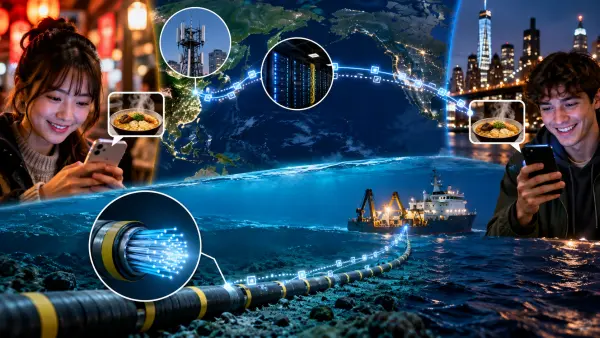
It is late evening in New York when a phone buzzes. A photo appears: a steaming bowl of noodles, taken in Seoul a moment ago. Sharing a picture this way has become so mundane that almost nobody stops to wonder how it works. Yet within a second or so, that image has been compressed, scrambled, cut into pieces, fired across an ocean as flashes of light and rebuilt without a single pixel out of place.
The journey begins inside the sender’s phone. A digital photo is already a long string of ones and zeros, and the messaging app usually compresses it first, often to around two megabytes, or some 16 million bits. Many apps then encrypt the file, so anyone who manages to intercept it along the way sees only gibberish. Once the file is encrypted, it is chopped into packets, bundles of up to about 1,500 bytes each. A two-megabyte photo becomes well over a thousand of them, and each one carries a label stating where it is going and where it fits in the sequence.
As soon as the packets leave the phone, they travel as radio waves to a nearby cell tower or Wi-Fi router. From there, equipment converts the signal into pulses of laser light and sends them into fiber-optic cable, strands of glass about as thin as a human hair. Inside glass, light slows to roughly 200,000 kilometers per second, about two-thirds of its speed in a vacuum, still fast enough to circle the Earth five times a second. Fiber also carries enormous amounts of data with little loss, which is why it forms the backbone of the internet.
What happens next surprises most people: no single machine plans the route. Each router along the way does one modest job. It reads the destination address and hands the packet to whichever neighbor is likely to bring it closer. If a link is congested or broken, the router sends traffic another way. Because the system is decentralized, with no central control room that could fail, it is remarkably resilient. Packets from the same photo can even take different paths.
To reach North America, the data has to cross the Pacific. Some of the cables linking Korea to the United States come ashore near Busan; others connect through Japan. On the deep-ocean floor, often several kilometers down, these cables are surprisingly slender: about as thick as a garden hose. The research firm TeleGeography tracks more than 600 active and planned submarine cables, which carry around 99 percent of the data that crosses oceans. Satellites, which many people assume do this work, handle only a small fraction of it. Because light fades in glass, devices called repeaters are spaced along the cable, typically every few dozen kilometers or more. Each one boosts the light directly, without turning it back into electricity.
Once the light reaches the West Coast, land cables carry the data across North America to New York, where the final stretch is radio again. The packets do not arrive neatly. They are jumbled, having taken different routes, and a few have been lost, perhaps dropped by an overloaded router. This is where the sequence numbers matter. The receiving device reassembles the packets in order, notices the gaps and asks for the missing pieces to be sent again. The photo does not appear until every piece is in place and the file has been decrypted.
How long does all of this take? Light alone needs about 60 milliseconds to cover the 12,000 kilometers or more between Seoul and New York. In practice, the latency, or delay, is higher: a signal making a round trip between the two regions typically takes around 180 milliseconds, because routers, detours and the longer real-world path all add time. The weak point of the system is surprisingly ordinary. Every year there are roughly 150 to 200 faults in submarine cables worldwide, and most are caused by fishing gear and ship anchors that snag cables on the seabed. When that happens, the routers send traffic another way while a repair ship locates the break, lifts both ends to the surface and joins the glass back together, one hair-thin strand at a time.
Vocabulary
Each word has a frequency score, a rank, and a tag. The score shows how common the word is in modern English: higher means more common, and each full point means roughly ten times more common. The rank is the word’s position on a list of about 321,000 English word forms, from most to least common. The tag shows where you are most likely to meet the word: Current, Formal, Literary, or Dated. The paragraph number shows where the word first appears in the reading. The labels are information, not instructions. Deciding which words are worth your time is up to you. How to read the scores, ranks, and tags.
mundane (adjective): so ordinary and familiar that it seems dull or not worth noticing.
Frequency: 3.43 | Rank: 16,455 | Current | Paragraph 1
Translations: 平凡的 | ありふれた | 평범한 | साधारण | عادي | обыденный | cotidiano | banal
- Sending a photo overseas has become so mundane that few people think about it.
- She spent the morning on mundane tasks like answering emails and paying bills.
intercept (verb): to stop, catch, or secretly take something while it is on its way from one place to another.
Frequency: 3.57 | Rank: 13,496 | Current | Paragraph 2
Translations: 拦截 | 傍受する | 가로채다 | बीच में रोकना | يعترض | перехватывать | interceptar | intercepter
- Encryption means that anyone who intercepts the photo sees only random data.
- The defender intercepted the pass and ran up the field.
gibberish (noun): speech, writing, or data that makes no sense and cannot be understood.
Frequency: 2.97 | Rank: 30,017 | Current | Paragraph 2
Translations: 乱码 | 意味不明な文字列 | 알아볼 수 없는 내용 | निरर्थक बातें | هراء | тарабарщина | galimatías | charabia
- Without the key, the encrypted file looks like gibberish.
- I was so tired that my notes from the lecture were pure gibberish.
backbone (noun): the main part of a system that supports and connects everything else; in networking, the high-capacity lines that carry most traffic.
Frequency: 3.53 | Rank: 14,307 | Current | Paragraph 3
Translations: 骨干 | 基幹 | 근간 | रीढ़ | العمود الفقري | основа | columna vertebral | colonne vertébrale
- Fiber-optic cable forms the backbone of the internet.
- Small family farms are the backbone of the local economy.
congested (adjective): so full of traffic, people, or data that movement becomes slow or blocked.
Frequency: 3.17 | Rank: 23,253 | Current | Paragraph 4
Translations: 拥堵的 | 混雑した | 혼잡한 | जाम | مزدحم | перегруженный | congestionado | saturé
- When one link is congested, routers send packets another way.
- The roads into the city are badly congested every Friday evening.
decentralized (adjective): controlled or organized by many separate parts rather than from one central place.
Frequency: 3.29 | Rank: 19,825 | Formal | Paragraph 4
Translations: 去中心化的 | 分散型の | 분산형의 | विकेंद्रीकृत | لامركزي | децентрализованный | descentralizado | décentralisé
- The internet is decentralized, so no single control room decides where packets go.
- The company has a decentralized structure, and each branch makes its own decisions.
resilient (adjective): able to keep working, or to recover quickly, after damage, difficulty, or a sudden change.
Frequency: 3.50 | Rank: 14,928 | Current | Paragraph 4
Translations: 有韧性的 | 回復力のある | 회복력 있는 | लचीला | مرن | устойчивый | resiliente | résilient
- The network is resilient because traffic can go around a broken link.
- Children are often more resilient than adults expect.
come ashore (phrasal verb): to arrive on land from the sea.
Frequency: no score (phrase) | Current | Paragraph 5
Translations: 上岸 | 陸揚げされる | 육지에 닿다 | तट पर पहुँचना | يصل إلى البر | выходить на берег | llegar a tierra | toucher terre
- Several Pacific cables come ashore on the coast of Oregon.
- The sailors came ashore to buy food and fresh water.
slender (adjective): thin and narrow, often in a way that is surprising or graceful.
Frequency: 3.59 | Rank: 13,127 | Literary | Paragraph 5
Translations: 细长的 | 細い | 가느다란 | पतला | رفيع | тонкий | delgado | fin
- Deep-sea cables are surprisingly slender for the data they carry.
- A slender cat squeezed through the gap in the fence.
fraction (noun): a small part or amount of something.
Frequency: 3.96 | Rank: 7,553 | Current | Paragraph 5
Translations: 一小部分 | ごく一部 | 일부 | अंश | جزء صغير | доля | fracción | fraction
- Satellites carry only a small fraction of the data that crosses oceans.
- The jacket was on sale for a fraction of the usual price.
boosts (verb, third person): makes something stronger, higher, or more powerful.
Frequency: 3.41 | Rank: 16,896 | Current | Paragraph 5
Translations: 增强 | 増幅する | 증폭시키다 | बढ़ाना | يقوّي | усиливает | refuerza | amplifie
- Each repeater boosts the light so it can keep crossing the ocean.
- A good night’s sleep boosts my mood for the whole day.
jumbled (adjective): mixed together in a confused way, with no clear order.
Frequency: 2.69 | Rank: 42,145 | Current | Paragraph 6
Translations: 杂乱的 | 順序がばらばらの | 뒤죽박죽인 | अस्त-व्यस्त | مبعثر | перемешанный | desordenado | mélangé
- The packets arrive jumbled because they take different routes.
- My clothes were all jumbled together at the bottom of the bag.
reassembles (verb, third person): puts the separate parts of something back together again.
Frequency: 1.57 | Rank: 157,761 | Formal | Paragraph 6
Translations: 重新组装 | 組み立て直す | 재조립하다 | फिर से जोड़ना | يعيد تجميع | собирает заново | reensambla | réassemble
- The phone reassembles the packets into a complete photo.
- After cleaning the bike, he reassembles it in the garage.
latency (noun): the delay between the moment data is sent and the moment it arrives.
Frequency: 3.31 | Rank: 19,336 | Formal | Paragraph 7
Translations: 延迟 | 遅延 | 지연 시간 | विलंबता | زمن التأخير | задержка | latencia | latence
- The latency between Seoul and New York is around 180 milliseconds for a round trip.
- Online gamers choose servers with low latency so the game feels smooth.
snag (verb): to catch on something sharp or rough, so that it is pulled, held, or torn.
Frequency: 3.27 | Rank: 20,356 | Current | Paragraph 7
Translations: 钩住 | 引っかける | 걸어 끌어당기다 | फँसा लेना | يعلَق بـ | зацеплять | enganchar | accrocher
- Ship anchors can snag cables lying on the seabed.
- Be careful not to snag your sweater on the nail.
Word Partners
Collocations. Match the two halves to make common phrases. Then use three of the phrases in sentences of your own.
| 1. mundane | a. backbone of the internet |
| 2. intercept | b. your confidence |
| 3. talk complete | c. of a second |
| 4. form the | d. a message |
| 5. heavily congested | e. gibberish |
| 6. remarkably | f. roads |
| 7. in a fraction | g. resilient |
| 8. boost | h. chores |
Answers
- mundane chores (h)
- intercept a message (d)
- talk complete gibberish (e)
- form the backbone of the internet (a)
- heavily congested roads (f)
- remarkably resilient (g)
- in a fraction of a second (c)
- boost your confidence (b)
Word families. Complete each sentence with the correct form of the word in brackets.
- Each repeater gives the fading signal a __________. (boosts)
- Traffic __________ is worst in the evening, when everyone is streaming video. (congested)
- Some governments want more __________ of power to cities and regions. (decentralized)
- Her __________ after the accident surprised everyone. (resilient)
- The drawer was a __________ of old cables and chargers. (jumbled)
- The police __________ of the message stopped the plan. (intercept)
Answers
- boost
- congestion
- decentralization / decentralisation
- resilience
- jumble
- interception
Activity Page
Open the activity page in a new tab
Speed Challenge
Answer 12 questions against the clock. Every wrong answer adds 5 seconds, and the lowest score wins. Open the speed challenge in a new tab.
Quick Reading and Typing: A Photo’s Journey in Brief
A shorter version of the reading that uses the lesson vocabulary. Read it for a quick introduction to the topic, or use it for reading aloud, shadowing (reading along with a model), and typing practice.
Sending a photo from Seoul to New York feels mundane, but a lot happens in a second or so. First, the messaging app compresses the photo, often to about two megabytes, or some 16 million bits. Many apps then encrypt it, so anyone who manages to intercept it sees only gibberish. Once the file is encrypted, it is chopped into packets of up to about 1,500 bytes. Each packet carries a label with its destination and its place in the sequence.
As soon as the packets leave the phone, they travel as radio waves to a nearby cell tower or Wi-Fi router. There, the signal becomes pulses of laser light in fiber-optic cable. Inside glass, light travels at about 200,000 kilometers per second. Fiber carries huge amounts of data with little loss, so it forms the backbone of the internet.
No single machine plans the route. Each router reads the address and passes the packet to a neighbor that is likely to bring it closer. If a link is congested or broken, the router sends the packet another way. This decentralized design makes the network resilient. Packets from the same photo can even take different paths.
To cross the Pacific, the data travels on cables that come ashore near Busan or connect through Japan. On the deep seabed, these cables are slender, about as thick as a garden hose. Undersea cables carry around 99 percent of the data that crosses oceans. Satellites carry only a small fraction. Along the way, each repeater boosts the fading light.
The packets arrive jumbled, and a few are lost. The receiving device reassembles the packets in order and asks for the missing ones again. The photo does not appear until every piece is in place. A round trip between Seoul and New York typically takes about 180 milliseconds. Most of that latency comes from distance and routing. Each year there are about 150 to 200 cable faults, mostly when fishing gear or ship anchors snag cables.
How to practice
- Read the text silently once and check any words you are unsure of.
- Read it aloud slowly, one sentence at a time. On the typing page, the Listen button reads each line with your device’s voice, so you can listen first and then repeat.
- Shadow: read aloud again at a natural speed, trying to keep a steady rhythm without stopping.
- Record yourself, listen back, and note one sentence to practice again.
- Type it on the typing page below and check your speed and accuracy.
Open the typing practice in a new tab
Comprehension Questions
- What does the messaging app do to a photo before it leaves the phone?
- Why does encryption matter if someone intercepts the data?
- What two pieces of information does each packet carry?
- How do the packets get from the phone to the fiber-optic network?
- Explain how routers move packets without a central plan.
- Why is the network described as resilient?
- Why are satellites less important than many people think?
- What problem does the receiving device have to solve, and how does it solve it?
- Why does the writer end with cable faults? What do they reveal about the internet?
IELTS-Style Questions
- True, False, or Not Given: “Satellites carry most of the data that crosses oceans.” Explain your answer using the reading.
- Yes, No, or Not Given: “The writer suggests that one broken link can stop all internet traffic.” Explain your answer using the reading.
- Author’s purpose: Why does the writer say the cables are “about as thick as a garden hose”? Is it (a) to help readers picture how surprisingly thin they are, (b) to explain how the cables are cleaned, or (c) to compare them with water pipes in cities?
AI Discussion Prompt
I just read an article about what happens when a photo is sent by phone from Seoul to New York. It explained how the photo is compressed, encrypted, and split into packets; how routers pass packets on without any central plan; how slender undersea cables carry about 99 percent of the data that crosses oceans, with repeaters boosting the light; how the receiving phone reassembles jumbled packets; and why fishing gear and anchors cause most cable faults. I am an English learner at about C2 level. Please ask me one question at a time, starting with how I share photos with people far away. Respond to my ideas first, challenge me to justify my opinions, then briefly point out any errors or more natural ways to say what I meant.
AI Vocabulary Prompt
I want to practice vocabulary from an article about how a photo travels across the ocean through undersea cables. Please quiz me on the following words one at a time, using a mix of question types: multiple choice, true/false, sentence completion, and using the word in a sentence of my own. Give me feedback after each answer before moving on, and bring back the words I miss later. Here are the words: mundane, intercept, gibberish, backbone, congested, decentralized, resilient, come ashore, slender, fraction, boosts, jumbled, reassembles, latency, snag.
Discussion Questions
- How many photos or messages do you think you send in a typical day? Who receives most of them?
- Before reading, did you think satellites or cables carried most international data? Where did that idea come from?
- Which step in the photo’s journey surprised you most, and why?
- How do you feel when a message takes longer than usual to send? What do you assume has gone wrong?
- Have you ever had a slow or broken internet connection at an important moment? What happened?
- Why do you think so few people know how the internet physically works?
- Encryption is meant to keep data safe. How much do you trust tech companies with your private pictures?
- Is it better for a system to be decentralized, like the internet, or controlled from one center? Think of examples beyond technology.
- The word resilient is used for networks, people, and cities. What makes a person or a community resilient?
- A few hundred cables connect the continents. Should countries treat them as critical infrastructure, and what would that mean in practice?
- Who should pay to protect and repair undersea cables: governments, telecom companies, tech firms, or users?
- How has the speed of communication changed relationships between people who live far apart?
- Is instant global communication always a benefit? What might we lose when everything arrives within a second?
- Some countries have only one or two cables linking them to the rest of the world. How might that affect their economy and politics?
Language Focus: Time Clauses (once, as soon as, until, by the time)
What it is: A time clause starts with a word such as once, as soon as, when, after, before, until, or by the time, and says when the action in the main clause happens. In a time clause about the future or about a general process, we use a present tense, not will.
Why writers use it: Explanations of processes rely on time clauses to show the order of steps and which step must finish before the next one begins.
Examples from the reading:
- “Once the file is encrypted, it is chopped into packets…”
- “As soon as the packets leave the phone, they travel as radio waves to a nearby cell tower or Wi-Fi router.”
- “The photo does not appear until every piece is in place and the file has been decrypted.”
- “Once the light reaches the West Coast, land cables carry the data across North America to New York…”
Part A. Sentence starters Finish each sentence so that it is true for you. Keep the time clause in a present tense.
Plans and the future
- As soon as I get home today, I …
- Once I have saved enough money, I …
- By the time I am forty, I …
Habits and routines
- I never check my messages until …
- When I travel abroad, I always …
Model answers
- As soon as I get home today, I will cook dinner and call my sister.
- Once I have saved enough money, I am going to buy a new laptop.
- By the time I am forty, I will have lived in at least two countries.
- I never check my messages until I have had breakfast.
- When I travel abroad, I always buy a local SIM card as soon as I land.
Part B. Questions Answer each question in a full sentence. Try to answer using a time clause with once, as soon as, until, or by the time. Then ask a partner.
- What is the first thing you do when you wake up?
- What will you do as soon as this class ends?
- How long do you usually wait before you reply to a message from a friend?
- What do you want to have done by the time you graduate or retire?
- When will you feel confident enough to give a presentation in English?
Model answers
- As soon as I wake up, I check the weather on my phone.
- As soon as this class ends, I will get a coffee.
- I usually reply as soon as I see the message, unless I am busy.
- By the time I graduate, I want to have spent a semester abroad.
- I will feel confident once I have practiced a few times in front of friends.
Online Resources
- A photo’s journey under the Pacific (Instagram). A short video that slows down the trip of a photo from one phone to another across the ocean.
- Submarine Cable Map (TeleGeography). An interactive world map of undersea cables. Click a cable to see where it comes ashore.
- Submarine Cable Frequently Asked Questions (TeleGeography). Clear answers about how many cables exist, how thick they are, and why satellites carry so little.
- Submarine communications cable (Wikipedia). A detailed overview of cable history, repeaters, and the causes of cable faults (paragraphs 5 and 7).
- What is a packet? (Cloudflare Learning Center). A plain explanation of how data is split into packets, labeled, and put back together (paragraphs 2 and 6).