
Level: C1
Before You Read | Reading | Vocabulary | Word Partners | Activities | Speed Challenge | Quick Reading | Questions | AI Prompts | Discussion | Language Focus | Resources
Printable: Student handout (PDF | Word) | Teacher’s key (PDF | Word)
Before You Read
Think about these questions or discuss them with a partner.
- Did you play football (soccer) or another ball game as a child? Where did you play, and what did you use for goals?
- Which football teams or players are popular where you live, and what makes them popular?
- How might people’s interest in football differ by country, age, or gender?
Reading
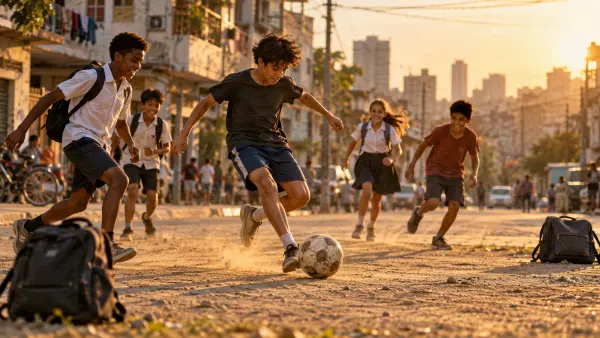
Walk through almost any city late in the afternoon and you are likely to find the same scene: a patch of dusty ground or a quiet side street, two schoolbags marking a goal, and a ball that has seen better days. The players might be in Lagos, Lima, Hanoi, or Marseille, but the game needs no translation. Football, or soccer as a few countries call it, asks for almost nothing: no special field, no expensive kit, just something round to kick. That goes a long way toward explaining its ubiquity. Its governing body, FIFA, now has more member associations than the United Nations has member states.
People have been kicking things around for a very long time. In China, a game called cuju was played more than 2,000 years ago with a ball stuffed with feathers, and early military writers presented it as training for soldiers. By the Song dynasty, about a thousand years ago, the best players had turned it into a profession. Medieval Europe had its own version, and it was far more unruly: whole villages chased a ball through the streets, with few rules and plenty of injuries. London banned the game in 1314, and English kings and towns kept issuing similar bans for centuries, to little avail.
The modern game, however, was born in a London pub. By the mid-1800s, English schools and clubs all played football, but each followed its own rules, so a match between two of them could easily degenerate into an argument. In October 1863, representatives of about a dozen clubs met at the Freemasons’ Tavern to agree on a single set of laws. One sticking point was whether players could carry the ball. Another was hacking, the practice of kicking an opponent in the shins. When the new laws banned hacking, the Blackheath club pulled out, and it later helped to found rugby’s own governing body. The organization that remained called itself the Football Association, and students at Oxford, who liked to shorten words and add “-er,” turned “association” into “soccer.”
What happened next is a story of trade and empire. In the late 1800s, British ships, engineers, and businesses reached almost every corner of the world, and football traveled with them. Sailors played on the docks, railway workers organized matches, and teachers at British-run schools put the game on the timetable. Many famous clubs still carry traces of this origin. Genoa in Italy was founded by British residents, and AC Milan still uses the English spelling of its city’s name. In Brazil, the best-known pioneer was Charles Miller, the São Paulo-born son of a Scottish railway engineer. He came home from school in England in 1894 with two footballs and a book of rules.
The pupils soon overtook their teachers. Uruguay won the Olympic football tournaments of 1924 and 1928 and then hosted the first World Cup in 1930, timed to coincide with a hundred years of independence. Only 13 teams took part, partly because the long sea voyage deterred most European countries. FIFA had been founded in Paris in 1904 by seven continental European associations, with no British members, and England did not enter a World Cup until 1950, when it famously lost to a team from the United States. Football was now growing on its own terms, no longer simply a British export.
Along the way, the game took on meanings far beyond sport. In 1958, a group of Algerian players left their clubs in France to form a team for the movement fighting for Algeria’s independence. They played more than a hundred matches abroad, helping to bolster support for the cause. Across Africa and Asia, newly independent countries often treated a national team as a rallying point, a way to make a young nation feel real. Women, meanwhile, were pushed to the edges. In 1921, a year after one women’s match had drawn a crowd of about 53,000, the English FA banned women’s games from its members’ grounds, calling football “quite unsuitable for females.” Brazil went further, outlawing women’s football from 1941 to 1979. Many historians see these bans as one reason the women’s game is still catching up in pay and attention.
The first World Cup in Asia was held in South Korea and Japan in 2002, and in 2022 Morocco became the first African team to reach the semi-finals. The 2026 tournament in Canada, Mexico, and the United States, the first with 48 teams, brought debuts for Cape Verde, Curaçao, Jordan, and Uzbekistan. Spain beat Argentina in the final, but one of the tournament’s quieter milestones came earlier. Curaçao, a Caribbean island of about 160,000 people, became the smallest country by population ever to qualify, and its players stepped onto the same stage as Brazil, where a young man had once unpacked two footballs and a rulebook.
Vocabulary
Each word has a frequency score, a rank, and a tag. The score shows how common the word is in modern English: higher means more common, and each full point means roughly ten times more common. The rank is the word’s position on a list of about 321,000 English word forms, from most to least common. The tag shows where you are most likely to meet the word: Current, Formal, Literary, or Dated. The paragraph number shows where the word first appears in the reading. The labels are information, not instructions. Deciding which words are worth your time is up to you. How to read the scores, ranks, and tags.
has seen better days (idiom (verb phrase)): is old and in poor condition after a lot of use.
Frequency: no score (phrase) | Current | Paragraph 1
Translations: 已经破旧不堪 | 使い古された | 낡을 대로 낡은 | पुराना और घिसा हुआ | بالٍ ومستهلك | видавший виды | ha conocido tiempos mejores | a connu des jours meilleurs
- The children played with a ball that had seen better days.
- My old laptop has seen better days, but it still works.
ubiquity (noun): the fact of being found almost everywhere.
Frequency: 2.66 | Rank: 43,663 | Formal | Paragraph 1
Translations: 无处不在 | どこにでもあること | 어디에나 있음 | सर्वव्यापकता | الانتشار في كل مكان | повсеместность | omnipresencia | omniprésence
- Football’s ubiquity owes a lot to how little equipment it needs.
- The ubiquity of smartphones has changed how people travel.
unruly (adjective): noisy, disorderly, and difficult to control.
Frequency: 3.08 | Rank: 26,092 | Current | Paragraph 2
Translations: 难以控制的 | 手に負えない | 무질서한 | उपद्रवी | غير منضبط | буйный | revoltoso | indiscipliné
- Medieval football was an unruly game with few rules.
- The teacher struggled with an unruly class on Friday afternoon.
to little avail (phrase): with very little success or effect.
Frequency: no score (phrase) | Formal | Paragraph 2
Translations: 收效甚微 | ほとんど効果なく | 별 효과 없이 | बहुत कम सफलता के साथ | دون جدوى تُذكر | почти безрезультатно | con escaso resultado | sans grand succès
- Authorities banned football many times, to little avail.
- I tried to fix the printer myself, to little avail.
degenerate (verb): to become worse, often gradually, as in a discussion that degenerates into a fight.
Frequency: 3.33 | Rank: 18,811 | Current | Paragraph 3
Translations: 恶化为 | 悪化する | 변질되다 | बिगड़ जाना | يتحول إلى الأسوأ | скатиться | degenerar | dégénérer
- Early matches could degenerate into arguments about the rules.
- The meeting degenerated into a shouting match.
sticking point (noun phrase): an issue that people cannot agree on and that blocks progress.
Frequency: no score (phrase) | Current | Paragraph 3
Translations: 症结 | 争点 | 쟁점 | विवाद का मुद्दा | نقطة خلاف | камень преткновения | escollo | point d’achoppement
- Hacking was a sticking point at the 1863 meetings.
- Salary was the main sticking point in the job offer.
traces (noun, plural): small signs or marks that show something existed or happened.
Frequency: 3.89 | Rank: 8,417 | Current | Paragraph 4
Translations: 痕迹 | 名残 | 흔적 | निशान | آثار | следы | huellas | traces
- Many clubs still carry traces of their British origins.
- The police found traces of paint on his shoes.
pioneer (noun): one of the first people to do something or develop a new area.
Frequency: 3.91 | Rank: 8,146 | Current | Paragraph 4
Translations: 先驱 | 先駆者 | 선구자 | अग्रणी | رائد | первопроходец | pionero | pionnier
- Charles Miller was a pioneer of football in Brazil.
- She was a pioneer in the use of online learning.
coincide (verb): to happen at the same time as something else.
Frequency: 3.49 | Rank: 15,146 | Current | Paragraph 5
Translations: 同时发生 | 同時に起こる | 동시에 일어나다 | एक साथ होना | يتزامن | совпадать | coincidir | coïncider
- The 1930 World Cup was timed to coincide with a national anniversary.
- My holiday coincides with my sister’s wedding.
deterred (verb, past tense): made someone decide not to do something, usually because of difficulty, cost, or fear.
Frequency: 2.90 | Rank: 32,798 | Formal | Paragraph 5
Translations: 使……望而却步 | 思いとどまらせた | 단념시켰다 | हतोत्साहित किया | أثنى عن | отпугнул | disuadió | a dissuadé
- The long journey deterred many European teams in 1930.
- The rain deterred few fans from coming to the match.
on its own terms (phrase): in a way that it chooses for itself, not controlled by others.
Frequency: no score (phrase) | Current | Paragraph 5
Translations: 按自己的方式 | 独自のやり方で | 자기 방식대로 | अपनी शर्तों पर | بشروطه الخاصة | на своих условиях | en sus propios términos | selon ses propres termes
- By 1930, football was growing on its own terms around the world.
- After years abroad, she wanted to live on her own terms.
bolster (verb): to make something stronger or more successful, such as support, confidence, or an argument.
Frequency: 3.31 | Rank: 19,336 | Current | Paragraph 6
Translations: 加强 | 強化する | 강화하다 | मज़बूत करना | يعزز | укреплять | reforzar | renforcer
- The Algerian team helped to bolster support for independence.
- A good result can bolster a young player’s confidence.
rallying point (noun phrase): a person, idea, or thing that brings people together to support a shared cause.
Frequency: no score (phrase) | Current | Paragraph 6
Translations: 凝聚人心的象征 | 結集の象徴 | 구심점 | एकजुटता का केंद्र | نقطة التفاف | объединяющий символ | símbolo de unidad | point de ralliement
- For many new nations, the national team became a rallying point.
- The old library became a rallying point for the neighborhood.
outlawing (verb, -ing form): making something illegal by law.
Frequency: 2.64 | Rank: 44,767 | Current | Paragraph 6
Translations: 取缔 | 非合法化 | 불법화 | ग़ैरक़ानूनी घोषित करना | تجريم | запрещение | prohibir | interdire
- Brazil went further, outlawing women’s football for almost 40 years.
- Several cities are outlawing old diesel cars from their centers.
milestones (noun, plural): important events that mark a stage in the development of something.
Frequency: 3.34 | Rank: 18,537 | Current | Paragraph 7
Translations: 里程碑 | 画期的な出来事 | 이정표 | मील का पत्थर | معالم بارزة | вехи | hitos | jalons
- Curaçao’s debut was one of the 2026 World Cup’s milestones.
- Walking and talking are important milestones in a child’s development.
Word Partners
Collocations. Match the two halves to make common phrases. Then use three of the phrases in sentences of your own.
| 1. an unruly | a. confidence |
| 2. degenerate into | b. the high cost |
| 3. a major sticking | c. crowd |
| 4. leave no | d. chaos |
| 5. pioneer a new | e. trace |
| 6. be deterred by | f. milestone |
| 7. bolster | g. technique |
| 8. reach an important | h. point |
Answers
- an unruly crowd (c)
- degenerate into chaos (d)
- a major sticking point (h)
- leave no trace (e)
- pioneer a new technique (g)
- be deterred by the high cost (b)
- bolster confidence (a)
- reach an important milestone (f)
Word families. Complete each sentence with the correct form of the word in brackets.
- Smartphones are now __________ in cities around the world. (ubiquity)
- She did __________ research on the history of women’s football. (pioneer)
- It was no __________ that the first World Cup was held in 1930. (coincide)
- Fines are meant to act as a __________ to dangerous driving. (deterred)
- The __________ of the debate into personal insults upset the audience. (degenerate)
- Many football traditions can be __________ back to British sailors and engineers. (traces)
Answers
- ubiquitous
- pioneering
- coincidence
- deterrent
- degeneration
- traced
Activity Page
Open the activity page in a new tab
Speed Challenge
Answer 12 questions against the clock. Every wrong answer adds 5 seconds, and the lowest score wins. Open the speed challenge in a new tab.
Quick Reading and Typing: Football History in Brief
A shorter version of the reading that uses the lesson vocabulary. Read it for a quick introduction to the topic, or use it for reading aloud, shadowing (reading along with a model), and typing practice.
On streets and dusty fields around the world, people play football with two bags for a goal and a ball that has seen better days. The game needs almost no equipment, which helps to explain its ubiquity. Its governing body, FIFA, has more member associations than the United Nations has member states.
Kicking games are very old. In China, a game called cuju was played more than 2,000 years ago, partly as training for soldiers. Medieval Europe had a more unruly version, in which whole villages chased a ball through the streets. London banned the game in 1314, and English authorities kept banning it for centuries, to little avail.
The modern game began in a London pub in 1863. Schools and clubs played by different rules, so matches could degenerate into arguments. One sticking point was hacking, the practice of kicking an opponent in the shins. The new Football Association banned it, and the club that wanted to keep it left and later helped found rugby. Later, students at Oxford turned “association” into “soccer,” a word still used in a few countries.
British sailors, railway workers, and teachers carried the game around the world. Many clubs still show traces of this origin. AC Milan, for example, still uses the English spelling of its city’s name. In Brazil, the best-known pioneer was Charles Miller, the son of a Scottish railway engineer. He came home from school in England in 1894 with two footballs and a book of rules. Local players soon made the game their own. Uruguay hosted the first World Cup in 1930, timed to coincide with a hundred years of independence. The long sea voyage deterred most European teams, so only 13 teams took part. Football was now growing on its own terms.
The game also took on meanings beyond sport. In 1958, Algerian players left their clubs in France to form a team that would bolster support for Algeria’s independence. For many new nations, a national team became a rallying point. Women, however, were pushed aside. In 1921, England’s FA banned women’s games from its members’ grounds. Brazil went further, outlawing women’s football from 1941 to 1979. In 2026, the World Cup had 48 teams for the first time. One of its milestones was the debut of Curaçao, an island of about 160,000 people. It became the smallest country by population ever to qualify.
How to practice
- Read the text silently once and check any words you are unsure of.
- Read it aloud slowly, one sentence at a time. On the typing page, the Listen button reads each line with your device’s voice, so you can listen first and then repeat.
- Shadow: read aloud again at a natural speed, trying to keep a steady rhythm without stopping.
- Record yourself, listen back, and note one sentence to practice again.
- Type it on the typing page below and check your speed and accuracy.
Open the typing practice in a new tab
Comprehension Questions
- According to the writer, why can football be played almost anywhere?
- What was cuju, and what was it partly used for?
- What was medieval football like in Europe, and how successful were the attempts to ban it?
- Why did matches between schools and clubs in England often end in arguments before 1863?
- What was hacking, and what did the new Football Association decide about it?
- Who was Charles Miller, and what did he bring to Brazil?
- Why did only 13 teams play at the first World Cup in 1930?
- Why did a group of Algerian players leave their clubs in France in 1958?
- Why does the writer describe Curaçao’s place at the 2026 World Cup as a milestone?
IELTS-Style Questions
- True, False, or Not Given? “Charles Miller later played for Brazil’s national team.”
- Yes, No, or Not Given? “The writer suggests that, by 1930, football still depended mainly on Britain to grow.” Explain your answer using the reading.
- Author’s purpose: Why does the writer mention the spelling of AC Milan’s name? Is it (a) to show a trace of the British origins of many clubs, (b) to compare the Italian and English languages, or (c) to suggest that AC Milan is the oldest club in Italy?
AI Discussion Prompt
I just read an article about the history and global spread of football (soccer). It covered early kicking games such as cuju in China, unruly medieval football in Europe, the founding of the Football Association in a London pub in 1863, how British sailors, railway workers, and teachers carried the game abroad, Charles Miller in Brazil, the first World Cup in Uruguay in 1930, the Algerian independence team of 1958, bans on women’s football in England and Brazil, and the first 48-team World Cup in 2026. I am an English learner at about C1 level. Please ask me one question at a time, starting with my own experience of football or another team sport. Respond to my ideas first, challenge me to support my opinions with examples, then briefly point out any language errors or more natural ways to say what I meant.
AI Vocabulary Prompt
I want to practice vocabulary from an article about the history and global spread of football. Please quiz me on the following words one at a time, using a mix of question types: multiple choice, sentence completion, collocations, and using the word in a sentence of my own. Give me feedback after each answer before moving on, and bring back the words I miss later. Here are the words: has seen better days, ubiquity, unruly, to little avail, degenerate, sticking point, traces, pioneer, coincide, deterred, on its own terms, bolster, rallying point, outlawing, milestones.
Discussion Questions
- Do you prefer to watch sports or to play them? Why?
- Which sports are popular in your country but little known elsewhere?
- Have you ever watched a big football match with a large group of people? What was the atmosphere like?
- What is this sport called in your language, and do you know where the word comes from?
- Cricket and rugby also traveled with the British. Why might football have spread more widely than either of them?
- Many clubs carry traces of their origins in their names, colors, or badges. Do you know the story behind a club or team near you?
- Is it a problem that so many global sports were first organized in just a few countries? Why or why not?
- Can a national team really be a rallying point for a country? Give an example you know.
- Should sport and politics be kept separate? Think about the Algerian team of 1958.
- Women’s football was banned or limited in several countries for decades. What effects might that still have today?
- Is a 48-team World Cup a good idea? Consider small countries, players’ health, and the quality of the matches.
- Ancient games such as cuju are sometimes revived for festivals and tourists. Is it worth keeping old games alive?
- How has the internet changed the way people around the world follow football?
- Some people say football is “just a game.” Others see it as part of who they are. Which view is closer to yours, and why?
Language Focus: Appositives: Noun Phrases That Rename
What it is: An appositive is a noun phrase placed right next to another noun to say who or what it is. When it adds extra information, it is set off with commas: <em>Charles Miller, the son of a Scottish railway engineer, …</em> It can come in the middle of a sentence or at the end.
Why writers use it: History writing introduces many people, places, and unfamiliar terms. An appositive lets the writer identify or explain them inside the same sentence, without stopping for a new one, which keeps the story moving.
Examples from the reading:
- “Its governing body, FIFA, now has more member associations than the United Nations has member states.”
- “Another was hacking, the practice of kicking an opponent in the shins.”
- “…the best-known pioneer was Charles Miller, the São Paulo-born son of a Scottish railway engineer.”
- “Curaçao, a Caribbean island of about 160,000 people, became the smallest country by population ever to qualify…”
Part A. Sentence starters Finish each sentence so that it is true for you. Add an appositive after the comma, then complete the sentence.
Appositive in the middle
- My hometown, a …
- My favorite athlete or performer, …
- The best teacher I have ever had, …
Appositive at the end
- One place I would love to visit is …
- At home, I still have …
Model answers
- My hometown, a small port city in the south, is famous for its seafood.
- My favorite athlete, a marathon runner from Kenya, trains at high altitude.
- The best teacher I have ever had, my high school history teacher, made every class feel like a story.
- One place I would love to visit is Patagonia, a wild region in the far south of South America.
- At home, I still have my first football, a gift from my grandfather.
Part B. Questions Answer each question in a full sentence. Try to answer using an appositive. Then ask a partner.
- Who is someone you admire?
- What is your favorite book, film, or series?
- Which sport or game do you know best?
- What is one dish visitors should try in your country or region?
- Who is a famous person from your country or city?
Model answers
- I admire my aunt, a doctor who works in rural clinics.
- My favorite film is Spirited Away, an animated film by Hayao Miyazaki.
- I know badminton best, a sport I played every day in high school.
- Visitors should try jollof rice, a spicy rice dish popular across West Africa.
- One famous person from my country is Wangari Maathai, a Kenyan environmental activist.
Online Resources
- The history of the FA (The Football Association). The FA’s own account of the 1863 meetings at the Freemasons’ Tavern and the argument over hacking (paragraph 3).
- Cuju (Wikipedia). How the ancient Chinese kicking game was played, who played it, and how it changed over the centuries (paragraph 2).
- History of the FIFA World Cup (Wikipedia). From the founding of FIFA in 1904 and the 13-team tournament in Uruguay to the 48-team World Cup of 2026.
- Algeria’s Équipe FLN: the movement that used football to fight for freedom (These Football Times). The story of the Algerian players who left French clubs in 1958 to play for independence (paragraph 6).
- Remembering Dick, Kerr Ladies 100 years on (Women in Football). Meet the team that drew a crowd of about 53,000 in 1920, a year before the FA ban (paragraph 6).