
Level: B1
Reading | Vocabulary | Activities | Speed Challenge | Shadow Reading and Typing | Questions | AI Prompts | Discussion | Language Focus | Resources
Printable: Student handout (PDF) | Teacher’s key (PDF)
Reading
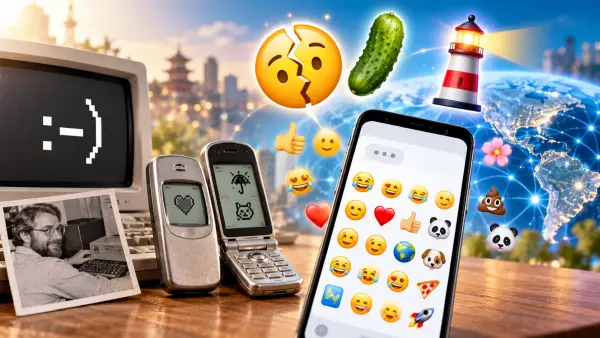
On September 16, 2026, the Unicode Consortium, the group that manages the codes for letters and symbols on computers, approved nine new emoji. They included a cracking face, a pickle, and a lighthouse. With the new skin tone versions, the official list grew to 3,972 emoji. These small pictures appear in messages all over the world, but their story began with a joke and a few Japanese phones.
Before emoji, there were emoticons: faces made from keyboard characters. On September 19, 1982, Scott Fahlman, a computer scientist at Carnegie Mellon University in the United States, suggested 🙂 as a way to mark jokes on an online message board. Readers turned their heads sideways to see the smile. The idea spread to other universities and, later, around the world.
The word emoji comes from Japanese: e means “picture,” and moji means “character.” It is not related to the English word “emotion,” although the two words look alike. In 1999, the phone company NTT Docomo released 176 small pictures for its i-mode mobile internet service. Shigetaka Kurita, a member of the i-mode team, designed them on a grid of only 12 by 12 pixels. The set had weather pictures, a heart, and simple faces. In 2016, the Museum of Modern Art in New York added it to its collection.
For many years, people called Kurita’s set the first emoji. The real history is more complicated. In 2019, the website Emojipedia reported that a J-Phone mobile phone had 90 emoji in 1997. J-Phone later became part of SoftBank. Its set included the famous pile of poo. Kurita himself wrote that year that the J-Phone set came first on phones. Then, in 2024, a games developer named Matt Sephton found emoji-like symbols on a Sharp electronic organizer from 1988. So who invented emoji? The answer depends on what you count as an emoji.
At first, emoji worked only inside Japan, and each phone company had its own set. In 2007, the Unicode Consortium accepted a proposal from Google engineers to add emoji to Unicode, the system that gives every character a number so that different devices show the same symbol. Apple engineers joined the work later. In 2010, Unicode added hundreds of emoji. The next year, Apple put an emoji keyboard on iPhones around the world. In 2015, Oxford Dictionaries chose the “face with tears of joy” emoji as its Word of the Year, using data from the keyboard company SwiftKey.
A shared number does not mean a shared picture. Each company draws its own emoji, so one character can look different on different phones. In 2016, Hannah Miller and a team at the University of Minnesota asked people in an online survey to describe popular emoji. When people looked at exactly the same picture, they disagreed about whether it was positive, neutral, or negative in 25 percent of cases. The disagreement grew when the pictures came from different companies.
Emoji can even matter in court. In March 2021, a grain buyer in Saskatchewan, Canada, sent a farmer a photo of a contract for flax and asked him to confirm it. The farmer replied with a thumbs-up emoji. He later said it only showed that he received the contract. The flax crop failed that year, and prices went up. In 2023, a judge decided that the emoji meant yes, and the farm had to pay about 82,000 Canadian dollars. In December 2024, two of three appeal judges agreed. The third judge did not accept that one small picture could count as a signature.
Vocabulary
Each word has a frequency score, a rank, and a tag. The score shows how common the word is in modern English: higher means more common, and each full point means roughly ten times more common. The rank is the word’s position on a list of about 321,000 English word forms, from most to least common. The tag shows where you are most likely to meet the word: Current, Formal, Literary, or Dated. The paragraph number shows where the word first appears in the reading. The labels are information, not instructions. Deciding which words are worth your time is up to you. How to read the scores, ranks, and tags.
versions (noun, plural): forms of something that are a little different from the original or from each other.
Frequency: 4.35 | Rank: 3,939 | Current | Paragraph 1
Translations: 版本 | バージョン | 버전 | संस्करण | إصدارات | варианты | versiones | versions
- With the new skin tone versions, the official list grew to 3,972 emoji.
- The film has two versions: one in English and one in Spanish.
official (adjective): approved by a government, an organization, or a person in charge.
Frequency: 5.14 | Rank: 756 | Current | Paragraph 1
Translations: 官方的 | 公式の | 공식적인 | आधिकारिक | رسمي | официальный | oficial | officiel
- The official list grew to 3,972 emoji.
- English is one of the official languages of Singapore.
sideways (adverb): toward one side, not forward, backward, up, or down.
Frequency: 3.54 | Rank: 14,106 | Current | Paragraph 2
Translations: 向侧面 | 横向きに | 옆으로 | एक तरफ़ | جانبيًا | набок | de lado | de côté
- Readers turned their heads sideways to see the smile.
- The car slid sideways on the icy road.
related (adjective): connected to something else in some way, for example by meaning or history.
Frequency: 5.10 | Rank: 831 | Current | Paragraph 3
Translations: 相关的 | 関係がある | 관련된 | संबंधित | مرتبط | связанный | relacionado | lié
- The word emoji is not related to the English word “emotion.”
- She is related to me: she is my cousin.
released (verb, past tense): made a product, film, or piece of software available to the public.
Frequency: 5.05 | Rank: 951 | Current | Paragraph 3
Translations: 发布 | 発表する | 출시하다 | जारी करना | أطلق | выпустить | lanzar | lancer
- In 1999, the phone company NTT Docomo released 176 small pictures.
- The band released a new album last spring.
grid (noun): a pattern of straight lines that cross each other and form small squares.
Frequency: 4.18 | Rank: 5,309 | Current | Paragraph 3
Translations: 网格 | 格子 | 격자 | ग्रिड | شبكة | сетка | cuadrícula | grille
- Kurita designed the pictures on a grid of only 12 by 12 pixels.
- The streets in the city center form a grid.
complicated (adjective): having many parts or details, so it is difficult to understand or explain.
Frequency: 4.47 | Rank: 3,161 | Current | Paragraph 4
Translations: 复杂的 | 複雑な | 복잡한 | जटिल | معقد | сложный | complicado | compliqué
- The real history of emoji is more complicated.
- The instructions were too complicated, so I asked for help.
depends (verb, third person): is decided by something else; changes when something else changes.
Frequency: 4.53 | Rank: 2,831 | Current | Paragraph 4
Translations: 取决于 | 次第である | 달려 있다 | निर्भर करता है | يعتمد على | зависит от | depende de | dépend de
- The answer depends on what you count as an emoji.
- Whether we eat outside depends on the weather.
proposal (noun): a formal plan or idea that is offered to a group so that it can decide.
Frequency: 4.47 | Rank: 3,161 | Formal | Paragraph 5
Translations: 提案 | 提案 | 제안 | प्रस्ताव | اقتراح | предложение | propuesta | proposition
- In 2007, the Unicode Consortium accepted a proposal from Google engineers.
- The students made a proposal to have longer lunch breaks.
devices (noun, plural): machines or tools made for a special purpose, such as phones, tablets, and computers.
Frequency: 4.59 | Rank: 2,523 | Current | Paragraph 5
Translations: 设备 | 機器 | 기기 | उपकरण | أجهزة | устройства | dispositivos | appareils
- Unicode helps different devices show the same symbol.
- Please turn off all electronic devices during the exam.
survey (noun): a set of questions that many people answer, used to learn what they think or do.
Frequency: 4.69 | Rank: 2,072 | Current | Paragraph 6
Translations: 调查 | アンケート調査 | 설문 조사 | सर्वेक्षण | استطلاع | опрос | encuesta | sondage
- The team asked people in an online survey to describe popular emoji.
- The school sent a survey to parents about lunch.
neutral (adjective): neither positive nor negative; not showing a strong feeling.
Frequency: 4.24 | Rank: 4,752 | Current | Paragraph 6
Translations: 中性的 | 中立的な | 중립적인 | तटस्थ | محايد | нейтральный | neutral | neutre
- People disagreed about whether the emoji was positive, neutral, or negative.
- Her face stayed neutral, so I did not know what she thought.
contract (noun): a written or spoken agreement between people or companies that the law can make them follow.
Frequency: 4.94 | Rank: 1,223 | Formal | Paragraph 7
Translations: 合同 | 契約書 | 계약서 | अनुबंध | عقد | договор | contrato | contrat
- A grain buyer sent a farmer a photo of a contract for flax.
- I signed a one-year contract for my apartment.
confirm (verb): to say or show that something is true, correct, or agreed.
Frequency: 4.40 | Rank: 3,612 | Current | Paragraph 7
Translations: 确认 | 確認する | 확인하다 | पुष्टि करना | يؤكد | подтвердить | confirmar | confirmer
- The buyer asked the farmer to confirm the contract.
- Please call the hotel to confirm your booking.
signature (noun): your name written in your own special way, often to show that you agree with a document.
Frequency: 4.25 | Rank: 4,667 | Current | Paragraph 7
Translations: 签名 | 署名 | 서명 | हस्ताक्षर | توقيع | подпись | firma | signature
- The third judge did not accept that one small picture could count as a signature.
- The bank needs your signature on this form.
Activity Page
Open the activity page in a new tab
Speed Challenge
Answer 12 questions against the clock. Every wrong answer adds 5 seconds, and the lowest score wins. Open the speed challenge in a new tab.
Shadow Reading and Typing: My Grandfather’s Thumbs-Up
This short text uses many of the words from this lesson. Use it for shadow reading (reading aloud along with a model) and for typing practice.
My grandfather sent me his first emoji last year. It was a thumbs-up, and I laughed, because he looked so proud. Then I started to think about these little pictures. I read that the official list now has almost 4,000 emoji, including all the versions with different skin tones.
The history was more complicated than I expected. Before emoji, people used emoticons, and you had to look at them sideways to see a face. The word emoji is not related to the English word emotion. It comes from Japanese, and one famous early set was drawn on a tiny grid of pixels. A Japanese phone company released that set in 1999.
Later, a proposal from Google engineers helped add emoji to Unicode, so that different devices could show the same symbol. But the pictures still look different on each phone. In one survey, people did not even agree whether an emoji was positive, negative, or neutral. So the meaning often depends on who is reading it.
One story surprised me. A farmer in Canada used a thumbs-up to confirm a contract, but later he said it only meant he got the message. A judge decided that it meant yes. One appeal judge disagreed and said a small picture is not a signature. Now I use the thumbs-up much more carefully.
How to practice
- Read the text silently once and check any words you are unsure of.
- Read it aloud slowly, one sentence at a time. On the typing page, the Listen button reads each line with your device’s voice, so you can listen first and then repeat.
- Shadow: read aloud again at a natural speed, trying to keep a steady rhythm without stopping.
- Record yourself, listen back, and note one sentence to practice again.
- Type it on the typing page below and check your speed and accuracy.
Open the typing practice in a new tab
Comprehension Questions
- What did the Unicode Consortium approve in September 2026?
- What did Scott Fahlman suggest in 1982, and why?
- Where does the word emoji come from? Is it related to the word emotion?
- What did NTT Docomo release in 1999, and who designed it?
- Why does the writer say that the history of emoji is more complicated than many people think?
- Why was Unicode important for the spread of emoji outside Japan?
- What happened to emoji in 2011 and in 2015?
- What did the 2016 survey at the University of Minnesota find?
- What happened in the Canadian court case, and why did the third appeal judge disagree?
IELTS-Style Questions
- True, False, or Not Given: “Emoji were common outside Japan before the year 2000.” Explain your answer using evidence from the reading.
- Yes, No, or Not Given: “The writer thinks that the question of who invented emoji has one simple answer.” Explain your answer using evidence from the reading.
- Author’s purpose: Why does the writer end with the court case in Canada? Is the aim to give legal advice, to show that emoji can have serious effects, or to explain how emoji are designed?
AI Discussion Prompt
I just read an article about the history of emoji. It covered the first emoticon in 1982, the Japanese word emoji, Shigetaka Kurita’s 1999 set for NTT Docomo, earlier sets from 1997 and 1988, how Unicode helped emoji spread around the world, a 2016 survey showing that people understand the same emoji differently, and a court case in Canada about a thumbs-up emoji. I am an English learner at about B1 level. Please ask me one question at a time, starting with how I use emoji in my own messages. Use simple language, respond to my ideas first, then briefly correct any language errors, and ask follow-up questions that make me explain my reasons.
AI Vocabulary Prompt
I want to practice vocabulary from an article about the history of emoji. Please quiz me on the following words one at a time, using a mix of question types: multiple choice, true/false, and sentence completion. Give me feedback after each answer before moving on, and bring back the words I miss later. Here are the words: versions, official, sideways, related, released, grid, complicated, depends, proposal, devices, survey, neutral, contract, confirm, signature.
Discussion Questions
- Which emoji do you use most often? Why do you like it?
- Do you use emoji more with friends, with family, or at work or school? Why?
- Have you ever sent an emoji that someone did not understand? What happened?
- Do you still type emoticons made from keyboard characters, such as :-)? When do you choose them instead of emoji?
- Some people add emoji to almost every message, and others almost never use them. Which kind of person are you?
- Is it polite to send emoji to a teacher or a manager? Where is the line for you?
- Kurita made his set on a grid of only 12 by 12 pixels. What can simple designs do better than detailed ones?
- Which new emoji would you like to see added to the official list? Who would use it, and when?
- People who speak different languages can all use the same emoji. Can emoji help people communicate across languages, or do they also cause new misunderstandings?
- Do you think older and younger people use the same emoji in different ways? Give an example if you can.
- Many people believe the first emoji came from NTT Docomo in 1999. Why do you think a story like this spreads, even when it is not fully correct?
- Should an emoji ever count as a signature? Explain your view.
- Oxford Dictionaries chose an emoji as its Word of the Year in 2015. Can a picture be a word? Why or why not?
- Is writing with pictures a step forward for human communication, or a step back? Explain your view.
Language Focus: Past Simple with Time Expressions
What it is: The past simple describes finished actions and events in the past. Time expressions such as “in 1999,” “on September 19, 1982,” “that year,” and “the next year” tell the reader exactly when each event happened.
Why writers use it: A history is a series of finished events. Putting the time expression at the start of the sentence helps the reader follow the order of events, one step at a time.
Examples from the reading:
- “On September 19, 1982, Scott Fahlman… suggested 🙂 as a way to mark jokes on an online message board.”
- “In 1999, the phone company NTT Docomo released 176 small pictures for its i-mode mobile internet service.”
- “The next year, Apple put an emoji keyboard on iPhones around the world.”
- “In 2023, a judge decided that the emoji meant yes…”
Practice task: Write three sentences about your own history with phones or messaging. Use the past simple and start each sentence with a different time expression, for example In 2015, When I was ten, or Last year.
(Example answer: “In 2014, I got my first smartphone. The next year, I sent my first emoji to my sister. Last year, I stopped using the crying-laughing face.”)
Recommended Resources
- Smiley is no joke (Carnegie Mellon University). A short page from the university where the first 🙂 was posted, with Scott Fahlman’s original message.
- Correcting the Record on the First Emoji Set (Emojipedia). Why Emojipedia decided that the 1997 J-Phone set, not the 1999 Docomo set, was the earliest known phone emoji set at that time.
- Investigating the Potential for Miscommunication Using Emoji (GroupLens, University of Minnesota). The research team explains its 2016 survey, with pictures of the same emoji on different phones.
- Sask. appeal court gives 2 thumbs up to decision that emoji is contractually binding (CBC News). A news report on the 2024 appeal in the thumbs-up case, including why one judge disagreed.
- What’s New In Unicode 18.0 (Emojipedia). A guide to the nine new emoji approved in September 2026, with notes on why some of them were added.