
Level: B2
Reading | Vocabulary | Activities | Speed Challenge | Shadow Reading and Typing | Questions | AI Prompts | Discussion | Language Focus | Resources
Printable: Student handout (PDF) | Teacher’s key (PDF)
Reading
In September 2026, forecasters at the US National Oceanic and Atmospheric Administration (NOAA) said that the El Niño in the Pacific Ocean was continuing to intensify. They gave a greater than 90 percent chance that it would become “very strong” by the end of the year. News outlets called it a “super El Niño,” an informal label, not an official category. But what can such a forecast tell farmers, water managers, and aid agencies, and what can it not tell them?
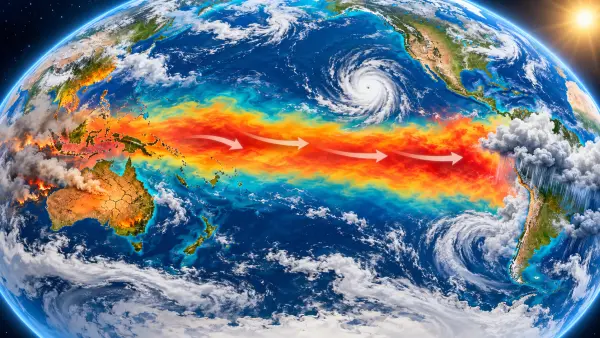
The name comes from Peru. In the nineteenth century, Peruvian fishermen noticed a warm current that appeared around Christmas, and they named it after the Christ child: el niño means “the child” in Spanish. Scientists later used the name for years when the warming is much stronger and more widespread. Normally, trade winds push warm surface water west. During an El Niño, those winds weaken and the warm water shifts east. NOAA declares an El Niño when the sea surface in a key part of the equatorial Pacific is at least 0.5°C warmer than average and the atmosphere responds. It calls an event very strong when the warming passes a threshold of 2.0°C. El Niño events tend to return every two to seven years.
Because the tropical Pacific is so large, El Niño disrupts rainfall and temperatures far away. Records show a pattern. Indonesia, Australia, and southern Africa tend to be drier than normal during El Niño years, while the coasts of Peru and Ecuador tend to be wetter. In India, a weak monsoon, the summer rainy season that farmers depend on, is more likely during an El Niño, and the risk of drought rises. But the pattern is loose. A study by K. Krishna Kumar of the Indian Institute of Tropical Meteorology, reported by the magazine Down to Earth, looked at El Niño years from 1880 to 2004: monsoon rainfall was below normal in 10 of them and normal in 13.
The clearest exceptions have come during strong events. The 1997-98 El Niño was one of the strongest of the twentieth century, yet India’s monsoon rainfall in 1997 was slightly above normal, a result later studied by Indian scientists. In late 2015, during another very strong El Niño, NOAA’s seasonal outlooks favored a wetter than normal winter in Southern California. Instead, the region stayed dry while heavy rain fell farther north. A 2018 study by researchers at Columbia University suggested one reason: the warmest water sat farther west than in earlier strong events. A high likelihood is not a promise.
El Niño is never the only influence. The World Meteorological Organization (WMO) has said that the strength of an El Niño does not directly match the strength of its impacts, and that no two events are alike. Other ocean patterns, such as the Indian Ocean Dipole, can push the weather in the same direction or the opposite one, and long-term warming also plays a part. El Niño’s effect on global temperature tends to be strongest in the year after it begins. The WMO says the 2023-24 El Niño contributed to 2024 becoming the warmest year on record, but it named greenhouse gases as the main cause of the recent heat.
The costs can persist long after an event ends. In severe cases, floods and droughts can trigger crop failures and disease outbreaks. In a 2023 study in the journal Science, Christopher Callahan and Justin Mankin of Dartmouth College estimated that the 1997-98 El Niño reduced global income by $5.7 trillion, because slower economic growth continued for at least five years. That is more than 100 times an earlier World Bank estimate of $45 billion in costs to governments, and some outside economists think the Dartmouth figures are too large. The gap mainly shows that the answer depends on what is counted and for how long.
Forecasts give people time. Floods, droughts, and fires are hazards that cannot be stopped, but aid agencies now try to anticipate El Niño’s effects and act before they arrive, especially for vulnerable farming families. In 2023, the UN Food and Agriculture Organization (FAO) supported repairs to about 4,600 meters of damaged riverbank along Somalia’s Shabelle River before expected floods. By its own assessment, every dollar spent on such early action brings farming families more than seven dollars in avoided losses and other benefits. For 2026-27, the forecast gives a probability, not a map of damage. Whether each region follows the usual pattern will be known only after its rainy season is measured.
Vocabulary
Each word has a frequency score, a rank, and a tag. The score shows how common the word is in modern English: higher means more common, and each full point means roughly ten times more common. The rank is the word’s position on a list of about 321,000 English word forms, from most to least common. The tag shows where you are most likely to meet the word: Current, Formal, Literary, or Dated. The paragraph number shows where the word first appears in the reading. The labels are information, not instructions. Deciding which words are worth your time is up to you. How to read the scores, ranks, and tags.
intensify (verb): to become stronger, greater, or more extreme.
Frequency: 3.16 | Rank: 23,536 | Formal | Paragraph 1
Translations: 加剧 | 強まる | 강화되다 | तेज़ होना | يشتد | усиливаться | intensificarse | s’intensifier
- In September 2026, the El Niño was continuing to intensify.
- The storm is expected to intensify over the weekend.
shifts (verb, third person): moves or changes position, direction, or emphasis.
Frequency: 4.01 | Rank: 7,009 | Current | Paragraph 2
Translations: 移动 | 移る | 이동하다 | खिसकता है | ينتقل | смещается | se desplaza | se déplace
- During an El Niño, the warm water shifts east.
- The wind shifts to the north in the evening.
declares (verb, third person): announces something officially or firmly.
Frequency: 3.71 | Rank: 11,015 | Formal | Paragraph 2
Translations: 宣布 | 宣言する | 선언하다 | घोषित करता है | يعلن | объявляет | declara | déclare
- NOAA declares an El Niño when the Pacific is at least 0.5°C warmer than average.
- The government declares a state of emergency.
threshold (noun): the level or point at which something starts or changes.
Frequency: 4.03 | Rank: 6,784 | Formal | Paragraph 2
Translations: 阈值 | しきい値 | 기준점 | सीमा | عتبة | порог | umbral | seuil
- An event is very strong when the warming passes a threshold of 2.0°C.
- Anyone who earns more than the tax threshold must file a return.
disrupts (verb, third person): interrupts the normal way something works or happens.
Frequency: 2.87 | Rank: 34,063 | Formal | Paragraph 3
Translations: 扰乱 | 混乱させる | 방해하다 | बाधित करता है | يعطّل | нарушает | altera | perturbe
- El Niño disrupts rainfall and temperatures far from the Pacific.
- The noise from the building site disrupts my sleep.
drought (noun): a long period with much less rain than normal, causing water shortages.
Frequency: 3.90 | Rank: 8,266 | Current | Paragraph 3
Translations: 干旱 | 干ばつ | 가뭄 | सूखा | جفاف | засуха | sequía | sécheresse
- During an El Niño, the risk of drought in India rises.
- The drought destroyed most of the corn crop.
exceptions (noun, plural): cases that do not follow a general rule or pattern.
Frequency: 3.97 | Rank: 7,445 | Current | Paragraph 4
Translations: 例外 | 例外 | 예외 | अपवाद | استثناءات | исключения | excepciones | exceptions
- India’s normal monsoon in 1997 was one of the clearest exceptions.
- Everyone passed the test, with two exceptions.
likelihood (noun): the chance or probability that something will happen.
Frequency: 3.91 | Rank: 8,146 | Formal | Paragraph 4
Translations: 可能性 | 可能性 | 가능성 | संभावना | احتمال | вероятность | probabilidad | probabilité
- A high likelihood of rain is not a promise of rain.
- Wearing a helmet reduces the likelihood of serious injury.
contributed (verb, past tense): helped to cause something, or gave something to a shared effort.
Frequency: 4.39 | Rank: 3,683 | Current | Paragraph 5
Translations: 促成 | 一因となった | 기여했다 | योगदान दिया | ساهم | способствовал | contribuyó | a contribué
- The 2023-24 El Niño contributed to 2024 becoming the warmest year on record.
- Poor planning contributed to the delay.
persist (verb): to continue to exist or happen, especially for longer than expected.
Frequency: 3.53 | Rank: 14,307 | Formal | Paragraph 6
Translations: 持续 | 続く | 지속되다 | बने रहना | يستمر | сохраняться | persistir | persister
- The economic costs of El Niño can persist for years.
- If the pain persists, see a doctor.
severe (adjective): very serious, harsh, or extreme.
Frequency: 4.56 | Rank: 2,669 | Current | Paragraph 6
Translations: 严重的 | 深刻な | 심각한 | गंभीर | شديد | серьёзный | grave | sévère
- Severe floods can destroy a whole season’s crops.
- The severe storm closed all the schools.
trigger (verb): to cause something to start or happen suddenly.
Frequency: 4.25 | Rank: 4,667 | Current | Paragraph 6
Translations: 引发 | 引き起こす | 유발하다 | उत्पन्न करना | يُسبّب | вызывать | desencadenar | déclencher
- Floods and droughts can trigger crop failures.
- Heavy rain can trigger landslides.
hazards (noun, plural): things that can cause harm, danger, or damage.
Frequency: 3.64 | Rank: 12,216 | Formal | Paragraph 7
Translations: 危险 | 危険 | 위험 요소 | खतरे | مخاطر | опасности | peligros | dangers
- Floods, droughts, and fires are natural hazards.
- Loose wires are a fire hazard.
anticipate (verb): to expect something and take action before it happens.
Frequency: 3.73 | Rank: 10,680 | Formal | Paragraph 7
Translations: 预料 | 予想する | 예상하다 | पूर्वानुमान करना | يتوقع | предвидеть | anticipar | anticiper
- Aid agencies try to anticipate El Niño’s effects.
- We anticipate large crowds this weekend.
vulnerable (adjective): easily harmed or affected by something, physically or emotionally.
Frequency: 4.21 | Rank: 5,025 | Current | Paragraph 7
Translations: 脆弱的 | 脆弱な | 취약한 | असुरक्षित | ضعيف | уязвимый | vulnerable | vulnérable
- Aid agencies try to help vulnerable farming families before floods arrive.
- Young children are especially vulnerable to heat.
Activity Page
Open the activity page in a new tab
Speed Challenge
Answer 12 questions against the clock. Every wrong answer adds 5 seconds, and the lowest score wins. Open the speed challenge in a new tab.
Shadow Reading and Typing: Watching the Forecast
This short text uses many of the words from this lesson. Use it for shadow reading (reading aloud along with a model) and for typing practice.
My family grows rice on a small farm, and every year we wait for the monsoon rains. This September, I read that forecasters expected the El Niño in the Pacific to intensify. Some news reports called it a super El Niño. My father was worried, because he still remembers a drought that ruined one of his harvests.
I wanted to understand the risk, so I read more about it. During an El Niño, the trade winds weaken, and warm water shifts east across the Pacific. This disrupts rain and temperatures in places far away. Scientists only declare a very strong event when the warming passes a certain threshold. So when forecasters talk about a high likelihood of one, it sounds frightening.
But I also learned that a forecast is not a promise. There have been many exceptions. In some El Niño years, the monsoon in India was normal, and in 1997 it was even slightly above normal. Other ocean patterns and long-term warming also shape the weather. Scientists say the last El Niño contributed to a record hot year, but greenhouse gases were the main cause.
Still, my father does not want to wait and see. A strong El Niño might trigger a bad season, or it might not. Floods and droughts are hazards that nobody can stop, but farmers can anticipate them. Small, vulnerable farms like ours can lose a lot in a severe year, and the damage can persist for years. This year, we are preparing early.
How to practice
- Read the text silently once and check any words you are unsure of.
- Read it aloud slowly, one sentence at a time. On the typing page, the Listen button reads each line with your device’s voice, so you can listen first and then repeat.
- Shadow: read aloud again at a natural speed, trying to keep a steady rhythm without stopping.
- Record yourself, listen back, and note one sentence to practice again.
- Type it on the typing page below and check your speed and accuracy.
Open the typing practice in a new tab
Comprehension Questions
- What did NOAA forecast in September 2026, and why is “super El Niño” not an official term?
- Where does the name El Niño come from?
- What happens to the trade winds and the warm water during an El Niño, and when does NOAA call an event very strong?
- Which regions tend to be drier and which tend to be wetter during El Niño years?
- Why does the writer say that the pattern for India is “loose”?
- Describe the two exceptions in the fourth paragraph. What possible reason for the second one does the reading give?
- Besides El Niño, what else shapes the weather and global temperature, according to the fifth paragraph?
- Why are the Dartmouth and World Bank estimates of the cost of the 1997-98 El Niño so different?
- How strong is the evidence for the FAO’s claim about early action? What would you want to know before accepting the figure?
IELTS-Style Questions
- True, False, or Not Given: “The study described in Down to Earth found that India’s monsoon was below normal in most El Niño years.” Explain your answer using evidence from the reading.
- Yes, No, or Not Given: “The writer believes that a forecast of a very strong El Niño shows exactly which places will be damaged.” Explain your answer using evidence from the reading.
- Author’s purpose: Why does the writer describe India in 1997 and Southern California in 2015-16? What effect does this have on the reader?
AI Discussion Prompt
I just read a B2 English lesson called Super El Niño: What a Forecast Can and Cannot Tell Us. It explained what El Niño is and where the name comes from, the typical wetter and drier regions, exceptions such as India’s normal monsoon in 1997 and dry Southern California in 2015-16, other influences such as the Indian Ocean Dipole and greenhouse gases, different estimates of El Niño’s economic cost, and early action by aid agencies. I am an English learner at about B2 level. Please have a balanced conversation with me about weather forecasts, risk, and preparation, presenting more than one perspective and asking one question at a time. Encourage me to use words like likelihood, exceptions, anticipate, vulnerable, and persist. Respond to my ideas first, then briefly point out one or two language errors.
AI Vocabulary Prompt
I want to practice vocabulary from a lesson about El Niño forecasts. Please quiz me on the following words one at a time, using a mix of question types: multiple choice, true/false, and sentence completion. Give me feedback after each answer before moving on, and bring back the words I miss later. Here are the words: intensify, shifts, declares, threshold, disrupts, drought, exceptions, likelihood, contributed, persist, severe, trigger, hazards, anticipate, vulnerable.
Discussion Questions
- Before you read, what did you know about El Niño? Which part of the reading was most new to you?
- Where do you get weather information, and how much do you trust it?
- Can you remember a time when the weather surprised everyone? What happened?
- What kinds of weather cause the most problems where you live?
- If a forecast says there is a 60 percent chance of rain, what do you do? Would you cancel an outdoor plan?
- Why do you think news outlets use labels like “super El Niño”? Are such labels helpful or misleading?
- Which groups of people in your country are most vulnerable to droughts, floods, or heat waves? Why?
- Farmers, city water managers, and insurance companies all use seasonal forecasts. How might each group use the same forecast differently?
- Should governments spend money preparing for a disaster that might not happen? How should they decide?
- If a government acts on a forecast and the disaster does not come, was the money wasted? Why or why not?
- The two estimates of El Niño’s cost differ by more than 100 times. How should the public treat large numbers like these in the news?
- Aid agencies often measure the success of their own programs. What are the advantages and risks of this?
- Scientists say El Niño and climate change both affect the weather. Why might people confuse the two, and does it matter?
- Rich and poor countries face the same El Niño but with different resources. What, if anything, do richer countries owe poorer ones when a forecast warns of hunger?
Language Focus: Describing Tendencies and Probability: Tend To and Likely
What it is: Use tend to plus a base verb for something that usually happens but not always (Dry weather tends to follow). Use be likely to plus a base verb, or be more likely, for something that probably will happen. Both are softer than will or always, and they let a writer describe a pattern without claiming a rule.
Why writers use it: Climate and weather research deals in patterns and chances, not certainties. These structures let the writer report what usually happens while leaving room for the exceptions the reading describes.
Examples from the reading:
- “El Niño events tend to return every two to seven years.”
- “Indonesia, Australia, and southern Africa tend to be drier than normal during El Niño years…”
- “…a weak monsoon, the summer rainy season that farmers depend on, is more likely during an El Niño…”
- “El Niño’s effect on global temperature tends to be strongest in the year after it begins.”
Practice task: Rewrite each sentence with the word in brackets: “Winters in this region are usually mild.” (tend) and “It will probably rain on Saturday.” (likely)
(Example answer: “Winters in this region tend to be mild. It is likely to rain on Saturday.”)
Recommended Resources
- ENSO Diagnostic Discussion (NOAA Climate Prediction Center). NOAA’s monthly update on El Niño and La Niña, with the latest probabilities.
- El Niño Set to Become Very Strong, Raising Risks of Extreme Weather into 2027 (World Meteorological Organization). The WMO’s 2026 update on the event, its likely impacts, and how countries can prepare.
- El Niño “Flavors” Affect California Rainfall (EARTH Magazine). Why the very strong 2015-16 El Niño did not bring the expected rain to Southern California.
- Dartmouth Study Lauded as Key New Climate Science Insight (Dartmouth College). A short article on the study that estimated El Niño’s long-term cost to the world economy.
- FAO’s Updated El Niño Anticipatory Action and Response Plan (Food and Agriculture Organization). How the FAO planned to act before the 2023-24 El Niño’s effects arrived, with examples from Somalia and elsewhere.