
Level: B2
Reading | Vocabulary | Activities | Speed Challenge | Shadow Reading and Typing | Questions | AI Prompts | Discussion | Language Focus | Resources
Printable: Student handout (PDF) | Teacher’s key (PDF)
Reading
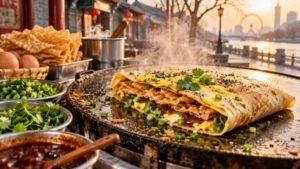 It is seven in the morning in Tianjin, and a line has formed at a cart with a large round griddle. The vendor pours batter onto the hot surface and spreads it into a thin circle. Next come an egg, a brush of sauce, and a piece of crisp fried dough, and then the whole thing is folded into a package and handed over. The sale takes about two minutes. This is jianbing, and trade at stalls like this one is always brisk at breakfast time, because people in a hurry will pay for something hot, cheap, and fast.
Legend says that the dish is almost 2,000 years old, and that it began when a famous strategist needed to feed soldiers who had lost their woks. Nobody can prove the story. Whatever the truth, the dish is now so closely tied to Tianjin that in 2017 the city added the skill of making it to its list of local intangible cultural heritage.
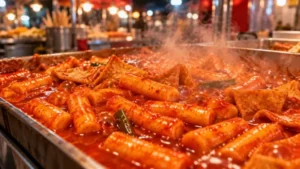 Cross the Yellow Sea to Seoul and the snack on every corner is tteokbokki, chewy rice cakes in a red chili sauce. The version that most Koreans know today is attributed to a vendor named Ma Bok-rim, who is said to have created it in 1953 in the Sindang district. The details vary: in some tellings she dropped a rice cake into a bowl of black bean noodles, and in others she mixed black bean paste and chili paste on purpose. Earlier tteokbokki was a mild royal court dish flavored with soy sauce. One newspaper analysis notes that the red version was not a standardized recipe at first and spread in the late 1960s, when it began appearing near schools.
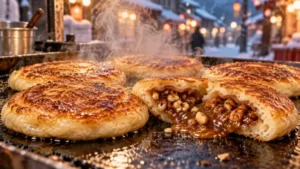 A second Korean favorite has a journey of its own. Hotteok, a thick pancake filled with brown sugar and nuts, is usually said to have arrived with Chinese merchants after 1882, when soldiers from China’s Qing dynasty were sent to Seoul during an uprising known as the Imo Incident. Because some Chinese pancakes were savory, the sellers are said to have changed the filling to suit Korean tastes, and hotteok became a hot winter snack that people eat from a paper cup. Stories like this are hard to confirm, so the details deserve some caution.
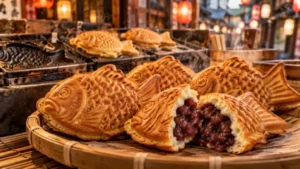 Bungeoppang took a similar route. This fish-shaped pastry filled with sweet red bean paste resembles taiyaki, which was first sold in Tokyo in 1909 by a shop that was struggling to sell round cakes. The shop reshaped the cakes as sea bream, a fish that stood for good luck and was too expensive for most people to eat. The shop’s founder reportedly wanted ordinary people to taste an expensive fish at a low price, so a luxury symbol became an affordable treat. Taiyaki later reached Korea, where Koreans began making their own version in the shape of a carp. Today bungeoppang is described as an iconic and nostalgic winter snack in Korea.
Japan’s food stalls, called yatai, were hit by new regulations before the 1964 Tokyo Olympics, and their numbers fell. Seoul reportedly cleared many street stalls before the 1988 Games as well. Fukuoka is the main exception in Japan. By one count it had about 450 stalls in the 1960s, and recent counts range from about 100 to 150. Under the city’s rules, a permit could not be transferred beyond one generation, so the number of stalls began to dwindle year by year. A city ordinance that took effect in 2013 set a target of 110 to 120 stalls, and the city has since chosen new operators through public applications. It also had to enforce its rules: in one review, officials suspected that about 30 percent of the stalls were run by people who did not hold the permit.
Taken together, these snacks suggest a pattern. A pancake crosses a border and becomes sweeter. A fish changes from a sea bream to a carp. Each food was reshaped by someone who needed to sell something, and each city has had to decide how much room its sellers should have. Does a street food belong to the place where it was invented, the place where it became popular, or the people who keep cooking it?
Vocabulary
Each word has a frequency score, a rank, and a tag. The score shows how common the word is in modern English: higher means more common, and each full point means roughly ten times more common. The rank is the word’s position on a list of about 321,000 English word forms, from most to least common. The tag shows where you are most likely to meet the word: Current, Formal, Literary, or Dated. The paragraph number shows where the word first appears in the reading. The labels are information, not instructions. Deciding which words are worth your time is up to you. How to read the scores, ranks, and tags.
batter (noun): a liquid mixture of flour, eggs, and milk or water that is cooked to make pancakes or similar foods.
Frequency: 3.56 | Rank: 13,695 | Current | Paragraph 1
Translations: 面糊 | 生地 | 반죽 | घोल | عجينة سائلة | жидкое тесто | masa líquida | pâte
- The vendor pours batter onto the hot surface and spreads it into a thin circle.
- Whisk the batter until there are no lumps left.
brisk (adjective): quick and busy, with a lot of activity or a lot of sales.
Frequency: 3.20 | Rank: 22,362 | Formal | Paragraph 1
Translations: 兴旺的 | 活発な | 활기찬 | ज़ोरदार | نشِط | оживлённый | animado | animé
- Trade at stalls like this one is always brisk at breakfast time.
- Business was brisk on the first day of the festival.
intangible (adjective): existing as an idea, a skill, or a quality that cannot be touched.
Frequency: 3.22 | Rank: 21,798 | Formal | Paragraph 2
Translations: 非物质的 | 無形の | 무형의 | अमूर्त | غير ملموس | нематериальный | intangible | immatériel
- Tianjin added the skill of making it to its list of local intangible cultural heritage.
- Friendship is intangible, but its value is very real.
attributed (verb, past participle): said to have been made, written, or caused by a particular person or thing.
Frequency: 4.05 | Rank: 6,565 | Formal | Paragraph 3
Translations: 被归功于 | によるものとされる | ~의 공으로 여겨지는 | का श्रेय दिया गया | يُنسب إلى | приписывается | atribuido a | attribué à
- The version that most Koreans know today is attributed to a vendor named Ma Bok-rim.
- The song is attributed to a poet from the eighth century.
standardized (adjective): made the same way every time, following one fixed set of rules or methods.
Frequency: 3.64 | Rank: 12,216 | Formal | Paragraph 3
Translations: 标准化的 | 標準化された | 표준화된 | मानकीकृत | موحَّد | стандартизированный | estandarizado | standardisé
- Red tteokbokki was not a standardized recipe at first.
- The test is standardized, so every student answers the same questions.
merchants (noun, plural): people whose job is to buy and sell goods, especially in large amounts or over long distances.
Frequency: 3.85 | Rank: 8,918 | Formal | Paragraph 4
Translations: 商人 | 商人 | 상인 | व्यापारी | تجّار | торговцы | comerciantes | marchands
- Hotteok is said to have arrived with Chinese merchants after 1882.
- Merchants carried silk and spices across the desert.
savory (adjective): having a salty or spicy flavor, rather than a sweet one.
Frequency: 3.00 | Rank: 28,918 | Current | Paragraph 4
Translations: 咸味的 | 塩味の | 짭짤한 | नमकीन | مالح | несладкий | salado | salé
- Because some Chinese pancakes were savory, the sellers changed the filling.
- I prefer savory snacks, such as cheese and crackers, to cake.
resembles (verb): looks like or is similar to another person or thing.
Frequency: 3.71 | Rank: 11,015 | Formal | Paragraph 5
Translations: 类似 | 似ている | 닮았다 | जैसा दिखता है | يشبه | напоминает | se parece a | ressemble à
- This fish-shaped pastry resembles taiyaki.
- Her handwriting closely resembles her mother’s.
affordable (adjective): cheap enough that most people can pay for it.
Frequency: 4.22 | Rank: 4,934 | Current | Paragraph 5
Translations: 实惠的 | 手頃な | 저렴한 | किफ़ायती | بأسعار معقولة | доступный по цене | asequible | abordable
- A luxury symbol became an affordable treat.
- The new cafe serves affordable lunches for students.
iconic (adjective): very famous and seen as a symbol of a particular place, time, or idea.
Frequency: 4.13 | Rank: 5,778 | Current | Paragraph 5
Translations: 标志性的 | 象徴的な | 상징적인 | प्रतीकात्मक | أيقوني | знаковый | emblemático | emblématique
- Today bungeoppang is described as an iconic and nostalgic winter snack in Korea.
- The tower is an iconic symbol of the city.
nostalgic (adjective): feeling a warm and slightly sad longing for the past.
Frequency: 3.45 | Rank: 16,005 | Current | Paragraph 5
Translations: 怀旧的 | 懐かしい | 향수를 불러일으키는 | पुरानी यादों वाला | حنيني | ностальгический | nostálgico | nostalgique
- Bungeoppang is described as an iconic and nostalgic winter snack in Korea.
- The old song made him feel nostalgic for his school days.
regulations (noun, plural): official rules made by a government or authority to control how something is done.
Frequency: 4.50 | Rank: 2,992 | Formal | Paragraph 6
Translations: 法规 | 規制 | 규정 | नियम | لوائح | правила | normas | réglementations
- Japan’s food stalls were hit by new regulations before the 1964 Tokyo Olympics.
- Safety regulations require every worker to wear a helmet.
transferred (verb, past participle): moved or passed from one person, place, or group to another.
Frequency: 4.36 | Rank: 3,875 | Formal | Paragraph 6
Translations: 被转让 | 譲渡された | 양도된 | हस्तांतरित | نُقل | передан | transferido | transféré
- A permit could not be transferred beyond one generation.
- The company transferred the files to a new computer.
dwindle (verb): to become smaller or fewer, slowly and steadily.
Frequency: 2.61 | Rank: 46,473 | Formal | Paragraph 6
Translations: 逐渐减少 | 減っていく | 점점 줄어들다 | घटते जाना | يتناقص | сокращаться | disminuir | diminuer
- The number of stalls began to dwindle year by year.
- Our savings dwindle quickly when we eat out every night.
enforce (verb): to make people obey a rule or law, often by using the power of an authority.
Frequency: 3.96 | Rank: 7,553 | Formal | Paragraph 6
Translations: 执行 | 施行する | 시행하다 | लागू करना | يُنفِّذ | обеспечивать соблюдение | hacer cumplir | faire respecter
- The city also had to enforce its rules.
- Police cannot enforce a law that nobody knows about.
Activity Page
Open the activity page in a new tab
Speed Challenge
Answer 12 questions against the clock. Every wrong answer adds 5 seconds, and the lowest score wins. Open the speed challenge in a new tab.
Shadow Reading and Typing: A Warm Pancake on a Cold Night
This short text uses many of the words from this lesson. Use it for shadow reading (reading aloud along with a model) and for typing practice.
On a cold evening last winter, I followed a sweet smell to a stall at the edge of a market. The vendor poured batter into a hot pan, and a line of customers formed behind me. Trade was brisk, and the person ahead of me bought four snacks at once. I waited my turn with cold hands and a warm feeling of hope.
The snack was thick, round, and filled with brown sugar. It was so affordable that I bought a second one before I had finished the first. It reminded me of a pancake my grandmother used to make, though hers was savory and filled with chives. Eating it felt nostalgic, as if the street remembered something I had forgotten.
While I ate, I wondered how food like this travels. Merchants, soldiers, and neighbors all carry recipes from one place to another. A snack from far away may resemble the one at home, but each cook changes it a little. Nobody can say for sure who made the first one, and that is part of the pleasure.
Later I read that cities often make new regulations for street vendors. Some stalls closed, and others dwindle every year when nobody takes them over. I hope the cook I met is still there next winter. I paid, thanked the vendor, and walked home slowly with the last warm bite.
How to practice
- Read the text silently once and check any words you are unsure of.
- Read it aloud slowly, one sentence at a time. On the typing page, the Listen button reads each line with your device’s voice, so you can listen first and then repeat.
- Shadow: read aloud again at a natural speed, trying to keep a steady rhythm without stopping.
- Record yourself, listen back, and note one sentence to practice again.
- Type it on the typing page below and check your speed and accuracy.
Open the typing practice in a new tab
Comprehension Questions
- How is jianbing made in the opening scene, and why is the trade at the cart brisk in the morning?
- What does the reading say about the legend of jianbing, and what did Tianjin do in 2017?
- Who is modern red tteokbokki attributed to, and why does the reading say the details vary?
- How was earlier tteokbokki different from the red version most people know today?
- According to the usual account, how did hotteok arrive in Korea, and what change did the sellers make?
- What is the connection between bungeoppang and taiyaki?
- Why did the Japanese shop reshape its cakes as sea bream?
- What happened to street stalls in Japan before the 1964 Olympics, and how has Fukuoka tried to keep its stalls?
- What pattern does the writer see across these snacks, and what question ends the reading?
IELTS-Style Questions
- True, False, or Not Given: “Hotteok was first invented in China.” Explain your answer using evidence from the reading.
- Yes, No, or Not Given: “The writer believes that stories about the origins of street foods should be treated with some caution.” Explain your answer using evidence from the reading.
- Author’s purpose: Why does the writer begin with a detailed scene at a jianbing cart in Tianjin? What does this opening add to the reading?
AI Discussion Prompt
I just read an article about street food in Northeast Asia. It covered jianbing in Tianjin, the history of red tteokbokki in Seoul, hotteok and Chinese merchants in Korea, the link between Japanese taiyaki and Korean bungeoppang, and how Japan’s yatai stalls have been regulated, especially in Fukuoka. I am an English learner at about B2 level. Please ask me one question at a time, starting with what street food I eat when the weather is cold. Respond to my ideas first, then briefly correct any language errors, and ask follow-up questions that make me explain my reasons.
AI Vocabulary Prompt
I want to practice vocabulary from an article about street food in Northeast Asia. Please quiz me on the following words one at a time, using a mix of question types: multiple choice, true/false, and sentence completion. Give me feedback after each answer before moving on, and bring back the words I miss later. Here are the words: batter, brisk, intangible, attributed, standardized, merchants, savory, resembles, affordable, iconic, nostalgic, regulations, transferred, dwindle, enforce.
Discussion Questions
- What street food do you eat when the weather is cold, and where do you buy it?
- Do you prefer sweet snacks or savory snacks? Is there a time of day when your choice changes?
- Which street foods remind you of your childhood? What memories do they bring?
- Is there a food in your country that was brought by people who came from another place? How has it changed?
- The reading says some origin stories, such as the one about jianbing, cannot be proved. Why do people enjoy stories like these even when they are uncertain?
- Food is often changed when it moves to a new place, as when hotteok became sweeter. What changes make a dish better for its new place, and what changes spoil it?
- The shape of taiyaki came from Japan, but bungeoppang is part of everyday life in Korea. Can a food belong to more than one place?
- Tianjin listed the skill of making jianbing as local heritage. Which food skills in your country deserve a heritage listing, and why?
- Governments often clear street stalls before big events such as the Olympics. Is this a good way to prepare a city? Explain your view.
- Fukuoka tried to limit each permit to one generation and later opened applications to new cooks. What are the advantages and disadvantages of each rule?
- Officials in Fukuoka suspected that some stalls were run by people who did not hold the permit. How should a city enforce rules without hurting small vendors?
- Many vendors work long hours for small profits. How should customers and cities treat the people who make cheap food?
- Should a city protect street food as part of its heritage, or should vendors compete freely with restaurants? Where would you draw the line?
- Does a street food belong to the place where it was invented, the place where it became popular, or the people who keep cooking it?
Language Focus: Relative Clauses with Who, That, and Where
What it is: A relative clause adds information about a noun. It begins with a relative pronoun such as who (for people), that or which (for things), or where (for places), and it comes directly after the noun it describes.
Why writers use it: Relative clauses let a writer pack a lot of information into one sentence without starting a new one. They are common in history and food writing, where each person, thing, or place needs a short description.
Examples from the reading:
- “…a famous strategist needed to feed soldiers who had lost their woks.”
- “…a vendor named Ma Bok-rim, who is said to have created it in 1953 in the Sindang district.”
- “…sea bream, a fish that stood for good luck and was too expensive for most people to eat.”
- “…about 30 percent of the stalls were run by people who did not hold the permit.”
Practice task: Join these two sentences with a relative clause: “The vendor works in Tianjin. The vendor makes jianbing.” Use who.
(Example answer: “The vendor who makes jianbing works in Tianjin.”)
Online Resources
- Jianbing: Traditional Chinese Breakfast Crepe (That’s Mandarin). A guide to jianbing, the Tianjin version, and the legend described in paragraphs 1 and 2.
- How spicy red tteokbokki became a national street food (Korea JoongAng Daily). A newspaper analysis of the 1953 story and the spread of red tteokbokki, which supports paragraph 3.
- Hotteok (Korean Culture and Information Service). An official Korean article on hotteok, the Imo Incident story, and winter street snacks, as in paragraph 4.
- Carp Bread Is The Korean Street Food That’s Much Sweeter Than It Sounds (Tasting Table). An article on how Japanese taiyaki became Korean bungeoppang, as in paragraph 5.
- Yatai: Fukuoka’s moveable feasts (Kyushu Tourism Organization). A visitor’s guide to Fukuoka’s stalls, including the rules and the public application system described in paragraph