
Level: B2
Reading | Vocabulary | Activities | Speed Challenge | Shadow Reading and Typing | Questions | AI Prompts | Discussion | Language Focus | Resources
Printable: Student handout (PDF) | Teacher’s key (PDF)
Reading
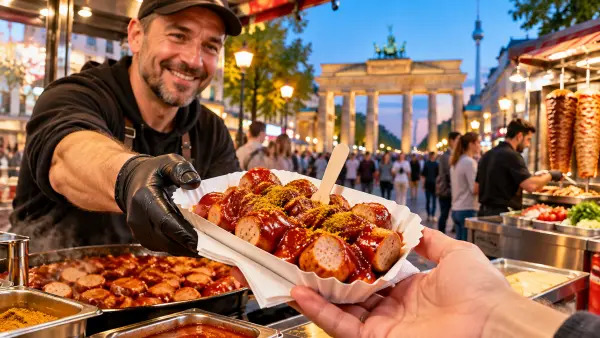
It is midnight in Berlin, and you are standing at a street stand with a paper tray of sliced sausage covered in curry-flavored ketchup, a small wooden fork stuck in the top. This is currywurst. If you asked ten Berliners what counts as the city’s real street food, you would probably get ten different answers, but this dish would be on many of their lists. Across Europe, street food stories like this one often turn out to be about people and ingredients arriving from somewhere else.
According to the story most often told, currywurst began in 1949, when a snack-stand owner named Herta Heuwer in the Charlottenburg district got hold of ketchup and curry powder from British soldiers. She improvised a spiced sauce, poured it over grilled sausage, and found that it sold well to the construction workers who were rebuilding the damaged city. The details are hard to check, but the main idea is believable: a dish made in a time of shortage from imported ingredients that foreign soldiers happened to have. The snack spread quickly. Konnopke’s Imbiss in East Berlin says that it began selling currywurst in 1960, so the dish soon became known on both sides of a divided city.
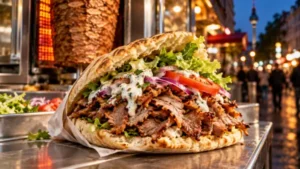 Berlin’s other famous street food has a different background. The Turkish word döner comes from a verb meaning to turn, which describes the meat on its slowly rotating vertical spit. Turkish cooks had long roasted meat this way, but the sandwich version, in which sliced meat is served in flatbread, took shape in West Berlin in the 1970s, where many Turkish workers had come to live and work. Today it usually comes with salad and sauce, but early versions reportedly held only meat, onion, and a little lettuce. An industry association credits a worker named Kadir Nurman with selling the first döner sandwich near the Zoo station in 1972. At least one other person has made a rival claim for 1971, and there is evidence that döner was served in some Turkish restaurants in Germany even earlier. The same association estimates that Germany now has well over ten thousand döner stands.
Neither dish is more than about eighty years old, yet both have become staples of daily life in Germany. Both have also kept changing, which makes any fixed idea of the original harder to defend. A food that many people have eaten for decades has a history of its own, even if it is not an ancient one. If a dish had to be centuries old to count as traditional, currywurst and döner would both fail the test. That is why the word authentic causes so much argument. Does it mean old, local, or made by the people who first cooked it?
 Prague offers the clearest case. In the old town, stalls selling trdelník, a hollow spiral pastry baked over coals and rolled in sugar and nuts, are ubiquitous. The pastry is often marketed as an old Czech tradition, but that description is misleading. Trdelník descends from the chimney cake of Hungarian-speaking Transylvania, and it is a specialty of the Slovak town of Skalica, whose version has had protected status under European Union rules since 2007. Prague’s own contribution seems to be the cone filled with ice cream that became popular in its cafes.
Does it matter? Some Czechs say it does, mainly because visitors leave with a false idea of what Czech food is. Their complaint is about the label, not the pastry. If the stalls sold it as a Central European treat, few people would object. A fair reply is that every food was new once, and that currywurst and döner would not pass a test of age either.
Food will always evolve, and the stories attached to it change too. The EU’s protected status covers a name tied to one town, not every pastry of this type. So the question is not only where a dish came from, but how long a street food needs to be sold before a city can call it its own.
Vocabulary
Each word has a frequency score, a rank, and a tag. The score shows how common the word is in modern English: higher means more common, and each full point means roughly ten times more common. The rank is the word’s position on a list of about 321,000 English word forms, from most to least common. The tag shows where you are most likely to meet the word: Current, Formal, Literary, or Dated. The paragraph number shows where the word first appears in the reading. The labels are information, not instructions. Deciding which words are worth your time is up to you. How to read the scores, ranks, and tags.
improvised (verb, past tense): made or did something quickly, using whatever was available, without a plan.
Frequency: 3.37 | Rank: 17,813 | Formal | Paragraph 2
Translations: 即兴制作 | 即興で作った | 즉석에서 만들었다 | तात्कालिक रूप से बनाया | ارتجل | импровизировать | improvisó | improvisé
- She improvised a spiced sauce and poured it over grilled sausage.
- We had no oven, so we improvised a way to bake the bread.
imported (adjective): brought into a country from another country in order to be sold or used.
Frequency: 3.95 | Rank: 7,672 | Current | Paragraph 2
Translations: 进口的 | 輸入された | 수입된 | आयातित | مستورد | импортный | importado | importé
- The dish was made from imported ingredients that foreign soldiers happened to have.
- Most of the coffee sold in this shop is imported.
credits (verb): says that someone is responsible for something good, such as an invention.
Frequency: 4.27 | Rank: 4,521 | Current | Paragraph 3
Translations: 把功劳归于 | 功績を認める | 공으로 돌리다 | श्रेय देता है | يُنسب الفضل إلى | приписывает заслугу | atribuye el mérito | attribue le mérite
- An industry association credits a worker with selling the first döner sandwich.
- The mayor credits the volunteers with saving the old market.
rival (adjective): made by a different person or group that is competing with another.
Frequency: 4.18 | Rank: 5,309 | Current | Paragraph 3
Translations: 对立的 | 競合する | 경쟁하는 | प्रतिद्वंद्वी | منافس | соперничающий | rival | concurrent
- At least one other person has made a rival claim for 1971.
- The two rival bakeries stand on opposite sides of the square.
estimates (verb): says what the size, cost, or amount of something probably is, without being exact.
Frequency: 4.30 | Rank: 4,302 | Formal | Paragraph 3
Translations: 估计 | 推定する | 추정하다 | अनुमान लगाता है | يقدّر | оценивает | estima | estime
- The same association estimates that Germany has well over ten thousand döner stands.
- The builder estimates that the repair will take two weeks.
staples (noun, plural): foods or things that people use or eat regularly as a normal part of life.
Frequency: 3.57 | Rank: 13,496 | Current | Paragraph 4
Translations: 日常必备品 | 定番 | 기본 음식 | मुख्य भोजन | أساسيات | основные продукты | alimentos básicos | aliments de base
- Both dishes have become staples of daily life in Germany.
- Rice and beans are staples in many households.
authentic (adjective): real and true to the original, not a copy or an imitation.
Frequency: 4.04 | Rank: 6,674 | Current | Paragraph 4
Translations: 正宗的 | 本物の | 정통의 | प्रामाणिक | أصيل | подлинный | auténtico | authentique
- That is why the word authentic causes so much argument.
- The restaurant serves authentic food from the north of the country.
ubiquitous (adjective): seen or found everywhere, or in very many places.
Frequency: 3.42 | Rank: 16,687 | Formal | Paragraph 5
Translations: 无处不在的 | どこにでもある | 어디에나 있는 | सर्वव्यापी | منتشر في كل مكان | повсеместный | omnipresente | omniprésent
- In the old town, stalls selling trdelník are ubiquitous.
- Smartphones are ubiquitous in cities around the world.
marketed (verb, past participle): advertised and sold to the public in a particular way.
Frequency: 3.64 | Rank: 12,216 | Current | Paragraph 5
Translations: 被宣传 | 売り込まれた | 홍보된 | प्रचारित | مُسوَّق | продвигаемый | comercializado | commercialisé
- The pastry is often marketed as an old Czech tradition.
- The drink was marketed as a healthy choice for children.
misleading (adjective): giving a false idea about something, even when it is not a direct lie.
Frequency: 3.90 | Rank: 8,266 | Current | Paragraph 5
Translations: 误导的 | 誤解を招く | 오해를 일으키는 | भ्रामक | مضلّل | вводящий в заблуждение | engañoso | trompeur
- That description is misleading, because the pastry is not originally Czech.
- The advertisement was misleading, so the shop had to change it.
descends (verb): comes from an earlier thing or an older form through a line of development.
Frequency: 3.16 | Rank: 23,536 | Formal | Paragraph 5
Translations: 源于 | に由来する | 에서 유래하다 | से उत्पन्न होता है | ينحدر من | происходит от | desciende de | descend de
- Trdelník descends from the chimney cake of Hungarian-speaking Transylvania.
- Many modern dogs descend from wolves.
specialty (noun): a food or product that a place or a person is especially known for.
Frequency: 3.89 | Rank: 8,417 | Current | Paragraph 5
Translations: 特产 | 名物 | 특산품 | विशेषता | طبق مميز | фирменное блюдо | especialidad | spécialité
- Trdelník is a specialty of the Slovak town of Skalica.
- Fish soup is the specialty of this small restaurant.
label (noun): a word or short phrase that is used to describe or name something.
Frequency: 4.43 | Rank: 3,422 | Current | Paragraph 6
Translations: 标签 | ラベル | 라벨 | लेबल | تسمية | ярлык | etiqueta | étiquette
- Their complaint is about the label, not the pastry.
- The label on the box says that the cake contains nuts.
object (verb): to say that you do not like or agree with something.
Frequency: 4.56 | Rank: 2,669 | Formal | Paragraph 6
Translations: 反对 | 反対する | 반대하다 | आपत्ति करना | يعترض | возражать | objetar | s’opposer
- If the stalls sold it as a Central European treat, few people would object.
- Some neighbors object to the noise from the night market.
evolve (verb): to change and develop slowly over a long period of time.
Frequency: 3.80 | Rank: 9,594 | Current | Paragraph 7
Translations: 演变 | 進化する | 진화하다 | विकसित होना | يتطور | развиваться | evolucionar | évoluer
- Food will always evolve, and the stories attached to it change too.
- Street food tends to evolve as new people arrive in a city.
Activity Page
Open the activity page in a new tab
Speed Challenge
Answer 12 questions against the clock. Every wrong answer adds 5 seconds, and the lowest score wins. Open the speed challenge in a new tab.
Shadow Reading and Typing: Dinner at a Street Stand
This short text uses many of the words from this lesson. Use it for shadow reading (reading aloud along with a model) and for typing practice.
Last winter I visited a big European city for the first time. On the second night I was hungry, and the only place still open was a small street stand. The menu was short, and the owner told me that the sausage was the specialty of the house. I ordered it without knowing what it was.
It arrived in a paper tray, and it was delicious. I asked the owner where the sauce came from. He said it was authentic, and that his family had improvised it with imported spices long ago. Later I read that the dish descends from a recipe from another country, and I smiled.
I do not think the owner was trying to mislead me. Many people believe the stories that are attached to their food. A rival stand across the street told me a completely different story about the same dish. A label like traditional can be useful, but it is not always a complete answer.
Today I eat street food whenever I travel, because these stalls are ubiquitous and each one has a small history. Sausages and bread are staples in many places, but every cook makes them differently. Foods evolve, and so do the stories. I always ask who first made the dish, and I always listen carefully.
How to practice
- Read the text silently once and check any words you are unsure of.
- Read it aloud slowly, one sentence at a time. On the typing page, the Listen button reads each line with your device’s voice, so you can listen first and then repeat.
- Shadow: read aloud again at a natural speed, trying to keep a steady rhythm without stopping.
- Record yourself, listen back, and note one sentence to practice again.
- Type it on the typing page below and check your speed and accuracy.
Open the typing practice in a new tab
Comprehension Questions
- What is currywurst, and how does the reading describe the scene at the start?
- According to the story most often told, how did currywurst begin, and why does the writer say the details are hard to check?
- Why was currywurst popular with construction workers in the early years?
- How did the döner sandwich appear in West Berlin, and who claims to have invented it?
- How does the reading show that the origin of the döner sandwich is not completely clear?
- Why does the writer say that currywurst and döner would fail a test of age, and what question does this raise?
- What does the reading say about where trdelník really comes from?
- What is the complaint of some Czechs about trdelník?
- What does the reading say the EU’s protected status covers, and why does this matter to the writer’s argument?
IELTS-Style Questions
- True, False, or Not Given: “Herta Heuwer patented her sauce in 1951.” Explain your answer using evidence from the reading.
- Yes, No, or Not Given: “The writer believes that trdelník should be banned from Prague’s old town.” Explain your answer using evidence from the reading.
- Author’s purpose: Why does the writer include the sentence about asking ten Berliners what counts as the city’s real street food? What does it add to the opening paragraph?
AI Discussion Prompt
I just read an article about street food in Europe. It covered currywurst in Berlin, the döner kebab sandwich and the disagreement over who invented it, the argument over what counts as traditional or authentic food, and the story of trdelník in Prague and the Slovak town of Skalica. I am an English learner at about B2 level. Please ask me one question at a time, starting with what street food is popular where I live. Respond to my ideas first, then briefly correct any language errors, and ask follow-up questions that make me explain my reasons.
AI Vocabulary Prompt
I want to practice vocabulary from an article about street food in Europe. Please quiz me on the following words one at a time, using a mix of question types: multiple choice, true/false, and sentence completion. Give me feedback after each answer before moving on, and bring back the words I miss later. Here are the words: improvised, imported, credits, rival, estimates, staples, authentic, ubiquitous, marketed, misleading, descends, specialty, label, object, evolve.
Discussion Questions
- What street food is popular where you live, and when do people usually eat it?
- Do you prefer to eat street food standing up, or do you like to sit down? Why?
- Is there a food in your country that was made popular by people who came from another place? Which one?
- Currywurst may have started with ingredients that foreign soldiers happened to have. Can a good dish come from shortage and improvisation?
- Many people now see döner as a German food. When does a food stop being foreign?
- Several people claim to have invented the döner sandwich. Why do origin stories matter to businesses and to cities?
- What does authentic mean to you when you talk about food: old, local, made by the first cooks, or something else?
- Have you seen a food in your country sold to tourists with a story that may not be true? What was it?
- Should visitors be told the real history of the food they buy, or is the taste enough?
- Some Czechs object to the trdelník label. Who should decide how a country’s food is presented to visitors?
- The EU protects some food names, such as Skalický trdelník. What are the advantages and disadvantages of protecting a food name?
- Some people worry that tourism changes local food to suit visitors. Have you noticed this in places you have visited?
- Street food often follows migration. What can a food that travels with people tell us about a society?
- Should a city try to protect traditional street food from change, or should vendors be free to experiment? Where would you draw the line?
Language Focus: The Second Conditional for Imagined Situations
What it is: The second conditional uses if with the past simple and would with a base verb: If + past simple, would + base verb. It talks about situations that are imaginary, unlikely, or opposite to the facts now.
Why writers use it: Writers use the second conditional to test an idea by imagining a different situation. The past simple after if does not refer to past time here. It marks the situation as unreal or unlikely, and would shows the imagined result.
Examples from the reading:
- “If you asked ten Berliners what counts as the city’s real street food, you would probably get ten different answers…”
- “If a dish had to be centuries old to count as traditional, currywurst and döner would both fail the test.”
- “If the stalls sold it as a Central European treat, few people would object.”
Practice task: Rewrite this fact as a second conditional: “I do not live in Berlin, so I cannot eat currywurst every day.” Begin with If.
(Example answer: “If I lived in Berlin, I could eat currywurst every day.”)
Online Resources
- Currywurst turns 70: The Berlin dish that wouldn’t exist without the British (The Local Germany). A news feature on the 1949 story, the British soldiers, and the museum’s account, as in paragraph 2.
- How the humble Döner kebab evolved into Berlin’s go-to fast food snack (The Local Germany). An article on Kadir Nurman, the rival claims, and the industry figures described in paragraph 3.
- A Brief History of the Döner Kebap (Berlin Food Stories). A local writer’s view of how the döner sandwich changed in Berlin, which adds to paragraph 3.
- Trdlo: Say It Five Times Fast! (My Czech Republic Blog). A short post by two Prague residents on where trdelník came from and how the ice cream version appeared, as in paragraph 5.
- Protected traditional Slovak food products (The Slovak Spectator). A news article on how EU protected status works, with Skalický trdelník as Slovakia’s first protected product, as in paragraphs 5 and 7.