
Level: C1
Reading | Vocabulary | Activities | Speed Challenge | Questions | AI Prompts | Discussion | Language Focus | Resources
Printable: Student handout (PDF) | Teacher’s key (PDF)
Reading
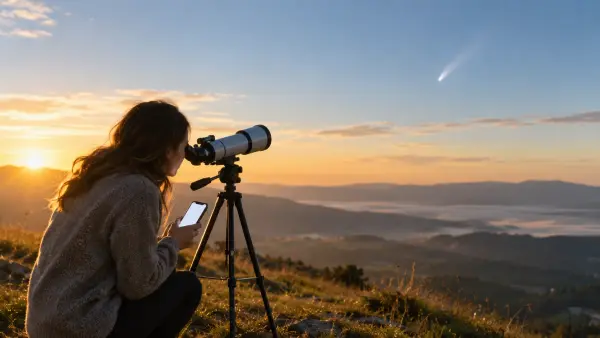
On July 1, 2025, the ATLAS survey telescope in Rio Hurtado, Chile, reported a faint, fast-moving speck. Its path showed that it had arrived from interstellar space, the space between star systems, which made it only the third such visitor ever confirmed, after ‘Oumuamua in 2017 and Borisov in 2019. Because it was discovered early and became bright, astronomers had an unprecedented chance to study an interstellar comet with dozens of telescopes, including Hubble and Webb. NASA classifies it as a comet because it has an icy nucleus and a cloud of gas and dust. On December 19, 2025, it came no closer to Earth than 270 million kilometers.
The science alone is remarkable. Estimates based on the comet’s speed suggested an age of roughly 3 to 11 billion years. In June 2026, a team led by Martin Cordiner of NASA reported in Nature that measurements with the James Webb telescope pointed to the older end of that range. The comet’s water contains roughly 30 times more deuterium than water in comets of our own solar system, which suggests that it formed in extreme cold. An age of up to 12 billion years is nearly three times the age of the solar system, so 3I/ATLAS may be a relic of a planetary system that formed long before ours. The figure remains an estimate, and different methods give different ranges.
Online, a different story spread. Avi Loeb, a Harvard astrophysicist who had earlier suggested that ‘Oumuamua might be artificial, published lists of “anomalies” in 3I/ATLAS, including its chemistry and path and a small non-gravitational acceleration that, he said, “might be produced by an engine.” Loeb also said the excess was not significant, and at times he said that the comet was most likely natural. He rated it 4 on his own scale from 0 (a natural comet) to 10 (alien technology), which kept an extraterrestrial origin open. Comets can show non-gravitational acceleration because escaping gas acts like a weak propulsion system, and NASA reports that the perturbations seen here were small and compatible with that process. A hypothesis that cannot yet be ruled out is not the same as evidence for it.
What happened next was speculation on a large scale. Mert Can Bayar of the University of Washington’s Center for an Informed Public studied about 700,000 English-language posts on X between July 1 and November 21, 2025. Roughly 40 percent invoked aliens or extraterrestrial technology, and the volume peaked around October 28 to 30, when the comet passed the Sun and Loeb appeared on a popular podcast. Some posts claimed that NASA and other agencies were preparing planetary defense. In fact, the International Asteroid Warning Network had announced a routine campaign to practice measuring comet positions. Bayar argues that lists of anomalies can amplify rumor, while nuanced explanations are drowned out. His study covers one platform, one language, and one analyst, so it describes a pattern rather than proving a cause.
When examined carefully, the evidence looks much less exciting. At a press conference on November 19, 2025, NASA officials said that the object is a comet. NASA’s summary says that its color, speed, and direction are all consistent with a comet. Searches for technosignatures, signs of technology such as artificial radio signals, found nothing. The SETI Institute and Breakthrough Listen used the Allen Telescope Array for 7.25 hours in July 2025 and found only interference and no signal worth follow-up. On December 18, 2025, the Green Bank Telescope found no transmitter above about 0.1 watts, roughly a tenth of the power of a mobile phone.
Those results have limits. A search finds only signals that are strong enough and at the frequencies observed, so it can rule out certain kinds of transmitter but cannot prove that none could exist. Scientists acknowledge that 3I/ATLAS raised real questions about where it formed and what its unusual chemistry means. The comet is almost certainly natural, yet natural explanations can still be surprising.
The line “extraordinary claims require extraordinary evidence” is often attributed to Carl Sagan, who popularized it in the late 1970s. The sociologist Marcello Truzzi used a similar phrase before him. It does not say what to do when a claim is attractive and hard to test. Bayar’s advice is to keep curiosity high and to separate an open question from a working hypothesis and from an extraordinary claim. A reader who is too gullible believes whatever spreads fastest, while one who is too skeptical stops asking questions. Asking who made a claim, and what evidence would change their mind, is a middle path. NASA reports that the comet’s speed on leaving matched its speed on arrival, as gravity alone would predict.
Vocabulary
Each word has a frequency score, a rank, and a tag. The score shows how common the word is in modern English: higher means more common, and each full point means roughly ten times more common. The rank is the word’s position on a list of about 321,000 English word forms, from most to least common. The tag shows where you are most likely to meet the word: Current, Formal, Literary, or Dated. The paragraph number shows where the word first appears in the reading. The labels are information, not instructions. Deciding which words are worth your time is up to you. How to read the scores, ranks, and tags.
interstellar (adjective): located or traveling between the stars, rather than inside a star system.
Frequency: 3.34 | Rank: 18,537 | Formal | Paragraph 1
Translations: 星际的 | 星間の | 성간의 | तारों के बीच का | بين النجوم | межзвёздный | interestelar | interstellaire
- 3I/ATLAS is only the third confirmed object from interstellar space.
- Interstellar travel remains theoretical, because the distances are so large.
unprecedented (adjective): never having happened or existed before.
Frequency: 3.82 | Rank: 9,313 | Formal | Paragraph 1
Translations: 前所未有的 | 前例のない | 전례 없는 | अभूतपूर्व | غير مسبوق | беспрецедентный | sin precedentes | sans précédent
- Astronomers had an unprecedented chance to study an interstellar comet.
- The speed at which AI tools entered classrooms has been unprecedented.
relic (noun): something that has survived from an earlier time, often from a world that no longer exists.
Frequency: 3.37 | Rank: 17,813 | Literary | Paragraph 2
Translations: 遗物 | 遺物 | 유물 | अवशेष | بقايا | реликт | reliquia | relique
- 3I/ATLAS may be a relic of a planetary system that formed long before ours.
- The old telephone booth is a relic of an earlier era.
anomalies (noun, plural): things that differ from what is normal, standard, or expected.
Frequency: 3.28 | Rank: 20,101 | Formal | Paragraph 3
Translations: 异常现象 | 異常 | 이상 현상 | विसंगतियाँ | شذوذات | аномалии | anomalías | anomalies
- Loeb published lists of anomalies in 3I/ATLAS.
- The audit found several anomalies in the company’s accounts.
extraterrestrial (adjective): originating, existing, or occurring outside Earth or its atmosphere.
Frequency: 3.10 | Rank: 25,367 | Formal | Paragraph 3
Translations: 地外的 | 地球外の | 외계의 | पृथ्वी से परे का | خارج الأرض | внеземной | extraterrestre | extraterrestre
- No confirmed evidence of extraterrestrial life has been found.
- Many people have an instinctive opinion about extraterrestrial intelligence.
propulsion (noun): a force or system that pushes something forward.
Frequency: 3.46 | Rank: 15,798 | Formal | Paragraph 3
Translations: 推进力 | 推進 | 추진력 | प्रणोदन | دفع | тяга | propulsión | propulsion
- Escaping gas acts like a weak propulsion system on a comet.
- The ship’s propulsion failed, and it drifted for two days.
hypothesis (noun): an idea proposed to explain something, which has still to be tested.
Frequency: 3.87 | Rank: 8,669 | Formal | Paragraph 3
Translations: 假说 | 仮説 | 가설 | परिकल्पना | فرضية | гипотеза | hipótesis | hypothèse
- A hypothesis that cannot yet be ruled out is not the same as evidence for it.
- The team tested the hypothesis that sleep improves memory.
speculation (noun): ideas or theories formed without firm evidence, or the act of forming them.
Frequency: 3.99 | Rank: 7,224 | Current | Paragraph 4
Translations: 推测 | 憶測 | 추측 | अटकलें | تكهنات | домыслы | especulación | spéculation
- What happened next was speculation on a large scale.
- There is a lot of speculation about the company’s next move.
amplify (verb): to make something stronger, louder, or more widely known.
Frequency: 3.16 | Rank: 23,536 | Formal | Paragraph 4
Translations: 放大 | 増幅する | 증폭하다 | बढ़ा-चढ़ाकर फैलाना | يضخّم | усиливать | amplificar | amplifier
- Lists of anomalies can amplify rumor when they are widely repeated.
- The microphone amplified her voice so that everyone could hear.
drowned out (phrasal verb, past participle): made impossible to hear or notice because something louder or more dominant is present.
Frequency: no score (phrase) | Current | Paragraph 4
Translations: 被淹没 | かき消される | 묻히다 | दब जाना | طغى عليه | заглушённый | ahogado | noyé
- Nuanced explanations are drowned out by dramatic claims.
- In large groups, quieter voices are often drowned out.
consistent (adjective): in agreement with something else and not contradicting it.
Frequency: 4.48 | Rank: 3,114 | Current | Paragraph 5
Translations: 与…一致的 | 矛盾しない | 부합하는 | संगत | متسق | согласующийся | consistente | cohérent
- Its color, speed, and direction are all consistent with a comet.
- The symptoms are consistent with a common cold.
technosignatures (noun, plural): detectable signs of technology, such as artificial radio signals, that would suggest an intelligent source.
Frequency: no score (compound word) | Formal | Paragraph 5
Translations: 技术特征信号 | テクノシグネチャー | 기술 신호 | तकनीकी संकेत | بصمات تقنية | технопризнаки | tecnofirmas | technosignatures
- Searches for technosignatures found only radio interference from Earth.
- Astronomers look for technosignatures near nearby stars.
acknowledge (verb): to accept or admit that something is true or exists.
Frequency: 4.18 | Rank: 5,309 | Current | Paragraph 6
Translations: 承认 | 認める | 인정하다 | स्वीकार करना | يعترف | признавать | reconocer | reconnaître
- Scientists acknowledge that 3I/ATLAS raised real questions.
- She acknowledged that she had made a mistake.
gullible (adjective): too ready to believe things without enough evidence or critical thought.
Frequency: 3.10 | Rank: 25,367 | Current | Paragraph 7
Translations: 轻信的 | だまされやすい | 잘 속는 | भोला | ساذج | легковерный | crédulo | crédule
- A gullible reader believes whatever spreads fastest.
- He felt gullible after falling for a misleading headline.
skeptical (adjective): inclined to doubt claims until they are supported by evidence.
Frequency: 3.68 | Rank: 11,541 | Current | Paragraph 7
Translations: 怀疑的 | 懐疑的な | 회의적인 | संशयी | متشكك | скептический | escéptico | sceptique
- Scientists were skeptical of the first claims and asked for more data.
- She was skeptical that the offer was as good as it sounded.
Activity Page
Open the activity page in a new tab
Speed Challenge
Answer 12 questions against the clock. Every wrong answer adds 5 seconds, and the lowest score wins. Open the speed challenge in a new tab.
Comprehension Questions
- According to the first paragraph, what was discovered on July 1, 2025, and why did astronomers have such a good chance to study it?
- What does the reading say about the age of 3I/ATLAS, and why does it call the figure an estimate?
- What did Avi Loeb say about the comet’s acceleration, and how does the reading explain why a natural comet can show non-gravitational acceleration?
- How did Loeb rate an extraterrestrial origin, and why is a hypothesis that cannot be ruled out not the same as evidence?
- What did Bayar’s study of posts on X find, and how far can its findings be trusted?
- How did a routine campaign by the International Asteroid Warning Network become a rumor about planetary defense?
- Describe the two radio searches for technosignatures in the reading, and explain what each one found.
- What limits do the radio results have, and why is the comet still called almost certainly natural?
- What “middle path” between being gullible and being skeptical does the last paragraph suggest, and how does the history of the phrase about extraordinary claims fit it?
IELTS-Style Questions
- True, False, or Not Given: “The radio searches proved that no extraterrestrial technology could exist anywhere.” Explain your answer using evidence from the reading.
- Yes, No, or Not Given: “The writer believes that 3I/ATLAS is an alien spacecraft.” Explain your answer using evidence from the reading.
- Author’s purpose: Why does the writer include the sentence “His study covers one platform, one language, and one analyst”? Is its purpose to reject the study, to show the limits of its evidence, or something else?
AI Discussion Prompt
I just read a C1 lesson about the interstellar comet 3I/ATLAS and online speculation. It covered the discovery in July 2025, the estimate that the comet may be up to 12 billion years old, Avi Loeb’s list of anomalies and his engine idea, a University of Washington study of about 700,000 posts on X, the rumor about planetary defense, radio searches by the SETI Institute and Breakthrough Listen, and the idea that extraordinary claims require extraordinary evidence. I am an English learner at about C1 level. Please ask me one question at a time, starting with whether I saw anything about the comet on social media. Respond to my ideas first, then briefly correct any language errors, and challenge my assumptions when it is useful.
AI Vocabulary Prompt
I want to practice vocabulary from a lesson about the comet 3I/ATLAS and online speculation. Please quiz me on the following words one at a time, using a mix of question types: multiple choice, true/false, and sentence completion. Give me feedback after each answer before moving on, and bring back the words I miss later. Here are the words: interstellar, unprecedented, relic, anomalies, extraterrestrial, propulsion, hypothesis, speculation, amplify, drowned out, consistent, technosignatures, acknowledge, gullible, skeptical.
Discussion Questions
- Before reading this, had you seen anything about 3I/ATLAS on social media? What did you think it was?
- Why do you think posts claiming a cover-up get more attention than posts explaining the science?
- When you see a story about aliens, ancient civilizations, or claims that science does not accept, do you usually watch or keep scrolling? Why?
- The comet may be up to 12 billion years old. How does trying to imagine a period of time like that make you feel?
- Do you believe that intelligent life exists elsewhere in the universe? What would count as convincing evidence for you?
- Loeb rated the comet 4 on his own scale, even though he also said it was most likely natural. How should a scientist communicate a possibility that is unlikely but not impossible?
- Bayar says that a scientist’s speculation can become someone else’s conspiracy theory. Who is responsible when this happens: the scientist, the media, the platforms, or the audience?
- The radio searches found nothing. Does a result like that feel like a disappointment, a relief, or something else?
- The reading says a null result cannot prove that no signal could exist. Can you think of another situation where a lack of evidence does not prove absence?
- Bayar’s study covers one platform, one language, and one analyst. What other information would you want before trusting its conclusions?
- Can you think of another story, from science, politics, or anywhere else, where social media turned a complicated truth into a simple, exciting rumor?
- What method do you use to decide whether to believe something you see on social media? Has the method ever failed you?
- If scientists did detect a real signal from an interstellar object, how do you think people in your country would react?
- The phrase “extraordinary claims require extraordinary evidence” is sometimes criticized because “extraordinary” is hard to define. Do you think the rule is useful anyway?
Language Focus: Relative Clauses and Apposition
What it is: A relative clause (who, which, that) adds information about a noun. A non-defining clause is set off by commas and adds extra detail. Apposition places a noun phrase next to another noun to rename or explain it.
Why writers use it: Relative clauses and apposition let writers pack background, definitions, and qualifications into one sentence. They are common in news writing, academic prose, and any text that must define technical terms without stopping.
Examples from the reading:
- “Avi Loeb, a Harvard astrophysicist who had earlier suggested that ‘Oumuamua might be artificial, published lists of ‘anomalies’…”
- “…a small non-gravitational acceleration that, he said, ‘might be produced by an engine.’”
- “Searches for technosignatures, signs of technology such as artificial radio signals, found nothing.”
- “A hypothesis that cannot yet be ruled out is not the same as evidence for it.”
Practice task: Combine the two sentences into one, using a non-defining relative clause: “Bayar studied about 700,000 posts. Bayar works at the University of Washington.”
(Example answer: “Bayar, who works at the University of Washington, studied about 700,000 posts.”)
Recommended Resources
- Comet 3I/ATLAS Facts and FAQs (NASA Science). NASA’s summary of the discovery, size range, path, and why the object is classified as a comet. Updated in May 2026.
- Alien of the Gaps: How 3I/ATLAS Was Turned into a Spaceship Online (Center for an Informed Public, University of Washington). The study of about 700,000 posts on X described in paragraph 4, with a timeline of the rumors and the limits of the data.
- Breakthrough Listen Observations of Interstellar Object 3I/ATLAS (SETI Institute). A summary of the radio searches, including the Green Bank Telescope observation, described in paragraph 5.
- Interstellar Comet 3I/ATLAS Might Be the Oldest Object Ever Seen in Our Solar System (Smithsonian Magazine). A news report on the June 2026 Nature study of the comet’s age, described in paragraph 2.
- Q&A About 3I/ATLAS, a Week Before Its Closest Approach to Jupiter (Avi Loeb on Medium (the scientist’s own view)). A March 2026 post in which Loeb explains his ranking of the comet on his own scale. This is opinion and personal commentary, not a peer-reviewed source.